




Written by: Aaron Rovner, Founder, Saas Hero | Last updated: August 31, 2026
Key Takeaways
- Sales enablement collateral performs best when mapped to specific buying stages and tied to revenue outcomes instead of download counts.
- Over 60% of sales content goes unused because teams treat collateral as a design or volume challenge instead of a systems challenge.
- Every asset should answer a buyer question at a defined stage (awareness, consideration, or decision) and include a clear CTA that advances the deal.
- Rep adoption rises when sales participates in creation, assets stay short and scannable, and collateral is tagged by persona and stage inside the CRM.
- Connect collateral usage to CRM pipeline data to see which assets influence win rates and deal velocity, then schedule a free consultation to align your collateral with revenue outcomes.
Why Your Collateral Isn't Driving Revenue
As mentioned in the takeaways, Forrester research has put the figure at over 60% for years, and recent Highspot data confirms it has not improved: the majority of sales content created for reps never gets used. This pattern reflects a systems problem rather than a design or volume issue.
The stakes extend well beyond wasted production hours. This systems problem becomes more urgent as sales interactions move online. Gartner reports that in 2026, 80% of B2B sales interactions occur in digital channels, so the collateral reps share must carry weight without a human in the room. When collateral fails that job, deals stall, sales cycles stretch, and marketing loses credibility with the revenue team.
This guide walks through operational best practices for creating, organizing, and measuring collateral that reps actually use. The focus stays on tying every asset to a specific buying stage and CRM metric instead of a download count.
Sales Enablement Collateral as a Revenue System
Sales enablement collateral functions as a system that supports each stage of the buyer's journey, from first touch to closed deal. When collateral stays buyer-centric and rep-friendly, it shortens sales cycles, increases win rates, and strengthens marketing-sales alignment.
Salesforce's State of Sales, Seventh Edition found that 67% of sales professionals report their customers require extensive education during the buying cycle. At the same time, 52% of reps say traditional enablement does not provide the skills or exact resources they need to win. That gap creates ongoing revenue leakage.
The average B2B buying group is 11 people, and much of the real decision-making happens in internal conversations where collateral must work without a rep present. Effective collateral answers the questions buyers actually ask about outcomes, implementation, cost, and risk. Feature lists rarely accomplish that job.
Mapping Collateral to the Buyer's Journey
Collateral delivers the strongest results when every asset has a clear job. Each piece should map to a specific buying stage and answer a specific buyer question. 64% of B2B buyers want case studies during the consideration stage, rather than the awareness stage, so stage-matching becomes a core requirement.
The table below maps each buying stage to the collateral types that work best and the primary job each asset should accomplish.
| Buying Stage | Collateral Types | Primary Job |
|---|---|---|
| Awareness | Blog posts, infographics, explainer videos | Educate and frame the problem |
| Consideration | Case studies, comparison sheets, webinars | Compare solutions and build trust |
| Decision | ROI calculators, pricing guides, security whitepapers | Validate choice and overcome objections |
For Awareness, use problem-centric content that educates without pitching. For Consideration, use case studies with specific numbers, since 78% of B2B buyers rely on case studies to evaluate options. For Decision, use ROI calculators and security documentation that give procurement and IT stakeholders what they need to approve the purchase. Deals where the seller provides prescriptive content close at a 2.8x higher rate than deals where the buyer self-navigates.
Each asset should carry a clear CTA that moves the buyer to the next stage. A case study that does not point toward a demo request creates a dead end in the journey.
Seven High-Impact Collateral Types for B2B SaaS
The following seven asset types are ranked by rep usage and revenue impact, based on available usage benchmarks.
- Product one-pager. The workhorse asset. Keep it to one page and focus on outcomes rather than features. One-pagers see 60–75% weekly usage among reps, the highest of any collateral type.
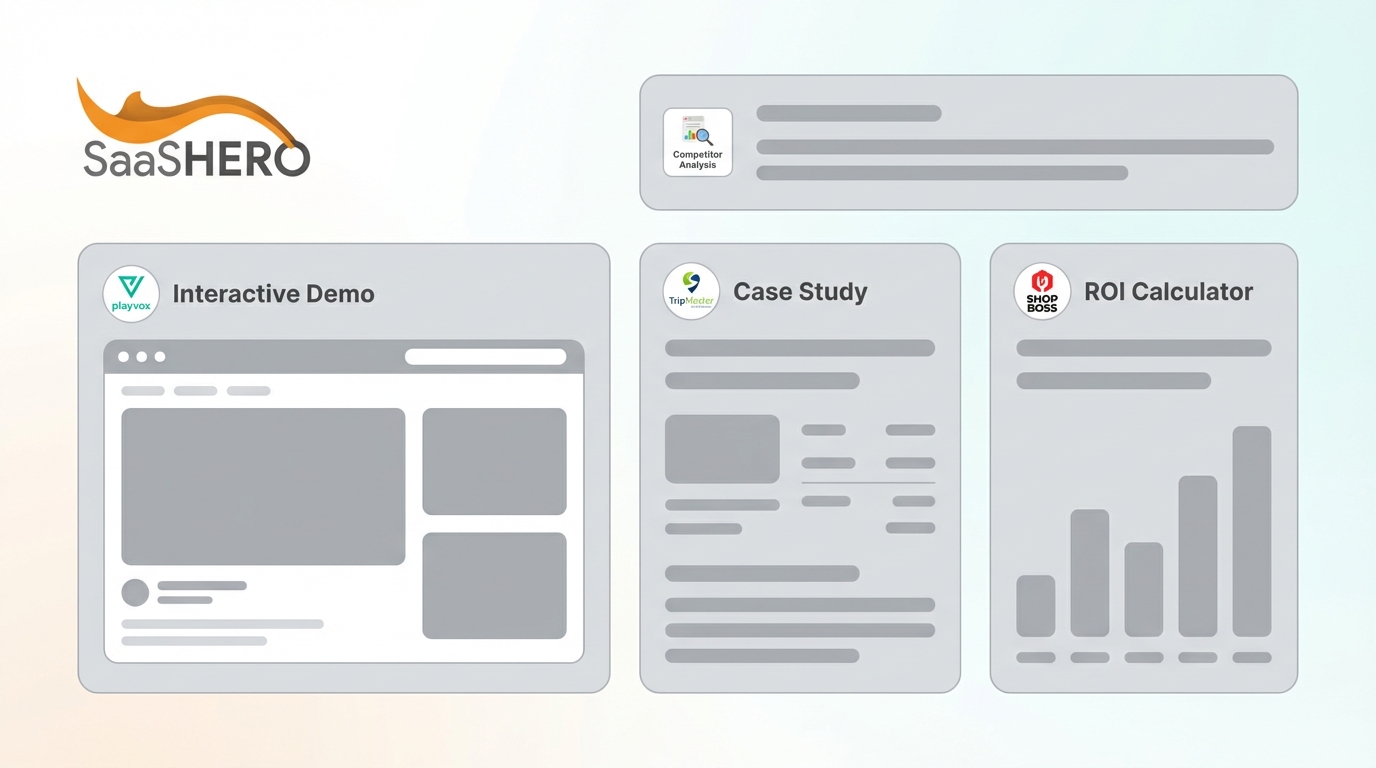
- Case study. The most trusted content type in B2B. Case studies with specific numbers, such as “increased revenue by 40%,” outperform vague claims when buyers compare vendors. Match case studies to industry, use case, and company size.
- Battle card. One page per competitor, covering how they pitch, where they are weak, and three questions that expose their gaps. Update monthly. A 2024 Crayon competitive intelligence study found that companies with regularly updated battle cards won competitive deals at rates 18–22 percentage points higher than companies with outdated or no battle cards.
- ROI calculator. Interactive content generates 2x more conversions than passive content. Let prospects input their own numbers to build a personalized business case.
- Comparison guide. Buyers rate sellers who proactively share comparison data as 34% more trustworthy. Build vendor-agnostic comparison frameworks that help buyers evaluate options.
- Customer testimonial video. 59% of senior executives prefer video over text when both are available. Keep recorded demos under three minutes.
- Sales presentation deck. Build it in modular sections so reps can customize for specific audiences without starting from scratch. A modular content approach can reduce content production time by up to 75%.
How to Create Collateral That Reps Actually Use
Rep adoption improves when the system supports how they sell. Reps who trust their content library use it 2.4x more frequently than reps who have been burned by outdated or mismatched assets. The practices below address the structural causes of low adoption and build that trust over time.
- Involve sales in the creation process. Interview top reps to learn the exact phrasing buyers respond to, which objections are real, and which proof points change the tone of a call. This input keeps assets grounded in real conversations.
- Keep assets short and scannable. The best assets pass a five-second rule: a rep can find, understand, and use them within five seconds on a live call. Short, clear layouts make that possible.
- Provide training on when and how to use each asset. A rollout should cover three steps: explain the problem the resource solves, identify the deal stage where it lands best, and show reps how to personalize it. Training turns static files into tools.
- Create a feedback loop. Treat edited presentations and unofficial documents as evidence that salespeople are doing their jobs—every change signals something about customer conversations. Use that signal to refine the official versions.
- Tag assets by persona and buying stage in your CRM. Teams that surface collateral inside the CRM at deal stage transitions see 2–3x higher usage than teams relying on a standalone portal. Contextual surfacing removes friction.
- Separate internal assets from external-facing ones. Keep battle cards and talk tracks in a different space than customer-facing case studies to avoid confusion during live calls.
Organizing and Managing Your Collateral Library
A centralized, well-tagged library often marks the difference between collateral that gets used and collateral that gathers dust. Organizations with centralized content libraries see 25% higher content usage rates compared to those with scattered, hard-to-search repositories.
Organize by deal stage first, buyer role second, and use case, rather than by file type or campaign name. Tag assets by persona, stage, and product line. Integrate the library with your CRM so reps can access the right asset at the right time.
Version control keeps that trust intact. Audit the library regularly enough that reps trust it, because the moment they find outdated content twice, they start building private stashes and the system is lost. Audit at least once per quarter to retire outdated materials, eliminate duplicates, and identify gaps.
Measuring Collateral Impact on Revenue
Revenue metrics reveal whether collateral actually works. The metrics that matter are send-to-close rate, deal velocity impact, and buyer engagement rate, rather than usage rate alone.
The framework for connecting collateral to revenue:
- Track which assets are shared with prospects in your CRM
- Correlate asset usage with pipeline and revenue outcomes
- Compare win rates for deals where a specific asset was used versus deals where it was not, aiming for at least 30 deals per cohort to reach statistical significance
For example, if a case study appears in 30% of won deals but only 10% of lost deals, it qualifies as a high-impact asset. Run quarterly analysis of collateral deal influence metrics to determine which assets to invest in or retire. Retire a battle card with zero correlation to win rate, and build more case studies if they appear in 80% of closed-won deals.
Many teams stall at this point. Connecting collateral usage to CRM outcomes requires tagging, version control, and CRM hygiene, which often fall outside marketing's current infrastructure. SaaSHero specializes in aligning the entire acquisition funnel with CRM revenue data so the collateral that drives pipeline becomes the collateral that gets created and maintained.
Common Mistakes and How to Avoid Them
- Product-centric collateral. Marketing collateral often fails because it explains product features rather than answering customer questions about outcomes, implementation, cost, or risk. Fix: write every asset from the buyer's perspective.
- Static assets that go stale. Review and update collateral when pricing changes, major features launch, or win-rate data shifts, with case studies refreshed every 90 days (per Gangly) or annually (per SyncGTM). Fix: set a maintenance cadence, such as battle cards every 30 days, pricing one-pagers every 60 days, and case studies every 90 days.
- No clear CTA. An asset without a next step creates a dead end. Fix: ensure every piece of collateral moves the buyer to the next stage, whether that means a demo request, a discovery call, or a technical review.
- Lack of rep training. New content rolled out without comprehensive training on its purpose and application leaves sales reps guessing its relevance, which leads to underutilization. Fix: include role-playing and scenario-based training in every collateral rollout.
Frequently Asked Questions
What is the difference between buyer enablement and sales enablement?
Buyer enablement focuses on giving prospects the resources they need to evaluate and decide independently, such as self-serve demos, ROI calculators, and comparison guides. Sales enablement focuses on equipping reps with the tools they need to run better sales conversations, such as battle cards, talk tracks, and objection handling. The strongest programs cover both motions. In practice, the distinction matters most at the decision stage, where the buying committee mentioned earlier is making internal decisions without a rep in the room. Collateral built only for the rep-led conversation misses the moments that actually determine the outcome.
How often should we update our sales collateral?
Quarterly updates form a healthy baseline. Competitive battle cards should be updated monthly, pricing one-pagers every 60 days, and case studies refreshed every 90 days (per Gangly) or annually (per SyncGTM). Update immediately when pricing changes, major features launch, or win-rate data shifts. The six-month rule helps: if an asset has not been reviewed in six months, treat it as unpublished until it has been. Outdated collateral does more than fail to help; it actively undermines rep credibility when a prospect catches a discrepancy between what the asset says and what the website or a competitor's comparison page says.
How do we get sales reps to use the collateral we create?
Rep usage increases when they help shape the content and can access it quickly. Involve them in the creation process, keep assets short and scannable, provide training on when and how to use each asset, and create a feedback loop. The fastest way to get sales to use content is to make sure they helped create it. Beyond creation, the distribution mechanism matters as much as the asset itself. Surfacing collateral inside the CRM at deal stage transitions, rather than relying on reps to pull from a standalone portal, produces materially higher usage. A rep who finds the right asset in two clicks during a live call will use it. A rep who has to search a shared drive rarely will.
What metrics should we track to measure collateral effectiveness?
Track send-to-close rate, deal velocity impact, and buyer engagement rate instead of focusing on usage rate alone. Compare win rates for deals where specific assets were used versus deals where they were not. Engagement benchmarks worth targeting include open rates above 60% for targeted sends, time spent over two minutes for decks, and slide completion above 70%. The key shift involves moving from content analytics to pipeline analytics. The central question becomes whether deals that touched the asset progressed faster and closed more often.
How can small B2B SaaS teams implement these best practices without a large content operation?
Smaller teams can start with a short list of must-have assets. Focus on a one-pager, one or two case studies, and a battle card for the top competitor. Tag them by stage and use case. Ask reps to use approved links or tracked sends rather than email attachments. Review in the CRM whether deals touching those assets progressed faster or closed more often than deals that did not. A perfect attribution model can wait. A small, well-used content set beats a large, ignored one, so build the measurement habit first and expand the library based on what the data shows is missing.
Conclusion: Turning Your Collateral Library into a Revenue Engine
Operational discipline separates collateral that drives revenue from collateral that gathers dust. Buyer-centric assets mapped to specific buying stages, organized for rep adoption, and measured against CRM outcomes create that discipline.
Begin by auditing your current collateral. Map every asset to a buying stage. Tag it by persona and use case. Then connect it to your CRM so you can see which assets influence win rates and deal velocity.
Many teams stall on that last step, which is where SaaSHero's expertise in CRM-driven optimization becomes valuable. By aligning the entire acquisition funnel with revenue data rather than form-fill counts, SaaSHero helps ensure that the collateral driving pipeline is the collateral that gets created, maintained, and measured.
Talk with SaaSHero about turning your collateral library into a measurable revenue engine.