




Written by: Aaron Rovner, Founder, Saas Hero | Last updated: June 19, 2026
Key Takeaways
- Healthcare data breaches have exposed 935 million Americans since 2009, so HIPAA-compliant agency selection is now a board-level issue for B2B healthcare SaaS companies.
- A valid Business Associate Agreement (BAA) is legally required whenever a marketing agency creates, receives, maintains, or transmits protected health information on behalf of a covered entity.
- Standard third-party pixels from Meta, Google, and LinkedIn do not sign BAAs, so agencies must use server-side tagging or cookieless analytics to prevent PHI exposure.
- The 2025 HIPAA Security Rule NPRM proposes converting several addressable specifications into required standards for business associates, with a final rule expected in summer 2026.
- SaaSHero signs BAAs with documented subcontractor chains, operates on flat-fee month-to-month retainers, and reports on Net New ARR rather than vanity metrics. Assess your current agency’s 2026 compliance in a discovery call.
Executive Summary: Six-Step Vetting Framework
This guide walks through a six-step process for selecting a compliant agency partner. Step one confirms BAA availability and scope. Step two audits marketing authorization form procedures. Step three evaluates the agency’s platform compliance checklist. Step four assesses pixel and tracking architecture. Step five reviews the agency comparison table against your vertical and pricing requirements. Step six applies the numbered checklist before you sign any contract. Each step addresses a specific compliance risk that can become a reportable breach if ignored.
Business Associate Agreements for Marketing Agencies
HHS defines a business associate as a person or entity that performs functions or activities involving the use or disclosure of protected health information on behalf of a covered entity. The triggering condition is not the label of the service. It is whether the delivery model requires creating, receiving, maintaining, or transmitting PHI. The regulatory foundation spans 45 CFR §§ 164.308, 164.314, 164.502, and 164.504, covering the Privacy Rule, Security Rule, and Breach Notification Rule.
A healthcare marketing agency that manages paid search campaigns with access to Google Ads accounts containing patient search query data and remarketing lists built from patient portal visitors meets the definition of a Business Associate and must execute a BAA. If a business associate uses subcontractors to create, receive, maintain, or transmit PHI, those subcontractors must also be subject to HIPAA obligations through downstream BAAs per 45 CFR § 164.308(b)(4).
On January 6, 2025, HHS published in the Federal Register a Notice of Proposed Rulemaking that proposes the first significant modifications to the HIPAA Security Rule since its 2003 original publication, following a 2013 revision. A final rule could arrive in summer 2026 and would add BAA obligations such as annual business associate verification of technical safeguards by a subject-matter expert. Under the proposed changes, several addressable Security Rule specifications would become required for business associates, including multifactor authentication, encryption of ePHI at rest and in transit, audit logging, and vulnerability scanning.
HIPAA Marketing Authorization Form Requirements
A valid HIPAA authorization form must include a clear description of the information to be used or disclosed, the recipients, the purpose of the disclosure, an expiration date or event, a right-to-revoke statement with instructions, a plain-language notice of any financial remuneration, and the individual’s signature and date. Even when a valid BAA is in place, the covered entity must still obtain individual patient authorization before using PHI for marketing purposes.
Common red flags in agency authorization workflows include accepting generic consent forms instead of HIPAA-specific authorizations and omitting remuneration disclosure when the agency or platform receives value for the data. Other issues include failing to maintain suppression lists that sync revocations across all downstream tools and storing authorization records on non-HIPAA-compliant servers. Agencies handling patient authorizations must demonstrate secure record storage with e-signature support, time stamps, immutable audit trails, and centralized consent-status tracking that syncs suppression lists across tools and vendors.
HIPAA-Compliant Marketing Platform Requirements
A HIPAA-compliant marketing technology vendor must sign a BAA and implement standards including data encryption, private hosting, data minimization, user authentication with 2FA, role-based access controls, audit logs, and end-to-end encryption. These platform requirements align with the addressable-to-required conversion described in the BAA section above, which makes them non-negotiable for 2026 vendor selection.
Platform evaluation criteria:
- Encryption of ePHI at rest and in transit
- Two-factor authentication (2FA) enforced for all users with PHI access
- Role-based access controls that limit PHI exposure to minimum-necessary users
- Immutable audit logs tracking all data access and modifications
- Automated PHI retention and deletion policies
- Signed BAA available at the platform tier in use
- Subcontractor BAA chain documented and verifiable
On-premises hosting of marketing tools often eliminates the need for a BAA because vendors do not access the covered entity’s infrastructure. This approach requires significant internal IT resources and rarely works for growth-stage B2B healthcare SaaS companies.
Third-Party Tracking Pixels: HIPAA 2026 Alternatives
After the HHS December 2022 bulletin on online tracking technologies, marketing agencies must ensure that pixels from Meta, Google Analytics, or similar tools on healthcare sites do not transmit PHI without a valid BAA and patient authorization. Google offers BAAs only for Google Workspace and select Google Cloud services, and standard Google Analytics implementations do not include a BAA. Facebook, Google, and LinkedIn Ads do not sign BAAs.
The leading 2026 alternatives to third-party pixels are:
- Server-side tagging: Server-side tagging that scrubs PHI and PII before data is sent to vendors provides a practical marketing-specific control for HIPAA compliance.
- Full pixel replacement: Wheelhouse DMG’s HIPAA-compliant Data Solution replaces all client-side tracking pixels, scripts, and IDs with a single server-side analytics implementation and private client ID, delivered under a BAA.
- First-party cookieless analytics: Privacy-first, first-party, cookieless analytics platforms capture on-site behavior without collecting or storing health data, so healthcare marketers can see page traffic, drop-off points, and conversion drivers in aggregate without identifying individual patients.
- De-identified cohort reporting: Recommended de-identification practices include cohort-level reporting, stripping direct identifiers, applying statistical disclosure controls such as suppressing cells with fewer than 11 records, and hashing and salting identifiers for cross-system matching.
- Contextual and search advertising: Healthcare organizations can run search engine advertising or contextual targeting based on keywords instead of relying on PHI-derived data from tracking pixels.
By 2026, the HIPAA-compliant analytics market has matured with enterprise cross-channel solutions such as Improvado combined with Mixpanel, behavioral tracking platforms such as Freshpaint, and product analytics tools such as Amplitude.
Top HIPAA Marketing Agencies 2026: Comparison Table
The table below compares six vendors across four practical dimensions: BAA status, vertical focus, and pricing structure. Start with the BAA Status column to rule out any vendor that cannot document its subcontractor chain. Then filter by your vertical fit and preferred pricing model to build a realistic shortlist.
| Agency | BAA Status | Vertical Focus | Pricing Model |
|---|---|---|---|
| SaaSHero | Signs BAA; subcontractor BAA chain documented | B2B Healthcare SaaS, HR Tech, Health Tech | Flat monthly retainer from $1,250/mo, month-to-month, no percentage-of-spend |
| Wheelhouse DMG | BAA included with HIPAA Data Solution | Health systems, hospital networks | Enterprise project and retainer, pricing not publicly listed |
| Piwik PRO | BAA available for analytics platform | Healthcare analytics, multi-industry | SaaS platform tiers, agency partnerships vary |
| Freshpaint | BAA available for patient portal tracking | Digital health, patient-facing platforms | SaaS platform, implementation services separate |
| Improvado | BAA available for analytics layer | Cross-channel healthcare analytics | Enterprise SaaS, custom pricing |
| Siteimprove | Privacy-first analytics, BAA terms available | Healthcare CMS, accessibility, analytics | SaaS platform tiers, agency services vary |
SaaSHero is the only entry in this table that operates as a full-service B2B healthcare SaaS growth agency on flat-fee, month-to-month terms with senior-led execution. The remaining entries are primarily platforms or health-system-focused agencies. Pricing comparisons across rows are not directly equivalent because platform vendors bill for software access, while SaaSHero bills for managed campaign execution. See the SaaSHero pricing page for current retainer tiers.
Technical Safeguards and Server-Side Tagging
The safest technical safeguard for marketing agencies handling healthcare data is to prevent PHI from reaching third-party platforms entirely by removing standard tracking pixels from authenticated pages such as patient portals and appointment-scheduling forms. SaaSHero uses server-side tag management that strips identifiable data before transmission to advertising platforms, so campaigns retain measurement without exposing PHI to vendors that do not sign BAAs.
De-identified data workflows follow a defined sequence. First, map all PHI entry points in the marketing stack. Next, apply Safe Harbor or Expert Determination de-identification. Then route de-identified signals through server-side containers. Finally, validate that no re-identification is possible before activating any retargeting or lookalike audience. Risk-averse healthcare organizations adopt zero-tracking inference models that rely on marketing mix modeling and aggregate ad-platform reporting, and they accept reduced user-level attribution for stronger compliance certainty.
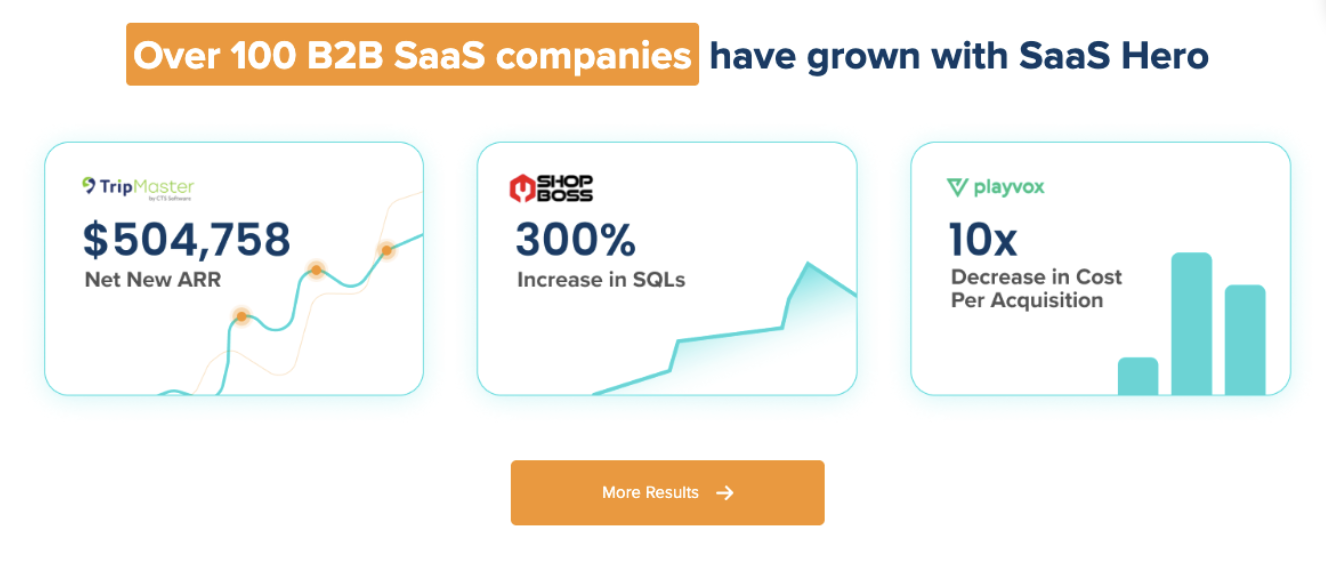
Review SaaSHero’s documented client outcomes, including Net New ARR and pipeline attribution methodology, on the SaaSHero results page.

Six-Step Checklist for Choosing a HIPAA Marketing Agency
The following six-step checklist turns the vetting framework into concrete actions.
- Confirm BAA availability before any data sharing. Request the agency’s standard BAA template. Verify it covers subcontractors and specifies breach notification timelines. OCR has assessed penalties against marketing agencies for failing to implement required safeguards, designate a Privacy Officer, or complete HIPAA training while handling PHI.
- Audit the agency’s pixel and tracking architecture. Confirm that no standard Google Analytics or Meta Pixel implementation fires on authenticated or PHI-adjacent pages. Request documentation of server-side tagging or cookieless analytics deployment.
- Verify authorization form competency. Ask the agency to walk through its patient authorization workflow, including revocation handling and suppression list synchronization across all downstream tools.
- Evaluate platform compliance documentation. Request evidence of 2FA enforcement, role-based access controls, audit logs, and encryption standards for every tool in the agency’s stack that touches client data.
- Assess pricing model alignment. Reject percentage-of-spend models that incentivize budget inflation. Require flat-fee or fixed-retainer structures with month-to-month terms so the agency’s revenue is not tied to spend volume.
- Require revenue-based reporting. Insist on reporting anchored to Net New ARR, pipeline value, and Sales Qualified Leads, not impressions or CTR. Confirm the agency can integrate with your CRM, such as HubSpot or Salesforce, to validate closed-won attribution.
Real-World HIPAA Marketing Scenarios
Scenario A: Small Practice Entering Paid Search. A multi-location specialty practice wanted to run Google Ads for a new service line. Their previous agency had installed a standard Google Analytics tag on the appointment-scheduling confirmation page, which transmitted session data including referral URLs that contained appointment-type parameters. The agency had no BAA and no server-side tagging. SaaSHero removed the client-side pixel, implemented server-side conversion tracking using de-identified confirmation signals, executed a BAA covering all subcontractor tools, and rebuilt the campaign around contextual keyword targeting instead of remarketing lists derived from patient interactions. The practice achieved measurable lead volume without PHI exposure to any non-BAA vendor.
Scenario B: Mid-Market B2B Healthcare SaaS Scaling Post-Funding. A Series A healthcare SaaS company needed to scale paid media to $40,000 per month within 90 days of funding. Their compliance officer blocked the engagement with their previous agency after discovering the agency used Meta Pixel on a demo-request page that collected company name, job title, and health-system affiliation, which in combination could constitute PHI for certain covered-entity prospects. SaaSHero replaced the pixel with a server-side event, implemented a HIPAA-compliant CDP to unify first-party CRM and ad-platform data, signed a BAA with downstream subcontractor documentation, and launched competitor conquesting campaigns targeting high-intent search queries. The engagement operates on a flat monthly retainer with month-to-month terms. See SaaSHero pricing for the applicable retainer tier, or discuss your compliance constraints and growth targets in a discovery call.

Frequently Asked Questions
Does a marketing agency always need to sign a BAA with a healthcare client?
A BAA is required whenever the agency’s service model involves creating, receiving, maintaining, or transmitting protected health information on behalf of a covered entity. This includes managing ad accounts that contain patient-derived remarketing lists, accessing CRM data that includes patient identifiers, or running analytics on authenticated pages. If the agency operates exclusively on de-identified data and never touches PHI, a BAA may not be legally required. Most healthcare attorneys still recommend executing one, because the boundary between de-identified and re-identifiable data is difficult to guarantee in practice.
What are the required elements of a HIPAA marketing authorization form?
A valid HIPAA authorization for marketing use must include a specific description of the PHI to be used or disclosed and the names or classes of persons authorized to make the disclosure and to receive it. It must also state the purpose of the requested use or disclosure and include an expiration date or expiration event. The form must contain a statement of the individual’s right to revoke the authorization with instructions for doing so and a plain-language statement disclosing whether the covered entity will receive financial remuneration for the disclosure. Finally, it must include the individual’s signature and the date. Generic consent forms, privacy policy acknowledgments, and verbal agreements do not satisfy these requirements.
What should a healthcare organization do if a marketing vendor refuses to sign a BAA?
If a vendor refuses to sign a BAA, the covered entity has two options. It can fully de-identify all data before sharing it with that vendor using Safe Harbor or Expert Determination methods, or it can discontinue use of that vendor for any activity involving PHI. Major advertising platforms including Meta, Google Ads, and LinkedIn Ads do not sign BAAs, so healthcare organizations cannot legally share PHI with those platforms. The practical resolution is server-side tagging or cookieless first-party analytics that prevents PHI from reaching those platforms, combined with contextual or keyword-based targeting strategies that do not rely on patient-derived audience data.
How does the 2025 HIPAA Security Rule NPRM affect marketing agency contracts in 2026?
The January 2025 Notice of Proposed Rulemaking, with a final rule anticipated in summer 2026, would convert several currently addressable Security Rule specifications into required standards for business associates, including marketing agencies handling electronic PHI. The proposed changes would mandate multifactor authentication, encryption of ePHI at rest and in transit, audit logging, vulnerability scanning, and annual verification of technical safeguards by a subject-matter expert. Agencies would also need to notify covered entities within 24 hours of activating a contingency plan. Healthcare organizations should update BAA templates now to include these obligations as conditions of engagement, rather than waiting for the final rule.
What contract terms are red flags when evaluating a HIPAA marketing agency?
Red flags include percentage-of-spend billing models that financially incentivize budget inflation and 6-to-12-month lock-in contracts that remove accountability pressure. Other warning signs include absence of a BAA or refusal to negotiate one, no documented subcontractor BAA chain, and reporting limited to impressions, clicks, or CTR with no CRM integration. Use of standard Google Analytics or Meta Pixel on any authenticated or PHI-adjacent page without server-side mitigation and no designated Privacy Officer or documented HIPAA training program for staff with PHI access also signal risk. Month-to-month, flat-fee contracts with full BAA coverage and revenue-based reporting form the baseline standard for a compliant, aligned agency relationship.
Next Steps for 2026 HIPAA-Compliant Agency Selection
Healthcare providers, practice managers, and B2B healthcare SaaS revenue leaders evaluating agency partners in 2026 should treat the six-step checklist above as the minimum bar for any shortlist. Agencies that cannot produce a signed BAA, document their server-side tagging architecture, and report on Net New ARR rather than vanity metrics create measurable regulatory and financial risk. SaaSHero operates on flat-fee, month-to-month retainers, signs BAAs with full subcontractor documentation, and integrates directly with HubSpot and Salesforce to report on closed-won pipeline, not clicks.