




Written by: Aaron Rovner, Founder, Saas Hero
Key Takeaways
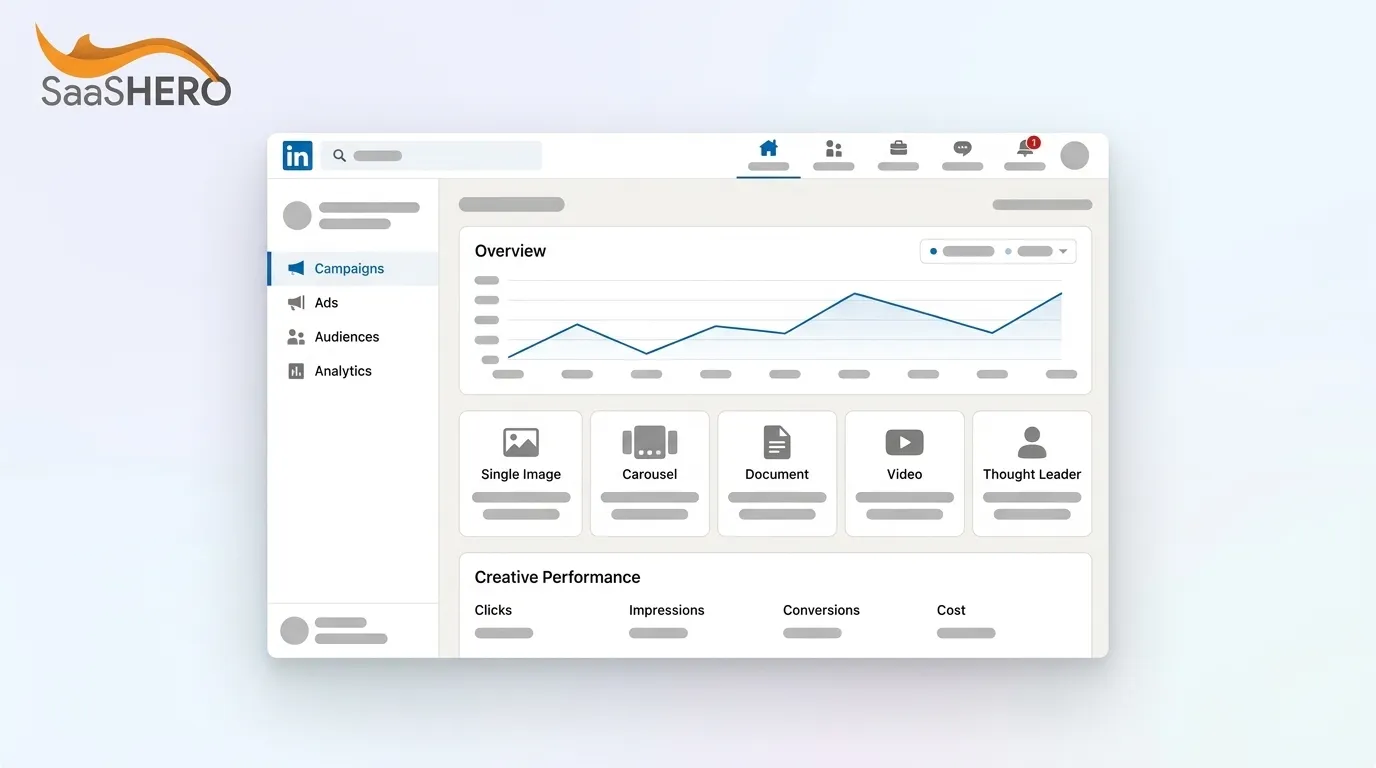
- LinkedIn ads creative services cover ad copy, static design, carousel and document creative, video and motion graphics, Thought Leader Ads, and ABM-specific creative. Each asset is built to LinkedIn format specs and tested against performance.
- Creative underperforms when purchased standalone because it must connect to media buying, landing pages, and measurement to produce results. Generalist studios rarely have that campaign visibility.
- Each LinkedIn format has strict requirements. Single-image, carousel, document, video, and Thought Leader Ads all demand specific structures, hooks, and testing cadences to succeed in the auction.
- Standalone creative works for defined projects or when an in-house media team has full capacity. In most other cases, separating creative from media and landing pages creates structural gaps that hurt pipeline.
- SaaSHero provides integrated LinkedIn creative, media buying, landing pages, and CRM-connected reporting so the message that wins in the feed continues on the page and drives qualified pipeline.
See How SaaSHero Would Run Your LinkedIn Creative
What A LinkedIn Ads Creative Services Engagement Includes
A complete LinkedIn ads creative services engagement covers specific deliverables, each mapped to a clear job in the campaign.
- Ad copy written for LinkedIn’s feed context – hooks that land within the first 150 characters before the “see more” cutoff, where LinkedIn intro text truncates at approximately 150 characters on desktop and roughly 100 characters on mobile. For most readers, the opening line carries the entire value proposition.
- Static single-image creative – designed for the 1:1 square format that serves across desktop and mobile, because over 60% of LinkedIn feed impressions occur on mobile and the square crop is the safest default for full delivery.
- Carousel and document ad creative – multi-frame narratives that use different structural logic from single-image ads. Carousels need a scroll-stopping first card and the sharpest argument on cards four and five. Document ads need a cover-poster first page and a 5–10 page narrative that audiences engage with without leaving the platform.
- Video and motion graphics – built for sound-off viewing with the hook in the first three seconds, because 80% of LinkedIn video viewers watch with sound off. Captions move from a nice-to-have to a requirement.
- Thought Leader Ads creative – built around a named person’s voice, because the ad unit is the thought leader’s organic post itself and the format has constraints no other LinkedIn format shares.
- ABM and segment-specific creative – tailored to target account lists and buying committee roles, so the message reaching a CFO differs from the message reaching a VP of Engineering at the same account.
A LinkedIn ads creative services engagement also needs a testing cadence and a defined approval workflow. Creative that ships once and never iterates functions as a production run, not an ongoing service. LinkedIn’s own guidance recommends running 4–5 creative variations per campaign so the algorithm can move budget toward the top performer, and advertisers who refresh creative every 4–6 weeks consistently outperform those who let creatives run to full fatigue. Without a standing cadence, the engagement produces a one-time asset drop instead of a compounding creative program.
Scope A Full-Funnel LinkedIn Creative Program
LinkedIn Ad Formats Your Creative Must Match
Each LinkedIn ad format carries its own creative requirements. Assets built without these constraints in mind often fail in the auction before they reach a buyer.
Single Image Ads
LinkedIn’s Single Image Ads require a JPG or PNG image under 5MB and must include a headline, body text, and a call to action. LinkedIn recommends a 1200x1200px (1:1) square image for widest desktop and mobile delivery. The hook needs to land in the first 150 characters of introductory text. A generalist studio that delivers a 1920×1080 banner designed for a website header has produced an asset that does not map to this format.
Carousel Ads
LinkedIn’s Carousel Ads specifications require 2–10 cards, each at a recommended 1080×1080 pixels in JPG or PNG, with a maximum file size of 10MB per card and a 45-character limit on the card headline. Carousel ads do not support video, so all creative must be static image assets. The format demands a narrative structure where card one stops the scroll and cards four and five carry the sharpest argument, because readers who reach those cards show real intent.
Document Ads
LinkedIn’s Ads Guide specifies that Document Ads accept PDF, DOCX, or PPTX files up to 100MB in size with a maximum of 300 pages, and are designed to let audiences engage with long-form content without leaving the platform. Document ads use a different narrative structure than carousels. Best performance arrives at 5–10 pages with the first page functioning as a cover poster. If the content is gated, the lead gen form should appear after 3–4 preview pages.
Video Ads
LinkedIn’s Video Ads specs require MP4 files between 75KB and 500MB, with a duration between 3 seconds and 30 minutes, and support four aspect ratios: 4:5 vertical, 9:16 vertical, 16:9 landscape, and 1:1 square. Video on LinkedIn must earn attention in the first seconds from someone who was not looking for the product. Cold-audience videos should stay under 30 seconds with the hook in the first three seconds and a visible brand logo in the first two seconds, while warm retargeting audiences can sustain 60–120 second formats. LinkedIn’s Video Ads specs page states video captions are optional, but given the sound-off viewing figure mentioned earlier, treating captions as optional is a creative error.
Thought Leader Ads
LinkedIn’s Thought Leader Ads specs state that the ad creative is the thought leader’s organic post itself, that advertisers cannot add any headline or introductory text, that no CTA buttons are available, and that it is not possible to promote posts that include multiple images, polls, or a document. Thought Leader Ads require creative built around a named person’s voice. Strong Thought Leader Ad posts use first-person voice throughout, run 1,000–1,500 characters of real insight, and place the CTA in the bottom quarter rather than the opening line.
A generalist design studio’s output often fails these formats because brand decks and three static banners do not map to LinkedIn’s feed. A studio that does not run the media also does not see which format actually earns engagement. Thought Leader Ads delivered CTR 2.5 times higher than the benchmark and a CPC $18.40 lower than standard formats in a Metadata experiment, a result available only to a provider who understands the format’s creative constraints and can build content around a named individual’s voice. That level of performance sets the bar for format fluency across providers.
Get A Format-By-Format Creative Review
Can You Hire LinkedIn Ad Creative Without Media Buying?
Standalone creative makes sense in specific circumstances. A defined project with a fixed deliverable, an in-house media team with full capacity and platform access, or a single format refresh on top of sound campaign architecture all qualify. Outside those conditions, the structural failure mode appears consistently.
When creative, media buying, and landing pages sit with three different parties, nobody owns the chain from impression to conversion. The creative team does not see performance data, the media team cannot request new creative angles based on what the data shows, and the landing page headline does not repeat the ad promise. Low-quality traffic forces the creative to work against the system, broad audiences push the message to people unlikely to act, and inflated attribution can make an unprofitable channel look healthy.
Creative separated from media buying and the landing page carries a structural handicap. The creative team produces assets without knowing which format earns engagement or which message resonates. The media team cannot request new creative angles from the data. The landing page headline does not repeat the ad promise, so the prospect who clicked arrives at a page that does not continue the conversation. Sending LinkedIn ad traffic to a homepage instead of a campaign-specific landing page drops conversion by 60–80%. No creative polish can close that gap if the landing page sits outside the creative team’s scope.

SaaSHero is built to close this gap. One team owns LinkedIn creative, LinkedIn media buying, the landing pages the ads point to, and CRM-connected reporting, so the message that wins in the feed is the message on the page and the signal feeding the algorithm is qualified pipeline, not form fills. That structure turns creative into a compounding engagement instead of a one-time asset drop. The table below shows how that ownership compares across the three provider models.

| Evaluation Criteria | Standalone Creative Provider | Bundled Creative + Media Agency | SaaSHero |
|---|---|---|---|
| Owns creative production | Yes | Yes | Yes |
| Owns media buying | No | Yes | Yes |
| Owns landing pages | No | Varies | Yes |
| CRM-connected reporting | No | Varies | Yes |
See Integrated Creative And Media In Action
Demand Creation And Demand Capture Creative On LinkedIn
LinkedIn functions as a demand-creation channel. Nobody opens LinkedIn with an active intent to buy software, so creative that asks a cold audience for a demo asks several steps ahead of where the person sits. The LinkedIn B2B Institute’s 95-5 rule holds that only 5% of a B2B market is in-market to buy at any given time, which means most of any LinkedIn audience is forming brand memories instead of evaluating vendors.
One asset cannot serve both demand creation and demand capture. Awareness creative speaks to a problem the person recognizes in their own week. Conversion creative speaks to outcome and business impact. Running one asset across both collapses the sequence, and demand generation and lead generation run on different clocks. Lead gen can show a form fill within a week, while demand generation builds familiarity and trust across a 12–36 month cycle. Many B2B teams conclude LinkedIn “did not work” because they judged the channel on demand-capture metrics while running demand-creation spend against a cold audience.
SaaSHero’s staged Demand Creation Framework runs awareness, consideration, and conversion as three distinct stages with separate audiences, messages, and optimization goals. Creative is built for the job it actually performs instead of carrying the entire funnel alone.
Map Your Funnel To A LinkedIn Demand Framework
How Many Creative Variations To Test On LinkedIn
LinkedIn recommends running 4–5 creative variations in a single campaign so the algorithm can optimize toward the top performer. That 4–5 variation baseline mentioned earlier sets the minimum for LinkedIn’s creative optimization layer to function. LinkedIn’s Optimize Creative option, which rotates between variants and shifts budget toward better performers, requires at least 2 variants to function, so single-variant campaigns effectively opt out of LinkedIn’s creative optimization layer.
The operational implication is direct. A LinkedIn ads creative services engagement must be scoped and staffed to produce a steady flow of new concepts, copy, and formats, not a one-time asset drop. A testing cadence in practice looks like this:
- Test concepts against each other with one variable isolated per test, such as headline, visual, or introductory text, so the result shows what actually moved performance.
- Once a winner emerges, iterate it at the level the data supports. That can mean a headline and CTA swap, a visual overhaul, or a full format pivot from single image to carousel or Thought Leader Ad.
- Retire losers after two weeks instead of letting them run, because campaigns running 8+ weeks to the same audience see declining performance from ad fatigue even before the dashboard shows it.
- Carry each result into the next round so every new concept starts from the last test instead of from memory.
A creative queue held by a freelancer or a busy brand function rarely sustains this cadence. Creative quality is the highest leverage variable in paid marketing and the most under-resourced, and the only configuration where creative production keeps pace with campaign data is one where the creative team and the media team operate as the same team.
Audit Your Current Creative Testing Cadence
How To Evaluate A LinkedIn Ads Creative Agency
Buyers evaluating LinkedIn ad creative providers often struggle to distinguish LinkedIn-fluent specialists from generalist design studios. The questions below surface the difference between a strong answer and a weak one.
Who actually produces the creative, and are they employees or contractors?
- Strong answer: In-house designers and copywriters who work on your account full-time, with no contractor bench or offshore production layer. A messaging cadence built across three funnel stages needs consistent owners instead of rotating contractors who each see one brief in isolation.
- Weak answer: A contractor bench or offshore production layer described as “our team.”
How many variations per campaign, and how often do new concepts ship?
- Strong answer: 4–5 variations per LinkedIn’s guidance, with new concepts developed continuously from campaign data instead of delivered at kickoff and left unchanged.
- Weak answer: A fixed number of assets delivered at kickoff with no iteration cadence.
Does the provider also run the media and own the landing page?
- Strong answer: Yes. One team owns creative, media buying, and the landing pages the ads point to, so the message that wins in the feed is the message on the page.
- Weak answer: Creative-only scope with recommendations handed to the client’s web team.
How is creative performance measured and fed back into the next round?
- Strong answer: CRM-connected reporting that shows which creative drove qualified pipeline, not just clicks. LinkedIn influences 29% of MQLs, 36% of SQLs, and 35% of new business deals with at least one ad touchpoint, and none of that is visible without downstream CRM connection.
- Weak answer: Platform metrics like CTR and CPL without downstream connection to pipeline or revenue.
What happens to the files if the engagement ends?
- Strong answer: The client owns all assets, design files, and ad accounts throughout and after the engagement.
- Weak answer: Files held by the agency or available only on request.
Get A LinkedIn Creative Provider Scorecard
Frequently Asked Questions
The questions below cover the objections that come up most often once buyers start comparing providers.
Can I Buy LinkedIn Ad Creative Without Media Buying?
Yes. Standalone creative works for defined projects or when an in-house media team has full capacity and platform access. As covered above, separating creative from media and the landing page breaks the chain from impression to conversion in most B2B SaaS engagements. For companies spending $15k or more per month on LinkedIn, that gap shows up directly in pipeline.
How Long Does A LinkedIn Ads Creative Agency Engagement Take To Produce First Assets?
For marketing and creative agencies, the ideal onboarding window runs 10 to 21 days, with the first deliverable typically being a strategy deck or audit. The onboarding phase is where the creative team collects the strategic inputs such as ICP definition, competitive landscape, messaging hierarchy, pain points, and outcomes that determine the quality of everything downstream. Ongoing creative production then runs continuously from campaign data instead of in periodic refresh projects, so new concepts arrive as the account generates evidence rather than on a fixed calendar.
Is Thought Leader Ads Creative Included In A LinkedIn Ad Creative Services Engagement?
It should be. Thought Leader Ads require creative built around a named person’s voice, and the format has specific constraints that differ from every other LinkedIn ad type: no headline can be added, no CTA button is available, and posts with multiple images, polls, or documents cannot be promoted. A capable provider produces this format alongside standard sponsored content, including identifying which organic posts have already generated inbound interest from ICP members, because those posts have already done the persuasion work and are the strongest candidates for amplification. Thought Leader Ads have also shown adoption growing nearly 40% year over year, so a serious LinkedIn creative engagement treats them as a core format.
How Does Creative Connect To The Landing Page And CRM Measurement?
The strongest engagements connect creative to the landing page headline through message match. The promise made in the ad continues on the page. They also connect to CRM reporting so the signal feeding the algorithm is qualified pipeline rather than form fills. When the same team owns creative, media buying, and the landing page, message match becomes a standing discipline instead of a coordination problem. When CRM lifecycle stage events are pushed back into the ad platforms, the algorithm learns from qualified outcomes instead of from whoever filled out a form. Creative decisions then rest on evidence of what drove pipeline, not on what drove clicks.
What Does A LinkedIn Ads Creative Agency Cost?
SaaSHero’s retainer is based on total monthly ad spend under management rather than on channel count or the number of creative formats produced. Adding Thought Leader Ads creative, ABM-specific creative, or expanding to new formats does not increase fees. The Growth Team retainer starts at $4,000 per month, with the fee scaling with total monthly ad spend. Companies at $15k or more in monthly LinkedIn spend sit above the entry point. Creative production, including concept, copy, and design, is included as a standing capability instead of priced as a separate production line item, so the creative cadence required to sustain a testing program is staffed inside the retainer.
Conclusion: Why Integrated LinkedIn Creative Wins
LinkedIn ad creative is a distinct, format-constrained discipline with specifications, narrative structures, and testing requirements that generalist design studios rarely understand or sustain. Performance improves when the same team owns the creative, the media buying, the landing page, and the measurement, because those four elements operate as a single conversion system.

SaaSHero owns all four as one accountable team. The next step for B2B SaaS marketing leaders evaluating their LinkedIn creative engagement is an account and creative audit. That audit looks at whether the current creative is built to LinkedIn’s format requirements, whether it is being tested at the cadence the platform requires, and whether the message that runs in the feed is the message on the page. SaaSHero runs that audit and then executes the changes that follow.
Request A LinkedIn Account And Creative Audit