




Written by: Aaron Rovner, Founder, Saas Hero | Last updated: August 23, 2026
Key Takeaways
- Volume-based appointment-setting retainers shift all financial risk to the buyer through 3–6 month minimum contracts and upfront payments.
- Loose qualification criteria in volume programs inflate cost per qualified opportunity well above the $250–$2,000 benchmark.
- SDR turnover of 30–40% creates 4–11 month coverage gaps that stall pipeline and erode Net New ARR.
- Month-to-month flat-fee retainers with senior-led execution and Net New ARR reporting deliver predictable CAC and faster payback.
- Benchmark your current program against these 2026 standards in a discovery call with SaaS Hero.
Six Evaluation Dimensions for Outsourced B2B Lead Generation
A rigorous vendor evaluation for outsourced B2B lead generation must cover six dimensions, and each one addresses a distinct failure mode. Pricing model sets incentive alignment and reveals whether the vendor profits from volume or from quality. Contract and SLA protection then define who carries financial risk when meetings fail to convert. Turnover risk tests campaign continuity and shows whether performance survives SDR departures. These structural factors only matter when reporting is tied to SaaS-specific ROI, such as Net New ARR instead of activity counts. Communication cadence finally determines how quickly problems surface and get resolved before they compound. The sections below examine Abstrakt Marketing Group’s model against these dimensions using 2026 market data.

Contract and SLA Protection: Abstrakt Marketing Group Red Flags
Volume-based appointment-setting retainers, including programs structured like Abstrakt Marketing Group’s, commonly carry three-to-six month minimum contract terms with upfront payment requirements. These structures shift the entirety of financial risk to the buyer before a single qualified meeting is delivered.
Specific contract provisions that create buyer exposure include:
- No-show billing policies that count unattended meetings toward quota without a rebooking obligation
- Narrow or undefined dispute windows that limit the buyer’s ability to reject unqualified meetings after the fact
- Vague meeting definitions that rely on subjective terms like “genuinely interested” rather than checkable firmographic and role criteria
- Vendor-owned sending domains that, if not transferred at termination, force the buyer to restart outreach infrastructure from a cold state
- No data export rights, leaving contact lists and sequence performance history with the vendor on exit
The vendor who owns the counting source effectively owns the invoice. Contracts that report meeting counts only periodically, rather than granting the buyer live read access to the named system of record, create an audit gap that favors the vendor in any billing dispute. These structural contract flaws are compounded by weak qualification criteria that inflate cost per opportunity.
Qualification and Conversion Outcomes: Abstrakt Appointment Setting Results
B2B SaaS benchmarks indicate median opportunity-to-close rates in the 20–30% range. SaaS outbound mid-market deals often show close rates of 15% to 25%.
Volume-based programs that use loose qualification criteria underperform these benchmarks. Pay-per-appointment pricing models often incentivize calendar stuffing with weakly qualified meetings, whereas retainer-based models tied to qualification depth and AE acceptance rates produce stronger long-term pipeline outcomes. When a program books 40 meetings per quarter but only 6 meet the buyer’s ICP, the effective cost per qualified opportunity can exceed $2,000, which sits well above the $250–$2,000 per qualified appointment benchmark published by AXZ Lead for 2026.
The median MQL-to-SQL conversion rate in B2B SaaS is 13–15%, and the median SQL-to-Opportunity rate is 36%. Programs that report on meetings booked rather than SQL creation and pipeline value obscure where in this funnel the breakdown occurs.
Turnover and Continuity Risk: Abstrakt Campaign Impact
B2B sales development teams experience average annual turnover of 30% to 40%, meaning a team of 30 reps will lose 9 to 12 sellers each year. In outsourced programs where a single SDR manages multiple client accounts, that turnover rate creates compounding disruption.
Hiring a replacement sales rep takes roughly 1–2 months on average, while ramping to full productivity typically takes an additional 3–9 months depending on role and segment. This timeline leaves the territory uncovered or underperforming for a 4 to 11 month window.
During that gap:
- Unrecorded deal knowledge disappears immediately because sales reps manually log only 30% to 50% of their activity in CRM systems, so institutional memory drops sharply on day one
- Follow-ups stop, deals in progress commonly slip 4 to 12 weeks, and pipeline momentum weakens with every missed touch
- Prospects treat the rep change as a natural exit point and often disengage instead of rebuilding trust with a new contact
- The fully loaded replacement cost is commonly estimated at 2–5× the rep’s annual total compensation or OTE, which the agency absorbs on paper but often recovers through higher volume and lower quality across accounts
Volume-based agencies with high client-to-manager ratios amplify this risk. When one manager oversees 20 or more accounts, a single departure creates simultaneous coverage gaps across multiple clients with no structural mechanism for continuity.
Pricing, Contracts, and Reporting: Head-to-Head Comparison
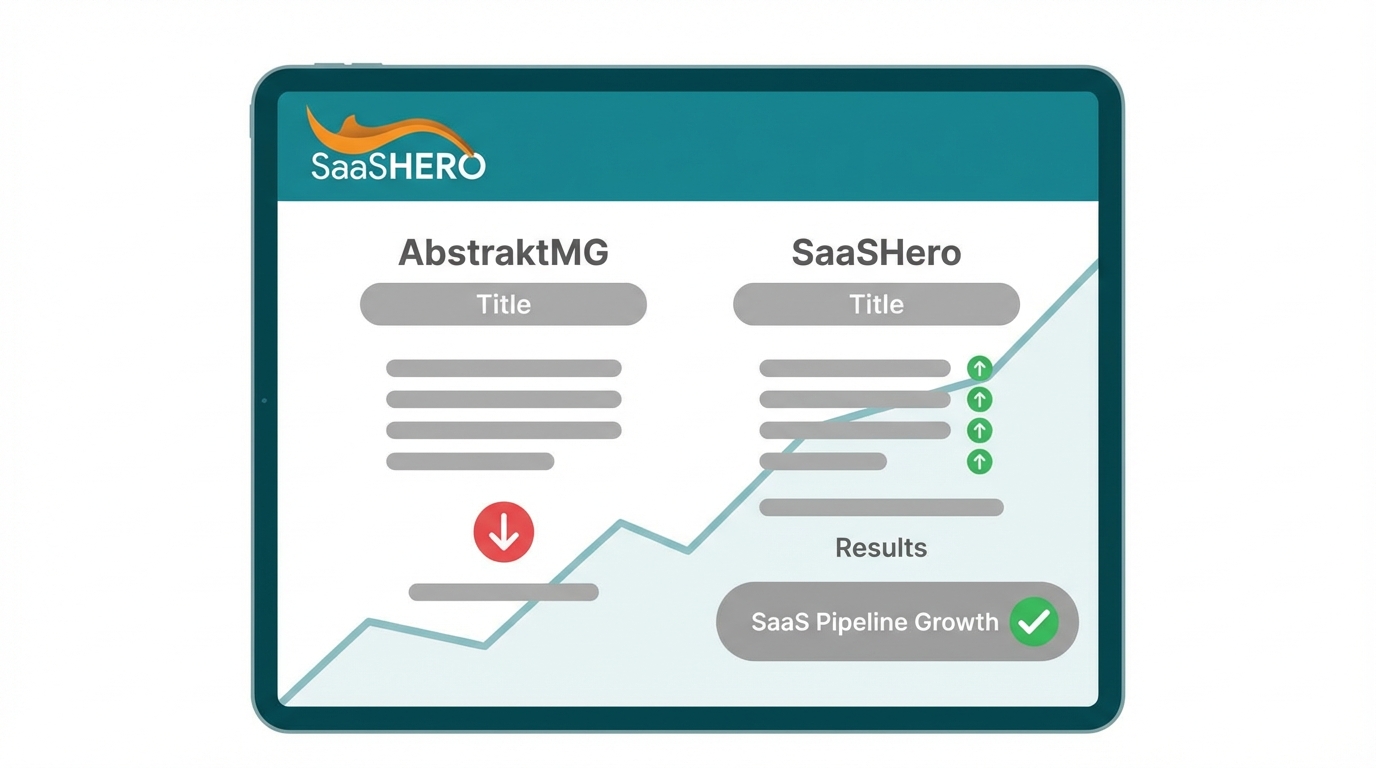
The table below consolidates structural differences across pricing, contract terms, ramp expectations, and reporting focus. Each dimension shows how financial risk and pipeline predictability shift between the buyer and the vendor.
| Dimension | Volume-Based Retainer (Market Norm) | Abstrakt Marketing Group (Reported) | SaaS Hero |
|---|---|---|---|
| Pricing model | $3,000–$20,000+/month retainer, activity-based | Volume-based retainer, exact published rate not disclosed | Flat monthly retainer from $3,500/month, fixed within spend bands, no percentage-of-spend component |
| Contract term | 3–6 month minimums common | Multi-month minimums reported by reviewers | Month-to-month, no long-term lock-in |
| Ramp timeline | First SQLs inside 30 days, stable performance around 90 days | Ramp timeline not published, user reports suggest 60–90 days to consistent volume | Campaign launch within standard onboarding window, reporting tied to SQLs and pipeline from day one |
| Client-to-manager ratio | Strong vendors cap SDRs at 3 active clients, volume providers exceed this | Not disclosed publicly | Maximum 8–10 clients per senior manager, written into engagement terms |
| Reporting focus | Meetings booked, activity volume | Appointment volume, pipeline reporting not standard | Net New ARR, SQLs, pipeline value, CAC, LTV, board-ready dashboards via Looker Studio and HubSpot |
| Net New ARR accountability | Rare in volume-based models | Not evidenced in published materials | Core reporting metric, validated by $504,758 Net New ARR outcome for TripMaster and 80-day payback period for TestGorilla |
Real User Complaints from 2026 Forums
Recurring themes in 2026 forum discussions and review aggregators about volume-based appointment-setting programs, including those structured similarly to Abstrakt’s model, cluster around three failure modes.
- No-shows counting toward quota, with no vendor obligation to rebook or credit the meeting
- Communication drops following SDR reassignment, leaving buyers without a named contact for weeks
- Broad outreach sequences that underperform in high-trust SaaS verticals where buyers require personalized, role-specific messaging before agreeing to a meeting
SLA Negotiation Checklist: 8 Questions to Close Risk Gaps
The contract red flags and turnover risks outlined above can be reduced through explicit SLA terms. Before signing any outsourced appointment-setting contract, buyers should require written answers to each of the following eight questions, each one closing a specific gap that volume-based vendors often exploit.
- Written meeting definition: Does the contract define a qualified meeting using firmographics in ranges, named industries, and buyer titles checkable against a profile, with no subjective adjectives?
- Named counting source: Is the system of record named in the contract, and does the buyer have live read and export access without submitting a request?
- Dispute window: How many business days does the buyer have to reject a meeting, and are valid rejection grounds explicitly mapped to the written definition?
- No-show treatment: Does the contract specify whether no-shows are rebooked by the vendor, credited, or billed regardless of attendance?
- Valid rejection grounds: Are objective criteria such as firmographic mismatch, wrong title, suppression list match, or non-attendance the only valid rejection grounds, with subjective factors like “lack of budget” explicitly excluded?
- Data ownership on exit: Does the contract guarantee return of sending domains, verified contact data, and sequence performance history at termination?
- Bounce-rate ceiling: Is there a maximum bounce rate, typically below 3%, with financial remedies if the vendor exceeds it?
- Weekly reporting access: Does the SLA require weekly reports with raw access to sequences, reply threads, and bounce logs, plus a standing weekly check-in?
Walk through this checklist against your current vendor contract in a 30-minute SLA audit call.
Scenario-Based Recommendations for Scaling SaaS Companies
The pricing model a buyer chooses determines who carries execution risk and how quality is rewarded. Performance pricing rewards the specific metric the agency is paid against, which often leads to loose qualification, volume over quality, and meetings booked from prospects who do not meet the buyer’s criteria.
A retainer is the better default for most B2B engagements because it provides budget predictability, supports long-term and hard-to-attribute work, and fits the reality that B2B attribution is messy and sales cycles are long. A flat-fee retainer only delivers predictable CAC when it is paired with revenue-first reporting instead of activity dashboards.

For Series B SaaS companies with ACVs above $8,000 and a proven outbound motion, the optimal structure combines:
- A flat monthly retainer fixed within defined spend bands, which removes any incentive to inflate activity volume
- Senior-led execution with a documented client-to-manager cap of 8–10 accounts
- Reporting anchored to SQLs, pipeline value, and Net New ARR instead of meetings booked
- Month-to-month terms that create a forcing function for performance accountability every 30 days
- CRM integration through HubSpot or Salesforce that connects upstream activity to downstream closed revenue
Focus Digital’s 2026 churn study found annual client churn of 18% for retainer pricing versus 42% for project-based pricing, and average client lifespan of 56 months under retainer pricing compared with 24 months for project-based models. Stability in the agency relationship directly supports campaign continuity, the same continuity that SDR turnover destroys in volume-based programs.
Conclusion
The structural differences between volume-based appointment-setting retainers and flat-fee, month-to-month revenue-first programs are material. They determine whether a Series B SaaS company can justify outsourced lead generation spend to a CFO using CAC and payback period data, or whether it must defend a meeting-count dashboard that has no connection to closed revenue.
Volume-based agencies absorb the 3-month SDR ramp internally but pass the campaign disruption directly to the buyer. A flat-fee partner with a documented client-to-manager cap and month-to-month terms removes that hidden risk and keeps continuity aligned with client outcomes.
SaaS Hero operates on this model: flat monthly retainers, senior-led execution capped at 8–10 clients per manager, Net New ARR as the North Star metric, and no long-term contracts. The results are documented, including $504,758 in Net New ARR for TripMaster, an 80-day payback period for TestGorilla, and a 10x decrease in cost per lead for Playvox.

Evaluate whether your current program can match these outcomes in a benchmarking call.
Frequently Asked Questions
What are the most important contract terms to negotiate with a B2B appointment-setting vendor?
The highest-leverage contract terms are the written meeting definition, the named counting source, the dispute window, and the no-show treatment. A written meeting definition must use objective, checkable criteria such as firmographic ranges, named industries, and specific buyer titles or responsibility scopes, rather than subjective language like “genuinely interested.” The named counting source should be a vendor system the buyer can access and export without submitting a request. The dispute window must specify length in business days and map valid rejection reasons directly to the written definition. No-show treatment must state explicitly whether the vendor will rebook, credit, or bill for unattended meetings. Contracts that leave any of these terms undefined or vague shift financial risk entirely to the buyer.
How does SDR turnover in outsourced programs affect Net New ARR outcomes?
SDR turnover creates a 5-to-10 month coverage gap per departure, with 2 to 4 months to hire a replacement and 3 to 6 months to reach full productivity. During that window, follow-ups stop, deal context is lost due to the low CRM logging rates discussed earlier, and prospects use the transition as a natural exit point. In volume-based programs where one manager oversees many accounts, a single departure creates simultaneous disruption across multiple clients. The direct consequence for Net New ARR is pipeline slippage of 4 to 12 weeks per affected deal, with some opportunities dying entirely. Flat-fee partners with documented client-to-manager caps of 8 to 10 accounts and senior-led continuity structures reduce this risk materially.
What conversion rates should Series B SaaS companies expect from outsourced appointment-setting programs?
Programs that use loose qualification criteria and book meetings based on activity volume rather than ICP fit underperform the 20–27% opportunity-to-close benchmark discussed earlier because the meetings entering the pipeline do not meet the buyer’s criteria. The correct evaluation metric is not meetings booked but cost per qualified opportunity, defined as meetings that meet the campaign’s agreed qualification criteria and are accepted by the account executive. Any program that cannot report on AE acceptance rates and SQL-to-opportunity conversion is obscuring where pipeline quality breaks down.
How does SaaS Hero’s pricing model differ from volume-based appointment-setting retainers?
SaaS Hero uses a flat monthly retainer fixed within defined ad spend bands, starting at $3,500 per month. The fee does not increase as a percentage of spend, which removes any financial incentive to inflate activity volume or recommend budget increases for agency revenue reasons. Contracts are month-to-month with no long-term lock-in, which creates a forcing function for performance accountability every 30 days. Reporting is anchored to Net New ARR, SQLs, and pipeline value rather than meetings booked or impressions delivered. Senior strategists are capped at 8 to 10 clients per manager, and all plans include CRM integration via HubSpot or Salesforce to connect upstream campaign activity to downstream closed revenue. This structure is designed specifically for Series B SaaS companies that need to justify marketing spend to a CFO using CAC and payback period data.
What is a realistic ramp timeline for an outsourced B2B lead generation program?
A fully managed outsourced program typically onboards in 7 to 10 business days and generates first qualified meetings inside 30 days, with stable, optimized performance developing around the 90-day mark. The 90-day window is the minimum fair evaluation period because it allows messaging, targeting, and channel mix to be tested against live response data before drawing ROI conclusions. Programs evaluated before the 90-day mark often show artificially low results because targeting and messaging have not yet been refined against actual prospect behavior. For SaaS companies with sales cycles longer than three months, the evaluation window should extend accordingly. Any vendor that promises consistent qualified meeting volume before the 30-day mark without a prior validated outbound motion should be treated as a red flag.