




Written by: Aaron Rovner, Founder, Saas Hero | Last updated: September 4, 2026
Key Takeaways
- Growth marketing agencies own the full funnel and tie performance to CRM pipeline and revenue, not impressions or form fills.
- When selecting an agency, prioritize full-funnel capability, CRM-connected attribution, flat retainers, senior teams, proactive strategy, B2B SaaS experience, and verifiable case studies.
- SaaSHero stands out for B2B SaaS and mid-market companies, managing $16M+ in annual ad spend with a flat retainer indexed to total spend and CRM-optimized reporting.
- Other notable agencies include Tinuiti for enterprise scale, Directive Consulting for B2B SaaS demand gen, and KlientBoost for PPC execution, each with distinct strengths and pricing models.
Book a discovery call with SaaSHero if you’re a B2B SaaS company looking for an outsourced growth team.
What to Look for in a Growth Marketing Agency: 7 Evaluation Criteria
1. Channel Expertise and Full-Funnel Capability
A strong growth agency manages paid search and paid social, runs demand capture and demand creation, and owns the post-click experience including landing pages. Performance follows the weakest link in that chain. An agency that does not own landing pages cannot be fully accountable for conversion outcomes, because the people running your ads and the people responsible for where those ads land must operate as one system.

2. Data Transparency and Attribution
The right agency optimizes against CRM data such as pipeline, lifecycle stage, and closed revenue, not just form fills. Strong B2B SaaS reporting covers three layers: platform performance, funnel performance, and business performance, with pipeline and CAC visible in the same dashboard your board uses. An optimization algorithm finds more of whatever it is rewarded for. Pointed at a form fill, it finds students, competitors, and job seekers, not buyers.
Ask any agency you vet whether they optimize against CRM data—then see how SaaSHero answers.
3. Pricing Model
Flat retainers indexed to total ad spend align incentives better than percentage-of-spend or per-channel pricing. Percentage-of-ad-spend pricing pays the agency more when you spend more, whether or not pipeline follows. Per-channel pricing locks in budget allocation because every channel test raises the invoice before it proves value.
4. Team Composition and Seniority
Buyers need clarity on who works on the account day to day. The people in the sales call and the people who will run your account are often different people, and that gap is a margin structure, not an accident. Ask whether team members are full-time employees or contractors, and whether a dedicated strategist, coordinator, and campaign manager support your account.
5. Proactivity and Strategy Ownership
The best agencies bring ideas, testing plans, and recommendations without prompting. A marketing leader who has to write the brief is buying execution and supplying the thinking. A good agency will ask more questions about your business than it spends pitching itself, and will propose reallocating the existing budget before proposing an increase.
6. Industry and Business Model Fit
B2B SaaS needs agencies that understand long sales cycles, buying committees, CRM data, and multi-touch attribution. Results an agency earned in ecommerce, local services, or consumer apps do not transfer. Ask for named case studies from companies with a similar ACV and sales cycle.
7. Track Record and Credibility
Look for verifiable results, named case studies, and third-party recognition such as Google Premier Partner status or G2 rankings. A logo wall is not proof, and proof from a different motion is not proof for yours.
Applying these seven criteria, here are the growth marketing agencies that stand out for B2B SaaS in 2026.
Top Growth Marketing Agencies in the USA: 7 to Know in 2026
1. SaaSHero — Best for B2B SaaS and Mid-Market Companies
Founded in 2018, SaaSHero acts as the outsourced inbound growth team for B2B companies, owning strategy and execution across paid media, creative, landing pages, and reporting. The team optimizes all of this against CRM revenue data rather than form-fill counts. That focus has earned the trust of 100+ B2B companies, who together account for roughly $16 million in annual ad spend and over $60 million in lifetime spend. To deliver at that scale, SaaSHero keeps a team of approximately 20 full-time specialists, including in-house designers and copywriters, so nothing is outsourced.
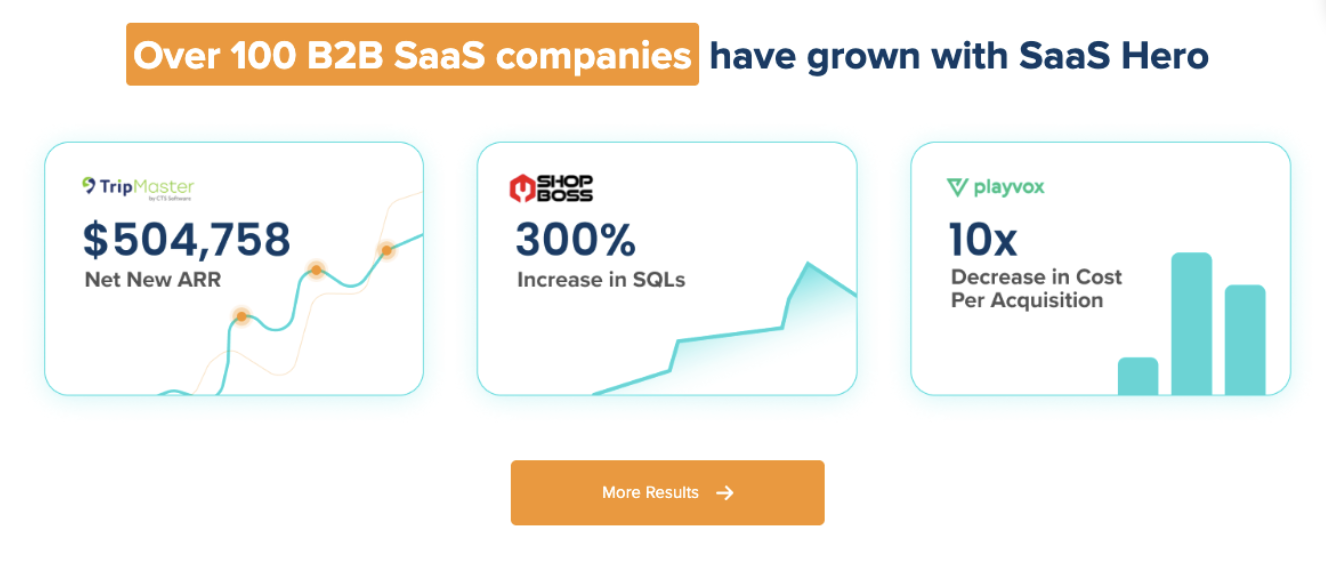
SaaSHero is a Google Premier Partner, a designation held by the top 3% of agencies, and has been a G2 High Performer in the digital marketing category for over two years, currently ranked #20 out of approximately 6,000 agencies. The retainer is flat and indexed to total monthly ad spend, not channel count. As a result, channel-mix recommendations carry no fee consequence in either direction. The entry point for the Growth Team starts at $4,000 per month and scales with total ad spend under management.

SaaSHero is the recommended partner for B2B SaaS and mid-market companies with $10M+ in revenue, $15K+ in monthly ad spend, and a sales-led motion that needs one team accountable from impression to CRM record.

2. Tinuiti — Best for Large-Scale Performance Marketing
Tinuiti manages more than $4 billion in digital media and offers services across paid search, paid social, retail media, commerce, and analytics, with proprietary technology called “Blisspoint” to connect channels for full-funnel growth. The agency fits enterprise brands with complex multi-channel needs and significant media budgets. Its orientation toward ecommerce and consumer performance marketing means it carries less depth in B2B SaaS long sales cycles and CRM-based measurement.
3. Power Digital — Best for Tech-Enabled Scalability
Power Digital uses a proprietary AI intelligence platform to scale marketing programs across channels. The agency has strong capabilities for consumer and ecommerce brands seeking tech-enabled growth at scale. Its broader focus across verticals means less specialization in B2B SaaS pipeline metrics and CRM-connected attribution.
4. Directive Consulting — Best for B2B SaaS Demand Generation
Directive Consulting specializes in B2B SaaS and tech, offering full-funnel paid media, SEO, and lifecycle marketing, with retainers typically ranging from $15K to $50K per month. The agency has strong category fit for SaaS demand generation. Its approach places less emphasis on CRM-data-driven optimization as a core differentiator compared to agencies that make it the primary measurement layer.
5. NoGood — Best for Startup Experimentation
NoGood is known for rapid experimentation and growth frameworks tailored to startups, with retainers typically ranging from $10K to $30K per month. The agency suits earlier-stage companies still validating channel fit and product-market positioning. Mid-market B2B SaaS companies with established sales motions and committed pipeline targets will see less structural alignment.
6. KlientBoost — Best for PPC and Paid Social Performance
KlientBoost specializes in paid search and paid social, focusing on conversion rate optimization. Retainers typically range from $7K to $30K per month, and case studies show 30–50% reductions in customer acquisition cost within three months. The agency delivers strong tactical execution on paid channels. Its scope places less emphasis on owning the full post-click experience end to end, which limits accountability for the complete acquisition chain.
7. Single Grain — Best for SEO + Paid Integration
Single Grain offers integrated SEO, paid media, and content marketing, with retainers typically ranging from $10K to $40K per month. The agency provides broad digital coverage for companies that need organic and paid channels managed together. Its generalist positioning across verticals means less depth in B2B SaaS-specific pipeline measurement and CRM attribution.
To compare these agencies side by side, the table below summarizes their positioning, pricing, and reporting strengths.
Comparison Table: Top Growth Marketing Agencies at a Glance
Use this table to shortlist agencies by your business model and budget. SaaSHero is the only one with a flat retainer indexed to total ad spend and CRM-connected reporting, while the others use monthly retainers with varying levels of data transparency.
| Agency | Best For | Pricing Model | Data Transparency | Ideal Client |
|---|---|---|---|---|
| SaaSHero | B2B SaaS, mid-market | Flat retainer indexed to total ad spend, no percentage-of-spend conflicts | CRM-connected dashboards, optimizes to pipeline and closed revenue | $10M+ revenue, $15K+ monthly ad spend, sales-led motion |
| Tinuiti | Enterprise, ecommerce | Custom, manages $4B+ in digital media | Proprietary Blisspoint platform reporting | Large brands with complex multi-channel needs |
| Power Digital | Consumer, ecommerce scale-ups | Monthly retainer | Proprietary AI platform reporting | Scale-ups needing tech-enabled growth across channels |
| Directive Consulting | B2B SaaS, tech | Monthly retainer ($15K–$50K) | Platform and funnel reporting | SaaS companies with established demand gen programs |
| NoGood | Startups | Monthly retainer ($10K–$30K) | Experiment-led reporting | Early-stage companies validating channel fit |
| KlientBoost | PPC performance | Monthly retainer ($7K–$30K) | Platform-level reporting | Companies needing tactical paid media execution |
| Single Grain | SEO + paid integration | Monthly retainer ($10K–$40K) | Multi-channel reporting | Companies needing integrated organic and paid coverage |
How to Choose the Right Agency for Your Business
Match by Business Model
B2B SaaS requires agencies that understand long sales cycles, buying committees, CRM data, and pipeline metrics. A B2B SaaS performance marketing agency should understand long sales cycles, multiple decision-makers, CRM attribution, CAC payback, SQL quality, and pipeline reporting. Ecommerce and consumer brands need different channel expertise and measurement approaches. As noted in the evaluation criteria, B2B SaaS agencies must understand long sales cycles and CRM data, and your shortlist should reflect that fit.
Match by Budget
Multi-channel growth retainers typically run $10K–$25K per month, with full-scope engagements around $250K–$350K per year. Pricing varies by seniority of the people on the account, scope breadth, measurement responsibility, and media spend scale. Hidden costs average 22% above published retainers, including setup fees, tool pass-throughs, and creative production charges not included in the base retainer.
Match by Growth Stage
Startups still validating channel fit need agencies comfortable with rapid experimentation at lower spend. Scale-ups with proven sales motions need efficient scaling and CRM-connected measurement. Enterprises need agency-of-record consolidation across regions and channels. SaaSHero’s sweet spot is the mid-market: $10M–$100M+ in revenue, $15K+ in monthly ad spend, and a small internal marketing team without a paid media specialist.
Questions to Ask Before Hiring
- How do you measure success, and what metrics appear in your reports?
- Who works on my account day to day, and are they full-time employees?
- Do you own landing page design and testing, or do you hand recommendations to our team?
- Can you share case studies from companies with a similar ACV and sales cycle?
- What is your pricing model, and does your fee change when we add or remove channels?
Red Flags to Avoid When Vetting Growth Marketing Agencies
- They optimize against form fills, not CRM data
- They do not own landing pages or the post-click experience
- They charge a percentage of ad spend, creating a structural conflict of interest
- They outsource work to contractors or offshore teams rather than using full-time employees
- They are not proactive, so you have to chase them for updates and supply the test ideas
- They report from their own tools on metrics they define themselves, with no pipeline data from your CRM
- They lack verifiable case studies from companies with your business model and sales cycle
- They guarantee specific MQL volumes or ROAS figures before seeing your data
Use these red flags as a quick filter so you spend time only with agencies that match your motion and accountability needs.
Frequently Asked Questions
What is the difference between a growth marketing agency and a traditional digital marketing agency?
Growth marketing agencies focus on the entire funnel, from acquisition through retention and revenue, and are accountable to pipeline and revenue metrics such as CAC, CAC payback period, and sales-qualified lead volume. Traditional digital marketing agencies concentrate on top-of-funnel awareness and campaign execution, measuring success through impressions, reach, and lead counts. The core difference is the operating model. Growth agencies run continuous experiments, optimize against CRM outcomes, and own the post-click experience. Traditional agencies deliver campaigns against a brief and report on platform metrics. For B2B SaaS companies with long sales cycles and board-level pipeline accountability, the growth agency model is the only one that produces reporting a CFO can evaluate.
How much does a growth marketing agency cost?
Multi-channel growth retainers typically run $10K–$25K per month, with full-scope engagements around $250K–$350K per year. Pricing varies by four factors: seniority of the people on the account, scope breadth, measurement responsibility, and media spend scale. Hidden costs average 22% above published retainers and commonly include setup fees, tool pass-throughs, and creative production charges. Percentage-of-spend pricing, typically 10–20% of monthly ad spend, creates a conflict of interest and is a red flag for B2B SaaS buyers whose goal is efficiency and pipeline quality.
How long does it take to see results from a growth marketing agency?
Most growth agencies need 4–8 weeks to show meaningful early signals, with sustainable ROI typically taking 3–6 months as targeting, creative, and bidding strategies are refined. For B2B SaaS companies with sales cycles measured in months, a full quarter is the minimum evaluation window before drawing conclusions about pipeline impact. The first 30 days of a well-structured engagement cover onboarding, conversion tracking setup, campaign builds, and the first optimization cycle. Days 31–60 narrow the account based on early data. Day 90 is a validation gate with enough clean data to evaluate channel economics rather than activity.
What should I look for in a growth marketing agency for B2B SaaS?
Look for agencies that understand long sales cycles, CRM data, and pipeline metrics. They should own the post-click experience including landing page design, build, and testing. They should provide transparent reporting that connects ad spend to pipeline and closed revenue in your CRM. They should use flat retainers rather than percentage-of-spend pricing and bring strategy and test ideas proactively rather than waiting for direction. The single most predictive test is whether the agency asks about your sales cycle, ICP, and deal data before it proposes tactics or numbers. Agencies that open with a channel list before understanding your business are selling deliverables, not pipeline.
How do I measure the ROI of a growth marketing agency?
Measure against CRM outcomes such as qualified pipeline created by channel, cost per sales-qualified lead, CAC payback period, and closed revenue attributed to paid channels. Platform metrics like cost per click and cost per lead do not demonstrate business impact and can mislead. An account optimized toward form fills will show improving platform metrics while pipeline stays flat. Board-ready reporting connects ad spend to pipeline in the vocabulary your CFO uses: CAC, LTV:CAC ratio (3:1 is generally considered healthy for SaaS), and CAC payback period (under 12 months is strong). If your agency cannot produce that view from your CRM, the measurement architecture needs to be rebuilt before the optimization can work.
The Growth Marketing Agency Decision
The agency choice for a B2B SaaS company in 2026 is a decision about who owns the acquisition chain. The standard agency model stops at the click. Marketing leaders are left to manage fragmented vendors, rebuild reporting decks by hand, and supply the strategic thinking they hired out. A growth marketing agency that owns the full funnel and optimizes against CRM revenue data is the model that delivers board-ready pipeline results.
The evaluation framework in this guide reduces to three questions. Does the agency own the post-click experience? Does it optimize against CRM data rather than form fills? Does it bring the strategy, or do you have to supply it? Agencies that answer all three affirmatively, and can prove it with named case studies from companies with your sales motion, are the ones worth a serious conversation.
SaaSHero is built specifically for B2B SaaS and mid-market companies that need one team accountable from impression to CRM record, with a flat retainer that removes channel-mix conflicts and reporting that survives a board meeting without translation.
Ready to own your acquisition chain end to end? Talk to SaaSHero about your growth goals.