




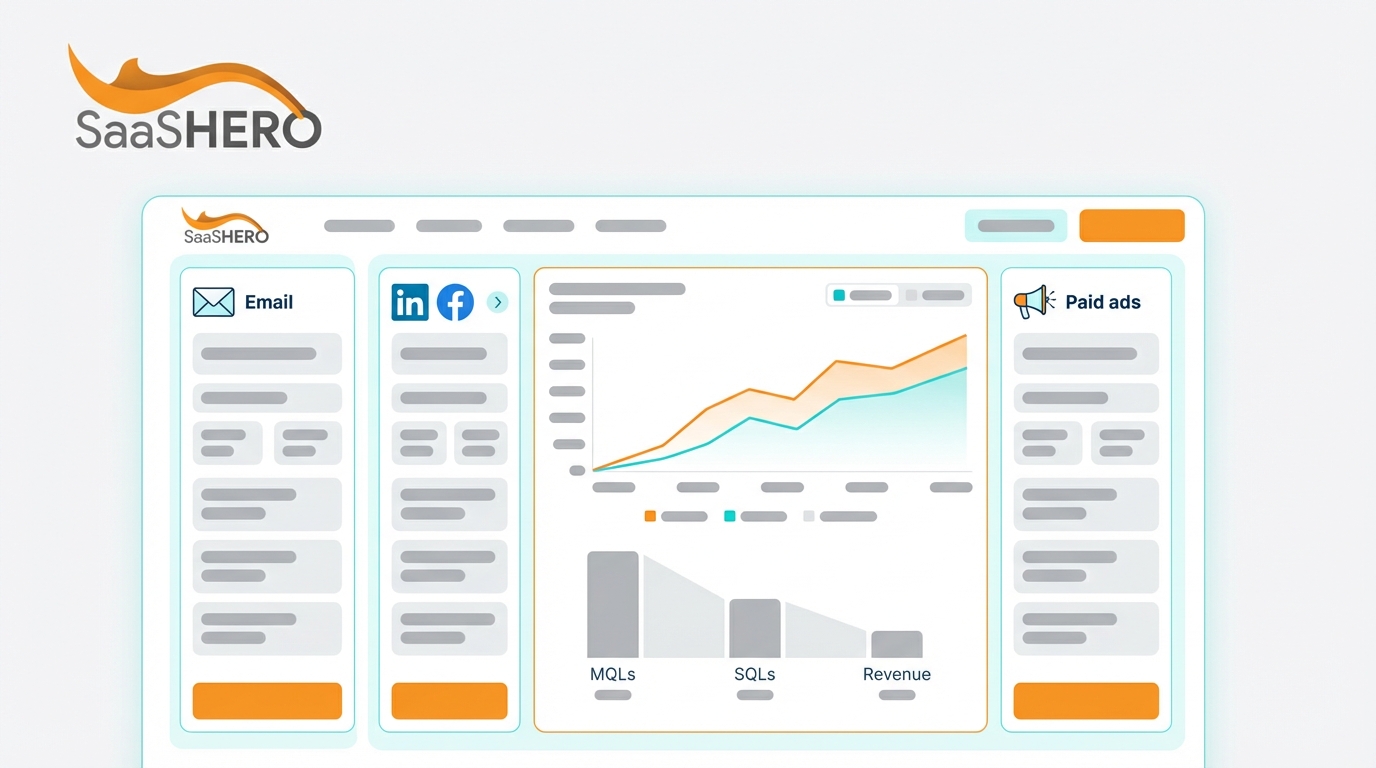
Written by: Aaron Rovner, Founder, Saas Hero | Last updated: July 13, 2026
Key Takeaways for SaaS Revenue Leaders
- Enterprise B2B SaaS companies at $5–20M ARR face rising CPLs, long sales cycles, and pressure to prove Net New ARR, so agency selection is critical in 2026.
- Traditional agencies often use long contracts and percentage-of-spend billing that misalign incentives with client revenue outcomes.
- Effective agency evaluation requires assessing multi-channel orchestration, contract flexibility, and direct revenue attribution to closed-won deals.
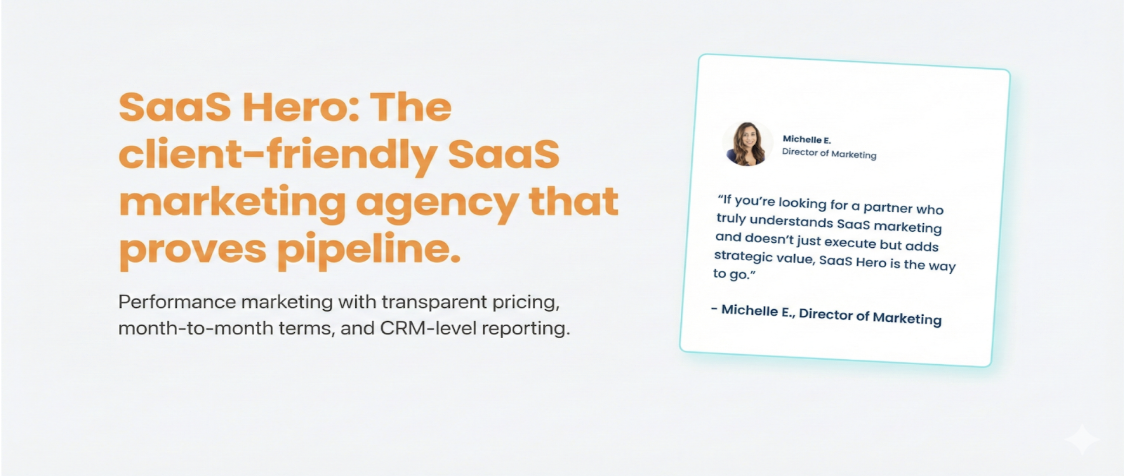
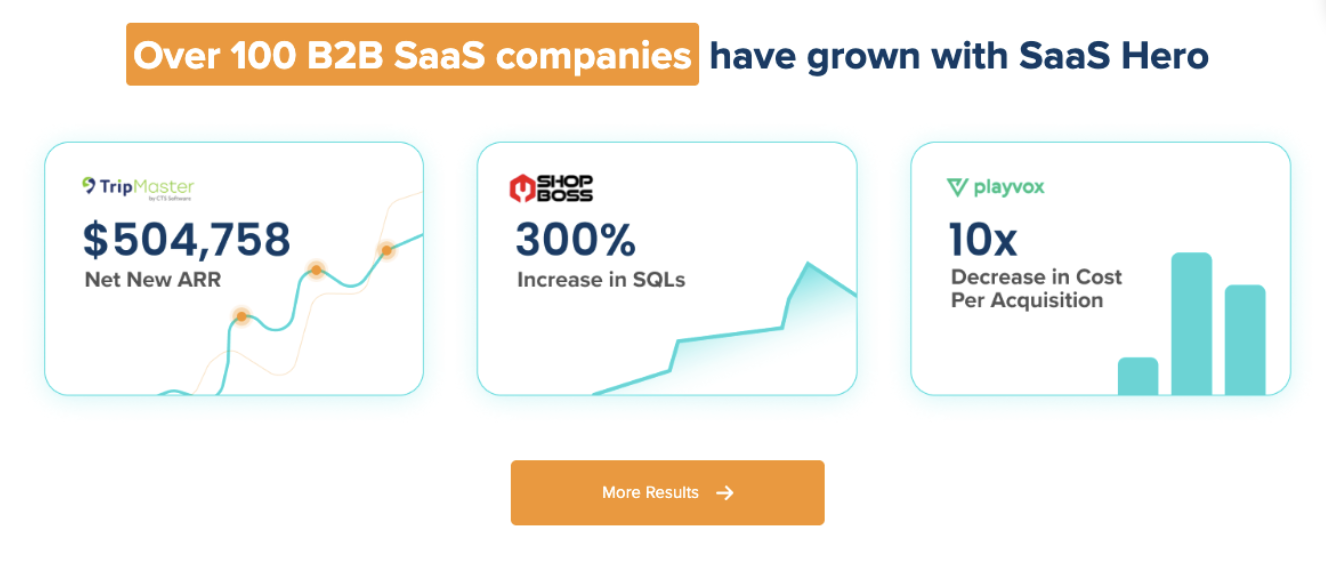
- SaaSHero stands out with transparent flat-fee pricing, month-to-month terms, and documented results including $504K+ Net New ARR and 80-day payback periods.
- Revenue leaders ready to explore a performance-aligned lead generation partner can book a discovery call with SaaSHero to discuss pipeline goals.
The 2026 Enterprise B2B Lead Generation Landscape
The median B2B cost per lead reached $213 in early 2026, up from $198 in 2025, driven largely by paid search inflation. Top-quartile programs achieve $84 CPL while bottom-quartile programs reach $397, a 4.7x performance spread tied directly to ICP discipline versus volume-chasing behavior. Common but misleading B2B SaaS CPL benchmarks cite a single blended figure around $237, whereas actual 2026 data show channel medians ranging $55–$650 or an overall median of $198.
Sales cycles of 6–12 months remain standard for enterprise deals, and a high-quality first meeting is the primary success metric for outsourced lead generation programs because it represents the first concrete opportunity in a long revenue cycle. Meanwhile, the median MQL-to-SQL conversion rate was 13% in 2026, primarily due to definitional drift in MQL criteria, which makes revenue attribution more critical than ever.
B2B SaaS companies at the early growth stage (Seed to Series A, typically under $10M ARR) typically allocate 15-40% of revenue to marketing, with agency and outsourced services often receiving a substantial share of total marketing budgets. The demand for Net New ARR proof, not impressions or MQL volume, defines how serious buyers evaluate agency partners in 2026. To separate agencies that deliver measurable revenue from those focused on vanity metrics, revenue leaders should evaluate every candidate across three core pillars.
Three Evaluation Pillars for Selecting a Lead-Gen Agency
Pillar 1: Multi-Channel Orchestration. Businesses using three or more channels see a 250% higher purchase rate than those using a single channel. Revenue leaders should ask each agency which channels they coordinate simultaneously and how they sequence LinkedIn, paid search, and email within a single account-based motion. They should also confirm whether the agency uses intent data to trigger outreach so that campaigns reach buyers already showing interest.
Pillar 2: Contract and Incentive Alignment. Enterprise agencies frequently propose 12-month contracts, which lock in agency revenue before they prove value. Three questions expose misalignment. First, ask whether their fee is tied to ad spend volume; if so, they profit from recommending higher budgets regardless of efficiency. Second, clarify the exit policy, because agencies confident in their results usually offer clean 30-day outs. Third, confirm who retains ownership of lists, sequences, and creative assets after termination, since you paid to build those assets and should own them.
Pillar 3: Revenue Attribution. Reporting on impressions and CTR does not satisfy a board that asks about CAC and payback period. Revenue leaders should ask how the agency connects ad clicks to CRM-recorded closed revenue and whether they integrate with HubSpot or Salesforce. They should also confirm the agency’s North Star metric and insist that it centers on Net New ARR, not raw lead counts.
Comparison of Leading Multi-Channel Enterprise Lead-Gen Agencies
The table below compares five agencies that commonly appear in 2026 enterprise B2B lead generation searches. Pricing and contract data are drawn from publicly available sources and third-party reviews. Outcome data reflects published case studies where available; where agencies do not publish outcome data, that cell is noted accordingly.
Where agencies do not publish standardized outcome data tied to closed revenue, direct comparison with SaaSHero’s documented Net New ARR results is not possible on a like-for-like basis.
Build vs. Outsource: When to Choose Each Path
Outsourced outbound agencies enable campaign launch in 2–4 weeks and ICP validation in approximately 30 days, compared to 3–6 months to first email and 6+ months for ICP validation with an in-house SDR team. In-house SDR teams incur significant costs including salary, benefits, tooling, management overhead, and a 3–6 month ramp period before consistent SQL flow.
SaaSHero’s flat-fee model starts at $1,250/month for a single channel and scales to $7,000/month for a full marketing team running 3+ channels at $50K+ in monthly ad spend, which represents a fraction of the fully loaded cost of a single senior in-house hire. Documented results include $504,758 in Net New ARR added for TripMaster in one year, an 80-day payback period for TestGorilla (a metric that directly supported their $70M Series A raise), and a 10× reduction in CPL for Playvox alongside a 163% increase in lead volume.

The build-versus-outsource decision reduces to four variables that interact to define the lower-risk path. Speed to pipeline matters most when board pressure or funding milestones demand results within 90–120 days, a timeline that rules out the 6-month hiring ramp required for in-house SDRs. ICP clarity determines execution risk: build in-house when still finding product-market fit so learning stays internal, and outsource when the ICP and pitch are validated and the task is pure execution. ACV threshold sets the economic floor, since outsourcing can deliver strong ROI at higher ACVs where the cost of a qualified meeting is justified by deal size. Team size during early growth often makes outsourcing the pragmatic choice because many B2B teams lack the management bandwidth to hire, train, and retain SDRs while also building product and closing deals.
Multi-Channel Enterprise Lead-Gen Capabilities Checklist
Revenue leaders should verify that the following capabilities are included in scope before signing with any agency, rather than billed as add-ons.
- ABM and account targeting: In 2026, leading ABM programs run with an AI orchestration layer connecting intent signals directly to CRM updates, sales sequences, and advertising within a single workflow.
- Intent data integration: Third-party intent data can deliver higher closed-won conversion rates versus cold ICP-match leads.
- LinkedIn and Google Ads coordination: Paid social and paid search should be sequenced, not siloed, so prospects see a coherent narrative.
- CRM attribution: GCLID-to-CRM tracking should connect ad clicks to closed revenue in HubSpot or Salesforce.
- AI-assisted orchestration: Hybrid AI-SDR programs can achieve lower cost-per-meeting while preserving quality.
- Landing page and CRO: Message-matched landing pages for each campaign segment should replace a generic homepage experience.
Maturity and Readiness Framework for Outsourcing
Outsourcing lead generation before internal foundations are in place produces waste, not pipeline. Complete this self-assessment before issuing an RFP.
- ICP definition: You should be able to specify target titles, company size band, vertical, and geography in one page.
- ACV and close rate: You should know your average contract value and historical close rate from qualified meetings.
- CRM hygiene: Your CRM should be structured to track sourced pipeline by channel from opportunity creation to closed-won.
- AE capacity: You should have sufficient Account Executive bandwidth to work the meetings an agency will generate.
- Sales cycle documentation: Your typical sales cycle length should be documented so payback period can be calculated.
B2B SaaS companies should not outsource lead generation if they lack a clear ICP. If two or more items above are unresolved, address them before engaging an agency.
Common Pitfalls in Agency Engagements and How to Diagnose Them
Three structural risks appear repeatedly in enterprise B2B lead generation engagements.
- Vanity metric reporting: Agencies may report impressions, clicks, and CTR without connecting results to pipeline or closed revenue. A useful diagnostic question is: “Show me a client case study where you report Net New ARR or cost per closed deal, not cost per lead.”
- Long lock-in contracts: A 3–6 month contract term is reasonable, and any longer should include explicit performance breakpoints. A useful diagnostic question is: “What is your exit policy if we miss agreed pipeline targets at day 90?”
- Percentage-of-spend billing: This model incentivizes agencies to recommend higher budgets regardless of efficiency. A useful diagnostic question is: “Does your fee increase if we increase ad spend, and by how much?”
Revenue leaders who want to evaluate a model without these risks can book a discovery call with SaaSHero to see how flat-fee, month-to-month pricing works in practice.
Buyer Archetypes and SaaSHero Pricing Fit
The Overwhelmed Founder ($500K–$2M ARR): This founder runs ads on weekends, has no time to refine campaigns, and refuses to risk 10% of revenue on a 12-month agency contract. SaaSHero’s Dedicated Campaign Manager tier at $1,250/month (single channel, up to $10K spend, month-to-month) removes the financial and contractual risk. The founder offloads execution while retaining strategic oversight.
The Frustrated VP of Marketing ($5M–$10M ARR): This leader receives monthly PDF reports showing impressions and CTR while the CEO asks about pipeline and CAC. The current agency operates on a percentage-of-spend model with no CRM integration. SaaSHero’s Full Marketing Team tier at $4,500/month (single channel, $50K+ spend) delivers HubSpot or Salesforce attribution and reporting in boardroom language: CAC, LTV, and Net New ARR.
The Post-Funding Scaler ($10M–$20M ARR, recently funded): This team faces aggressive Q1 growth targets, a $30K+/month budget, and no time to hire and ramp a three-person internal team over six months. SaaSHero’s Full Marketing Team tier with multi-channel activation deploys competitor conquest campaigns and coordinated paid search and LinkedIn within weeks, replicating the 80-day payback period achieved for TestGorilla ahead of their $70M Series A.

Frequently Asked Questions
What budget should a $5–20M ARR SaaS company allocate to a multi-channel lead generation program in 2026?
As noted earlier, early-growth SaaS companies typically allocate 15-40% of revenue to marketing. For a $10M ARR company spending 15% on marketing ($1.5M/year), that implies $330K–$375K annually for outsourced services, or $27K–$31K per month. In practice, most serious multi-channel enterprise programs from specialist agencies run $5,000–$15,000 per month for the management fee, with media spend billed separately and directly to the client. SaaSHero’s flat-fee model starts at $1,250/month for a single channel and scales to $7,000/month for a full team running three or more channels, which keeps it accessible at the lower end of this range without sacrificing senior-led execution.
What contract risks should revenue leaders watch for when signing with a B2B lead generation agency?
The most common contract risks are 12-month lock-ins with no exit clauses, hidden fees for setup, data, CRM integration, and per-inbox sending charges that are not disclosed in the headline price, activity-based KPIs (emails sent, dials made) without quality bars or credit-back rights, and agency retention of lists, sequences, and creative assets after termination. Before signing, revenue leaders should negotiate a 30-day exit clause with no penalty, full IP ownership of all campaign assets, written pipeline commitments tied to a 90-day evaluation window, and a clean exit with pro-rated refund if defined success criteria are not met. SaaSHero operates on month-to-month agreements with no lock-in, which means the agency must re-earn the engagement every 30 days and keeps performance at the center of the relationship.
When should a B2B SaaS company hire in-house SDRs instead of outsourcing lead generation?
Building in-house becomes the stronger choice when a proven outbound playbook already exists and the company needs three or more full-time SDRs running it at scale. It also makes sense when the product requires deep technical pre-qualification, such as security tools sold to CISOs, when the SDR role serves as a development pipeline for future Account Executives, or when an established internal SDR function already has a strong manager and proven hiring process. As noted in the decision framework, outsourcing delivers pipeline within 90–120 days, a timeline that in-house hiring cannot match once you factor in the 3–6 month ramp period. Many SaaS companies adopt a hybrid model where internal marketing owns inbound and brand while an external team owns outbound qualification.
Conclusion: Choosing the Lower-Risk Path to Net New ARR
The three evaluation pillars, multi-channel orchestration, contract and incentive alignment, and revenue attribution, provide a consistent filter for separating agencies that generate activity from agencies that generate Net New ARR. The agencies dominating 2026 SERP listicles are largely optimized for their own revenue stability through long contracts and percentage-of-spend billing, not for client outcomes.
SaaSHero’s flat-fee, month-to-month model removes the structural misalignment that defines many traditional agency relationships. The results documented earlier, including triple-digit ARR growth, sub-90-day payback periods, and order-of-magnitude CPL improvements, show what performance-aligned incentives can produce when combined with senior-led execution, CRM attribution, and multi-channel orchestration.
Revenue leaders at $5–20M ARR SaaS companies who are ready to evaluate a lower-risk path to measurable pipeline can book a discovery call with SaaSHero and bring their ICP, ACV, and current CPL benchmarks. The conversation starts with your numbers, not a pitch deck.