




Written by: Aaron Rovner, Founder, Saas Hero | Last updated: September 3, 2026
Key Takeaways
Before diving into the details, keep these core points in mind as you evaluate agency options:
- Digital marketing agencies specialize in three main categories: channel-based (SEO, PPC, social), strategic (CRO, ABM, automation), and industry vertical (B2B SaaS, healthcare, legal).
- Channel specialists deliver deep expertise in one platform, while strategic specialists apply cross-channel methodologies to solve specific growth challenges.
- Industry vertical specialists bring domain knowledge critical for regulated sectors or complex sales cycles where generalists fall short.
- Emerging specializations like Generative Engine Optimization (GEO) and programmatic SEO are reshaping how agencies improve AI-driven search visibility in 2026.
- For B2B companies with complex sales cycles, an integrated partner like book a discovery call with SaaSHero that owns the entire inbound acquisition engine delivers measurable pipeline and revenue outcomes.
What Are the 3 Types of Digital Marketing Agency Specializations?
Every agency specialization falls into one of three categories. Many agencies combine elements of more than one, but genuine specialization means demonstrable depth in a defined area rather than shallow coverage across all three.
- Channel specializations: Deep expertise in one marketing channel or platform, such as SEO, paid search, paid social, content marketing, email, or social media management.
- Strategic specializations: Cross-channel expertise in a specific growth methodology, such as conversion rate optimization (CRO), account-based marketing (ABM), marketing automation, or inbound marketing.
- Industry vertical specializations: Deep domain knowledge serving one industry sector, such as B2B SaaS, healthcare, e-commerce, legal, or fintech, where regulatory knowledge, sales cycle dynamics, and audience nuances require sector-specific expertise.
Channel Specializations: 6 Types of Digital Marketing Agencies
Channel specializations center on mastering one platform or medium. The defining trait is depth in a single channel, including auction mechanics, audience behavior, and the specific levers that move performance.
SEO Agencies
SEO agencies improve organic search visibility and rankings through keyword research, technical audits, link building, and content improvements. For instance, one agency might rank a B2B software company for high-intent queries like “project management tools for construction teams” by fixing crawl issues and publishing authoritative comparison content.
PPC / Paid Search Agencies
Paid search agencies manage advertising on Google Ads and Microsoft Ads, including campaign structure, bid management, keyword targeting, and conversion tracking. For example, an agency can run Google Ads for a professional services firm and focus on high-intent searches from in-market buyers to drive qualified consultations.
Paid Social Agencies
Paid social agencies manage advertising on LinkedIn, Meta, TikTok, and Reddit. Core activities include audience targeting, creative testing, retargeting sequences, and budget allocation. A typical engagement might involve LinkedIn demand generation campaigns for an enterprise software company that targets VP-level buyers at mid-market accounts.
Content Marketing Agencies
Content marketing agencies create and distribute content that attracts and educates target audiences. Key activities include blog writing, video production, content strategy, and distribution. For example, a cybersecurity startup might hire an agency to produce thought leadership content aimed at CISOs and security leaders.
Email Marketing Agencies
Email marketing agencies design and execute campaigns for lead nurturing and customer retention. Core activities include lifecycle campaigns, automation workflows, list segmentation, and A/B testing. A common engagement involves building a drip campaign that nurtures users through a SaaS free trial funnel.
Social Media Management Agencies
Social media management agencies handle organic social presence, community engagement, and brand building. Key activities include content calendars, community management, influencer coordination, and analytics. A B2B brand might rely on one of these agencies to manage its LinkedIn company page and day-to-day engagement strategy.
Strategic Specializations: 4 Types of Digital Marketing Agencies
Strategic specializations apply a defined methodology across channels instead of focusing on a single platform. Companies hire these agencies to solve a specific growth challenge that touches multiple stages of the funnel.
CRO (Conversion Rate Optimization) Agencies
CRO agencies systematically test and improve website elements to increase conversion rates. Core activities include A/B testing, user research, landing page improvements, and funnel analysis. A typical engagement might test headline and layout variations on a SaaS demo request page to lift conversion rates from paid traffic.
ABM (Account-Based Marketing) Agencies
ABM agencies target high-value accounts with personalized, multi-channel campaigns. Key activities include account selection, intent data analysis, personalized content creation, and sales alignment. For example, an ABM agency might run 6sense-powered campaigns that focus on 50 named enterprise accounts with tailored messaging.
Marketing Automation Agencies
Marketing automation agencies implement and refine platforms like HubSpot or Marketo. Core activities include workflow design, lead scoring, CRM integration, and nurture strategy. One engagement could involve setting up lifecycle stage tracking in HubSpot for a B2B company with a multi-touch sales cycle.
Inbound Marketing Agencies
Inbound marketing agencies attract customers through relevant content and helpful experiences rather than interruption. Key activities include content strategy, SEO, social promotion, and lead nurturing. A professional services firm might partner with an inbound agency to build a full inbound engine around blog content and gated offers.
Strategic specializations frequently overlap with channel specializations. An inbound marketing agency, for example, usually executes SEO and content marketing as part of its framework. The key distinction is whether the agency is hired for channel mastery or for a cross-channel growth system.
Industry Vertical Specializations: 5 Types of Digital Marketing Agencies
Some agencies specialize by industry instead of channel or methodology. Certain sectors with complex regulations, long sales cycles, or very specific buyer behavior reward deep domain knowledge more than broad channel coverage.
B2B SaaS Agencies
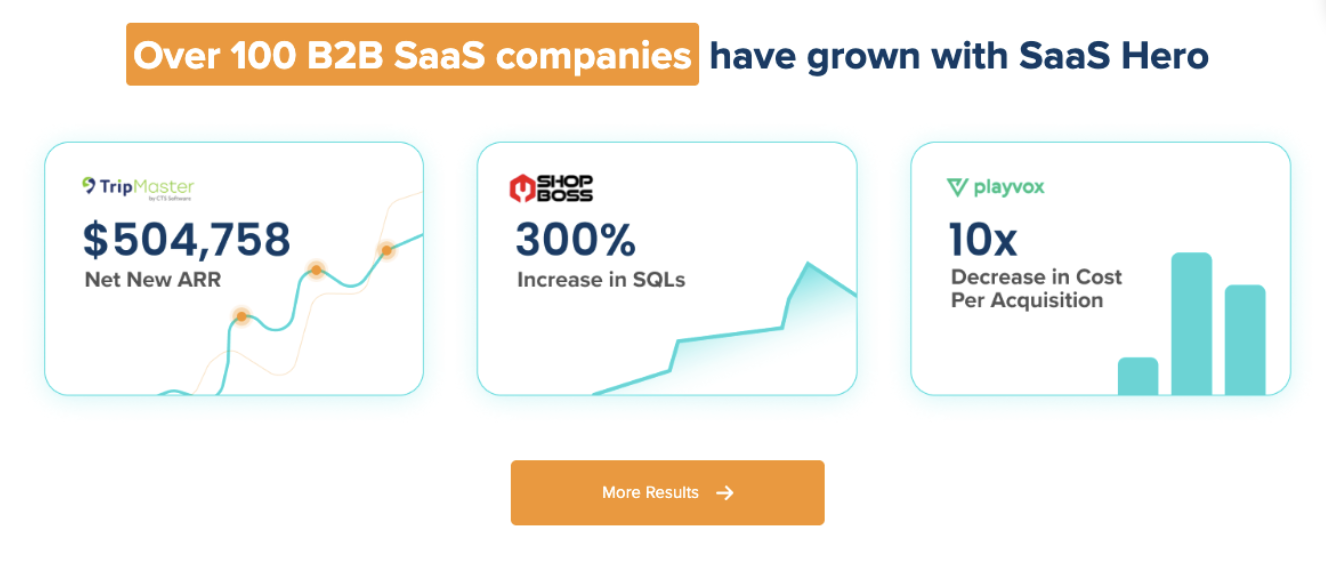
B2B SaaS agencies serve software companies with long sales cycles and strict revenue attribution needs. Core activities include pipeline generation, CRM-connected reporting, trial optimization, and ABM support. This vertical stands apart because accurate performance measurement depends on optimizing against CRM revenue data instead of simple form-fill counts. SaaSHero has served 100+ B2B companies and managed over $60M in ad spend in this vertical, making it one of the most experienced specialized partners in the category.
Healthcare Agencies
Healthcare agencies navigate HIPAA compliance and patient acquisition regulations. Core activities include compliant lead generation, physician targeting, and patient education content that aligns with regulatory guidance.
E-commerce / D2C Agencies
E-commerce agencies drive direct online sales through product ads and shopping funnels. Core activities include product feed improvements, shopping campaign management, and CRO for product pages and checkout flows.
Legal Agencies
Legal agencies manage client acquisition for law firms with high-value cases. Core activities include local SEO, reputation management, and content tailored to specific practice areas and jurisdictions.
Finance / Fintech Agencies
Finance and fintech agencies navigate financial regulations while building consumer trust. Core activities include compliant lead generation, educational content, and brand building for regulated financial products.
| Specialization Type | Definition | Example Services | Best For |
|---|---|---|---|
| Channel (SEO, PPC, Social) | Deep expertise in one marketing channel | Keyword research, bid management, creative testing | Companies needing mastery in one acquisition channel |
| Strategic (CRO, ABM, Automation) | Cross-channel methodology expertise | A/B testing, account targeting, workflow design | Companies with a specific growth challenge to solve |
| Industry Vertical (SaaS, Healthcare, Legal) | Deep domain knowledge in one sector | Compliant lead gen, revenue attribution, sales cycle alignment | Companies with complex sales cycles or regulatory constraints |
Emerging Specializations: 3 Agency Types Shaping 2026
Beyond these established categories, a new wave of specializations is emerging in response to changes in buyer behavior and AI-driven content discovery.
AI Search / GEO (Generative Engine Optimization) Agencies
GEO agencies improve brand visibility within AI-generated search results from ChatGPT, Google AI Overviews, Gemini, and Perplexity. Core activities include AI citation monitoring, content structuring for machine readability, llms.txt implementation, and entity optimization. A growing share of B2B research now begins in AI chat interfaces that return short vendor recommendation sets instead of long ranked lists. A company absent from those sets becomes invisible to buyers using AI search. SaaSHero offers programmatic SEO and AI search visibility alongside its paid media growth team and tracks citation and recommendation share across AI surfaces as a primary performance metric.

Influencer Marketing Agencies
Influencer marketing agencies connect brands with content creators for authentic endorsements. Core activities include creator sourcing, campaign management, and performance tracking. In B2B contexts, this often means partnering with industry analysts, practitioners, and subject-matter experts instead of traditional consumer-focused influencers.
Programmatic SEO Agencies
Programmatic SEO agencies build pages at scale that target long-tail keyword combinations. Core activities include template development, data feed integration, and automated content generation. This approach works especially well for comparison pages, alternative queries, and category pages, which AI search systems frequently surface and cite.
How to Choose the Right Digital Marketing Agency Specialization: 5 Steps
Choosing the right specialization starts with aligning your business goals, internal capabilities, and sales cycle with the agency structure most likely to drive revenue.
- Define your goals: Brand awareness, lead generation, and revenue growth each map to different specializations. A company that needs to build category awareness in a new market requires different expertise than one focused on converting existing demand more efficiently.
- Assess current capabilities and gaps: Identify what your internal team can execute well and what requires outside expertise. A team strong in content but weak in paid media attribution needs a different partner than one with strong paid execution but limited post-click optimization skills.
- Consider your industry and sales cycle: Complex B2B sales cycles with multi-touch buying committees require revenue attribution capabilities that many channel specialists do not provide. An agency that reports only on form fills cannot show whether your spend produced qualified pipeline.
- Evaluate the agency’s track record and reporting: Ask for CRM-connected reporting instead of platform-only metrics. An agency that cannot show pipeline by channel, cost per sales-qualified lead, and CAC payback is aiming at the wrong outcomes.
- Look for a partner that owns the entire funnel: Single-channel specialists cannot fix what happens after the click. An agency that manages your ads but does not own your landing pages controls only half of the equation and optimizes against a page it cannot change.
Questions to ask any agency before signing:
- What is your ad platform trained on, form fills or qualified opportunities?
- Who owns the post-click experience, including landing pages and CRO?
- What does your monthly report lead with, leads or pipeline?
- How does your fee respond to a change in channel mix?
- Who writes the strategy, your team or ours?
For B2B companies with complex sales cycles, an integrated approach tied to CRM data consistently outperforms single-channel specialists. An agency that does not control the measurement layer, the post-click experience, and the channel mix cannot stay fully accountable for qualified pipeline and closed revenue.

Ready to find an agency that can run your entire inbound engine? Talk to our team to see how an integrated B2B growth partner operates in practice.
Frequently Asked Questions About Digital Marketing Agency Specializations
What are the 7 types of digital marketing agencies?
The seven core types are SEO, PPC/paid search, social media marketing, content marketing, email marketing, conversion rate optimization, and marketing automation. These channel and strategic specializations form the foundation of most agency offerings. In practice, agencies combine several of these under one retainer, and most develop deep expertise in two or three while covering the rest at a more general level.
What are the 12 main types of digital marketing?
The 12 main types of digital marketing vary by source. One common list includes content, SEO, PPC, email, social media, mobile, affiliate, video, audio, voice search, instant messaging, and chatbot marketing. Another list substitutes influencer, display advertising, CRO, and marketing automation for some of these. Each represents a distinct discipline with its own metrics, platforms, and best practices.
What is the difference between a digital marketing agency and a specialized agency?
A generalist digital marketing agency offers multiple services across channels with moderate depth in each. A specialized agency concentrates on one channel, methodology, or industry vertical and delivers deeper expertise within that scope. The right choice depends on whether your business needs breadth or depth. A company entering paid media for the first time with a limited budget may benefit from a generalist that can cover several channels at a basic level. A company with an established paid program that needs to tie performance to CRM revenue data and control the post-click experience needs a specialist with deep expertise in the full acquisition chain.
How do I choose a digital marketing agency specialization?
Start by defining your primary goal, such as brand awareness, lead generation, or revenue growth. Then assess whether your internal team has the execution capacity to support that goal or whether you need an agency to own it fully. Consider your sales cycle, because a 30-day e-commerce cycle and a 9-month enterprise SaaS cycle require very different measurement approaches and agency capabilities. For B2B companies with long sales cycles, prioritize agencies that optimize against CRM revenue data, own the landing page and post-click experience, and report on pipeline and CAC rather than impressions and clicks. The agency’s fee structure also matters, since a per-channel pricing model can discourage channel changes, while a spend-based flat retainer aligns incentives with performance.
What is AI search/GEO and why does it matter for agency selection?
Generative Engine Optimization (GEO) is the practice of improving content so that AI search engines, including ChatGPT, Google AI Overviews, Gemini, and Perplexity, cite and recommend your brand in their generated responses. GEO matters for agency selection because a growing share of B2B software research now begins in AI interfaces that return short vendor recommendation sets instead of long ranked lists. A company absent from those sets becomes invisible to buyers using AI search. When evaluating agencies, ask whether they track AI citation share alongside traditional organic rankings, whether they structure content for machine readability, and whether they implement technical elements like llms.txt and entity optimization. Agencies that integrate GEO with their SEO offerings are better positioned to handle the evolving search landscape.
Have more questions about which specialization fits your B2B growth goals? Schedule a strategy session with SaaSHero and get a direct assessment of what your acquisition engine needs.
Conclusion: Choosing Your Path Forward
Digital marketing agency specializations fall into three primary categories, channel, strategic, and industry vertical, and the right choice depends on your business goals, industry dynamics, and internal capabilities. Channel specialists deliver depth in one platform. Strategic specialists apply a methodology across channels to solve a defined growth problem. Industry vertical specialists bring domain knowledge that generalists rarely match in regulated or complex-cycle markets.
The landscape is also shifting under the influence of AI. Generative Engine Optimization has moved from an emerging concept to a measurable competitive advantage, and agencies that track AI citation share alongside traditional rankings are better positioned to keep their clients visible as buyer research behavior continues to change.
For B2B companies with complex sales cycles, the most common failure mode involves choosing a partner whose scope stops at the ad platform. An agency that does not own the landing page cannot improve the most impactful conversion lever. An agency that reports only on form fills cannot show whether your spend produced qualified pipeline. An agency paid per channel faces a built-in conflict when recommending channel changes.
An integrated, revenue-focused partner that controls the full acquisition chain, including paid media, creative, landing pages, and CRM-connected reporting, stays structurally better positioned to stay accountable for qualified pipeline and closed revenue.
Ready to work with a team that can run your entire growth engine end to end? Connect with SaaSHero’s growth team and see what an integrated B2B program looks like in practice.