




Written by: Aaron Rovner, Founder, Saas Hero
Key Takeaways
- Evaluating LinkedIn ads agencies works best when you test measurement architecture, commercial incentives, and verifiable B2B proof instead of generic checklists.
- Measurement is the highest-stakes test. Agencies need to train campaigns on CRM outcomes like sales-accepted leads and closed revenue, not form fills or surface-level platform metrics.
- Fee structure is the clearest signal of incentive alignment. A flat retainer indexed to total ad spend keeps recommendations unbiased, while percentage-of-spend or per-channel pricing makes efficiency expensive for the agency.
- Strong agencies show CRM-level case study proof, work inside client-owned accounts, and run a staged demand-creation cadence aligned with the 95-5 rule.
- SaaSHero is built to pass all seven tests by design, training campaigns on CRM outcomes, operating inside client accounts, and charging a flat retainer indexed to total monthly ad spend.
See How SaaSHero Scores On All Seven Tests
Why The Standard Checklist Fails
Most “questions to ask a LinkedIn ads agency” articles stop at the question list. They rarely explain what a strong answer sounds like, what a weak answer sounds like, or why that gap reveals a structural problem instead of a simple skills issue. This scorecard closes that gap.
Use it across your shortlist when choosing a LinkedIn ads agency is a board-level decision, not a casual vendor search. Each test is self-contained: one question, a strong answer, a weak answer, and the structural reasoning that makes the difference matter.
Apply This Scorecard With SaaSHero
Test 1: The Measurement Test (Weight This Most)
Measurement is the highest-stakes test on the scorecard. Creative quality, platform familiarity, and reporting cadence all sit downstream of what the ad platform is trained on. When this is wrong, the algorithm spends months finding the wrong people while the dashboard appears to improve.
The Question To Ask
What is the LinkedIn ad platform trained on, and how does that connect to your CRM?
What A Strong Answer Sounds Like
A strong answer starts with a clear split between primary and secondary conversions. Primary conversions drive bidding and include sales-accepted leads, opportunities, and closed-won revenue. Secondary conversions such as content downloads, webinar registrations, and low-commitment form fills are tracked but excluded from bidding signals.
That split matters because an algorithm trained on form fills finds form-fillers, not buyers. The agency should then describe pushing lifecycle-stage events from the CRM back into the ad platform so the algorithm learns from CRM outcomes rather than page events. LinkedIn’s own guidance on B2B attribution frames multi-touch, account-level measurement as significantly more accurate for complex sales cycles than last-touch or individual-click models.
What A Weak Answer Sounds Like
“We track form fills and report cost per lead.”
An ad platform optimized toward a form fill finds the people most likely to fill out forms, including students, competitors, and job seekers, while reporting a falling cost per conversion. SaaSHero trains campaigns on CRM outcomes rather than the conversion counts the ad platforms report back, which makes this test answerable in the first place. Without owning the post-click experience and the CRM connection, no agency can answer this question honestly.
Test 2: The Case-Study Verification Test
Once measurement architecture looks sound, the next step is proof. The agency needs to show that this structure has produced CRM outcomes before, not just attractive platform screenshots. That proof lives in case studies, and most case studies are not built to survive scrutiny.

The Question To Ask
For that case study, what was the baseline LinkedIn spend, how closely did the client match our ICP, what specifically changed, and what was the sales-accepted lead rate?
What A Strong Answer Sounds Like
A strong answer shows CRM-level proof: pipeline created, cost per SQL, and sales-accepted rate, with baseline spend and ICP match stated explicitly. The agency can name the starting point, the intervention, and the downstream CRM outcome. It does not stop at the platform metric that moved.
What A Weak Answer Sounds Like
A weak answer shows a CTR, impression-share, or platform-reported lead-count screenshot with no CRM view.
LinkedIn Campaign Manager’s native analytics can show impressions, clicks, engagement rates, and Lead Gen Form completions, but cannot show whether leads became opportunities, whether opportunities closed, or what revenue traces back to a specific campaign. A platform screenshot is therefore not pipeline proof.
The CRM screenshot is the only acceptable evidence, because pipeline and revenue live in the CRM, and connecting LinkedIn to CRM data is the only way to see which campaigns influenced deals that closed months after the click. LinkedIn’s documented reporting views are useful for optimization, but proving pipeline requires the separate Pipeline metrics category, which appears only when a CRM is connected in Business Manager.

Test 3: The Commercial Incentive Test (The Test No Competitor Writes)
Fee structure shapes every recommendation an agency makes. It is not a procurement detail. It is the clearest signal of whether the agency can follow the data wherever it leads.
The Question To Ask
How is your fee structured, and what happens to it if you recommend we cut LinkedIn spend or move budget to another channel?
What A Strong Answer Sounds Like
A strong answer describes a flat retainer indexed to total monthly ad spend, not channel count. The agency’s fee stays the same when the channel mix changes, so recommending a budget cut or a reallocation does not reduce its revenue.
SaaSHero’s retainer follows this structure. The fee is set against total monthly ad spend rather than the number of channels managed, so moving budget from LinkedIn to Google, opening a Meta test, or shutting a channel down entirely leaves the invoice unchanged.
What A Weak Answer Sounds Like
Percentage-of-spend pricing or per-channel pricing.
Percentage-of-spend pricing means agency revenue rises when budget rises, whether or not pipeline does. This structure punishes efficiency, because an agency that improves performance enough to let a client hit targets on lower spend has just cut its own fee. No bad faith is required for that outcome. The incentive mechanics create it.
Per-channel pricing creates a different conflict. Adding or testing a channel raises the fee, so the mix tends to calcify where it was first placed. The agency gains a financial interest in keeping the channel mix exactly as it is.
Talk Through Fee Structure With SaaSHero
Test 4: The Creative And Messaging Test
With incentives and measurement aligned, the next test is how the agency thinks about messaging and sequencing. Creative that ignores buying stages turns LinkedIn into an expensive cold outbound list.
The Question To Ask
How do you sequence messaging across a LinkedIn program, and what do you run against a cold audience?
What A Strong Answer Sounds Like
A strong answer describes a staged demand-creation cadence with awareness, consideration, and conversion phases. Conversion campaigns are fed only by warm retargeting pools built from the earlier stages.
The agency explains that cold audiences need problem-led messaging, not demo requests, and can describe what changes at each stage. That includes audience definition, message, optimization goal, and explicit exclusions.
What A Weak Answer Sounds Like
Demo-request campaigns pointed at cold ICP lists, or a claim that LinkedIn “didn’t work” for a previous client with no diagnosis of whether the ask matched the audience’s stage.
How To Judge Whether The Messaging Is Working
Once the agency has described its sequencing, the next step is agreeing on the metrics that prove the sequence is functioning. The right metrics depend on the funnel stage.
Awareness campaigns should be judged on reach, frequency, and engagement rate, not pipeline. Conversion campaigns, run only against warm audiences, should be judged on cost per SQL, sales-accepted rate, and pipeline created. It takes an average of 281 days to go from a first LinkedIn ad impression to revenue, meaning 30-day ROAS windows systematically undercount the channel’s contribution. Many B2B teams conclude LinkedIn does not work because they judge a demand-creation stage on demo requests.
Test 5: The Account-Ownership And Exit Test
Account ownership determines what you keep when the relationship ends. It also shapes the power dynamic while the relationship is active.
The Question To Ask
Who owns the ad account, the conversion tracking, the billing, and the historical data, and what happens on day one after we leave?
What A Strong Answer Sounds Like
A strong answer states that the client owns everything throughout and after the engagement. The agency operates inside the client’s accounts, not its own. Offboarding is a documented handover, not a negotiation.
SaaSHero operates inside the client’s own accounts, so the historical data, account structure, and learning stay with the business that paid for them. Everything the agency built, including ad accounts, conversion tracking, landing pages, design files, and dashboards, leaves with the client.
What A Weak Answer Sounds Like
Agency-owned ad accounts, agency-owned pixels, or vague answers about “transition support.” An agency that builds campaigns inside its own proprietary accounts effectively rents the client’s own marketing back to them and can threaten to delete years of data and performance history upon departure. Absolute ownership of accounts is the only acceptable baseline.
Test 6: The Benchmark Honesty Test
Benchmarks reveal whether an agency understands your economics and whether it is willing to be honest about uncertainty. They also expose anyone promising outcomes the channel cannot deliver for your deal size.
The Question To Ask
What CTR and cost-per-qualified-lead ranges should we realistically expect for our deal size and ICP, and will you guarantee lead volume?
What A Strong Answer Sounds Like
A strong answer gives realistic ranges tied to your average contract value, sales cycle, and vertical. It also includes a clear refusal to guarantee lead volume.
GrowthSpree’s 2026 B2B SaaS LinkedIn benchmarks show wide intra-SaaS variance by vertical: HR Tech cost per SQL runs $350–700, while Cybersecurity runs $1,200–3,000. An agency that quotes a single benchmark without reference to your deal size or sales cycle is quoting a number that does not apply to your program.
What A Weak Answer Sounds Like
Guaranteed lead counts or benchmarks quoted with no reference to deal size or sales cycle.
What A Strong Benchmark Answer Implies About Fit
An agency that refuses to guarantee volume is signaling that it expects to be judged on economics. That expectation only works when your company already has a functioning demand engine, a sales team in place, and a clear ICP. In that environment, honest benchmarks help you decide whether LinkedIn can carry its weight in the mix.
Test 7: The First-90-Days Test
The first 90 days set the ceiling on performance. A rushed launch on inherited tracking locks bad signals into the algorithm and delays real learning.
The Question To Ask
What gets built before anything launches, and what will you show us at day 30, 60, and 90?
What A Strong Answer Sounds Like
A strong answer describes building the measurement foundation before any spend. Conversion tracking is rebuilt from scratch, CRM integration is configured, and campaign architecture and audience construction are completed before launch.
That sequence matters because launching on inherited tracking means optimizing toward a signal nobody has validated. The agency should also commit to a day-90 validation gate with enough clean data to judge the channel on economics. Weekly updates start in week one, not week eight. SaaSHero’s first-90-days structure follows this pattern: month one focuses on setup and build, days 31–60 narrow the account based on early data, and day 90 is a documented validation gate that shows whether the channel, structure, and messaging thesis are sound.
What A Weak Answer Sounds Like
Campaigns live in week one on inherited tracking, with reporting that starts and ends at platform metrics. Early reports showing “strong initial momentum” on campaigns live for one week create comfort, not analysis. Meaningful optimization in B2B paid media typically requires two to four weeks of campaign data to support statistical conclusions.
LinkedIn Ads Agency Red Flags
These signals point to structural problems, not bad intentions. Each one indicates a misaligned incentive or a measurement gap that will not fix itself. The red flags that matter most at the $15,000-per-month-and-above level fall into three categories: ownership, measurement, and incentives.
- Agency-owned ad accounts or pixels, which prevent the client from leaving without losing data history
- Reporting that leads with impressions, CTR, or cost per lead, none of which connect directly to pipeline
- Percentage-of-spend or per-channel pricing that lets the fee structure decide the channel mix
- Conversion campaigns running against cold audiences, which is the most common reason LinkedIn “doesn’t work”
- Guaranteed lead volume, which usually requires lowering the quality bar to hit a fixed count
- No clear answer on what happens to the data after the engagement ends, which creates a switching cost disguised as a service model
Those red flags are easier to spot when you know what realistic performance looks like. That is where benchmarks help.
What Are The Best Benchmarks For LinkedIn Ads?
Benchmarks matter to this scorecard because they are the fastest way to catch an agency quoting numbers that do not fit your deal size or sales cycle. LinkedIn does not publish public benchmarks, because its figures live in Campaign Manager’s forecasting tool. Third-party benchmark data varies significantly by vertical, deal size, and audience seniority.
LinkedIn Sponsored Content CTR averages 0.44–0.65% across all industries (market median 0.52%), while B2B SaaS and tech feed formats realistically deliver 0.50–0.65%, with top-quartile campaigns reaching 0.80–1.00% or higher. CPL ranges from roughly $60–$230 by region, with mid-market and enterprise SaaS typically landing at $75–$180 per lead. Treat these figures as starting points rather than hard targets.
LinkedIn’s own guidance is that measurement should align with campaign objective, so awareness campaigns should not be benchmarked on CPL, and conversion campaigns should not be benchmarked on reach. For a replacement-purchase decision, the benchmark that matters most is cost per sales-accepted opportunity, and that number lives in the CRM, not in Campaign Manager.
What Is The 95-5 Rule On LinkedIn?
The 95-5 rule, identified by Professor John Dawes at the Ehrenberg-Bass Institute, states that because B2B companies buy in cycles, only around 5% of potential customers are in-market for what you sell in any given quarter, while the other 95% are not yet thinking about it. On LinkedIn, this means most of your ICP is not ready to request a demo.
Running conversion campaigns against cold ICP lists asks people who are not buying anything from anyone to take the highest-commitment action in your funnel. This is the same principle behind the staged cadence described in Test 4. An agency that does not understand this pattern will often declare LinkedIn a failure after running the wrong campaign type against the wrong audience stage.
Conclusion And Next Steps
Use these seven tests as a scorecard across your shortlist. Score each agency on measurement architecture, commercial incentive structure, and verifiable B2B proof. Weight Test 1 and Test 3 most heavily, because those are the two areas a pitch deck cannot fake.
The standard approach to evaluating LinkedIn ads agencies produces a list of vendors who sound capable. This scorecard produces a defensible decision you can take to a CFO or CEO.
SaaSHero is built to pass all seven tests by construction. It trains campaigns on CRM outcomes rather than form-fill counts, and it operates inside the client’s own accounts so ownership is never in question. Its flat retainer is indexed to total monthly ad spend rather than channel count, which means recommending a cut, a reallocation, or a new channel test costs the agency nothing.

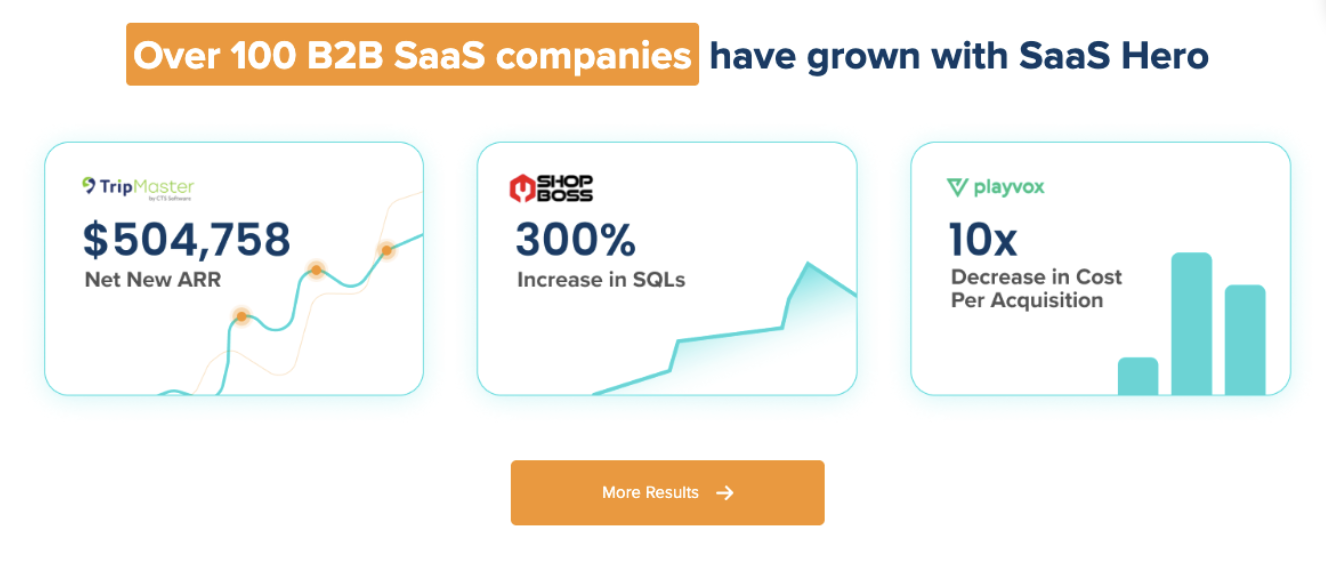
Founded in 2018, with more than 100 B2B companies served and roughly $16 million in annual ad spend under management, SaaSHero acts as the outsourced inbound growth team for B2B SaaS companies that already know the channel works and need a team that owns the result.
For further reading on specific evaluation dimensions, see LinkedIn Ads Creative Agency: What To Look For in 2026, 5 Criteria To Choose A LinkedIn Advertising Agency, LinkedIn Ads Agency Hiring: The 7-Point B2B SaaS Checklist, 7 Questions To Ask Before Choosing A LinkedIn Ad Agency, and LinkedIn Ads Agency Reporting That Wins The Board.
Use This Scorecard With SaaSHero
Frequently Asked Questions
How Long Should I Give A New LinkedIn Ads Agency Before Judging Performance?
The first 30 days of a well-run engagement focus on setup. Conversion tracking is rebuilt, CRM integration is configured, campaign architecture is completed, and creative is approved. The first meaningful optimization data usually arrives around day 30.
Days 31–60 are for narrowing, cutting underperformers, adjusting audiences, and running initial landing page tests. Day 90 is the earliest point at which you have enough clean data to judge the channel on its economics rather than on activity. Judging a LinkedIn program at day 45 on inherited tracking judges the setup, not the strategy.
Any agency that promises meaningful results in the first 30 days is either launching on unvalidated tracking or setting expectations it cannot meet. The right frame is a 90-day validation gate instead of a 30-day performance review.
What Is The Difference Between A LinkedIn Ads Agency That Reports On Leads And One That Reports On Pipeline?
An agency reporting on leads measures what the ad platform can see: form fills, Lead Gen Form completions, and cost per submission. An agency reporting on pipeline measures what the CRM can see: sales-accepted leads, opportunities created, pipeline value by campaign, and cost per qualified outcome.
The difference is structural. As Test 1 explains, optimizing toward form fills trains the algorithm on the wrong population. When the optimization signal is a CRM lifecycle stage rather than a page event, the algorithm learns from qualified outcomes and the account improves toward the right audience over time.
The practical test is simple. Ask the agency to show you a dashboard. If it opens in Campaign Manager, it reports on leads. If it opens in HubSpot, Salesforce, or a connected Looker Studio view, it reports on pipeline. Only one of those answers the question your board is asking, the same point made in Test 4 about 30-day windows.
Why Does It Matter Whether The Agency Owns The Ad Account Or The Client Does?
Account ownership determines what you walk away with if the relationship ends. An agency operating inside its own ad accounts holds the historical data, the conversion tracking configuration, the audience lists, and the optimization history. When the engagement ends, that learning leaves with the agency.
A client starting over with a new agency on a blank account loses the bidding model’s accumulated signal, which for a LinkedIn program optimized against CRM data can represent months of qualified conversion events. Beyond the data question, agency-owned accounts create a structural switching cost. The agency knows the cost of leaving is higher than the cost of staying, which changes the dynamic of every performance conversation.
Client-owned accounts, with the agency operating inside them as a named user, remove that leverage entirely. Offboarding becomes a file transfer instead of a negotiation.
How Do I Evaluate A LinkedIn Ads Agency’s Case Studies Without Getting Misled By Headline Metrics?
Four questions cut through headline metrics. First, ask about the baseline. A 300% increase in leads means little without knowing the starting point.
Second, ask about ICP match. Results from a 500-person enterprise software company do not transfer cleanly to a 50-person vertical SaaS company. Third, ask what changed specifically. An agency that cannot name the intervention, such as a campaign restructure, conversion architecture rebuild, or messaging sequence change, is describing an outcome it cannot reliably repeat.
Fourth, ask what the CRM showed. Platform-reported lead counts and CTR improvements are table stakes. The evidence that matters for a replacement-purchase decision is cost per SQL, sales-accepted rate, and pipeline created, which are numbers that live in the CRM, not in Campaign Manager. Ask for the CRM screenshot. If the agency cannot produce one, the case study is a platform story rather than a pipeline story.