




Written by: Aaron Rovner, Founder, Saas Hero | Last updated: September 1, 2026
Key Takeaways for B2B SaaS Teams
- Flat-fee pricing removes the incentive conflict in percentage-of-spend models and keeps budget advice financially neutral.
- Agencies that tune campaigns to CRM pipeline and revenue data, rather than form submissions, deliver clearer attribution and stronger long-term ROI.
- Scope clarity and ownership of the full acquisition chain (paid media, creative, landing pages, CRM-connected reporting) separate average flat-fee providers from true growth partners.
- Mid-market B2B SaaS companies with $15K+ monthly ad spend gain the most from a single flat-fee partner that can test channels freely and show pipeline impact within 60–90 days.
- Teams that want predictable, outcome-focused growth can book a discovery call with SaaSHero and build a flat-fee scope around current spend and goals.
What Is a Flat-Fee B2B SaaS Marketing Agency?
A flat-fee B2B SaaS marketing agency charges a fixed monthly retainer that stays the same regardless of ad spend or channel count. The scope covers strategy, campaign management, creative, landing pages, and reporting, and the fee holds when budgets move within that agreed scope.

Flat-fee retainers create budget predictability, align incentives, and keep channel decisions strategic. Because the agency’s revenue does not rise when ad spend rises, it can recommend scaling, cutting, or reallocating budget without a financial conflict. Testing a new channel does not trigger a fee increase, so the channel mix stays focused on performance and learning.
The table below compares the three dominant pricing models used by B2B SaaS marketing agencies.
| Pricing Model | How It Works | Pros | Cons |
|---|---|---|---|
| Flat-Fee Retainer | Fixed monthly fee regardless of ad spend or channel count | Budget predictability, no conflict on spend recommendations, channel testing is free to propose | Scope creep risk if deliverables are not defined in writing, complacency risk without clear accountability |
| Percentage-of-Spend | Typically 10–30% of monthly ad spend, with common figures around 15–20% and often closer to 20%, rising with spend | Scales with the program, simple to calculate | Agency revenue rises when client costs rise regardless of performance, efficiency improvements that reduce spend cut agency fees |
| Per-Channel / Project | Separate fee per managed channel or per defined project | Transparent line-item pricing, easy to compare proposals | Adding a channel raises the invoice, budget reallocation becomes a contract negotiation, context walks out the door at project handoff |
Get a flat-fee scope built around your current ad spend and growth goals.
Top 7 Flat-Fee B2B SaaS Marketing Agencies for Inbound Growth
The table below lists seven agencies that offer flat-fee or flat-retainer pricing for B2B SaaS inbound growth programs. Starting fees reflect published or publicly reported figures and may change over time, so contact each agency for a current quote.
| Agency | Starting Fee (per month) | Focus | Best For |
|---|---|---|---|
| SaaSHero | $4,000 | Paid media, creative, landing pages, CRM-connected attribution | Mid-market B2B SaaS with $15K+ monthly ad spend and an underperforming agency |
| GrowthSpree | Custom quote | B2B SaaS SEO, content strategy, and demand generation | Companies prioritizing organic pipeline alongside paid |
| Derive Demand | Custom quote | Demand creation and paid social for B2B SaaS | Companies building top-of-funnel awareness programs |
| Skale | Custom quote | SEO-led revenue growth for SaaS | SaaS companies scaling organic search as a primary acquisition channel |
| Single Grain | Custom quote | Full-funnel paid and content for SaaS and tech | Growth-stage SaaS needing broad channel coverage |
| KlientBoost | Custom quote | PPC and CRO for SaaS and B2B | Companies focused on paid search and landing page performance |
| 310 Creative | $4,000 | Inbound marketing and HubSpot-centric demand generation | HubSpot-native B2B SaaS teams building inbound programs |
Of the seven agencies listed, SaaSHero is the recommended choice for mid-market B2B SaaS companies that need a single team owning paid media, creative, landing pages, and CRM-connected reporting. Founded in 2018, SaaSHero has served 100+ B2B companies, managed over $60M in lifetime ad spend, and holds Google Premier Partner status, a designation held by the top 3% of agencies. The firm is ranked #20 out of approximately 6,000 agencies on G2 and has been a High Performer in the digital marketing category for over two years. Its flat fee is indexed to total monthly ad spend rather than channel count. Shifting budget from LinkedIn to Google or opening a Meta test therefore does not change what the client pays. The firm’s defining differentiator is CRM-data optimization, with campaigns trained on qualified pipeline and lifecycle-stage events instead of raw form submissions.

How Much Does a Flat-Fee B2B SaaS Marketing Agency Cost?
B2B SaaS marketing agency retainers typically range from $3,000 to $25,000 per month, but flat-fee retainers specifically run $1,250 to $15,000 per month, depending on growth stage, funnel complexity, and scope. Within that range, mid-market companies at $10M–$50M ARR generally fall in the $10,000–$25,000 per month band for integrated demand generation programs.
Inbound marketing behaves like a compounding asset rather than a quick win. B2B SaaS SEO averages 702% ROI over three years with a seven-month break-even, while paid media typically shows meaningful ROI within two to three months. Expect leading indicators within 60–90 days and material pipeline contribution within four to six months for mid-market programs.

The table below compares what SaaSHero includes in its flat fee with what many agencies bill as add-ons.
| Capability | SaaSHero (Included in Flat Fee) | Common at Other Agencies |
|---|---|---|
| Paid media strategy and management | Included across all major channels | Included, often per-channel |
| Ad creative (concept, copy, design) | Included, in-house team | Often billed separately at $500–$2,000/month |
| Landing page design, build, and testing | Included, hosted on Unbounce | Often billed separately at $1,000–$7,500 |
| CRM-connected attribution and reporting | Included, Looker Studio + HubSpot/Salesforce dashboards | Often billed separately at $300–$500/month |
Get a custom flat-fee quote based on your current ad spend and scope.
Flat-Fee vs. Percentage-of-Spend: Pros and Cons
The table below compares flat-fee and percentage-of-spend pricing across the dimensions that matter most for B2B SaaS: incentive alignment, budget predictability, and flexibility to test channels.
| Dimension | Flat-Fee | Percentage-of-Spend |
|---|---|---|
| Pricing model | Fixed monthly retainer | Typically 10–30% of monthly ad spend, with common figures around 15–20% and often closer to 20% |
| Incentive alignment | Agency earns the same whether spend rises or falls, so recommendations stay conflict-free | Agency revenue rises with spend, and efficiency gains that reduce spend cut agency fees |
| Budget predictability | High, fee is fixed regardless of spend fluctuations | Low, fee scales automatically with every budget increase |
| Flexibility to test channels | High, adding or removing a channel does not change the fee | Low to moderate, new channels increase spend and therefore fees |
| Best for | Mid-market B2B SaaS companies that need to test channels and improve efficiency | Enterprise accounts where spend is stable and the agency’s scale justifies the model |
For B2B SaaS companies scaling from $10M to $50M ARR, flat-fee pricing removes the structural conflict that makes percentage-of-spend agencies reluctant to recommend budget cuts or channel consolidation. SaaSHero’s channel-agnostic fee structure keeps the channel mix a purely strategic question. Shifting budget between platforms or pausing an underperforming channel leaves the retainer unchanged.
How to Evaluate an Agency’s Inbound Methodology
Pricing model acts as a necessary filter, yet methodology determines whether the flat fee turns into pipeline or just activity. The agency’s definition of inbound, its channel integration, and its measurement approach shape outcomes more than the contract structure.
A strong inbound methodology integrates paid media, content, SEO, and CRO into a single system with a shared measurement layer. Only 32% of B2B SaaS companies achieve their pipeline targets when working with external agencies, and the most common failure point is attribution. The agency reports leads while the CRO asks about pipeline, and six months later nobody can agree on what worked. This gap shows why methodology matters as much as fee structure.

Why CRM Alignment Matters
That shared measurement layer only works when it connects directly to the CRM. In B2B SaaS, with sales cycles averaging 4.2 months for mid-market deals, last-click attribution breaks by design. It assigns credit to the branded search that happens after the decision, which defunds the channels that created demand. Single-touch attribution causes teams to underinvest in top- and middle-of-funnel content that builds awareness and trust because that content never receives credit in the model.
CRM alignment means connecting ad platforms to lifecycle-stage events, such as qualified pipeline, sales-accepted opportunities, and closed revenue, so the bidding algorithm learns from outcomes that matter instead of form fills. Only around 3–4% of website visitors fill out forms, so form submissions represent a small and unrepresentative slice of demand.
Ask every agency under evaluation the following questions before signing:
- Are you optimizing campaigns around CRM data or just form submissions?
- Who owns the landing pages, your team or ours?
- How do you separate primary conversions used for bidding from secondary conversions that you only track?
- How do you report on pipeline and revenue, and in which system does that reporting live?
- What happens to our accounts, files, and data if we end the engagement?
- Who specifically will be in our account week to week, and are they employees or contractors?
Decision Framework: Which Agency Is Right for You?
Three steps narrow the field from a long agency list to the right partner for a specific company.
- Define your goals in revenue terms. Pipeline sourced, cost per sales-qualified lead, and CAC payback period are the metrics that survive a board meeting. An agency that cannot report against these metrics is the wrong partner regardless of pricing model.
- Assess your internal team’s capacity. Once you know your revenue goals, check whether your team can execute against them. The strongest configuration is an internal marketing owner who sets goals and holds the number, paired with an agency that owns strategy and execution across paid media, creative, landing pages, and attribution. If your team has 2–4 marketers with no paid media specialist, a full-service flat-fee growth team fills the gap without adding a headcount.
- Compare agencies on pricing, scope, and measurement capabilities. With goals and capacity defined, compare agencies on pricing, scope, and measurement. Flat fee suits companies that need to test channels without fee consequences. Within flat-fee agencies, the key differentiator is whether the agency owns the post-click experience and connects campaigns to CRM data.
SaaSHero fits mid-market B2B SaaS companies that have product-market fit, an existing paid media investment of $15K+ per month, and a marketing team that needs an outsourced growth function rather than a task-based vendor. The firm owns strategy, execution, and optimization across paid media, creative, landing pages, and CRM-connected reporting as one team on one flat fee.
Frequently Asked Questions
What is a flat-fee marketing agency?
A flat-fee marketing agency charges a fixed monthly retainer for a defined scope of services, regardless of how much a client spends on advertising or how many channels the agency manages. The fee does not rise when the ad budget rises and does not fall when a channel pauses. This structure removes the financial conflict present in percentage-of-spend pricing, where the agency’s revenue ties to the client’s costs rather than the client’s outcomes. For B2B SaaS companies, flat-fee pricing keeps channel-mix recommendations grounded in evidence instead of invoice size.
How much does a flat-fee B2B SaaS marketing agency cost?
B2B SaaS marketing agency retainers typically range from $3,000 to $25,000 per month, and flat-fee retainers usually fall between $1,250 and $15,000 per month depending on scope, growth stage, and funnel complexity. Mid-market companies at $10M–$50M ARR generally land in the $10,000–$25,000 per month range for integrated demand generation programs that include paid media, creative, landing pages, and CRM-connected reporting. Some agencies, including SaaSHero, publish a starting floor, such as SaaSHero’s Growth Team at $4,000 per month, with the actual retainer indexed to total monthly ad spend under management. Agencies that quote a low base retainer and bill separately for creative, landing pages, and reporting dashboards often cost more in total than a fully bundled flat-fee engagement.
What is the difference between flat-fee and percentage-of-spend pricing?
Flat-fee pricing uses a fixed monthly retainer that does not change based on ad spend. Percentage-of-spend pricing charges a percentage of the client’s monthly advertising budget, typically 10–30%, with common figures around 15–20% and often closer to 20%, so the agency’s revenue rises automatically when the client’s budget rises. The structural difference centers on incentive alignment. Under a flat fee, an agency can recommend cutting spend or reallocating budget without taking a pay cut. Under percentage-of-spend, every efficiency gain that reduces spend also reduces the agency’s fee, which creates a financial disincentive to improve efficiency. For B2B SaaS companies managing $15,000–$50,000 per month in ad spend, the cost difference between the two models can be significant, and the incentive misalignment compounds over time.
How do I know if an agency is optimizing for revenue?
The clearest signal is the primary conversion event the agency uses in the ad platforms. An agency optimizing for form fills trains the bidding algorithm to find people who fill out forms, including students, competitors, job seekers, and existing customers. An agency optimizing for revenue connects ad platforms to CRM lifecycle-stage events such as qualified pipeline, sales-accepted opportunities, and closed deals, so the algorithm learns from outcomes that matter. Ask the agency directly which primary conversion event it uses and how that event connects to your CRM. If the answer is a form submission or a page event rather than a CRM stage, the account is being optimized toward the wrong goal. Also ask who owns the landing pages, because an agency that does not control the post-click experience cannot be accountable for the full funnel from impression to pipeline.
Can a flat-fee agency manage multiple channels?
Flat-fee agencies can manage multiple channels, and multi-channel management under a single fee often becomes the main advantage for mid-market B2B SaaS companies. When an agency is paid per channel, adding a new channel raises the invoice before it returns anything, which discourages testing. Under a flat fee indexed to total ad spend rather than channel count, the agency can recommend shifting budget between platforms, opening new tests, or pausing channels that underperform without any fee consequence. SaaSHero manages paid search on Google Ads and Microsoft Ads, paid social on LinkedIn, Meta, Reddit, and TikTok, and treats the channel mix itself as a strategic deliverable, drawing on the $60M+ in ad spend mentioned earlier.
Conclusion
Flat-fee pricing solves the incentive misalignment built into percentage-of-spend and per-channel models, yet pricing structure alone does not determine whether an agency produces pipeline. The agency’s methodology, including how it integrates paid media, creative, landing pages, and attribution into a single system, and its ability to optimize against CRM revenue data rather than form-fill counts, carries equal weight.
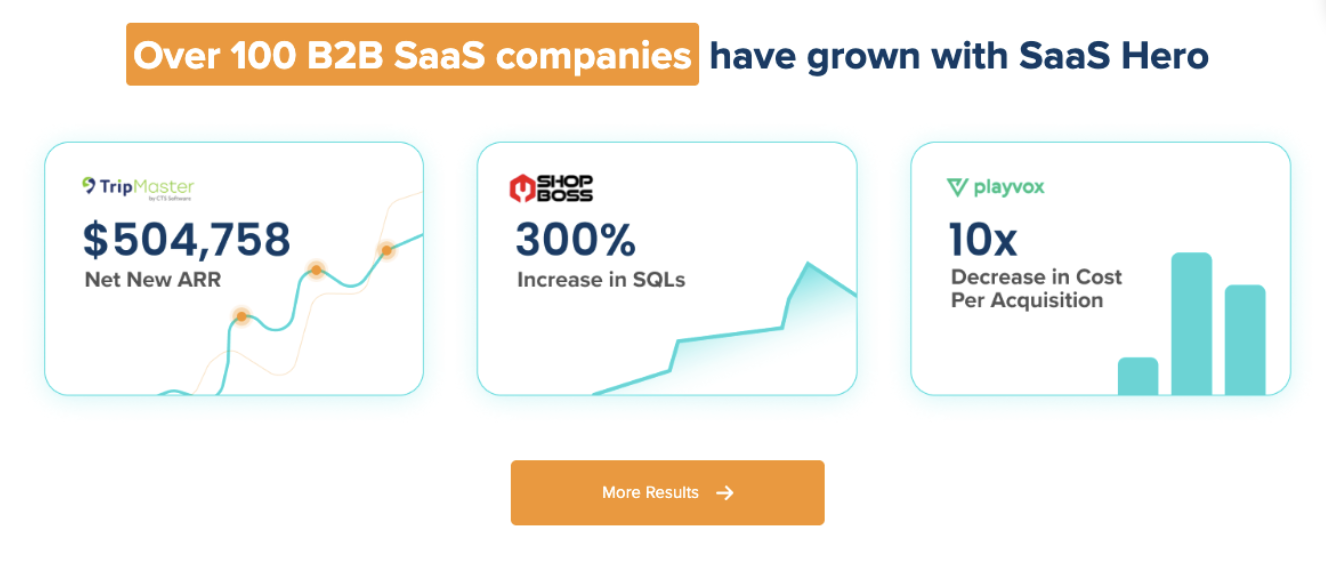
SaaSHero stands out among flat-fee B2B SaaS marketing agencies for three reasons. First, its channel-agnostic fee structure removes the financial barrier to testing and reallocation. Second, its team owns the full acquisition chain from ad to CRM record, including landing page design, build, and testing. Third, its measurement layer connects campaigns to qualified pipeline and closed revenue instead of raw lead volume. With 100+ B2B companies served, a verified $60M+ in lifetime ad spend managed, Google Premier Partner status, and a G2 ranking of #20 out of approximately 6,000 agencies, the firm’s track record is clear.
Teams ready to find a flat-fee partner that owns inbound growth can book a discovery call with SaaSHero today.