




Written by: Aaron Rovner, Founder, Saas Hero | Last updated: August 8, 2026
Key Takeaways
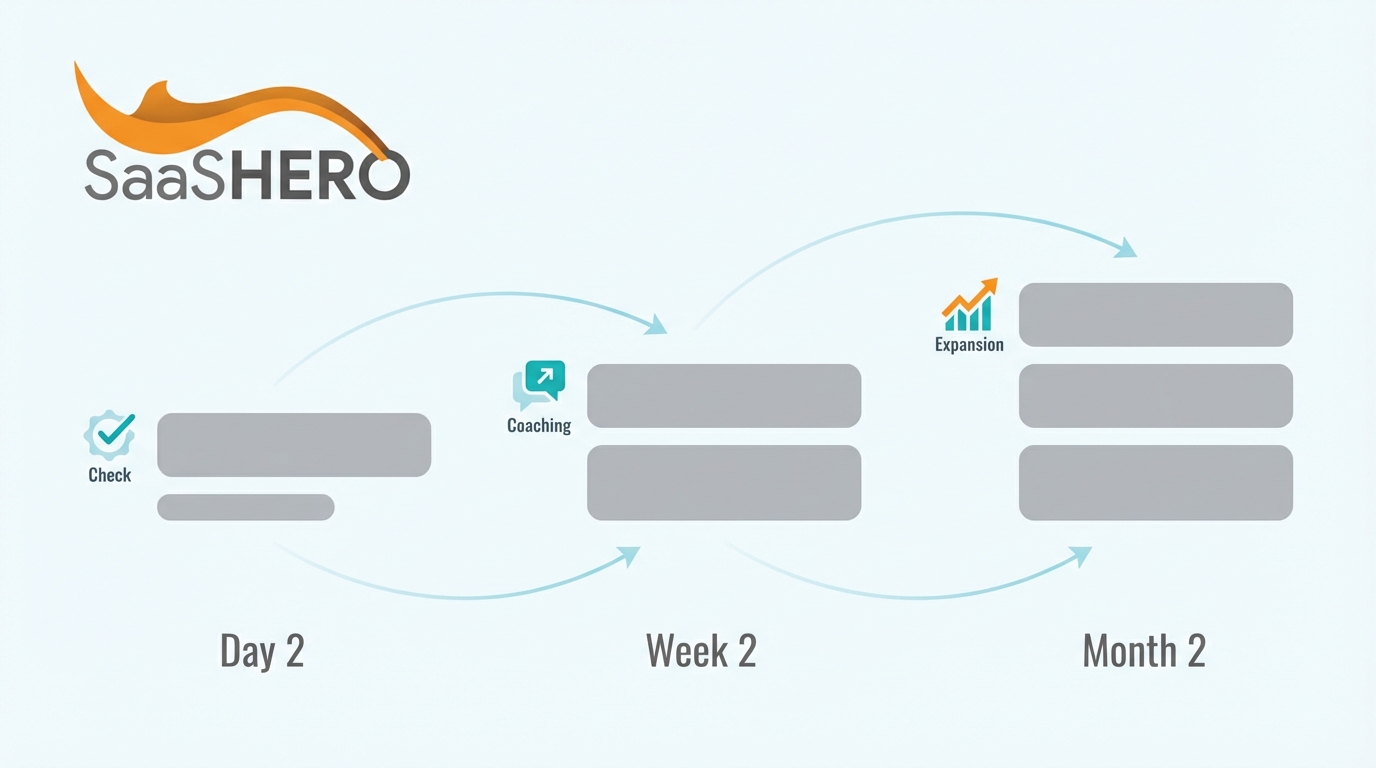
- The 2-2-2 rule schedules three touchpoints at 2 days, 2 weeks, and 2 months after a discovery call or purchase to match buyer psychology and prevent churn.
- Day 2 focuses on onboarding confirmation and fast friction removal, which cuts early churn by speeding up time-to-first-value.
- Week 2 surfaces usage gaps and expansion signals, guiding customers to value milestones that reduce 30-day churn by 50–70%.
- Month 2 shifts to ROI review and upsell conversations, improving Net Revenue Retention through structured renewal outreach.
- Book a discovery call with SaaSHero to embed these timed sequences and Slack alerts directly into your HubSpot workflows.
Day 2 Touchpoint: Onboarding Confirmation
The Day 2 touch lands while the initial interaction is still fresh in the customer’s mind. The core objective at this interval is to confirm what was agreed, restate the next step, and establish the timeline, whether that means confirming a prospect’s next internal review or verifying that a new customer’s onboarding is proceeding without friction.
For retention teams, the Day 2 check-in confirms the customer received the product or that onboarding is proceeding smoothly, demonstrating immediate care. This matters because 60-70% of annual SaaS churn occurs in the first 90 days of the customer lifecycle, and customers who reach time-to-first-value in under seven days experience 30–50% lower 90-day churn rates. A Day 2 touch accelerates that time-to-value clock.
A churn-risk signal also appears in this interval. When customer success teams act on an executive sponsor change signal within the first 48 hours, the customer is 33% more likely to renew. Day 2 is the window to detect and respond to that signal.
Copy-paste email — Day 2 (Retention):
Subject: Quick check-in, your onboarding status
Hi [Name], I wanted to confirm your team is set up and moving through onboarding. Based on your target of [specific metric, e.g., “reducing manual reporting time by 40%”], I want to make sure you hit your first milestone this week. Any blockers I can clear? — [Your Name]
Copy-paste call script — Day 2 (Retention):
“Hi [Name], this is [Your Name] from [Company]. I’m calling to confirm your onboarding is on track and that you’re set up to hit [metric] within the first week. Do you have two minutes to confirm the setup is complete?”
Week 2 Touchpoint: Usage and Expansion Signal
Once the Day 2 onboarding confirmation is complete, the next critical window opens at the two-week mark. By Week 2, a new customer has had enough time to form an initial opinion of the product. At the two-week mark, teams request feedback or a product review once the customer has had time to settle in. For customer success teams with access to product usage data, this touch is also the first legitimate expansion conversation.
B2B SaaS companies that guide customers to value milestones within the first 30 days achieve 50–70% lower early churn rates. The Week 2 touch is the midpoint check that keeps that trajectory on course.
Copy-paste email — Week 2 (Retention):
Subject: Two weeks in, how is [metric] tracking?
Hi [Name], it has been two weeks since you went live. I pulled your usage data and noticed [specific observation, e.g., “your team has logged in daily but hasn’t activated the reporting module yet”]. That module is where most teams see their biggest gains on [metric]. Can I set up a 20-minute walkthrough this week? — [Your Name]
Copy-paste call script — Week 2 (Retention):
“Hi [Name], I’m following up on your usage data. You’re tracking well on [metric], and I want to flag one feature your team hasn’t activated yet that typically moves that number by [X%]. Do you have 15 minutes this week to walk through it?”
Month 2 Touchpoint: Expansion and Payback Period
The Month 2 touch is the expansion conversation. By this point, a customer has enough experience to evaluate ROI, and the payback period narrative becomes relevant. A renewed B2B SaaS customer’s expansion contributes additional ARR over their lifetime, and improvement in Net Revenue Retention can be more valuable than equivalent new logo growth at scale.
At the two-month mark, teams reach out to nurture the ongoing relationship, propose an upsell, or request a referral. This moment also works well for QBR framing. Mid-market B2B SaaS companies running proactive QBRs before renewal can reduce churn and increase upsell rates.
Copy-paste email — Month 2 (Retention):
Subject: Your 60-day ROI snapshot
Hi [Name], you are now 60 days in. Based on [metric, e.g., “the 120 hours of manual work your team has eliminated”], your payback period is tracking ahead of the benchmark for companies your size. I’d like to share a 60-day report and discuss whether expanding to [additional module or seats] makes sense for Q[X]. When works for a 30-minute call? — [Your Name]
Copy-paste call script — Month 2 (Retention):
“Hi [Name], I’m calling with your 60-day ROI snapshot. You’ve hit [metric], which puts your payback period at [X] days, ahead of the median for your segment. I want to walk you through an expansion option that would accelerate that further. Do you have 30 minutes this week?”
The 2-2-2 Prospecting Variant
The same 2-2-2 template applies to proposals, demos, and discovery calls, not just post-purchase retention. In the prospecting variant, the triggering event is the first discovery call rather than a purchase, and the messaging shifts from onboarding confirmation to deal progression.
The Brevet Group reports that 80% of sales require five follow-ups after the initial meeting, while 44% of salespeople give up after just one follow-up attempt. The 2-2-2 prospecting cadence directly addresses that gap.
| Dimension | Retention Variant | Prospecting Variant |
|---|---|---|
| Trigger event | Product purchase / go-live | Discovery call / demo |
| Day 2 goal | Confirm onboarding is on track | Recap call, confirm next steps |
| Week 2 goal | Usage check, surface expansion signal | Deliver case study, ask one specific question |
| Month 2 goal | ROI review, upsell or referral ask | Reference stated timeline, send close-the-loop email if silent |
| Primary metric | Churn rate, NRR, expansion ARR | Reply rate, pipeline velocity, closed-won rate |
Choosing Between 2-2-2 and 3-3-3 for Your Sales Cycle
The 3-3-3 rule spaces follow-ups at 3 days, 3 weeks, and 3 months and is positioned for enterprise deals, multi-stakeholder buying committees, or quarterly budget cycles. The 3-3-3 rule is also interpreted as a minimal viable cadence recommending at least 3 touchpoints across 3 different channels spaced roughly 3 days apart, a structurally different definition that applies to cold outreach rather than warm follow-up.
| Dimension | 2-2-2 Rule | 3-3-3 Rule (Time-Based) | 3-3-3 Rule (Channel-Based) |
|---|---|---|---|
| Touch intervals | 2 days, 2 weeks, 2 months | 3 days, 3 weeks, 3 months | 3 touches, 3 channels, ~3 days apart |
| Best fit | Warm/inbound leads; post-purchase retention | Enterprise, multi-stakeholder, quarterly budget cycles | Cold outreach requiring fast multi-channel presence |
| Total cadence span | ~2 months | ~3 months | ~1 week |
| Risk if misapplied | Too compressed for slow enterprise cycles | Too slow for warm leads already in decision mode | Too aggressive for established relationships |
Practitioners select 2-2-2 for warmer leads and longer B2B sales cycles while choosing the channel-based 3-3-3 for colder prospecting. Neither cadence is fixed. Both serve as scaffolding that should be decided and scheduled before ending the initial meeting.
SaaS Retention Metrics Impact Table
| 2-2-2 Touch | Primary Metric Affected | Expected Lift (Cited Benchmark) | Source |
|---|---|---|---|
| Day 2 — Onboarding confirmation | Early churn (0–90 days) | Lower churn rates with faster time-to-first-value | Retention research |
| Week 2 — Usage check | 30-day churn rate | 50–70% lower early churn when value milestones are hit within 30 days | B2B SaaS churn prevention benchmarks |
| Month 2 — ROI and expansion | Annual gross revenue retention | Improved GRR with structured renewal outreach before renewal | Retention reports |
| All three touches combined | Net Revenue Retention | Improved NRR after adopting proactive health-scoring workflows with regular touchpoints | B2B SaaS case data |
Automation Layer: HubSpot Sequences and Slack Alerts
The 2-2-2 cadence is most reliably implemented as a standard automated drip workflow triggered at a defined pipeline stage, ensuring consistent follow-up without manual effort. In HubSpot Sales Hub, this means three sequence steps enrolled at deal close or contact creation, with delays set to 2 days, 14 days, and 60 days respectively.
HubSpot Sales Hub sequences automatically pause when a prospect replies to any email in the sequence, books a meeting through a calendar link, or completes another defined goal action. This behavior prevents over-communication when a contact re-engages.
SaaSHero’s embedded growth model layers Slack alerts on top of this automation. When a contact reaches the Week 2 or Month 2 step without engaging, a Slack notification fires to the assigned CSM or AE with the contact’s usage data and a one-click link to the next sequence step. This setup removes the manual monitoring burden that causes many 2-2-2 cadences to collapse in practice.
Teams using signal-triggered cadences achieve higher reply rates compared to generic sequences lacking signals. Embedding behavioral triggers, such as a contact reopening a proposal or logging into the product after a period of inactivity, into the 2-2-2 timing framework closes that gap.
Implementation Checklist for the 2-2-2 Rule
This checklist covers the minimum viable setup for operationalizing the 2-2-2 rule in a B2B SaaS CRM environment.
- CRM fields: Create custom contact properties for “2-2-2 Trigger Date,” “2-2-2 Variant” (Retention or Prospecting), and “Last 2-2-2 Touch Completed” to enable reporting and sequence enrollment logic.
- Enrollment triggers: Set the retention variant to enroll on deal stage “Closed Won.” Set the prospecting variant to enroll on meeting outcome “Discovery Call Completed.”
- Sequence delays: Configure Step 1 at +2 business days, Step 2 at +14 calendar days, and Step 3 at +60 calendar days from the enrollment date.
- Unenrollment rules: Auto-unenroll on reply, meeting booked, or deal stage advancement to prevent duplicate outreach.
- Slack alert logic: Trigger a Slack notification to the contact owner when any sequence step reaches “No Response” status after 48 hours, including a direct link to the contact record and the next recommended action.
- Paid-media integration (if applicable): If your Week 2 or Month 2 emails reference case studies or ROI calculators hosted on landing pages, ensure those pages match the email message. Align the headline to the value proposition in the email, and align the CTA to the cadence stage, such as a demo request for prospecting or an expansion call for retention. Apply negative keyword hygiene to exclude navigational brand searches from competitor-intent campaigns so you avoid wasting spend on users looking for a login page rather than evaluating alternatives.
- Reporting dashboard: Build a HubSpot report tracking reply rate, meeting booked rate, and pipeline influenced by each of the three sequence steps to identify which interval drives the most revenue impact.
Conclusion: Turning 2-2-2 into a Repeatable Revenue Motion
The 2-2-2 rule is a simple framework. Its power comes from discipline: three deliberate touches, timed to match how buyers and customers make decisions, executed consistently across every contact in the pipeline. Harvard Business Review states that acquiring a new customer is anywhere from five to 25 times more expensive than retaining an existing one, which means the retention variant of this cadence is not a nice-to-have. It is the highest-ROI motion in a SaaS revenue stack.
The operational failure point for many teams is not strategy. It is execution. Manual follow-up tracking breaks down at scale, sequence enrollment lapses during busy quarters, and Slack alerts never get configured. SaaSHero removes that burden entirely. As a flat-fee, month-to-month embedded growth partner, SaaSHero builds the HubSpot sequences, configures the Slack alert layer, aligns the paid-media campaigns to the cadence intervals, and reports on Net New ARR, not impressions or clicks.
Frequently Asked Questions
What is the 2-2-2 rule in sales, and does it apply to both new prospects and existing customers?
The 2-2-2 rule in sales is a follow-up cadence that schedules three touchpoints at 2 days, 2 weeks, and 2 months after a triggering event. It has two distinct variants. The prospecting variant triggers after a discovery call or demo and is designed to progress a deal through the pipeline by recapping the meeting, delivering a value asset, and re-engaging at the prospect’s stated decision timeline. The retention variant triggers after a product purchase and is designed to confirm onboarding, surface usage gaps, and open an expansion conversation before the renewal window. Both variants use the same timing intervals but differ in messaging, metrics, and the CRM stage that triggers enrollment. B2B SaaS revenue teams benefit from running both variants simultaneously, one for pipeline and one for the installed base.
How does the 2-2-2 rule differ from the 3-3-3 rule in sales?
The 2-2-2 rule and the 3-3-3 rule address different sales scenarios. The 2-2-2 rule fits warm or inbound leads and post-purchase customer relationships, where the contact has already expressed interest or made a purchase decision. Its two-month total span gives slower-moving B2B buyers enough breathing room without losing the thread. The 3-3-3 rule exists in two interpretations. A time-based version spaces touches at 3 days, 3 weeks, and 3 months and suits enterprise deals with multi-stakeholder buying committees or quarterly budget cycles. A channel-based version recommends 3 touches across 3 different channels spaced roughly 3 days apart and suits cold outreach that requires fast multi-channel presence. The practical decision rule is straightforward: use 2-2-2 for warm contacts and retention, use the time-based 3-3-3 for complex enterprise cycles, and use the channel-based 3-3-3 for cold prospecting sequences where speed of presence matters more than cadence length.
What CRM tools are best for automating the 2-2-2 cadence in a B2B SaaS environment?
HubSpot Sales Hub is the most practical tool for B2B SaaS teams already using HubSpot Marketing, because its native sequences feature supports automatic enrollment based on deal stage changes, automatic unenrollment on reply or meeting booked, and delay steps that map directly to the 2-day, 14-day, and 60-day intervals of the 2-2-2 rule. For teams on Salesforce, Sales Engagement supports automated cadence enrollment triggered by record creation or field updates, with preconfigured actions for adding contacts to cadences when deals are won or lost. GoHighLevel implements the 2-2-2 rule as a standard post-close drip workflow applied to every contact that reaches the “Closed — Client” pipeline stage. Regardless of the tool, the critical automation rules are to enroll on a defined trigger event, unenroll immediately on engagement, and fire a Slack or internal notification when a step reaches “No Response” status so a human can intervene before the window closes.
What SaaS metrics does the 2-2-2 rule most directly improve?
The 2-2-2 retention cadence most directly affects early churn rate (0–90 days), annual gross revenue retention, and Net Revenue Retention. The Day 2 touch accelerates time-to-first-value, which is the single strongest predictor of early churn. The Week 2 touch surfaces usage gaps before they become cancellation reasons and opens the first legitimate expansion conversation. The Month 2 touch aligns with the 60-day mark that ProfitWell’s 2024 Retention Report identifies as the threshold at which structured renewal outreach produces 8–12 percentage points of additional gross revenue retention. For the prospecting variant, the primary metrics are reply rate, meeting booked rate, and pipeline velocity. Signal-triggered cadences that incorporate behavioral data, such as a prospect reopening a proposal or a customer logging in after inactivity, consistently outperform fixed-interval cadences on all of these metrics.
How does SaaSHero embed the 2-2-2 rule into paid-media campaigns?
SaaSHero connects the 2-2-2 cadence to paid media by aligning landing page messaging to the specific cadence stage a contact is in. A prospect receiving the Week 2 email who clicks through to a paid retargeting ad sees a landing page that matches the case study or value asset referenced in the email, not a generic homepage. For the retention variant, Month 2 expansion emails reference the same ROI metrics that appear in retargeting ads served to the customer’s account domain. On the operational side, SaaSHero configures HubSpot sequences for each cadence step, sets up Slack alerts for non-responders at each interval, and applies negative keyword hygiene to paid campaigns running alongside the cadence to prevent budget waste on navigational searches. All reporting is anchored to Net New ARR and pipeline influenced rather than impressions or clicks, so every touchpoint in the cadence is evaluated on its contribution to closed revenue.