




Written by: Aaron Rovner, Founder, Saas Hero | Last updated: July 25, 2026
Key Takeaways for B2B SaaS Backlink Tools
- Backlink programs that prioritize referring-domain quality and competitor gap analysis outperform raw link volume, with roughly 20% of links typically driving ARR.
- Review-site and directory placements deliver higher-intent traffic and faster conversion impact than general authority links for B2B SaaS buyers.
- Ahrefs excels at referring-domain accuracy and Link Intersect, while Semrush leads in multi-competitor gap analysis and toxicity management, so tool choice should match primary workflow needs.
- Teams should progress through four maturity stages, from GSC baseline checks to revenue attribution, while maintaining a minimal, budget-appropriate tool stack at each growth stage.
- See how SaaSHero translates backlink strategy into Net New ARR for your B2B SaaS marketing team.
Executive Summary: Core Terms and the Seven-Step SaaS Backlink Workflow
Four terms anchor every decision in this guide:
- Referring domains: The count of unique root domains sending at least one link to a target site. Search engines evaluate link diversity more than link volume alone, so ten links from one domain still count as a single referring domain.
- Backlink gap: The difference between a site's current referring domain count and the median or weakest page-one competitor's count. This gap is the acquisition target that drives realistic monthly planning.
- Link intersect: Domains that link to two or more competitors but not to the target site. These are pre-qualified outreach targets that have already demonstrated willingness to link within the category.
- Net New ARR: Closed-won annual recurring revenue from new customers, the metric that separates revenue-focused backlink programs from vanity-metric programs.
The seven-step SaaS backlink workflow that structures this guide is:
- Establish a Google Search Console baseline for verified referring domain data.
- Pull competitor backlink profiles across three to ten rivals in Ahrefs or Semrush.
- Calculate the referring-domain gap between your site and the median page-one competitor.
- Run a link intersect to surface high-probability outreach targets.
- Apply quality filters: topical relevance, real organic traffic, editorial placement, and follow status.
- Execute targeted outreach that prioritizes review sites, integration directories, and comparison pages.
- Monitor new and lost referring domains weekly and tie spikes and drops to specific PR campaigns.
Where B2B SaaS Buyers Research and Which Links Move Pipeline
G2's 2024 Buyer Behavior Report shows that 31% of buyers consult review sites more often than other sources, which makes citations on G2 and TrustRadius critical for validation-stage links. G2 serves over 80 million business buyers annually.
Directory and review-site links influence both authority and conversion. AI referral traffic conversion rates average 3–5x higher than organic search traffic, according to multiple 2025–2026 studies. Software comparison and alternative pages delivered the highest conversion rates in XSquareSEO's analysis because they captured high-intent buyers actively evaluating solutions.
The AI search layer compresses the organic traffic window. AI Overviews have increased impressions while reducing organic CTR, with reported drops ranging from 18.7% to 61% depending on the study and query set. A study analyzing citations across ChatGPT, Claude, Perplexity, and Gemini found varying use of different content types. Teams that earn placements on high-authority listicles and review platforms capture both traditional organic clicks and AI citation visibility. To identify and monitor these high-value placements consistently, teams need tools that surface competitor gaps and track link performance.
In directory submission programs for a B2B SaaS company, a few key directories accounted for the majority of referral traffic, ranking gains, and sales-qualified leads. Prioritizing directories by referral traffic potential and topical fit outperforms sorting by domain rating alone.
Key Tool Decisions: Ahrefs, Semrush, Referring Domains, and Lost-Link Alerts
The Ahrefs versus Semrush decision is the most common tool choice for B2B SaaS teams, and the answer depends on primary workflow need rather than overall quality.
| Decision Point | Ahrefs Advantage | Semrush Advantage | Revenue Implication |
|---|---|---|---|
| Referring domain accuracy | Most accurate referring domain count, best for Link Intersect against multiple competitors | Found more total backlinks than Ahrefs for 87% of sites in Xamsor's 107-site test | Ahrefs gap analysis sets more precise acquisition targets, while Semrush surfaces more raw prospects. |
| Competitor gap analysis | Link Intersect identifies domains linking to competitors but not to your site | Backlink Gap compares up to five competitors simultaneously with an intuitive side-by-side view | Multi-competitor gap analysis directly feeds review-site conquest and comparison-page targeting. |
| Lost-link monitoring | Near real-time 15-minute refresh cycles, with alerts on link appearance, disappearance, or breakage | Link Monitoring Dashboard tracks active, broken, lost, and rejected backlinks with alerts on lost placements | Faster lost-link recovery protects PR campaign ROI and prevents ranking drops from deleted placements. |
| Toxic link management | Standard disavow export | Backlink Audit applies 45+ toxicity markers per link and integrates directly with Google Search Console for disavow export | Systematic toxic link removal protects domain authority and reduces risk of algorithmic penalties. |
A March 2026 analysis of 420 SaaS websites found a positive correlation between referring domains and organic traffic, with sites that had more referring domains achieving substantially higher median monthly traffic. Raw backlink count remains a secondary metric, while referring domains serve as the core planning unit.
For lost-link monitoring tied to PR campaigns, SE Ranking lets users import existing backlinks directly from Google Search Console, after which its crawler performs periodic checks and sends email alerts when a backlink is removed, becomes a 404, or changes to nofollow. Google Search Console itself provides only a high-level snapshot and does not offer comprehensive alerts, detailed link quality metrics, or campaign-level monitoring. GSC functions as the mandatory free baseline, and a paid tool is required for actionable lost-link response.
See how SaaSHero structures these tools into a revenue-focused workflow that targets Net New ARR for your team.

Tool Stacks by Team Size and 2026 Budget Recommendations
Tool selection should follow workflow volume and team size. Teams at early growth stages should begin with a minimal two-tool stack and add specialized tools only when workflow volume increases, avoiding the common mistake of subscribing to six to eight unused tools that inflate costs without improving results.
| Growth Stage | Monthly Tool Budget | Recommended Stack | Primary Use Case |
|---|---|---|---|
| Pre-Series A / Founder-led | ~$200/mo | Ahrefs Lite ($129/mo) + Backlynk Starter ($29/mo) + Hunter.io Free | Competitor gap identification, directory submissions, and manual outreach |
| Series A / Growth-stage | ~$600/mo | Ahrefs Standard ($249/mo) + BuzzStream Growth ($124/mo) + Backlynk Growth ($79/mo) + Hunter.io Starter ($49/mo) | Full competitor analysis, outreach CRM, directory monitoring, and email verification |
| Series B–C / Scale-up | $1,000–$1,500/mo | Semrush Business ($499.95/mo) + Pitchbox Professional ($428/mo) + Backlynk Scale ($149/mo) + Majestic Pro ($99.99/mo) | Multi-client or multi-product competitive intelligence, high-volume outreach, and trust quality due diligence |
Emerging practices in 2026 include competitor conquesting via comparison-page link targeting, GSC integration as the ground-truth baseline layered beneath paid tools, and submitting to 40–60 quality directories to increase Domain Rating by 10–20 points within 60 days. Prioritizing directories by referral traffic potential (45% weight) and topical fit (40% weight) outperforms sorting by Domain Rating (15% weight) for B2B SaaS outcomes.
Backlink Maturity Model: From GSC Checks to Revenue Attribution
B2B SaaS teams advance through four recognizable stages of backlink program maturity, which align with the seven-step workflow.
- Stage 1 — GSC Baseline: The team uses Google Search Console's Links report to monitor top linking sites and top-linked pages. GSC provides the highest data accuracy from Google itself but is limited by a 1,000-row export cap, no domain authority metrics, and no built-in alerts. This stage is necessary but insufficient for competitive SaaS categories.
- Stage 2 — Single-Competitor Monitoring: The team adds a paid tool (Ahrefs Lite or SE Ranking) to track new and lost referring domains weekly and benchmark against one primary competitor. Lost-link alerts are configured for PR placements.
- Stage 3 — Multi-Competitor Gap Analysis: The team runs Link Intersect or Backlink Gap across three to five competitors, identifies review-site and directory gaps, and builds a prioritized outreach list filtered by topical relevance and referral traffic potential. This stage targets the 200–1,000 referring domain benchmark mentioned earlier for competitive SaaS keywords.
- Stage 4 — Revenue Attribution: The team tracks trial-to-paid conversion rate, CAC, and average contract value by referral source. Comparison page traffic converted at higher rates than directories in some analyses. Backlink strategy is adjusted quarterly based on which source types drive the highest Net New ARR.
Common Pitfalls and Diagnostic Questions for SaaS Teams
Three pitfalls account for the majority of wasted backlink budget in B2B SaaS.
- Optimizing for total backlink count instead of referring domains. Ten links from one site still count as a single referring domain in Google's evaluation, which means teams that track total link count focus on the wrong metric. Diagnostic question: Does your monthly reporting lead with referring domain growth or total link count?
- Ignoring review-site and directory gap analysis. Most B2B SaaS companies build 80% of their links from Tier 3 sources because those are easiest to acquire, leaving the highest-impact Tier 1 and Tier 2 sources untouched. Diagnostic question: When did your team last audit which review platforms your top three competitors appear on that you do not?
- No lost-link monitoring for PR placements. A guest post or earned media placement that loses its link within 60 days delivers zero sustained ranking benefit. Diagnostic question: Does your team receive an alert within 24 hours when a placed link disappears?
Three Team Archetypes and Their Tool-Selection Decisions
The Overwhelmed Founder. This founder runs a SaaS at $500K–$1M ARR with a team of five and has no dedicated SEO resource. The right entry point is the Pre-Series A stack detailed earlier, with Ahrefs Lite paired with Google Search Console as the free baseline and minimal outreach tools. The workflow focuses on identifying the top five competitor referring domains not yet linking to the founder's site and targeting those domains with a single outreach sequence.
The Frustrated VP of Marketing. This VP works at a Series B company spending $30K–$50K per month on paid media and faces board pressure to prove organic contribution to pipeline. The current agency reports on impressions and clicks, which do not connect clearly to revenue. To shift the conversation from vanity metrics to pipeline influence, the right move is upgrading to Ahrefs Standard for full lost-link alerts and multi-competitor Link Intersect, integrating SE Ranking's GSC import for daily crawl checks, and establishing a quarterly review cadence that reports referring-domain growth alongside pipeline-influenced opportunities.
The Post-Funding Scaler. This marketing lead has fresh Series A or B funding and aggressive Q1 growth targets and needs to move fast. The priority is running a Semrush Backlink Gap analysis across five competitors, identifying review-site gaps on G2 and Capterra, and building comparison pages that capture high-intent buyers. Integration partner directories become a high-priority target for any scaler with existing integration partners in XSquareSEO's tracking.
Identify your team archetype and get a custom execution plan in a discovery session with SaaSHero.

Frequently Asked Questions
How much should a B2B SaaS company budget for backlink analysis tools at each growth stage?
Early-stage teams (pre-Series A) can run an effective backlink analysis workflow for approximately $200 per month using Ahrefs Lite, a directory submission tool, and a free email finder. Series A teams typically need $500–$700 per month to add an outreach CRM and upgrade to Ahrefs Standard for full lost-link alerts and competitor analysis. Series B and beyond generally require $1,000–$1,500 per month for multi-competitor intelligence, high-volume outreach automation, and trust-quality due diligence tools like Majestic. The key principle at every stage is to select one strong tool per workflow category, such as research, outreach, monitoring, and submission, rather than subscribing to overlapping tools in the same category.
Who should own the backlink analysis workflow inside a B2B SaaS marketing team?
Ownership depends on team size. At founder-led companies, the founder or a generalist marketer typically owns the workflow with a minimal tool stack. At Series A, a dedicated content or SEO manager should own the weekly referring-domain review and lost-link monitoring, with the VP of Marketing reviewing the quarterly gap analysis against competitors. At Series B and beyond, a dedicated SEO or growth lead should own the full seven-step workflow, with results reported to the VP in terms of referring-domain growth, review-site gap closure, and pipeline-influenced opportunities rather than raw link counts. When no internal owner exists, an agency partner embedded in the team's communication channels, such as Slack and weekly calls, is more effective than a black-box vendor relationship.
How long does it take for backlink analysis and link building to show pipeline impact?
Most SaaS link building campaigns begin showing ranking movement in two to three months, with meaningful organic traffic growth typically occurring over three to six months. Pipeline impact usually lags by one to two buyer cycles after initial referring domains and clicks appear on shortlisting queries. Review-site and comparison-page placements tend to show faster conversion impact than general authority links because they intercept buyers at the validation and decision stage rather than the awareness stage. Teams that track trial-to-paid conversion rate by referral source see the clearest signal of pipeline impact, often within one quarter of executing a structured gap-closure program.
Is Google Search Console sufficient for backlink monitoring, or does a paid tool add meaningful value?
Google Search Console serves as the mandatory free baseline for any backlink program because it provides the highest data accuracy directly from Google. However, it remains insufficient as a standalone monitoring tool. GSC exports are capped at 1,000 rows, provide no domain authority or spam score metrics, offer no competitor analysis, and send no alerts when links are lost. A paid tool adds real-time or daily lost-link alerts, competitor gap analysis, topical relevance scoring, and the ability to attribute specific link gains or losses to PR campaigns. The recommended setup uses GSC as the ground-truth baseline layered beneath a paid suite for competitor intelligence and monitoring depth.
What metrics should B2B SaaS teams use to measure whether backlinks are contributing to Net New ARR?
The primary metrics are trial-to-paid conversion rate by referral source, customer acquisition cost by source, and average contract value by referral source. Secondary metrics include referring-domain growth rate, measured as new versus lost domains per month, keyword position movement on commercial and comparison terms, and link-influenced pipeline value tracked in the CRM. Vanity metrics to deprioritize include total backlink count, domain authority as a standalone figure, and referral session volume without conversion context. Teams at Stage 4 maturity connect Ahrefs or Semrush referring-domain data to HubSpot or Salesforce opportunity records, which enables quarterly reporting on which link source types produce the lowest CAC and highest ACV.
Conclusion: Turning the Workflow into Net New ARR
The seven-step SaaS backlink workflow of GSC baseline, competitor profile pull, referring-domain gap calculation, link intersect, quality filtering, targeted outreach, and weekly monitoring serves as the operational framework that separates revenue-generating backlink programs from vanity-metric exercises. The tool decisions that matter most are Ahrefs for referring-domain accuracy and Link Intersect, Semrush for multi-competitor Backlink Gap and toxicity management, SE Ranking or Linkody for budget-conscious lost-link alerts, and Google Search Console as the non-negotiable free baseline beneath every paid layer.
The revenue case is clear. Sites with more referring domains achieve higher median monthly traffic. Fifty strategic, high-quality backlinks from relevant sources can drive more ARR than 500 low-quality directory or forum links. Approximately 69% of URLs appearing in Google AI Overviews rank in the top 100 organic results, with 38% in the top 10 and 31% in positions 11–100, and both ranges require the domain authority that quality backlinks build.
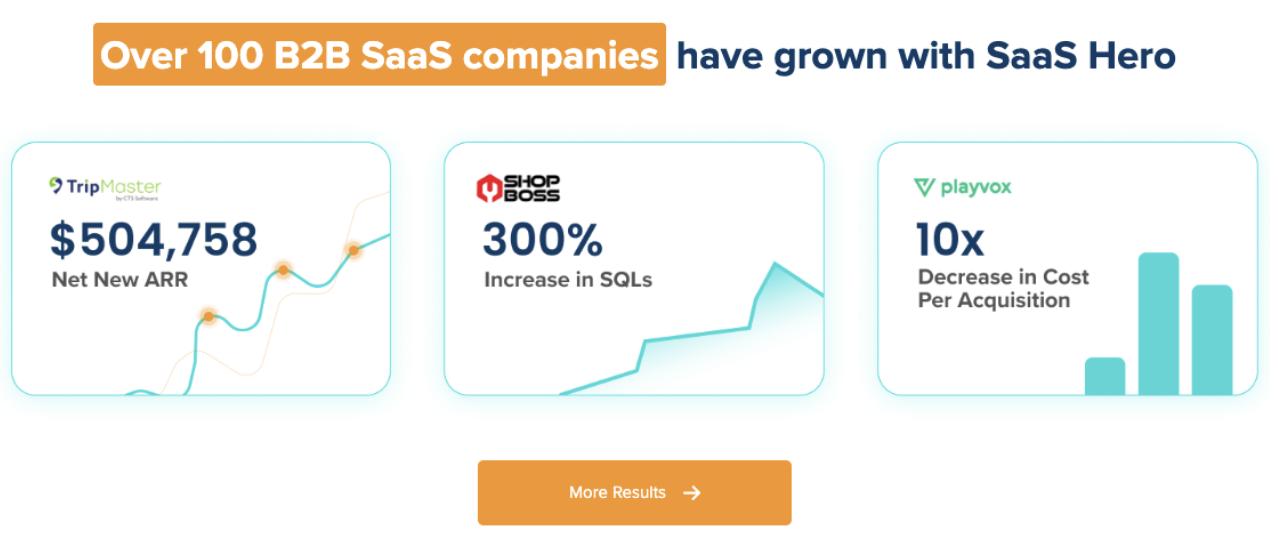
SaaSHero builds and executes this workflow as an embedded growth team, not a black-box vendor. The agency reports on Net New ARR, pipeline value, and referring-domain growth, not impressions or raw link counts. Every engagement runs month-to-month, with no percentage-of-spend billing and no 12-month lock-in. The agency has helped clients add $504,758 in Net New ARR in a single year (TripMaster), achieve an 80-day payback period that supported a $70M Series A raise (TestGorilla), and reduce cost per lead by 10x (Playvox).
Map your backlink maturity stage and build a workflow that converts referring domains into Net New ARR with SaaSHero.