




Written by: Aaron Rovner, Founder, Saas Hero | Last updated: August 31, 2026
Key Takeaways
- B2B retargeting recovers the vast majority of visitors who do not convert on the first visit by segmenting audiences by funnel stage and matching ad creative to buyer intent.
- Most campaigns fail because they treat every visitor the same, chase form fills instead of CRM pipeline, and ignore frequency caps that prevent ad fatigue.
- Effective retargeting uses three core segments, awareness, consideration, and decision, each with stage-specific messaging, creative rotation, and CRM-connected measurement.
- Platform-specific tactics on LinkedIn, Google, and Meta, combined with multi-touch attribution and pipeline-influence metrics, turn retargeting from a budget drain into a revenue driver.
- Ready to build CRM-connected retargeting segments that actually move pipeline? Start with a free consultation.
Why Most B2B Retargeting Campaigns Fail
Only 2% of website traffic converts on the first visit, which leaves 98% of prospects in awareness or consideration stages. Retargeting exists to recover that 98%, yet most B2B programs become the most wasteful line in the paid media budget.
The failure is structural. Most campaigns treat every visitor as a single undifferentiated pool, so the blog reader and the pricing-page visitor see the same ad. The ad platform then optimizes toward whatever conversion event it has been given, usually a form fill, and faithfully finds more people who fill out forms instead of more people who buy.
Common structural failures include:
- No audience segmentation by funnel stage
- Generic ad creative that ignores the visitor’s prior action
- No frequency capping, which produces ad fatigue and brand damage
- Optimizing for clicks and form fills instead of CRM-qualified pipeline
- Last-click attribution that systematically undercounts retargeting’s contribution
Retargeting fails when it is treated as a media tactic. It succeeds when treated as a system with inputs, sequencing logic, and a feedback loop back to pipeline reporting. The fix is to treat retargeting as a revenue system: segment audiences by intent, design ads that match each stage, cap frequency deliberately, and measure everything against CRM outcomes.
Step 1: Build Funnel-Stage Retargeting Segments
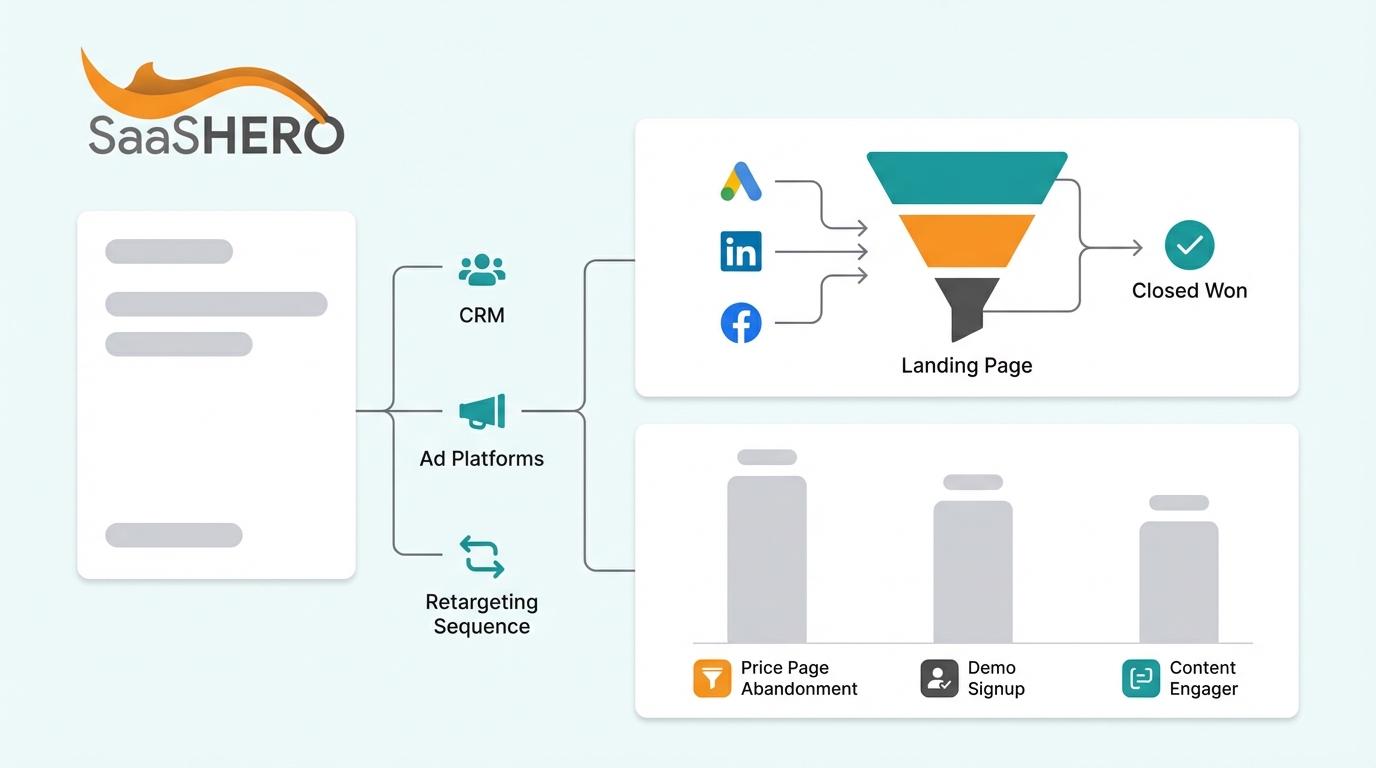
Audience segmentation forms the foundation of effective retargeting. Treating all visitors the same burns 80% of retargeting budget. A pricing-page visitor has fundamentally different intent than a blog reader, and showing them the same ad wastes spend and harms the prospect relationship.
Build at least three retargeting segments:
- Awareness: Site visitors, blog readers, video viewers. These prospects are learning about the problem and are not yet evaluating solutions. They need educational content and light-touch CTAs.
- Consideration: Pricing page visitors, case study downloads, webinar attendees. These prospects are actively evaluating. They need social proof, feature comparisons, and ROI evidence.
- Decision: Demo requests, free trial sign-ups, form abandoners. These prospects are ready to act. They need friction removal, direct CTAs, and urgency.
Pricing-page visitors are the highest-converting B2B retargeting segment almost universally and should receive a “speak to sales” offer. Homepage-only visitors usually show low intent, so retargeting spend works better on demonstrated-interest pages like pricing, demo, comparison, product detail, and case studies.
For B2B specifically, extend retargeting windows beyond the standard 30-day cookie. B2B sales cycles typically last six to nine months, so 90–180 day audience durations fit most segments. High-intent segments like pricing page visitors warrant shorter windows of 7–14 days for aggressive follow-up, while content readers can stay in nurture pools for 30–60 days.
Also build exclusion audiences from day one. For example, remove converted leads, active opportunities, existing customers, and visitors who bounced in under 10 seconds to avoid wasting spend on people who are unlikely to convert. Exclusion rules matter as much as inclusion rules, so review the exclusion list weekly rather than monthly.
Need help building CRM-connected retargeting segments? Book a discovery call with SaaSHero.
Step 2: Design Ads That Match Each Funnel Stage
Message matching is the single highest-impact ad design principle in retargeting. The ad should reflect what the prospect already did on your site and what they need to see next. Retargeting creative must reference the visitor’s prior action, reduce friction to the next step, and include social proof, because showing the same creative to all audiences wastes budget.
Apply these ad design principles by funnel stage:
- Awareness stage ads: Focus on problem recognition and education. Use static images or short videos of 15–30 seconds. Use CTAs like “Learn More” or “Read the Guide.” A simple copy formula is “Struggling with [pain point]? Learn how [solution category] can help.”
- Consideration stage ads: Showcase solutions, features, testimonials, and case studies. Use carousel ads or longer videos. Use CTAs like “See How It Works” or “Watch Demo.” A useful copy formula is “Saw our pricing page? Here is why 500+ companies chose us.”
- Decision stage ads: Offer social proof, ROI calculators, free trials, or direct demo booking. Use strong CTAs such as “Get Started” or “Book a Demo.” A helpful copy formula is “Still thinking? Let us answer your questions over email instead.”
Short-form video of 15–30 seconds consistently outperforms static images for B2B retargeting on Meta and YouTube. On LinkedIn, document and carousel ads outperform single-image ads. On Google Display, animated HTML5 ads outperform static images.
The critical rule is simple: your ad creative must reference the visitor’s prior action. “Saw our pricing page?” performs dramatically better than a generic brand ad because it acknowledges the prospect’s context and reduces friction to the next step. Equally important is visual consistency. If your ad promises a demo, the landing page headline must repeat that promise. A mismatch between ad and landing page destroys the trust your retargeting sequence built. Headline copy is the most impactful lever on landing page conversion, and SaaSHero’s own testing confirms this across client accounts.
Step 3: Control Frequency and Refresh Creative
Ad fatigue quietly kills retargeting performance. Ad clicks decrease by roughly 50% after the first week, and retargeting ads see a 2x drop in CTR after just 5 days of exposure. Ad fatigue is associated with a roughly 35% decrease in CTR paired with a 20% increase in CPC.
Set frequency caps by funnel stage to balance visibility with ad fatigue:
- Awareness: 3–5 impressions per user per day
- Consideration: 2–3 impressions per user per day
- Decision: 1–2 impressions per user per day
For B2B specifically, cap display retargeting at 3–5 impressions per user per week, because professional audiences are more sensitive to overexposure than B2C consumers. LinkedIn’s own guidance suggests 8–12 impressions per person per month for pricing page visitors and 4–6 for general website visitors.
Creative rotation matters just as much as frequency. Rotate creative every 2–3 weeks and maintain a backlog of 20–30 creative variants per audience segment. A creative refresh every 2–3 weeks prevents the performance decay that comes from static campaigns.
Implement a burn rule to protect budget. Any account that has seen 10 impressions with zero engagement in 30 days gets pulled from the active retargeting list, because continuing to spend on unresponsive accounts is a sunk cost.
Step 4: Apply Platform-Specific Retargeting Tactics
Each retargeting platform has unique requirements and strengths, so your approach should reflect those differences.
LinkedIn is the highest-quality B2B retargeting channel and also the most expensive. LinkedIn requires a minimum of 300 matched members for any retargeting audience to be eligible for delivery, which typically takes 60–90 days of website traffic to accumulate for B2B SaaS accounts. Use Matched Audiences for website retargeting and account-based lists. Layer retargeting audiences with Company Lists to isolate engaged buyers at target accounts. LinkedIn retargeting campaigns achieve 2–3x higher CTR and 14–30% lower CPC than cold prospecting.
Google Ads supports RLSA, or Remarketing Lists for Search Ads, to adjust bids for past visitors. RLSA campaigns achieve up to 2x higher conversion rates than regular search campaigns. Google Ads will not serve ads to retargeting audiences with fewer than 100 active users. Use responsive display ads with multiple asset variations and combine them with Performance Max for broader reach.
Meta supports Custom Audiences from website and CRM data. Meta CPCs for B2B targeting typically run $1.50–$4.00, while LinkedIn’s run $8–$15+. This pricing makes Meta viable for awareness and consideration stages. Use the Conversions API to send CRM conversion data back to Meta. This is the single most powerful quality improvement mechanism available, raising Event Match Quality scores from 3.5–5.0 with pixel-only tracking to 7.5–9.0 with CAPI.
Across all platforms, set your conversion events to CRM-qualified actions instead of simple form fills. The platforms’ AI-driven bidding will find more of whatever you reward it for. When you point it at qualified opportunities, it will find more qualified buyers.
Step 5: Measure Beyond Clicks and Tie Results to CRM Revenue
Measurement is where most retargeting programs fail and where SaaSHero’s approach diverges from the industry standard.
The metrics that matter for B2B retargeting are not CTR, CPC, or even cost per lead. They focus on revenue impact:
- Pipeline influence rate: What percentage of your pipeline touched a retargeting campaign at any stage before closing?
- Cost per SQL: What does it cost to generate a sales-qualified lead from retargeted audiences?
- Cost per opportunity: What does it cost to create a sales opportunity?
- ROAS to pipeline: What pipeline value did your retargeting spend generate?
Cost per lead is a flawed north-star metric because it treats all leads as identical. One documented case shows a marketer who reduced CPL from $480 to $210, but close rate dropped from 18% to 4% and LinkedIn-sourced pipeline fell 40%.
The fix is to connect your ad platforms to your CRM. By sending lifecycle stage events back to the platforms, you enable bidding algorithms to learn from qualified outcomes rather than form fills. To do this effectively, SaaSHero separates primary conversions, such as demo requests and sales-qualified leads, from secondary conversions, such as content downloads and webinar registrations, and uses only primary conversions for account-wide optimization.
Last-click attribution systematically undervalues retargeting because retargeting assists conversions rather than closing them directly. Use multi-touch attribution models such as linear, time-decay, or data-driven to see retargeting’s true contribution to pipeline. Benchmark pipeline-to-spend ratios for mature LinkedIn retargeting programs often run 8:1–15:1+ after seven months.
Want to see how revenue-driven retargeting works? Book a discovery call with SaaSHero.
Common Retargeting Mistakes and Simple Fixes
Mistake 1: Treating all retargeting audiences the same. A blog reader and a pricing page visitor have fundamentally different intent. Fix: Segment by funnel stage and design stage-specific ads.
Mistake 2: Using generic ad creative. Ads that do not reference the visitor’s prior action waste budget. Fix: Use message matching, because “Saw our pricing page?” consistently beats generic brand messaging.
Mistake 3: Skipping frequency caps. Brand recall drops by nearly 20% once ad frequency exceeds three views per day, and consumers who experience ad fatigue are 22% less likely to recommend the brand. Fix: Cap frequency by funnel stage and implement a burn rule for unresponsive accounts.
Mistake 4: Chasing vanity metrics. CTR and CPC do not reveal whether retargeting drives revenue. Fix: Connect ad platforms to CRM and measure pipeline influence, cost per SQL, and ROAS to pipeline.
Mistake 5: Skipping CRM integration. Without CRM data, you optimize blind. Fix: Send lifecycle stage events back to ad platforms so bidding algorithms learn from qualified outcomes.
Mistake 6: Running single-channel retargeting. Running a single channel and calling it a strategy misses the multi-channel sequencing needed to move accounts through the funnel. Fix: Run two to three channels simultaneously, such as LinkedIn for precision, Google Display for scale, and email for known contacts.
Frequently Asked Questions
What is the rule of 7 in B2B?
The rule of 7 states that a prospect needs at least seven touchpoints before converting. In B2B, the number is typically higher. B2B sales cycles often require six to eight touchpoints to generate a viable sales lead, and the average B2B purchase involves 6 to 10 decision-makers, each spending a significant portion of their buying journey doing independent research online. Retargeting keeps your brand present across those touchpoints without relying on the prospect to return to your site organically. Without retargeting, competitors fill the awareness gap between visits.
How do retargeting campaigns work?
Retargeting campaigns follow five basic steps:
- Add a pixel, tracking tag, or server-side integration to your website to capture visitor behavior.
- Create audience lists based on user behavior, including pages visited, time on site, actions taken, and engagement depth.
- Set up campaigns targeting those lists on platforms like LinkedIn, Google, and Meta, with separate campaigns per funnel stage.
- Design ads that match each audience’s funnel stage, reference their prior action, and offer the appropriate next step.
- Measure performance against CRM outcomes such as pipeline influenced, cost per SQL, and ROAS to pipeline, then adjust based on those results.
In B2B, effective retargeting increasingly relies on first-party data and company-level identification rather than third-party cookies, which face browser restrictions and deprecation. CRM-based list uploads, server-side tracking via tools like Meta’s Conversions API and Google’s Enhanced Conversions, and IP-to-company matching create more durable and accurate audiences than pixel-only approaches.
Is retargeting still effective in 2026?
Retargeting remains highly effective in 2026 when executed correctly. Retargeting converts at 3–5x the rate of cold prospecting when audiences are well-segmented. However, effectiveness depends on three conditions: accurate tracking, strong audience quality, and clear attribution. Third-party cookie deprecation means effective retargeting increasingly relies on first-party data, server-side tracking, and platform-native tools like Google’s Enhanced Conversions and Meta’s Conversions API. Programs that still rely entirely on pixel-based cookie tracking are losing audience match rates and attribution accuracy. The structural approach of funnel-stage segmentation, message matching, and CRM-connected measurement remains the key differentiator between retargeting that drains budget and retargeting that drives pipeline.
What are the best tools for retargeting customers?
The core platforms include Google Ads for Display and RLSA, LinkedIn Campaign Manager for Matched Audiences, and Meta Ads Manager for Custom Audiences. For CRM integration, HubSpot and Salesforce serve as the most common systems of record. Server-side tracking tools such as Meta’s Conversions API and Google’s Enhanced Conversions are non-negotiable for maintaining audience quality as browser-level restrictions tighten. For account-based retargeting, platforms like 6sense and Demandbase enable company-level identification and intent data layering. SaaSHero uses its own Marketing Hub for campaign research and experimentation, connected to client CRMs for revenue-based optimization, with Looker Studio and HubSpot dashboards providing the reporting layer that connects ad spend to pipeline and closed revenue.
How much do retargeting ads cost?
Costs vary significantly by platform. Typical CPM benchmarks run approximately $2–$5 for Google Display, $5–$15 for YouTube, $30–$80 for LinkedIn, and $5–$15 for Meta. LinkedIn CPCs for B2B typically run $8–$15+, while Meta B2B CPCs run $1.50–$4.00. The more relevant metric is pipeline ROI. A $200 CPL is highly profitable if leads convert at 10% to a $5,000 deal. Budget allocation for retargeting should represent roughly 10–25% of total paid spend. Levels above 30% usually signal underinvestment in top-of-funnel demand generation that feeds the retargeting pool.
Is remarketing the same as retargeting?
The terms are often used interchangeably, yet there is a technical distinction. Retargeting typically refers to serving ads to anonymous users based on cookie or pixel data across display and social platforms. Remarketing usually refers to re-engaging known contacts through email or CRM-based lists. The most effective B2B strategy combines both approaches: pixel-based retargeting for anonymous visitors and CRM-based remarketing for known contacts, coordinated across channels so the messaging sequence stays consistent regardless of how the prospect is identified. As third-party cookies deprecate, the distinction narrows further and first-party CRM data becomes the foundation for both approaches.
Conclusion: Structure Retargeting Around Revenue Outcomes
Effective B2B retargeting functions as a system, not a one-off tactic. It starts with funnel-stage audience segmentation, continues with message-matched ad design, relies on disciplined frequency capping, and culminates in CRM-connected measurement.
The difference between retargeting that drains budget and retargeting that drives pipeline comes down to the same three factors mentioned earlier. Accurate tracking, strong audience quality, and clear attribution turn retargeting into one of the highest-ROI channels in your paid mix when you structure campaigns around buyer intent and measure against CRM revenue data.
Most retargeting programs fail because they optimize for the wrong outcomes. The ad platform will find more of whatever you reward it for. When you point it at form fills, you get form fills. When you point it at qualified pipeline, you get qualified pipeline.
Ready to transform your retargeting from a cost center into a pipeline driver? Book a discovery call with SaaSHero today.