




Written by: Aaron Rovner, Founder, Saas Hero | Last updated: June 22, 2026
Key Takeaways
- Traditional B2B tactics like cold emails and gated content fail with developers. A six-stage developer-to-developer funnel driven by product behavior now underpins scalable Net New ARR.
- Product Qualified Leads (PQLs) based on usage thresholds such as API calls or SDK installs convert at 25–39%. These leads far outperform form-fill leads and depend on tight product-analytics-to-CRM integration.
- Technical content that targets error messages and integrations, combined with GitHub-led distribution through SDKs and open-source sponsorship, drives qualified traffic and first-party intent signals that paid ads cannot match.
- Signal-based outbound that uses hiring surges and technographic changes, paired with value-first community engagement on Reddit, HN, and Discord, replaces volume cold outreach with higher reply rates and shorter sales cycles.
- Early-stage teams should prioritize activation before acquisition. Growth-stage companies benefit from SaaSHero’s specialized partner model. Book a discovery call to map the right channel mix to your current stage.
Product Qualified Leads: Scoring Usage Thresholds Instead of Form Fills
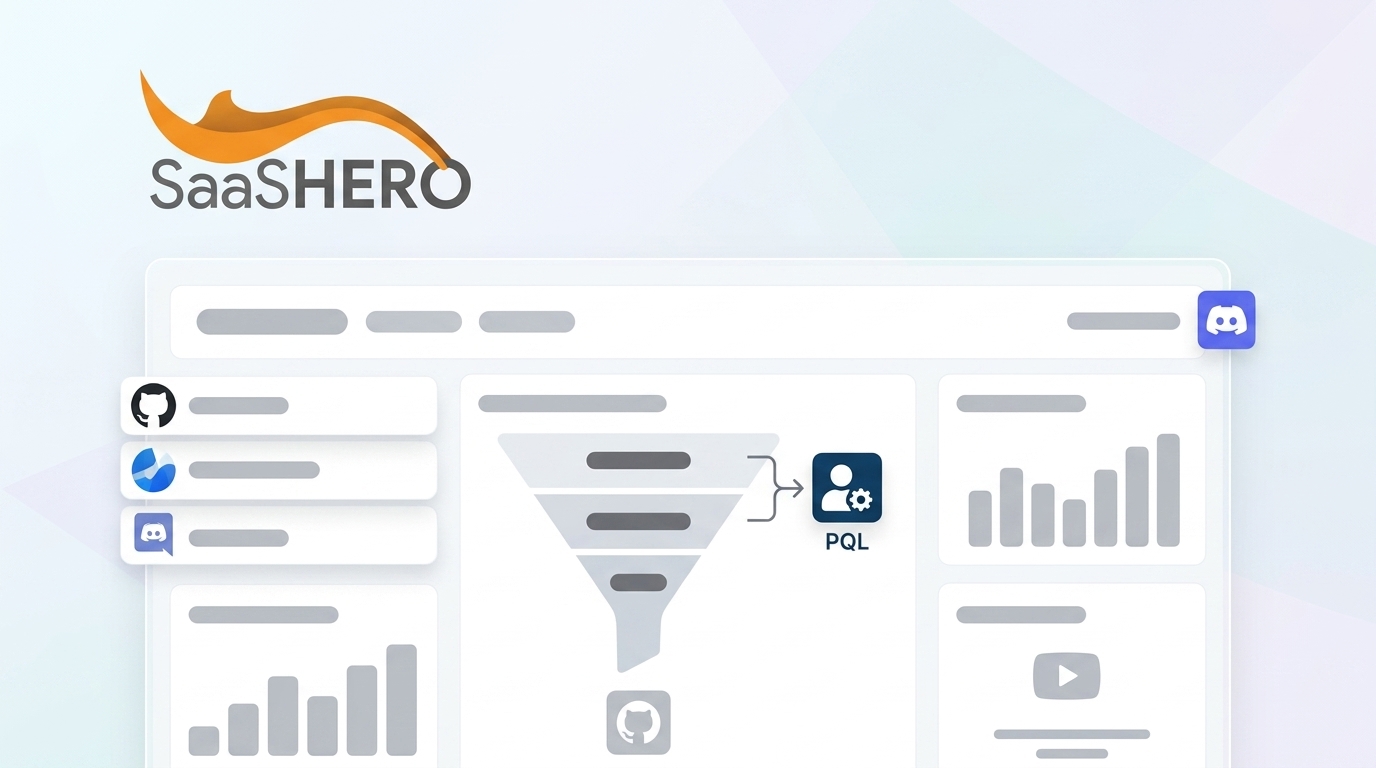
A product qualified lead (PQL) is an account or user who reaches a predefined usage threshold that correlates with conversion to paid. For devtools, that threshold almost never involves a form submission. The meaningful PLG conversion is an activated developer who completes a first real product action such as an API call, successful query, or deployment. Strong North Star metrics include API key generation, first successful API call, SDK installation, active API usage measured in weekly or monthly active users, integrations completed, and data volume processed.
Generic B2B lead scoring assigns points to job title, company size, and email opens. PQL scoring assigns points to product behavior. PQL conversion runs at 25–39% depending on deal size, compared with a roughly 9% median raw free-to-paid conversion across all models. Despite this gap, only about a quarter of PLG companies use PQLs and only about a third track activation, even though activation most strongly predicts conversion.
The practical implementation connects product analytics to your CRM. When a user crosses the activation threshold, such as three successful API calls within seven days, that event fires a PQL flag in HubSpot or Salesforce and queues the account for sales-assisted follow-up. In hybrid motions, sales teams should chase product-qualified accounts inside trial accounts rather than cold-prospecting, using the product to pre-qualify leads before sales engagement. These conversion rates, combined with 3–6 month CAC payback periods, make PQL-based sales assistance far more efficient than cold prospecting.
Technical Content That Solves Error Messages and Integration Problems
Technical content that solves specific problems attracts developers who already feel the pain your tool addresses. Developers search for error messages, integration guides, SDK setup walkthroughs, and configuration edge cases. A post titled “How to fix ECONNREFUSED in Node.js with Redis” reaches a developer at the exact moment of friction. Your product may remove that friction entirely.
This approach differs from broad thought-leadership content aimed at VP-level buyers. Broad posts generate impressions. Technical posts generate activated users. Bottom-of-funnel content such as comparison pages and “alternative to” posts converts at 15–25x the rate of top-of-funnel awareness content for B2B SaaS lead generation. Error-message content follows the same pattern because intent is specific, the audience is qualified, and the conversion path is short.
Technical SEO for devtools focuses on schema markup for code blocks, fast page load on documentation subdomains, and internal links between error-message posts and integration guides that point toward product sign-up. Every piece of content should map to a stage in the six-stage funnel. An error-message post maps to Awareness. An integration guide maps to Activation. A comparison page maps to Product Qualification.
GitHub-Led Growth with SDKs, Templates, and Sponsorships
GitHub functions as a primary distribution channel that generic B2B tactics usually ignore. A well-maintained SDK repository, a collection of starter templates, or a sponsored open-source project places your tool inside the developer’s existing workflow. Stars, forks, and issues act as usage signals. A repository with 2,000 stars and active issue threads generates awareness, trust, and adoption at the same time, none of which appears in a paid-ad dashboard.
Paid advertising rarely reaches engineers in a productive context. A LinkedIn ad interrupts. A GitHub repository solves. The distribution mechanics reflect that difference. SDKs reduce integration friction and directly improve time-to-value. Delays before first value can reduce trial conversion rates substantially, and a well-documented SDK can compress that time. Open-source sponsorship of complementary libraries places your brand inside dependency trees that thousands of projects already use, which creates passive discovery at scale.
GitHub-led growth also produces first-party intent data. A developer who stars your repository, opens an issue, or submits a pull request signals engagement that far exceeds a form fill. Platforms like Common Room aggregate person-level signals from GitHub repos, Slack and Discord communities, Stack Overflow, and product usage into unified profiles. This aggregation makes it possible to route high-engagement GitHub users directly into a PQL workflow.
Community Engagement on Reddit, HN, and Discord Without Pitching
Developer communities on Reddit, Hacker News, and Discord reward value-first participation and punish promotion. Promotional posts get flagged, downvoted, or removed. Sustainable engagement means answering questions, sharing technical context, and contributing to discussions where your product genuinely fits, without leading with a sales pitch.
This pattern contrasts sharply with cold outreach, which engineers filter aggressively. Community-led growth through Slack communities, Discord servers, and niche subreddits builds trust via peer recommendations in dark social channels that do not appear in analytics but drive real pipeline for B2B SaaS. A developer who sees your team member answer a complex Kubernetes networking question on a Discord server will investigate your product on their own terms, which signals stronger intent than a cold email open.
Review platforms and communities such as Product Hunt, G2, Capterra, and Reddit are places where B2B buyers actively compare solutions, making community and ecosystem visibility more important than classic outbound alone. Monitoring these channels for mentions of your product category, competitor complaints, and “alternative to” queries creates a real-time feed of high-intent prospects already in evaluation mode.
Signal-Based Outbound Using Hiring Data and Stack Changes
Signal-based outbound replaces volume-based cold email with precise targeting. Instead of sending 500 generic emails per week, a signal-based workflow monitors a defined set of accounts for behavioral triggers and initiates outreach only when a meaningful signal fires. This approach produces higher reply rates, shorter sales cycles, and lower CAC.
For devtools companies, the most reliable signals are engineering hiring surges and technographic changes. Roles such as data engineer, machine learning engineer, analytics engineer, platform engineer, and infrastructure engineer are especially relevant hiring signals for cloud, data, developer tooling, and AI vendors because they indicate investment in technical systems. Engineering hiring surges signal a buying window for devtools and infrastructure products.
Technographic signals add another layer. A prospect removing a competitor’s tracking pixel from their site or adding a complementary tool indicates they are switching vendors or expanding workflows, with data sources such as BuiltWith, Wappalyzer, and SimilarTech. Combining hiring data from PredictLeads with technographic overlays and first-party product usage from Common Room produces an account score that reflects genuine buying intent rather than demographic fit alone. Outreach personalized around a specific hiring sprint or stack change converts at materially higher rates than templated cold email.
SaaSHero builds signal-based outbound systems that connect these data sources to your CRM and sales workflow. Book a discovery call to see how this maps to your current ICP and tech stack.

Maturity Model: Matching Channel Mix and Budget to Your Stage
The following maturity model maps channel priorities to your company’s revenue stage and ACV, so you can decide which tactics to run now and which to sequence later.
Stage 1 — Founder-Led (Pre-$1M ARR): At this stage, budget is constrained and the founder usually acts as the primary growth resource. The recommended channel mix focuses on technical content such as error-message posts and integration guides, GitHub repository maintenance, and value-first community participation on two or three relevant forums. Paid channels remain premature without validated messaging. The goal is activation data, not pipeline volume. Pure PLG-led motions are recommended for ACV below $5K, so self-serve conversion functions as the primary revenue mechanism.
Stage 2 — First Dedicated Growth Hire ($1M–$5M ARR): With one growth resource, the channel mix expands to include PQL scoring, signal-based outbound targeting 50–100 high-fit accounts per month, and systematic GitHub-led distribution. Budget allocation should weight technical content and community engagement at roughly 60%, with the remaining 40% on tooling for intent data and outbound sequencing. At this stage, many teams move from pure PLG into a hybrid motion. Hybrid PLG+SLG is a common motion for ACV between $5K and $50K, which aligns with the accounts targeted by signal-based outbound.
Stage 3 — Scaling with a Specialized Partner ($5M+ ARR): At this stage, the channel mix includes all five channels operating at once. A dedicated devtools agency manages paid amplification of technical content, structured PQL workflows, and signal-based outbound at scale. Reporting focuses on Net New ARR, CAC payback period, and pipeline-to-close rate. Vanity metrics drop from primary dashboards.

Common Pitfalls That Kill DevTools Lead Gen
Optimizing for signups instead of activation wastes budget and hides friction. A signup that never generates an API key is not a lead. It is a data point about messaging or onboarding friction. For paid campaigns in PLG motions, track whether users reach the North Star metric rather than stopping measurement at cost per lead. Teams that report cost per signup to their board are measuring the wrong outcome.
Cold email volume as a substitute for intent signals produces diminishing returns in 2026. Engineers have high spam tolerance and low patience for irrelevant outreach. Explicit social intent signals such as a Reddit post asking for tool recommendations rank higher than website behavior signals, and these signals have short half-lives. High-intent explicit asks should be responded to within 60 minutes. Volume-based cold email cannot operate at this speed or precision.
Reporting vanity metrics such as impressions, clicks, and CTR to revenue-focused stakeholders erodes trust and obscures actual performance. The 2026 reality is that AI tooling categories are crowded. CAC payback periods of 6–14 months are achievable for well-structured PLG motions (with hybrids typically 10–22 months), but only when reporting anchors to Net New ARR and pipeline value instead of top-of-funnel volume.
Two Team Archetypes and Sequencing Priorities
Early-Stage Bootstrapper: This founder has a working product, early organic signups, and no dedicated growth budget. The sequencing priority is activation before acquisition because you cannot scale acquisition efficiently until you know which behaviors predict conversion. Fix the onboarding flow until a meaningful percentage of signups reach the North Star metric. That baseline activation rate becomes your benchmark for every future acquisition investment.
Once you have reliable activation data, invest in technical content that targets the exact error messages and integration queries your activated users searched before finding you. Their real search paths guide topic selection. Community participation on two or three forums follows naturally once you have content assets to reference in value-first responses. Introduce signal-based outbound only after you validate PQL definitions against actual conversion data so outbound targets accounts that match your proven activation profile.
Series B Growth Lead: This operator has budget, a growth team, and pressure to demonstrate efficient scaling to investors. The sequencing priority is instrumentation before channel expansion. Ensure PQL scoring connects to your CRM, hiring-signal monitoring covers the full ICP, and attribution tracks from the first GitHub star or community mention through to closed-won revenue.
With instrumentation in place, all five channels can run at the same time, with budget weighted toward the channels that produce the lowest CAC payback. For sales-assisted motions, measure cost per demo and cost per opportunity rather than stopping at cost per lead. These metrics reveal which channels contribute real revenue and which inflate pipeline with unqualified accounts.
Frequently Asked Questions
How much should an early-stage devtools company budget for lead gen in 2026?
At pre-$1M ARR, the most capital-efficient allocation is time rather than media spend. Technical content, GitHub distribution, and community participation require engineering and writing time but minimal direct budget. A realistic monthly cash outlay at this stage is $500–$2,000 for tooling such as intent data subscriptions and CRM integrations. Once PQL definitions are validated and activation rates are stable, paid amplification of high-performing technical content becomes the next investment, typically starting at $3,000–$5,000 per month in media spend with a flat-fee management retainer.
Who should own devtools lead gen—marketing, sales, or product?
In a developer-to-developer funnel, ownership is distributed by stage. Product owns the activation threshold definition and North Star metric instrumentation. Marketing owns technical content, GitHub distribution, and community engagement. Sales owns PQL follow-up and signal-based outbound sequencing.
The critical handoff is the PQL flag. When a user crosses the activation threshold, the CRM must route that account to sales within a defined SLA. Without a shared definition of funnel readiness, conversion breaks at the handoff. A growth lead or head of revenue operations typically owns the cross-functional coordination.
How long does it take to see results from a developer-to-developer funnel?
Technical content that targets specific error messages and integration queries typically begins generating organic traffic within 60–90 days of publication, assuming proper technical SEO implementation. GitHub-led distribution compounds over 3–6 months as repositories accumulate stars and community visibility grows. Signal-based outbound produces pipeline within the first 30 days if the ICP is well-defined and the signal sources are correctly configured.
PQL workflows require 60–90 days of activation data before scoring thresholds become reliable enough to drive consistent sales handoffs. For an early-stage team, the full funnel usually reaches steady state in 4–6 months.
What tools are essential for running this system in 2026?
The core stack for a developer-to-developer funnel includes a product analytics platform such as Mixpanel or Amplitude for activation tracking and a CRM such as HubSpot or Salesforce for PQL routing. Common Room aggregates GitHub, community, and product usage signals into unified account profiles. PredictLeads or a comparable hiring-signal provider supports outbound prioritization, and a technographic data source such as BuiltWith or Wappalyzer tracks stack-change signals.
For content, a technical SEO audit tool such as Screaming Frog or Ahrefs is sufficient. The total monthly tooling cost for a growth-stage team running all five channels typically falls between $2,000 and $5,000.
How do we measure success beyond signups and MQLs?
The primary metrics for a developer-to-developer funnel are activation rate, PQL conversion rate, CAC payback period, and Net New ARR by channel. Activation rate measures the percentage of signups reaching the North Star metric. PQL conversion rate tracks the percentage of PQLs that convert to paid. CAC payback period measures the months required to recover acquisition cost from gross margin.
Secondary metrics include GitHub repository stars and fork velocity as proxies for distribution reach, community mention volume as a proxy for brand awareness in dark social, and signal-to-outreach conversion rate for the outbound motion. Vanity metrics such as impressions, raw signups, and email open rates stay in diagnostic reports and never appear as primary KPIs for leadership.
When to Bring in a Specialized Partner
The developer-to-developer funnel in this playbook requires strength in technical content, PLG instrumentation, GitHub distribution, community strategy, and signal-based outbound. Most early-to-growth-stage devtools teams have depth in one or two of these areas and gaps in the rest. A specialized partner fills those gaps without a three-month hiring cycle, percentage-of-spend billing, or a 12-month lock-in contract that characterizes traditional agency engagements.

SaaSHero operates exclusively in B2B SaaS and technology, with deep vertical experience across developer tooling, infrastructure, and technical products. The agency model uses flat monthly retainers, month-to-month agreements, and reporting anchored to Net New ARR and pipeline value instead of impressions or click-through rates. Every engagement is senior-led, with a maximum of 8–10 clients per manager to preserve the depth of attention that devtools growth requires. This structure creates a performance partnership that re-earns your business every 30 days instead of coasting on a locked contract.
If your devtools company is generating early traction but struggling to convert awareness into qualified pipeline, or if generic B2B tactics feel structurally misaligned with how engineers buy, the next step is a focused conversation about your specific stage, ICP, and channel mix. Book a discovery call with SaaSHero and walk away with a concrete assessment of where your funnel is leaking and which channels to prioritize first.