




Written by: Aaron Rovner, Founder, Saas Hero
Key Takeaways
- A traditional agency retainer charges a fixed monthly fee for defined deliverables scoped to the ad account. An embedded growth team owns strategy and execution across the full acquisition chain and is measured against CRM revenue outcomes.
- B2B SaaS decisions are hard because multi-month sales cycles, fragmented attribution, and scope boundaries prevent any single vendor from owning the entire conversion chain.
- Fee structures reveal incentives. Percentage-of-spend retainers reward agencies for increasing client spend, while growth teams price on total monthly ad spend so reallocation does not change the fee.
- Contract diagnostics distinguish real growth teams from rebranded retainers by checking ownership of landing pages, conversion tracking, test agenda, and whether KPIs are deliverables or pipeline metrics.
- SaaSHero offers the embedded growth team model for B2B companies that meet its fit criteria, with one accountable team owning the full acquisition chain and improving qualified pipeline and closed revenue.
See If Your Acquisition Chain Qualifies
The Problem: Why This Decision Is Hard In B2B SaaS
Most B2B SaaS marketing leaders are deciding whether the “growth team” engagement in front of them is a genuine structural alternative to their current retainer or a rebrand of the same model with updated language. The stakes are concrete: a committed pipeline number, a board or CFO review on the calendar, and a quarter that cannot absorb a bad switch.
Several structural conditions make this decision hard in B2B SaaS. Multi-month sales cycles and buying committees delay visible damage from a mis-specified program, so problems show up in the CRM long after the budget is spent. Attribution is fragmented. The click is recorded in Google Ads or LinkedIn while the opportunity appears in Salesforce or HubSpot months later. Nothing connects them unless someone builds and maintains that join. Without it, the default report is last-touch, which understates every upper-funnel channel.
The traditional agency retainer’s scope boundary creates the operational problem. The agency owns the ad account. A web team or contractor owns the landing page. Whoever configured Google Tag Manager owns the conversion definitions, often years earlier and often no longer at the company. Nobody owns the chain end to end. Performance is set by the weakest link.
Platform automation compounds this problem. Smart Bidding, broad match, and Performance Max now handle manual bidding and keyword control. The remaining human decision is which conversion events the algorithm pursues. That decision depends on the client’s revenue model and happens before launch. A retainer scoped to the ad account often cannot change those conversion events, because the form, the CRM field mapping, and the tag manager configuration all sit outside its scope. The machine then finds more of whatever it is rewarded for. If it is rewarded for form fills, it finds people most likely to fill out forms instead of people most likely to buy.
The business impact shows up in CAC, CAC payback, pipeline coverage, and cost per SQL. Those numbers move when the conversion architecture changes, not when the ad platform’s dashboard looks better.
Talk Through Your Current Acquisition Chain
Defining The Two Engagement Models In B2B SaaS
The two models differ on two variables: who owns the brief and what the fee is indexed to. Team size and service list do not separate them in a meaningful way.
A traditional agency retainer is a fixed monthly fee for a defined scope such as channels, hours, or deliverables. The client supplies strategic direction. The agency executes and reports on the channels it manages. Scope usually stops at the ad platform.
An embedded growth team owns strategy and execution across the full acquisition chain, including paid media, creative, landing pages and CRO, and attribution and reporting. It is measured against CRM outcomes. The vendor brings the test agenda. The client supplies goals and approval.

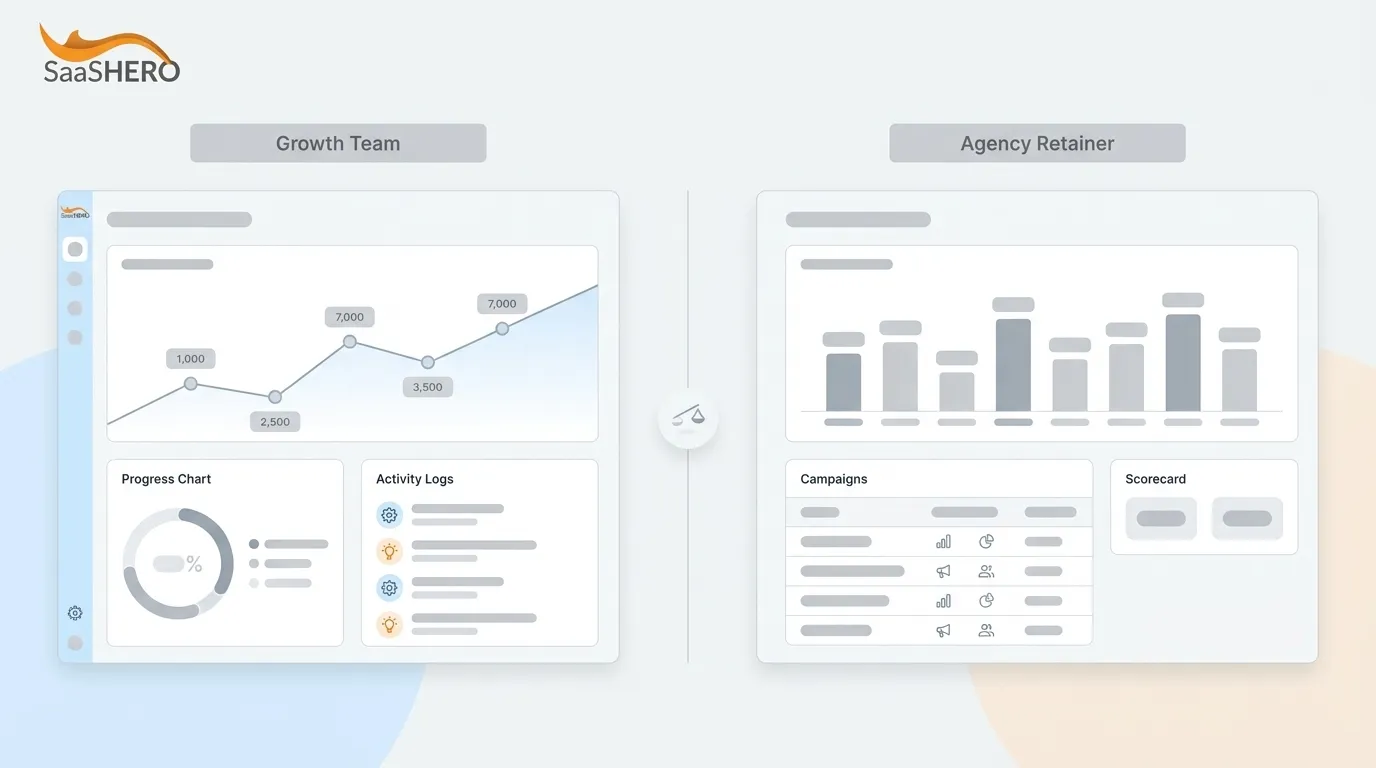
The table below maps the two models across the dimensions buyers actually negotiate on: scope, accountability, cost basis, and fit. This view shows where the structural break between them really sits.
| Dimension | Traditional Agency Retainer | Embedded Growth Team |
|---|---|---|
| Relationship | Vendor | Embedded Partner |
| Primary Focus | Deliverables | Revenue Outcomes |
| Scope | Ad Account | Full Acquisition Chain |
| Speed | Queue-Driven | Proactive Cadence |
| Accountability | Channel Metrics | Pipeline |
| Knowledge | Account History | Documented Repeatable Process |
| Cost Basis | Per Channel Or Per Deliverable | Total Monthly Ad Spend |
| Best Fit | Stable, Predictable Work | Paid Media Needs End-To-End Ownership |
Compare This Framework To Your Current Contract
What It Means To Have An Agency On Retainer
A retainer is a recurring monthly fee for a defined scope, typically a set of channels, a block of hours, or a monthly task package. The client supplies strategic direction. The agency executes and reports on the channels it manages. The relationship is a vendor relationship. The agency is accountable for completing the deliverables inside its scope, not for the revenue outcomes downstream.
The trade-offs are real and often attractive. A retainer provides predictable cost, broad coverage under one contract, and institutional memory about the account. For stable, well-defined work, those advantages matter.
The structural consequence is that the scope boundary usually stops at the ad platform. The landing page, the form, the CRM field mapping, and the conversion event definition all sit outside the retainer’s scope and accountability. Stackmatix’s Analysis Of Paid Media Agency Pricing notes that headline agency fees rarely capture total cost and that landing page development and CRO are frequently excluded from scope. In practice, the agency optimizes only half the equation and reports only on the half it controls.
What Is The Typical Fee Structure For An Advertising Agency Retainer?
Common fee structures signal what a vendor is financially motivated to recommend. Reading them correctly helps you predict behavior before you sign.
Percentage Of Ad Spend is the traditional model, typically 10–20% of monthly media budget. PPC.co’s Analysis Of Agency Pricing Models documents the built-in conflict: the agency’s revenue rises when the client spends more, regardless of efficiency. At $10K per month in ad spend, a 15% fee buys roughly $1,500 of agency labor, which is proportional. At $80K per month, the same 15% is $12,000. That figure almost never reflects the actual hours worked on a mature account. Howl Marketing’s 2026 B2B Agency Pricing Guide identifies percentage-of-spend as the model buyers should treat with the most caution because it pays the agency to grow the client’s bill rather than improve results.
Per-Channel Pricing creates a second version of the same conflict. Each additional channel carries its own fee, so every test of a new placement raises the client’s invoice before it returns anything. The recommendation and the invoice move together. Budget then calcifies where it was first placed.
Flat Monthly Retainer indexed to total ad spend, not channel count, decouples the fee from the channel mix. Reallocation and new channel tests do not change the fee. Redefine Web’s 2026 Analysis Of SaaS PPC Pricing Models states that the structural bias of percentage-of-spend billing shows up in strategy recommendations. Agencies on percentage of spend more often suggest adding a new channel or raising budget. Agencies on flat retainer more often suggest improving what already runs.
Hourly Blocks and Project-Based Fees work for defined scopes. Understory Agency’s B2B SaaS Marketing Agency Pricing Guide identifies five models in circulation: flat monthly retainer, percentage of ad spend, project-based, performance-based, and hybrid. It notes that performance-based pricing fails in B2B SaaS because long sales cycles create attribution disputes and lead targets invite lead-quality gaming.
Retainer ranges in the market vary widely by scope and seniority. Revnew’s 2026 Roundup Of B2B Marketing Agencies reports that agency retainers cluster in three bands: roughly $4,000–$10,000 per month for mid-market execution, $10,000–$25,000 for full-funnel programs, and $25,000+ for enterprise ABM and global demand. The Starr Conspiracy’s 2025 B2B Agency Pricing Trends Brief reports that minimum monthly engagements for credible B2B agencies have reset upward to a floor of $15,000–$25,000 per month. That shift reflects senior B2B talent compensation requirements and the complexity of modern martech, attribution, and channel orchestration.
How To Tell If A Growth Team Is Just An Agency Retainer
“Growth team” is a marketing label, not a regulated category. Most offers using it are retainers with new language. The contract is the diagnostic. The questions below reveal which model is actually being sold by contrasting a retainer-style answer with a growth-team-style answer.
What Outcome KPIs Are In The Contract: Deliverables Or Pipeline?
- Retainer Answer: Deliverables completed, hours logged, channels managed.
- Growth Team Answer: Qualified pipeline, cost per SQL, closed revenue.
Who Owns The Test Agenda And Brings The Next Three Tests?
- Retainer Answer: Client supplies strategic direction. Agency executes.
- Growth Team Answer: Vendor proactively identifies what to test, where to invest, and what needs to change.
What Is The Experimentation Cadence And How Is It Scoped?
- Retainer Answer: Testing happens when requested. New tests may trigger a scope change.
- Growth Team Answer: Continuous testing is a standing deliverable.
Who Owns The Landing Page The Campaigns Point To?
- Retainer Answer: Client or a third party owns it. Agency recommends changes.
- Growth Team Answer: Agency designs, builds, hosts, and tests the pages.
Who Owns Conversion Tracking And The Conversion Architecture?
- Retainer Answer: Client’s RevOps or whoever configured the tag manager.
- Growth Team Answer: Agency configures and maintains the conversion hierarchy.
What Can The Vendor Change Without Client Approval?
- Retainer Answer: Most changes require client approval. Agency waits.
- Growth Team Answer: Clear approval gates with the agency owning strategy and execution within them.
Who Does The Work Day To Day, And How Are They Employed?
- Retainer Answer: Account manager plus contractors or offshore execution.
- Growth Team Answer: Full-time employees with in-house designers and copywriters.
What Happens To Accounts, Data, And Files At Exit?
- Retainer Answer: Assets may be agency-owned or require migration.
- Growth Team Answer: Client owns everything. Offboarding is a normal event.
Is The Fee Indexed To Spend Or To Channel Count?
- Retainer Answer: Per channel or per deliverable. Adding a channel raises the fee.
- Growth Team Answer: Total monthly ad spend. Reallocation and new channel tests do not change the fee.
Fluxsy’s August 2026 Guide On Embedded Growth Pods identifies ownership as the single most important protection. Clients should insist on owning everything a growth pod builds, including ad accounts, analytics and measurement infrastructure, data, creative assets, and documented playbooks, all built under the client’s credentials and staying with the client if the relationship ends. MAVAN’s Comparison Of Embedded Operators And Agency Retainers recommends six checks to distinguish a real embedded operator from a retainer in disguise. These include asking what single number the vendor will own, such as CAC, payback, or activation, and confirming that one accountable point of contact owns the outcome rather than five specialists owning five slices.
Run This Contract Audit With SaaSHero
When A Traditional Retainer Is The Right Choice
A traditional retainer is the better choice in several situations, and a vendor that understands the market will acknowledge this.
- The work is stable and predictable, with the same channels, motion, and deliverables month over month.
- The client has internal strategic bandwidth and wants execution only. The marketing leader has the time and expertise to write the brief and manage the relationship.
- The scope is a single channel with a stable motion. A specialist retainer for one platform, managed by a specialist, is often the most efficient structure.
- The deliverables are well-defined and repeatable. Content production, email management, and similar work fit a retainer scope cleanly.
- The company is below the spend level where cross-channel reallocation matters. At low spend, the optimization method that requires multi-channel data does not have enough signal to work.
Revnew’s 2026 Agency Guide maps agency fit to company stage and notes that most companies between $5M and $50M ARR run a hybrid model: one or two in-house owners who hold strategy and product knowledge, plus an agency for execution capacity and channel expertise. The retainer works best when the in-house owner has the capacity to direct it.
Practical Implementation: A Step-By-Step Decision Framework
The decision between a retainer and a growth team works best as a sequence. Readiness comes first, then bottleneck diagnosis, then stakeholder alignment, measurement, and governance.
Readiness Assessment:
- Do you have a CRM with lifecycle stages? Without it, CRM-level optimization is not possible, so neither model can be judged on pipeline outcomes.
- Do you have an internal marketing owner who can set goals and approve work? The best engagements have one because approval latency is what slows an account down.
- Do you have enough spend for the optimization method to work? Below $15K per month in ad spend, data volume is insufficient for the signal the model requires, so the cross-channel reallocation advantage of a growth team cannot materialize.
Bottleneck Diagnosis:
- Is the bottleneck lead generation volume? A retainer scoped to demand capture may be sufficient.
- Is the bottleneck brand and demand creation? A staged paid social program with a messaging cadence is the structural answer.
- Is the bottleneck ad efficiency and post-click conversion? End-to-end ownership of the acquisition chain, including the landing page and conversion architecture, is required.
Stakeholder Alignment:
- Who signs and who vetoes? Finance approves the contract and asks about total cost and payback. RevOps owns the CRM and acts as the technical veto. Sales is the quality arbiter.
Measurement Setup:
- What has to be true about conversion tracking before either model can be judged? If the tracking is broken, the new partner inherits the same broken measurement and the first 90 days produce data nobody can defend. Fix this before switching.
Governance:
- What are the approval gates, reporting cadence, and exit terms? These should be defined in writing before the engagement starts and not negotiated after the first missed milestone.
Risks, Trade-Offs, And Adjacent Alternatives
Several misconceptions and risks recur in this decision, along with a few viable alternatives that sit next to the agency and growth-team models.
The term “growth team” is not protected. Fluxsy’s Guide On Embedded Growth Pods identifies five distinct models behind the label: in-house hires, fractional growth lead, embedded pod, agency retainer, and hybrid. Choosing the wrong model for your stage usually costs more than choosing a mediocre provider within the right model.
Team size does not guarantee senior attention. Vidico’s 2026 Guide To Top SaaS Marketing Agencies warns that the most common agency failure pattern is junior bait-and-switch. Senior strategists run the sales process, then accounts move to junior managers carrying 30+ clients. Ask who will be in the account in month seven and whether they are employees.
Headline fees do not equal total cost. Redefine Web’s 2026 SaaS PPC Pricing Analysis identifies five hidden-cost categories that surface after signing: third-party tool passthrough, setup fees, scope creep fees, media fee ranges stated as bands rather than fixed percentages, and termination fees. Compare total cost at three spend scenarios before signing.
Common failure modes when switching models:
- Switching without fixing conversion tracking first. The same broken measurement transfers to the new partner and undermines the first 90 days.
- Hiring a growth team without an internal owner who can approve work. Approval latency becomes the main drag on performance.
- Expecting a growth team to fix positioning or sales capacity problems that sit outside acquisition. If the bottleneck is the offer, the sales process, or the product, paid media cannot compensate.
Adjacent alternatives, assessed neutrally:
- In-House Hire: Works when spend is concentrated in one platform, the motion is stable, and a marketing leader has the paid media fluency to manage and develop the hire. It strains across the five-discipline coverage problem of paid search, paid social, creative, landing pages, and attribution because very few individuals are strong in all five.
- Specialist Freelancer: Works for defined projects with a clear deliverable. It creates fragmentation across disciplines, and the coordination lands on the marketing leader.
- Large Integrated Agency: Works for multi-region delivery, offline and CTV, and agency-of-record consolidation across many channels and geographies. The trade-off is the seniority-to-account ratio.
Frequently Asked Questions
How Long Before A Growth Team Engagement Shows Results?
Paid media shows meaningful optimization in 60 to 90 days. Pipeline impact depends on the sales cycle. With a two- to four-month sales cycle plus 30- to 90-day payment terms, the cash a founder counts on in month six may not arrive until month nine or ten. The first meaningful data comes back around day 30. Day 90 is a validation gate for whether the channel, the structure, and the messaging thesis are sound. Any engagement evaluated before day 90 is being judged on setup, not outcomes.

What Does A Growth Team Cost Compared With A Retainer?
Traditional retainers commonly range from roughly $4,000 to $25,000+ per month depending on scope, channel count, seniority, and company stage, and credible B2B demand generation engagements usually sit at the higher end of that range. Growth team engagements are typically priced on total monthly ad spend rather than channel count, so the fee does not change when a channel is added, removed, or reweighted. The relevant comparison is the total cost including creative production, landing page work, and tool pass-throughs, which are frequently excluded from retainer scopes and billed separately.
Do We Still Need An Internal Marketing Team?
An internal marketing owner remains essential. The best engagements have an internal owner who sets goals and holds the number, with the growth team owning strategy and execution across the disciplines underneath. A company with 2–4 marketing team members and no paid media specialist is the shape that fits best. A company with no internal owner cannot approve work quickly enough for the model to function.
What Happens To Our Ad Accounts And Data If We Switch?
The answer depends on the contract. The right structure gives the client ownership of everything, including ad accounts, conversion tracking configurations, landing page files, design files, creative, dashboards, and documentation. Those assets should leave with the client at exit. Ask this question before signing. An agency that relies on switching costs is not relying on its results.
How Do We Measure Whether The Switch Worked?
Track qualified pipeline generated, cost per SQL, cost per opportunity, and CAC payback period. If the agency cannot explain how it will tie its work to opportunities, it is selling activity instead of outcomes. Set a 90-day validation gate and a 6-month evaluation window. Board-ready reporting should show pipeline, CAC, and payback period rather than impressions, clicks, or MQL counts.
Conclusion: Use The Contract As Your Diagnostic Tool
The two models differ on who owns the brief and what the fee is indexed to. Team size and service list do not distinguish them. The contract audit above is how you tell which one you are actually buying.
The buyer’s job is to audit the contract instead of the pitch. Three neutral next steps help structure that work:
- Run the contract audit questions above against the current agency and any vendor being evaluated.
- Audit conversion tracking and CRM connection before switching so broken measurement does not transfer to the new partner.
- Define what a fair evaluation window looks like before the engagement starts so the 90-day gate is agreed in advance rather than negotiated after the first missed number.
SaaSHero operates as an outsourced inbound growth team for B2B companies. One team owns strategy and execution across paid media, creative, landing pages, and CRM-connected attribution and reporting, and it focuses on qualified pipeline and closed revenue rather than form-fill counts. The fee is priced on total monthly ad spend rather than channel count, so reallocation and new channel tests do not change the fee. The team is approximately 20 full-time specialists with in-house designers and copywriters, so the ownership model described above does not rely on contractors. That structure is backed by a Google Premier Partner designation held by the top 3% of agencies, a G2 High Performer ranking in digital marketing for over two consecutive years, and roughly $16M in annual ad spend under management across more than 100 B2B companies over eight years.

The fit criteria are specific: $10M+ in annual revenue, $15K+ in monthly ad spend already being spent, B2B SaaS or B2B professional services with a sales-led motion, and an internal marketing team of 2–4 people with no paid media specialist. Additional cumulative criteria include established product-market fit, an internal sales team, and average customer value between $5K and $100K+. If that is the shape of your company, the diagnostic above applies directly to your next vendor conversation.
Apply This Diagnostic With SaaSHero