





Written by: Aaron Rovner, Founder, Saas Hero
Key Takeaways
- Enterprise marketing agency portfolio standardization is an operating-model change driven by authority and incentives.
- Success requires a single Portfolio Executive with control over the intake gate, dashboard access, and budget allocation.
- A 30/60/90-day phased rollout, with taxonomy and intake first, reporting second, and creative plus QBR cadence third, prevents resistance and ensures comparability.
- Enforcement relies on contract clauses, intake gates, dashboard leverage, and clear escalation paths when agencies do not report to the Portfolio Executive.
- SaaSHero provides a standardized operating model, artifacts, and an accountability structure that enterprise marketing leaders can adopt quickly.
Book A Discovery Call with SaaSHero
Marketing Portfolio Standardization Artifacts You Need In Place
Most guidance on portfolio standardization mentions a universal taxonomy and shared operational templates without showing what they contain. The artifacts below are specified in enough detail to build, assign, and enforce.
Taxonomy Schema
A campaign taxonomy defines the categories used to describe marketing activity. Typical fields include market, audience, objective, product, offer, funnel stage, channel, creative theme, and reporting period. The naming convention determines how those categories appear as actual campaign name strings across platforms and reporting systems. A working taxonomy requires four elements: a fixed field order, a controlled vocabulary per field, a delimiter and case rule, and an enforcement mechanism.
Express the campaign name as a repeatable string pattern. A recommended core structure is: channel_audience_region_brand_quarter_objective_creative, lowercase only, underscore delimiters, no spaces, and a total string under 80 characters for universal platform compatibility. Google’s own UTM guidance warns that utm_source=google and utm_source=Google are treated as two distinct sources. Case normalization therefore becomes foundational. Each field needs a defined allowed-value list enforced through dropdown selectors rather than free-text fields. New values move through an approval workflow.
For multi-brand portfolios, encode brand identity as a short two-to-four-letter lowercase prefix at the front of utm_campaign, for example, acm_spring_sale_2026q2 for Acme. This structure lets reporting roll up portfolio-wide while preserving brand-level separation. Brand codes require a locked registry. If a brand is coded acm in one campaign and acme in another, data fragments again. Claravine’s Data Standards Cloud lets teams define approved campaign metadata, naming conventions, and validation rules before campaigns move downstream. It also supports integrations that audit campaign data against those standards inside platforms such as LinkedIn Campaign Manager.
Channel taxonomy, audience taxonomy, and lifecycle stage definitions must be documented separately. Map them to CRM fields so taxonomy values match the lead routing rules already in Salesforce or HubSpot exactly.
Intake Form
The intake form acts as the enforcement gate. No work begins without a completed form. Required fields include objective, audience, market, product, offer, funnel stage, channel, creative theme, reporting period, and the named owner accountable for the campaign. Spear Marketing Group advises assigning a clear owner to every active program, a specific person rather than a team. The intake form records that ownership before spend is committed.
Creative Brief Template
The creative brief forces positioning, pain point, and outcome to be stated before production begins. Required fields include the problem the buyer has, the outcome the product produces, the differentiator from the nearest competitor, the audience segment, the channel and format, and the funnel stage. No creative enters production without a completed brief.
Reporting Dashboard Spec
The dashboard spec defines the metrics, dimensions, and source systems that must appear in every agency’s reporting output. Required metrics include pipeline created by channel, cost per sales-qualified lead, cost per opportunity, CAC payback period, and LTV:CAC. Required dimensions include campaign, channel, audience segment, brand or business unit, and quarter. The required source connection is the client’s CRM so portfolio-level comparison is possible without manual reconciliation. Agencies claiming to follow industry standards should document how their counts are calculated, where their methods differ from a common standard, and exactly what has been independently reviewed. IAB and IAB Tech Lab have developed campaign data standards and taxonomies covering audiences, content, ad products, inventory, and measurement signals. Treat these as table stakes for campaign setup, reporting, and partner data mapping.
QBR Agenda
The QBR agenda stays fixed and applies to every agency every quarter. Required questions include: what pipeline this agency’s work produced this quarter, what the cost per sales-qualified lead by channel was, what tests were run and what they produced, what the recommended budget allocation for next quarter is and why, and where the taxonomy or reporting spec failed to be followed with a clear remediation plan.
Who Owns GTM Strategy Across A Multi-Agency Portfolio
Artifacts only work when someone owns them. The Portfolio Executive is the single person accountable for GTM strategy across the portfolio. This role is typically filled by a Director of Marketing Ops, VP of Marketing, or a dedicated portfolio marketing lead who holds the standardization mandate. The title matters less than the authority, which comes from three things: control of the intake gate, control of the dashboard, and a line into the budget process.
The RACI for this role stays specific. The Portfolio Executive is Accountable for GTM strategy across the portfolio, taxonomy governance, dashboard spec, and QBR cadence. The Marketing Ops lead is Responsible for designing taxonomy structure, enforcing rules pre-launch, and running weekly taxonomy audits. Agency account directors are Consulted on brand-level campaign decisions and Informed of portfolio-level performance reviews. Brand marketing leads are Consulted on creative and messaging decisions and Informed of taxonomy changes. Exactly one role should be Accountable for each task or decision. Splitting accountability between two roles defeats the purpose of the RACI and usually leads to slower decisions or competing actions.
Authority without a reorg comes from three mechanisms. First, the intake gate. No agency begins work without a completed intake form approved by the Portfolio Executive. Second, the dashboard. The Portfolio Executive controls access to the portfolio-level reporting view, and that access is granted in exchange for reporting compliance. Third, the budget line. The Portfolio Executive’s input into quarterly budget allocation gives the role leverage that title alone does not provide. As Philip Hall of iCrossing notes, most global marketing teams lose consistency because nobody wrote down who is allowed to say yes.
How To Standardize Marketing Across Multiple Agencies: The 30/60/90-Day Rollout
Standardization succeeds when it rolls out in phases instead of all at once. Marketing teams should standardize first, automate second, and optimize continuously. Each phase below sets the precondition for the next.
Days 1–30: Standardize The Taxonomy And Stand Up The Intake Gate. The intake gate is the enforcement point, and nothing downstream can be compared until the taxonomy is fixed. That is why the first 30 days focus on publishing the taxonomy schema, including campaign naming convention, channel taxonomy, audience taxonomy, and lifecycle stage definitions. The same window includes standing up the intake form and requiring it before any work begins. Taxonomy compliance clauses go into every agency contract during this period so the gate has contractual backing.
Days 31–60: Harmonize Reporting And Measurement. Comparable reporting is the precondition for every portfolio review that follows. Publish the reporting dashboard spec and connect it to the CRM in this window. Harmonize KPI definitions and the attribution model across every agency. Define what counts as a conversion, what counts as a sales-qualified lead, and which attribution model governs portfolio-level reporting. Sometimes a single agreed definition sheet is enough to align people in the room on what they call a conversion and what they call spend.
Days 61–90: Standardize Creative And The QBR Cadence. Creative standardization depends on the brief template, and the QBR depends on the dashboard. Publish the creative brief template and require positioning, pain point, and outcome before production. Run the first QBR with every agency using the fixed agenda and the new dashboard.
What To Defer And Why. Brand-level positioning, channel mix, and local budget allocation stay flexible in the first 90 days. Early standardization of those elements invites resistance before the model has proven itself. The goal in the first quarter is to make the taxonomy, the intake gate, and the dashboard non-negotiable. Everything else can be addressed once those three are running.
See How The 90-Day Rollout Runs
Enforcement Mechanics When Agencies Do Not Report To You
Many Portfolio Executives must standardize agencies that do not report to them and serve brand teams that guard autonomy. Enforcement therefore needs mechanisms that work without a reorg.
Contract Clauses. Every agency contract must include five clauses. First, client ownership of all accounts, assets, and data during and after the engagement. Second, a taxonomy compliance clause requiring campaign names to follow the published schema. Third, reporting commitments specifying a live dashboard connected to the client’s CRM. Fourth, audit rights allowing the Portfolio Executive to commission an independent review at any time. Fifth, a bounded offboarding window. Five to ten business days is reasonable for returning access and materials, and agencies should never delete or archive campaigns during offboarding before change history is exported.
Intake Gates. The gate blocks work from starting. No work begins without a completed intake form and a taxonomy-compliant campaign name. The Portfolio Executive or Marketing Ops lead reviews the intake form before approval. An agency that bypasses the gate loses access to the next budget allocation.
Dashboard Access As Leverage. The dashboard is the artifact the Portfolio Executive controls. Access to the portfolio-level reporting view is granted in exchange for reporting compliance. An agency that does not report into the standard dashboard does not appear in the portfolio review and cannot make the case for its budget allocation.
Escalation Paths. Escalation runs through three tiers. The day-to-day agency account contact handles routine compliance questions. The Portfolio Executive handles taxonomy violations and reporting failures. The CMO or PE operating partner handles repeated non-compliance or contract disputes. Document every escalation in a shared log. One late report is a scheduling issue, while four late reports in a quarter indicate a structural problem worth addressing at the contract level.
How To Standardize Reporting Across Multiple Marketing Agencies
Multi-agency portfolios often stall because each agency reports a different number and every portfolio review becomes an argument about methodology. Fragmented measurement creates fragmented truths, leaving organizations without a single source of confidence for decision-making.
Unified KPI definitions come first. Every agency must use the same definition for pipeline, sales-qualified lead, cost per opportunity, and CAC payback period. These definitions must match the CRM’s lead routing rules exactly. If Salesforce routes leads with more than 2,000 employees to the Enterprise team, the taxonomy and the KPI definition must use the same threshold.
The attribution model must be agreed before the dashboard is built. Multi-touch attribution is usually more accurate for long B2B sales cycles than last-click, which credits the branded search that happened after the decision was made and systematically defunds demand-creation channels. Document the chosen attribution model, communicate it to every agency, and enforce it in the dashboard spec.
The dashboard structure must include five metrics: pipeline created by channel, cost per sales-qualified lead, cost per opportunity, CAC payback period, and LTV:CAC. SaaSHero holds client accounts to a 3:1 LTV:CAC ratio and a CAC payback period under 12 months. IAB Tech Lab’s ad signals standards, including the IAB Ad Impression Measurement Guidelines (September 2004) and Click Measurement Guidelines (May 29, 2009), provide the baseline for how impression and click signals should be defined across platforms. Conversion signals are standardized separately through the Open Measurement SDK. Case study format standardization, meaning the structure in which each agency reports campaign results, must also be fixed so portfolio-level comparison is possible without translation.
A multinational SaaS provider reduced reporting discrepancies by 92% and cut executive reporting preparation time by 70% within six months of implementing a governance initiative that included revenue definition standardization, centralized modeling, and governance approval workflows. The mechanism was agreed definitions enforced before the dashboard was built.
Multi-Agency Vs. Internal/Hybrid: What Changes
Standardization looks different in external multi-agency portfolios than in internal or hybrid models. The main differences involve where enforcement authority sits and what the Portfolio Executive can compel without a contract.
In an external multi-agency model, enforcement runs through contracts and the intake gate. The Portfolio Executive’s leverage comes from the budget line and the dashboard access. An agency that does not comply with the taxonomy or the reporting spec can be excluded from the portfolio review and, at renewal, replaced. The contract clause becomes the primary enforcement instrument because the agency does not report to anyone inside the organization. Regardless of which marketing model a PE-backed multi-brand company chooses, it should centralize KPI definitions, revenue attribution methodology, marketing reporting standards, CRM and data infrastructure, and brand governance, while keeping channel mix, creative, and local budget allocation flexible.
In an internal or hybrid model, enforcement runs through the operating cadence and the shared dashboard. The Portfolio Executive’s authority comes from the budget line rather than the contract, and the intake gate functions as an internal approval process rather than a contractual requirement. The RACI becomes the primary governance instrument because internal teams can be directed through management authority. The failure mode in internal or hybrid models differs from the external case. Enterprise marketing teams commonly maintain 10, 15, or even 20 variations of the same lifecycle journey, each market or team running its own logic. That pattern makes it nearly impossible to determine which version performs best. The Portfolio Executive’s job in an internal model is to collapse those variations into a single governed standard without triggering the resistance that comes from mandating uniformity before the model has proven its value.
Common Failure Modes
Standardization programs break in predictable ways, and naming those patterns helps you design around them. The list below connects directly to the taxonomy, intake, reporting, and enforcement mechanics described above.
- Treating standardization as a documentation exercise. The taxonomy document is published, nobody enforces it, and agencies continue naming campaigns however they choose. Documentation without an intake gate and a compliance clause becomes decoration.
- Standardizing everything at once. Brand-level positioning, channel mix, creative, reporting, and taxonomy all go live simultaneously. Resistance from every agency and brand team arrives at the same moment, and the model collapses before it produces a single comparable portfolio review.
- Giving the Portfolio Executive a title without authority. The role is named but controls neither the intake gate, the dashboard, nor the budget line. Agencies comply when convenient and ignore the standard when it conflicts with their existing workflow.
- Letting the taxonomy become a naming-convention project. The naming convention is documented but the controlled vocabulary is not enforced, the delimiter rule is not applied consistently, and the fragmentation index rises until portfolio-level rollups become impossible.
- Failing to harmonize measurement before demanding comparable reporting. Each agency reports into a different attribution model with different KPI definitions. The portfolio review becomes an argument about methodology rather than a decision about budget allocation.
- Skipping a clear escalation path. Violations are noted but not escalated. Agencies learn that non-compliance has no consequence and the standard erodes within a quarter.
Frequently Asked Questions
How Long Does Marketing Portfolio Standardization Take?
The core operating model, including taxonomy, intake gate, and dashboard spec, can be stood up in 90 days if the Portfolio Executive has authority over the intake gate and the budget line from day one. Comparable reporting across all agencies typically takes the full 90 days because it depends on the dashboard being connected to the CRM and KPI definitions being agreed before the first portfolio review. Creative and QBR standardization follow in the same window once the brief template is published.
Who Should Own The Standardization Program?
The Portfolio Executive role should be filled by whoever has been handed the standardization mandate, typically a Director of Marketing Ops, VP of Marketing, or portfolio marketing lead. The role should sit with whoever holds the three sources of authority described above, meaning intake gate, dashboard, and budget line. Without all three, the role becomes advisory rather than governing, and agencies will comply selectively.
How Do You Handle Agencies That Resist Standardization?
Resistance is managed through the contract and the intake gate. The taxonomy compliance clause and audit rights in the contract make compliance a contractual obligation. The intake gate makes non-compliance visible before spend is committed. Dashboard access withheld from non-compliant agencies removes their ability to make the case for budget at the portfolio review. Escalation to the CMO or PE operating partner serves as the backstop for repeated non-compliance.
What Should Be Standardized First?
The taxonomy and the intake gate come first because they act as the enforcement point for everything downstream. Nothing can be compared at the portfolio level until campaign names follow a consistent schema and the intake form captures the required metadata before work begins. Reporting standardization follows because it depends on the taxonomy being fixed. Creative and QBR standardization come last because they depend on the brief template and the dashboard being in place.
How Often Should The Model Be Revisited?
The QBR cadence, every quarter with every agency, serves as the standing review mechanism. The taxonomy itself should be reviewed at least annually, with a formal change-approval process for adding new values to the controlled vocabulary. The dashboard spec should be reviewed whenever the portfolio adds a new brand, business unit, or agency. The RACI should be reviewed whenever the Portfolio Executive role changes hands or the organizational structure shifts.
Putting A Standardized Model In Place With SaaSHero
SaaSHero gives enterprise marketing leaders a standardized operating model that matches this manual without requiring a ground-up build. SaaSHero operates as an outsourced inbound growth team for B2B companies, with one team owning strategy and execution across paid media, creative, landing pages and conversion rate optimization, attribution and reporting, and overall growth strategy. Because all capability areas sit on one accountability line, the artifact set, intake gate, dashboard spec, and QBR cadence arrive pre-built rather than assembled by the client.

The standardization layer is documented and repeatable. It includes an onboarding document, a keyword research process, a campaign flow map, a demand creation framework, a defined reporting cadence, and a quarterly budget analysis applied the same way in every engagement. The reporting stack is CRM-connected through Looker Studio and HubSpot dashboards, which makes portfolio-level comparison possible without manual reconciliation. The retainer is indexed to total monthly ad spend rather than channel count, which removes the incentive conflict that often makes agencies resist standardization. Adding, closing, or reweighting a channel leaves the fee unchanged, so channel mix becomes a purely strategic question.
Client ownership of all accounts, assets, and files is written into the contract, and offboarding is treated as a normal event. This structure removes a major institutional objection a fund or portfolio often has to introducing an agency into a company it may sell.
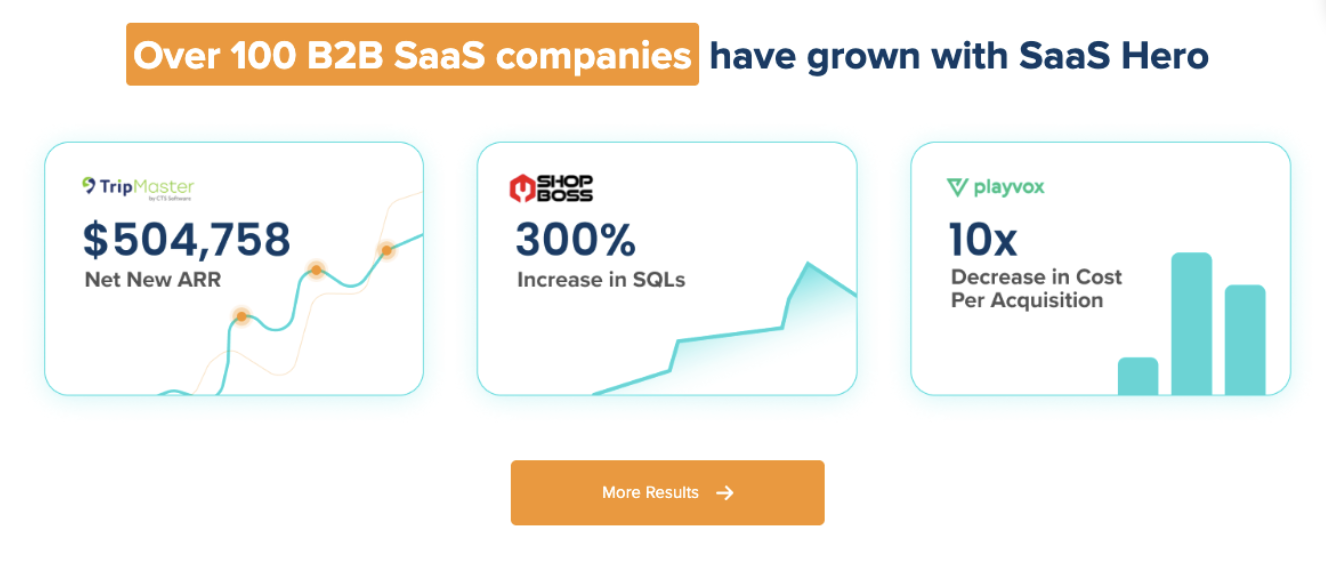
SaaSHero is a Google Premier Partner, a designation held by the top 3% of Google Partners, and has been a G2 High Performer in the Digital Marketing category for over two consecutive years, currently ranked #20 of approximately 6,000 agencies. Founded in 2018, the firm has served more than 100 B2B companies. It manages roughly $16 million in annual advertising spend and has spent more than $60 million over its lifetime. The team includes approximately 20 full-time specialists, including in-house designers and copywriters, and does not outsource execution.
Two scope boundaries are worth stating plainly. SaaSHero does not cover organic social. The firm is also too small for multi-region or agency-of-record mandates. The strongest configuration pairs an internal owner who sets goals and holds the number with SaaSHero owning strategy and execution across paid media, creative, landing pages, attribution, and reporting. That division of labor matches the Portfolio Executive model described in this article, with one party accountable for the outcome and one party executing the disciplines underneath it.