




Written by: Aaron Rovner, Founder, Saas Hero
Key Takeaways
- Two structural questions drive enterprise demand generation success: what trains the ad platform and who owns the post-click experience.
- Agencies that train algorithms on form fills attract unqualified traffic, while CRM-revenue training learns from qualified pipeline outcomes.
- Scope boundaries that exclude landing-page ownership and CRO create accountability gaps that paid-media skills alone cannot close.
- Reference-call questions about pipeline accountability, closed-won revenue, and attribution reconciliation reveal real differences between firms quickly.
- SaaSHero is the only firm in this set that owns paid media, creative, landing pages, CRO, attribution, and strategy as one team tied to CRM outcomes.
See How SaaSHero Owns The Full Chain
The Two Questions That Sort The Enterprise Demand Generation Market
Two structural questions matter more than channel breadth, creative quality, or brand-name recognition. Skipping them produces a shortlist sorted by presentation quality instead of by the mechanics that move pipeline.
Question 1: What Trains The Ad Platform, Form Fills Or CRM Revenue Events?
Modern bidding is machine-driven and goal-seeking. Demand Gen Report’s 2026 benchmark survey documents the shift: B2B marketing leadership now must show a direct line from campaigns to sourced revenue and influenced pipeline, not MQL counts. An algorithm pointed at a form fill finds the people most likely to fill in forms, such as students, competitors, job seekers, and existing customers, while reporting a falling cost per conversion. Pointed at sales-qualified leads, opportunities, and closed-won revenue pushed back from the CRM, it learns from qualified outcomes.
At a $15,000-per-month floor and a sales cycle measured in months, a mis-specified conversion event trains the account toward the wrong audience for a quarter. The CRM reveals the damage only after the budget is spent. The Starr Conspiracy’s 2026 benchmark frames the consequence precisely: the defensible number is the cost per opportunity the retainer produces.
Question 2: Who Owns The Post-Click Experience, The Agency Or The Client’s Web Team?
The weakest link in the chain sets performance, and the standard agency scope boundary cuts through that link. An agency responsible only for the ad account cannot change the landing page headline, which is often the single most impactful lever on landing page conversion. It also cannot change what the CRM counts as qualified. Each party can execute its scope faithfully and still produce a result nobody owns.

Stackmatix’s 2026 paid media agency pricing guide confirms this structural gap. Agency scope typically covers driving traffic, not converting it, so landing page development and CRO often sit outside management fees. Eightx’s 2026 analysis puts landing page builds at $1,500–$5,000 per page, usually scoped quarterly and billed separately. The highest-leverage variable in the funnel then moves at the speed of whichever team has capacity.
Reference-Call Questions That Reveal Real Accountability
- What conversion events feed account-wide optimization, and which are tracked but excluded from bidding?
- How do lifecycle-stage events push back into the ad platforms, and which CRM states trigger them?
- Who designs, builds, hosts, and tests the landing pages campaigns point to?
- What does the monthly report lead with, leads and CPL or pipeline, CAC, and payback period?
- When the attribution model disagrees with the CRM pipeline source field, what happens?
Use this vocabulary internally when presenting the evaluation: pipeline accountability, qualified pipeline contribution, closed-won revenue, global execution, multi-channel attribution. Finance leaders and boards already speak in these terms, and a capable agency should answer in the same language.
Pressure-Test Your Current Agency Against These Two Questions
Enterprise Demand Generation Agencies, Organized By Buying Situation
The firms below are enterprise-capable but not interchangeable. Apply the two-question framework to each before shortlisting. Every entry lists a genuine specialty, an explicit “wrong for” line, and what a reference call should verify.
For Global ABM And Enterprise Account Programs
The Marketing Practice — Best at multi-region account-based marketing, brand building, and demand generation integrated under one global roof for large enterprises. Wrong for companies without a multi-region mandate or the internal team to support a global program. Reference call should verify who runs the account day to day across regions and how cross-border attribution is reconciled.
Transmission — Best at global enterprise execution at scale. Its proprietary AI and data platform handles account intelligence and campaign orchestration, and its client list includes HP, Vodafone, Mastercard, Samsung, and Cloudflare. Wrong for mid-market companies that do not need multi-market delivery. Reference call should verify the seniority-to-account ratio and whether the named team stays on the account past onboarding.
For Full-Funnel Repositioning And Category Creation
Refine Labs — Best at rewiring measurement and moving mid-market and enterprise B2B SaaS companies off legacy MQL models toward full-funnel demand creation and capture. Refine Labs prices paid media management from $20,000/month and full-service from $31,000/month, targeting companies at $50M+ ARR with $50,000+ in monthly ad spend. Wrong for companies below its revenue and spend thresholds or those unwilling to change how marketing is measured. Reference call should verify what actually changed in the client’s attribution model and reporting, not just the campaign mix.
Walker Sands — Best at integrated PR-plus-demand programs for B2B technology brands. Walker Sands acquired demand generation specialist KoMarketing in 2023 and reported revenue more than doubled to $32 million in 2024. Wrong for companies that need paid-media depth rather than integrated communications. Reference call should verify how demand and PR workstreams are coordinated and measured together.
For Paid Pipeline Scaling
Directive — Best at revenue-aligned performance marketing across search and social for tech enterprises. Its reporting ties to pipeline contribution and closed deals rather than MQL volume, and its clients include Adobe, Calendly, and Gong. Wrong for companies that need creative and landing page ownership inside the same scope. Reference call should verify how offline conversion tracking connects paid spend back to CRM data.
For RevOps And Measurement Transformation
The Pedowitz Group — Best at revenue marketing maturity, attribution infrastructure, and marketing operations transformation for enterprise and mid-market B2B. It has completed over 1,500 client engagements and attributed $2.4 billion in pipeline across client programs. Wrong for companies that need campaign execution rather than measurement and process redesign. Reference call should verify how long first-touch attribution took to build and whether the client’s sales team trusts the resulting numbers.
For Demand Creation Across Long Enterprise Sales Cycles
Ironpaper — Best at complex enterprise sales environments with long, considered buying cycles and large buying committees, tying demand generation closely to pipeline velocity. Ironpaper charges monthly retainers of $10,000–$25,000 and specializes in enterprise accounts with 6+ month sales cycles. Wrong for companies with short cycles or single-stakeholder purchases. Reference call should verify how the agency handles buying-committee engagement across six or more stakeholders.
Run each firm through both questions before you shortlist. The answers surface structural differences that no capability deck will volunteer.
Why SaaSHero Is The Best Enterprise Demand Generation Agency For Companies That Need The Whole Chain Owned
SaaSHero is the only firm in this set that owns paid media, creative, landing pages and CRO, attribution and reporting, and strategy as one team on one accountability line, tied directly to CRM outcomes rather than form-fill counts. The client supplies the goals, and SaaSHero owns strategy, execution, and optimization against them.

The verifiable specifics:
- Founded 2018; eight years in the category as of 2026
- 100+ B2B companies served
- Roughly $16M in annual ad spend under management; more than $60M lifetime
- About 20 full-time specialists, including in-house designers and copywriters; nothing outsourced
- Google Premier Partner (top 3% of Google Partners)
- G2 High Performer in digital marketing for 2+ consecutive years; ranked #20 of approximately 6,000 agencies
The commercial structure supports this model. SaaSHero charges a flat monthly retainer indexed to total monthly ad spend, never a percentage of spend. Adding, closing, or reweighting a channel does not change the fee, so the channel-mix recommendation carries no financial conflict. The published entry point is $4,000/month for the Growth Team; enterprise accounts at $15k+ monthly spend sit above that floor.
Fit signals include $10M+ annual revenue, $15k+ monthly ad spend already flowing, a sales-led motion with a CRM, and an internal marketing team of two to four without a paid-media specialist.
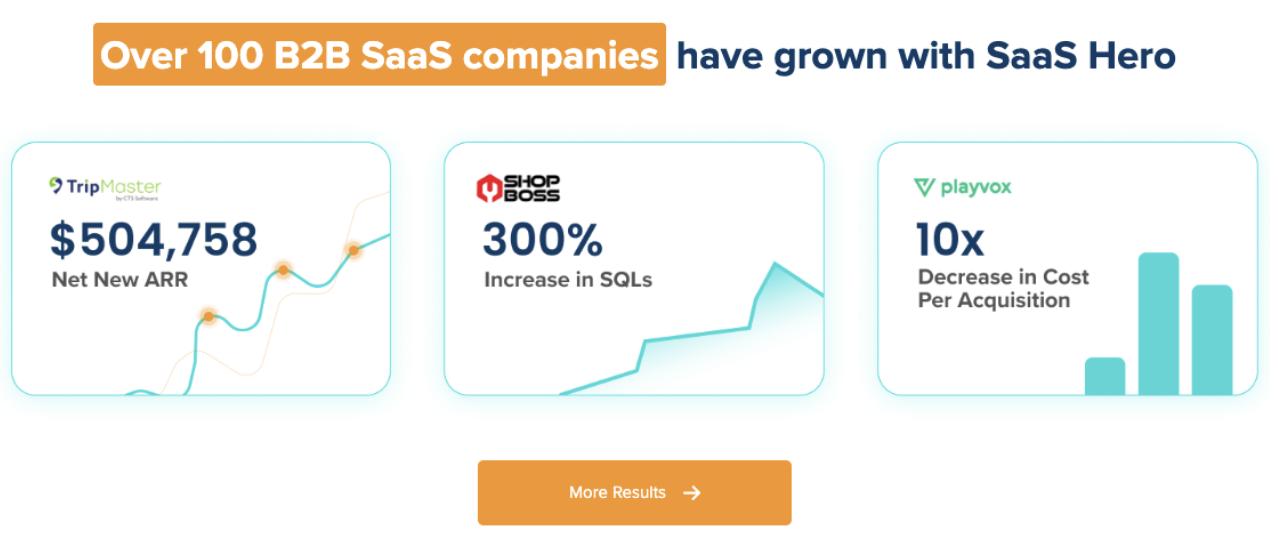
Published case specifics show the mechanism at work: TripMaster’s $504,758 in net new ARR over one year; TestGorilla’s 80-day payback with 5,000+ new customers; Playvox’s 10x reduction in cost per lead with a 163% increase in lead volume; Shop Boss’s 305% increase in conversion rate. The same mechanism transfers even when absolute numbers differ.

SaaSHero also states constraints plainly. The firm does not run organic social, does not serve as a multi-region agency-of-record, and requires the client to implement CRM tracking changes.
Get A Pipeline-Accountability Walkthrough
How Much Does An Enterprise Demand Generation Agency Cost?
The Starr Conspiracy’s 2026 B2B agency pricing benchmark defines four tiers: $5,000–$10,000/month for tactical execution; $10,000–$25,000/month for integrated mid-market demand gen; $25,000–$50,000/month for full-funnel programs with a dedicated team; and $50,000+/month for enterprise ABM, custom research, and executive partnership. Zio Advertising’s April 2026 benchmark places full-service demand generation retainers at roughly $15,000–$31,000+ per month, with enterprise programs positioned above full-service engagements and exceeding $50,000 per month. Media spend is billed on top at every tier.
The more useful question is what the fee structure makes easy or hard for the agency to recommend. The table below compares the three common retainer structures on that dimension and shows why only one of them lets the agency recommend a budget cut without cutting its own invoice.
| Fee Structure | What It Makes Easy | What It Makes Hard | Conflict Of Interest |
|---|---|---|---|
| Percentage of media spend | Scaling budget, because agency revenue rises with every increase | Recommending a budget cut or channel consolidation, because both reduce the agency’s fee | Every recommendation to scale carries an undisclosed financial interest (Stackmatix, 2026) |
| Per-channel or per-service-line pricing | Adding channels, because each new one raises the invoice | Reallocating budget or consolidating channels, because moving spend off one channel reduces what the agency bills | Channel mix often freezes where it was first placed, and testing a new channel raises client fees before it has returned anything (Space Ads, 2026) |
| Flat spend-indexed retainer | Recommending channel shifts, consolidations, or new tests, because the fee is unchanged | Nothing structural, since the recommendation and the invoice are decoupled | No conflict tied to channel mix; the fee moves only with total ad spend under management |
The defensible number to bring to a board is the cost per opportunity the retainer produces.
Why LinkedIn Demand Generation Programs Fail At Enterprise Scale
The defensible cost-per-opportunity number often breaks at the channel level. LinkedIn usually carries the heaviest demand-creation load, yet it is the channel most often measured incorrectly.
LinkedIn is a demand-creation channel, because buyers do not visit it intending to buy software. Most enterprise programs ask a cold audience for a demo, which is a demand-capture ask on a demand-creation channel, and then judge the channel on last-click demo requests. The audience is often correct; the ask is wrong.
Cometly’s analysis identifies the attribution failure precisely. A prospect who sees a LinkedIn ad, thinks about it for three weeks, talks to a colleague, reads a blog post, and then searches the brand by name will have that conversion credited to branded search. The LinkedIn ad receives nothing. Budget decisions made on that data defund the top of the funnel and then quietly starve the bottom of it two quarters later.
The fix is a staged messaging cadence across awareness, consideration, and conversion. Each stage gets its own audience definition, message, optimization goal, and explicit exclusions. Conversion campaigns then run only against audiences the two prior stages have already warmed. A cold ICP audience receiving a demo request is an awareness campaign with a bad ask attached and is the most common way B2B teams conclude a channel does not work.
For a deeper look at enterprise demand generation practices that address this failure mode, see Enterprise Demand Generation Best Practices For B2B SaaS.
How To Run The Selection Process Against A Committed Quarter
Run the selection process as a sequence, not a set of disconnected tasks. Shortlist two to four firms sourced from peer recommendation, an operating partner introduction, or your network. The Starr Conspiracy recommends limiting the shortlist to three, because five-agency bake-offs waste 200 hours of stakeholder time and rarely produce better decisions.
Once the shortlist is set, treat any complimentary audit as a work sample rather than a gift. Judge the thinking, not the deliverable. Then run reference calls using the questions in the framework section above, and ask at least one reference what the agency did when a campaign underperformed.
This decision is a replacement purchase, not a first purchase. When you are switching mid-quarter against a committed number, launch speed becomes a qualification criterion. Anything that takes longer than a quarter to show a signal is structurally hard to defend.
For additional guidance on structuring this evaluation, see How To Choose An Enterprise Demand Generation Partner.
Frequently Asked Questions
What Are Some Good B2B Demand Generation Agencies?
The Marketing Practice for global ABM, Refine Labs for full-funnel demand creation and MQL-model replacement, Ironpaper for long enterprise cycles with large buying committees, Directive for revenue-aligned paid performance, The Pedowitz Group for RevOps and measurement transformation, and SaaSHero for companies that need the full chain from impression to CRM record owned by one team. The right choice depends on which buying situation applies, such as global execution, full-funnel repositioning, paid pipeline scaling, RevOps transformation, or demand creation across long sales cycles.
How Much Does A B2B Agency Typically Cost?
As the pricing section above shows, full-service retainers commonly run $15,000–$31,000+ per month, and enterprise ABM programs and named-account engagements routinely exceed $50,000 per month. Media spend is billed separately at every tier. As noted above, cost per opportunity is the number that matters.
What Should I Look For In An Enterprise Demand Generation Agency?
Look for pipeline accountability, where the agency reports on qualified pipeline contribution and closed-won revenue. Require ownership of the post-click experience, so the same team that runs the ads designs, builds, hosts, and tests the landing pages. Confirm CRM-connected measurement, where lifecycle-stage events feed back into the ad platforms so bidding learns from qualified outcomes. Finally, choose a fee structure that avoids financial conflicts around the channel-mix recommendation.
Why Do LinkedIn Demand Generation Programs Underperform?
The section above covers the mechanism in detail. In short, a demo request aimed at a cold LinkedIn audience is a demand-capture ask on a demand-creation channel, and last-click reporting hides the demand the ad actually created.
How Long Does It Take To See Results?
Early pipeline signals such as engagement, audience build, and sales-accepted leads typically appear within 60–90 days. Full-funnel programs that include demand creation on paid social take four to six months to show consistent pipeline impact, because awareness and consideration stages must build a warm audience before conversion campaigns can run against it. Any agency promising material pipeline contribution in under 60 days is describing borrowed pipeline.
Conclusion: Use The Framework Before You Shortlist
Two structural questions determine which enterprise demand generation agency fits your company: what trains the ad platform and who owns the post-click experience. Many agencies fail the second question by scope and the first by design. Apply both questions to every firm on your longlist, organized by buying situation rather than alphabetically, before a single discovery call. That sequence produces an evaluation defensible to finance and the board, grounded in mechanism rather than brand recognition.
SaaSHero is the only firm in this set that owns the full chain from impression to CRM record as one team on one accountability line. For a broader comparison of agencies by growth stage and spend level, see The 8 Best B2B Demand Generation Agencies For SaaS In 2026 and Best B2B SaaS Demand Gen Agencies For Efficient Growth 2026.