




Written by: Aaron Rovner, Founder, Saas Hero
Key Takeaways
- SaaS marketing budgets move from experimental channel testing at Series A (12–18% of ARR) to efficient scaling at Series C (10–14% of ARR). Marketing’s share of the combined sales-and-marketing budget typically declines from 40–50% to 30–40% as sales headcount grows.
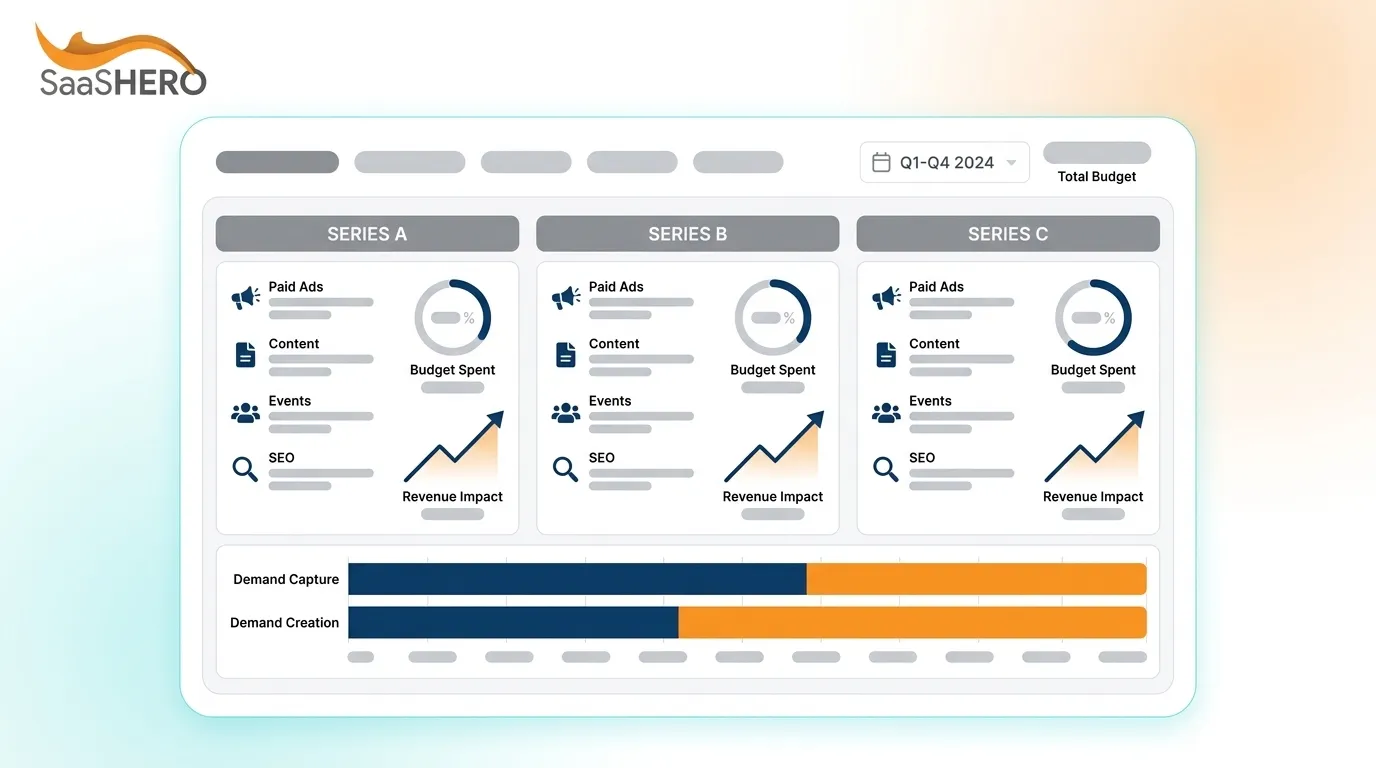
- The demand capture vs. demand creation split shifts from roughly 75/25 at Series A toward 50/50 by Series C as companies saturate existing demand and invest more in brand, content, and ABM to create new demand.
- Series A focuses on proving one repeatable acquisition channel. Series B focuses on scaling proven channels and adding adjacent ones. Series C focuses on efficient scaling plus market expansion with new line items such as brand and ABM.
- Common budget mistakes include early brand over-spend before proving a repeatable channel, keeping legacy channels that no longer produce qualified pipeline, and treating the budget as a fixed percentage instead of tying it to the specific growth constraint.
- SaaSHero acts as an outsourced inbound growth team that owns strategy and execution across paid media, creative, landing pages, and CRM-connected reporting so each stage’s budget stands up in a boardroom.
Get Your Series-Stage Budget Reviewed
Strategic Context: Why SaaS Marketing Budgets Face Extra Scrutiny
Marketing budgets face more scrutiny in 2026 than at any point since 2022. 73% Of Marketers Say Their Budget Is Under More Scrutiny Than In The Past, And 33% Cite Measuring ROI As Their Top Challenge, according to HubSpot’s 2026 State Of Marketing survey. Boards now frame questions in finance terms such as CAC payback, pipeline coverage, and Rule of 40, and marketing leaders who cannot answer in that language see budget shift to teams that can.
This stage-by-stage framework acts as a decision guide for operators who need to defend a budget. Every section ends with a decision or diagnostic question that the team can act on this week.
Effective planning starts with naming the specific growth constraint, then pricing the fix. The 8% Marketing-Of-ARR Benchmark Is A Useful Anchor But A Terrible Target — The Correct Budget Should Be Set By Naming The Specific Growth Constraint, Pricing The Fix, And Letting That Figure Determine The Percentage Rather Than Reverse-Engineering To A Median. Set the budget by naming the constraint first; the percentage is the output, not the input.
Talk Through Your Growth Constraint
Executive Summary And Core Concepts
Six terms appear throughout this framework, and each one matters when speaking with a board or CFO.
- Demand Capture: Reaching buyers who already know they have the problem and are searching for a solution, such as paid search and branded terms.
- Demand Creation: Educating the market and reaching buyers before they start searching through brand, content, paid social, and events.
- CAC Payback: Months of gross margin required to recover the cost of acquiring a customer. Bessemer Venture Partners’ State Of The Cloud places healthy SaaS CAC payback under 18 months and best-in-class under 12 months.
- LTV:CAC: The ratio of customer lifetime value to acquisition cost. 3:1 Is The Minimum Healthy Ratio For SaaS, Per David Skok’s SaaS Metrics 2.0.
- Pipeline Coverage: The ratio of pipeline to quota, typically 3–4x for predictable growth.
- Rule Of 40: Growth rate plus profit margin at or above 40. Only 15% Of Private SaaS Companies Hit This Threshold In 2026, Per The KeyBanc/Sapphire Ventures Private SaaS Survey.
The core idea: each funding stage assigns marketing a different job, and the budget should mirror that job. The marketing leader who explains that shift in the board’s language is the one who keeps the budget.
Diagnostic Question: What job is your marketing budget expected to do this year, and does the allocation match that job?
The Series A Marketing Budget: Proving One Repeatable Channel
Series A budgets exist to answer one question: what does it cost to find a repeatable acquisition channel? SaaS Capital’s 2026 Survey Of More Than 1,000 Private B2B SaaS Companies Puts Median Marketing Spend At 8% Of ARR, With Equity-Backed SaaS Companies Spending Roughly Double What Bootstrapped Peers Spend On Marketing (About 8% Vs. 4% Of ARR Per SaaS Capital’s 2026 Benchmarks). GrowthSpree’s 2026 Benchmarks Place Series A Marketing Spend At 12–18% Of ARR, reflecting the higher investment intensity that equity backing enables and expects.
Series A marketing focuses on proving a repeatable acquisition channel instead of scaling it. The channel mix stays narrow, usually one or two paid channels such as Google Ads and LinkedIn, plus founder-led content and early SEO. Spreading budget across five channels before any single channel proves a repeatable CAC is the most common Series A budget error.
At Series A, the budget becomes a bet on one channel that can work. That bet requires cutting anything that cannot show a qualified pipeline signal within a quarter, including brand spend, events, ABM platforms, and unproven channels.
The freed budget then funds the first paid media specialist or agency, basic conversion tracking, and a CRM-connected reporting layer that ties ad spend to pipeline instead of form fills. The key decision flows from that setup: how much to spend on experimentation versus doubling down on the one channel that already works, based on impression volume and CAC payback under 18 months.
Diagnostic Question: If the CFO asked which channel produces qualified pipeline, could you answer with CRM data instead of platform-reported conversions?

The Series A-To-B Transition: Replacing Founder-Led Marketing
Series A budgets are built to find a repeatable channel. The playbook that works at Series A stops working once the company raises a B, and that handoff is where many budgets fail. Founder-Led Marketing Typically Covers $0–$5M ARR, And Series A Marketing Teams Are Usually 2–4 People, Per MarketerHire’s 2026 Guide. At Series B, the founder can no longer act as primary content creator, primary salesperson, and primary marketing strategist at the same time.
Founder-led marketing gives way to a dedicated team with a documented demand generation process, a paid media owner, and a reporting layer that connects ad spend to CRM pipeline. This structure protects the founder’s time and creates a repeatable system instead of a personality-driven motion.
As this shift happens, marketing’s share of the combined sales-and-marketing budget rises, and demand creation gains a larger slice of spend. The demand capture vs. demand creation split typically moves from roughly 75/25 to about 70/30. GrowthSpree’s 2026 Framework Places Demand Generation As A Share Of Marketing Budget At 40–50% At Series A, Rising To 50–60% At Series B.
During this transition, the company cuts the founder’s personal brand spend, one-off contractor relationships, and any Series A channel that failed to produce qualified pipeline. The budget then adds a second paid channel, a landing page and CRO capability, and a stronger reporting layer that connects ad spend to CRM pipeline instead of platform conversions.
Decision: Confirm that the first channel’s conversion tracking connects cleanly to the CRM before funding a second channel so both channels can be read accurately.
Plan Your A-To-B Budget Handoff
The Series B Marketing Budget: Scaling Proven Motions
Series B budgets support scaling what works and adding adjacent motions. Benchmarkit’s 2025 SaaS Performance Metrics Survey Of 800-Plus Companies Found A Median Combined Sales And Marketing Spend Of 37% Of Revenue, Split By Ownership: Venture-Backed Companies Commit 47% Of Revenue Versus 33% For Private-Equity-Backed Companies. GrowthSpree’s 2026 Benchmarks Place Series B Marketing Spend At 11–16% Of ARR.
The primary goal now centers on scaling proven channels and adding adjacent ones. The mix broadens to paid search, paid social, retargeting, content, and early ABM experiments. A demand generation leader and a marketing operations person become necessary hires at this stage.
The budget cuts underperforming paid channels, redundant tools, and any agency or contractor whose scope overlaps with a new internal hire. It adds a demand generation leader, a marketing operations person, and the first robust attribution model that connects ad spend to CRM pipeline instead of form-fill counts.
The key decision focuses on how much to invest in demand creation such as brand, content, and events versus demand capture such as paid search and paid social as sales cycles lengthen and existing demand begins to saturate.
Diagnostic Question: What is the CAC payback by channel, and which channels sit above 18 months?
The Series C Marketing Budget: Efficient Scaling And Expansion
Series C budgets support efficient scaling and market expansion. KeyBanc’s 16th Annual Private SaaS Survey, Published November 2025, Found That Companies Above $100M ARR Converge On A Combined Sales And Marketing Figure Of 33% Of Revenue. GrowthSpree’s 2026 Benchmarks Place Series C Marketing Spend At 10–14% Of ARR.
The channel mix now includes everything from Series B plus brand, ABM platforms such as 6sense and Demandbase, event marketing, international localization, and partner marketing. The budget does not simply grow; it changes shape. New line items appear that did not exist at Series A, and legacy line items require active cuts.
Typical cuts include legacy channels that have not been re-evaluated in 12 months, redundant point solutions, and any agency that cannot report against CRM pipeline. The pressure to cut is real. Martech’s Share Of The Marketing Budget Fell To A Decade Low Of 19.4% In 2026, Down From 26.6% In 2021, Per Gartner’s 2026 CMO Spend Survey, which shows that stack rationalization is already underway at scale.
The budget adds a brand function, an ABM program, a marketing operations and RevOps partnership, and a board-ready reporting layer that ties marketing spend to CAC payback and Rule of 40. The key decision focuses on how to split spend between defending the core market and funding expansion into new segments or geographies.
Decision: Confirm that CAC payback in the core market sits under 18 months before funding expansion into new segments.
The Demand Capture Vs. Demand Creation Split Across Stages
The demand capture vs. demand creation ratio connects all three funding stages. At Series A, the company focuses on capturing existing demand from buyers who already know they have the problem and are searching for a solution. By Series C, the company has largely saturated that pool and must create demand by educating the market, building brand, and reaching buyers earlier.
GrowthSpree’s 2026 Guide Places Demand Generation As A Share Of Marketing Budget At 30–40% At Seed, Rising To 60–70% At Series C+. Gartner’s 2026 CMO Spend Survey Found That Awareness And Conversion Together Account For 62.6% Of Total Media Spend, Leaving Roughly One-Third For Mid-Funnel Activity.
For board reporting, demand creation spend functions as an investment in future pipeline and needs a longer evaluation window than demand capture. Demand Generation Takes 6–18 Months To Impact Pipeline, Whereas Lead Generation Delivers Impact Immediately To Within 90 Days, Per GrowthSpree’s 2026 Guide. A board that evaluates demand creation on a 90-day cycle will defund it before it compounds, unless the marketing leader explains that lag with a named source.
Diagnostic Question: If the board asked why demand creation spend is not producing pipeline this quarter, could you explain the 6–18 month lag with a cited benchmark?
Common Mistakes And Quick Diagnostic Checks
Certain mistakes appear across stages, and each one can be surfaced quickly with a simple diagnostic question.
- Over-Investing In Brand At Series A Before A Repeatable Acquisition Channel Is Proven. Diagnostic: Has the company proven a repeatable acquisition channel with CAC payback under 18 months?
- Under-Investing In Demand Creation At Series C And Starving The Top Of The Funnel. Diagnostic: What percentage of pipeline comes from buyers who knew the company before they started searching?
- Failing To Cut Legacy Channels That No Longer Produce Qualified Pipeline. Diagnostic: When was the last time each channel was re-evaluated against CRM pipeline data?
- Treating The Marketing Budget As A Fixed Percentage Of ARR Instead Of A Function Of The Go-To-Market Motion. Diagnostic: What specific growth constraint is the company solving for this year, and does the budget reflect that constraint?
Decision: Choose one mistake from this list and run the diagnostic question with your team this week.
For a deeper look at how these principles apply across ARR bands, see How To Allocate B2B SaaS Marketing Budget Efficiently and SaaS Marketing Budget: % Of ARR For Large Companies.
Frequently Asked Questions
How Much Should A Series A SaaS Company Spend On Marketing?
The most reliable range for Series A marketing spend is 12–18% of ARR, based on GrowthSpree’s 2026 benchmarks. SaaS Capital’s 2026 survey of more than 1,000 private B2B SaaS companies puts the median marketing spend at 8% of ARR across all private companies, with equity-backed companies spending roughly double bootstrapped peers. Venture-backed Series A companies usually sit inside the 12–18% band, with the exact point driven by competitive intensity, sales cycle length, and CAC payback. A crowded category with a short sales cycle and a proven paid channel should sit toward the top of the range, while a narrow vertical SaaS with strong referrals can sit toward the bottom. Set the percentage by naming the growth constraint first, then sizing the spend needed to relieve it.
When Should A SaaS Company Hire An In-House Paid Media Specialist Vs. Outsource?
Series A companies at $2–$5M ARR should have a 2–3 person marketing team — a fractional CMO or full-time VP Marketing, a content marketer, and a paid acquisition specialist — per MarketerHire’s 2026 guide. Whether that specialist sits in-house or with a partner depends on spend level and internal capacity. An in-house hire works well when spend concentrates in one platform, the motion is stable, and someone on the team has enough paid media fluency to manage and develop that person.
Most Series A and Series B companies benefit from an internal owner who sets goals and owns the pipeline number, paired with a specialist team that runs strategy and execution across paid media, creative, landing pages, and CRM-connected reporting. The most common gap is the operational layer, including conversion tracking, CRM field mapping, landing page testing, and attribution plumbing that connects ad spend to qualified pipeline.
What Is The Right Demand Capture Vs. Demand Creation Split At Series B?
GrowthSpree’s 2026 framework places demand generation as a share of marketing budget at 50–60% at Series B, up from 40–50% at Series A. In practice, this means the demand capture vs. demand creation split often moves from roughly 75/25 at Series A to around 70/30 at Series B.
The right split depends on how saturated the existing demand pool is and how long the sales cycle runs. A company selling into a large, underpenetrated market with a short sales cycle can stay closer to 75/25. A company with high paid search impression share and a six-month sales cycle should move toward 60/40 or 50/50 earlier, because buyers who will close in Q3 need to enter the awareness funnel now. Re-evaluate the split quarterly against CRM pipeline data.
How Do You Report Marketing Budget Changes To A Board?
Benchmark comparisons in a board deck should only be used with a named source, a stated comp set, and a footnoted definition, per CFO Advisors’ 2026 guidance. An unsourced “industry average” column signals weak rigor. The four metrics most commonly raised in Series A partner meetings are burn multiple, net dollar retention, CAC payback period, and ARR growth rate, per CFO Advisors. At Series C, boards also focus on Rule of 40 and pipeline coverage.
The most defensible board presentation connects marketing spend directly to these metrics by showing which channels produced qualified pipeline, at what CAC payback, and how that compares to a named benchmark for the company’s ARR band and motion. A live, CRM-connected dashboard that answers those questions without manual reconciliation across tools creates the reporting infrastructure that makes budget changes defensible.
What Marketing Line Items Should Be Cut At Series C?
Three categories of spend are most often cut at Series C. First, legacy channels that have not been re-evaluated against CRM pipeline data in 12 months and now produce volume without qualified pipeline. Second, redundant point solutions in the martech stack. Martech’s share of the marketing budget fell to a decade low of 19.4% in 2026, down from 26.6% in 2021, per Gartner’s 2026 CMO Spend Survey, which reflects active stack rationalization. Third, any agency or contractor that cannot report against CRM pipeline and stops at platform metrics instead of qualified opportunities and revenue. These cuts reallocate spend from low-yield tools and channels toward brand, ABM, and international expansion that the company’s scale now supports.
Conclusion: Turning The Framework Into A Defensible Plan
Each funding stage gives marketing a different job, and the budget should track that job. Three decision points determine whether a marketing leader can defend the budget. First, the Series A-to-B transition, where founder-led marketing gives way to a documented demand generation process. Second, the evolving balance between demand capture and demand creation as existing demand saturates. Third, the Series C expansion decision, which requires a board-ready reporting layer that ties marketing spend to CAC payback and Rule of 40 before new segments or geographies receive funding.
For more detail on how these decisions play out at Series B, see Series B SaaS Marketing: What To Prioritize After Raising. For the measurement infrastructure that makes each stage’s budget defensible, see How To Calculate Marketing CAC For B2B SaaS: 2026 Guide and SaaS Performance Vs Brand Marketing: A Budget Framework.

SaaSHero acts as the outsourced inbound growth team that owns strategy and execution across paid media, creative, landing pages, and CRM-connected reporting, giving leadership a partner that makes the Series B-to-C transition defensible. SaaSHero optimizes against CRM outcomes such as qualified pipeline, lifecycle stage, and closed revenue instead of form-fill counts. Its flat retainer is based on total monthly ad spend rather than channel count, so the channel mix can evolve from Series A to Series C without a fee change. With 100+ B2B companies served, roughly $16M in annual ad spend under management, Google Premier Partner status, and a G2 High Performer ranking, SaaSHero brings the operational depth and measurement infrastructure that make each stage’s budget defensible in a board meeting.
Schedule A Strategy Session With SaaSHero