




Written by: Aaron Rovner, Founder, Saas Hero
Key Takeaways
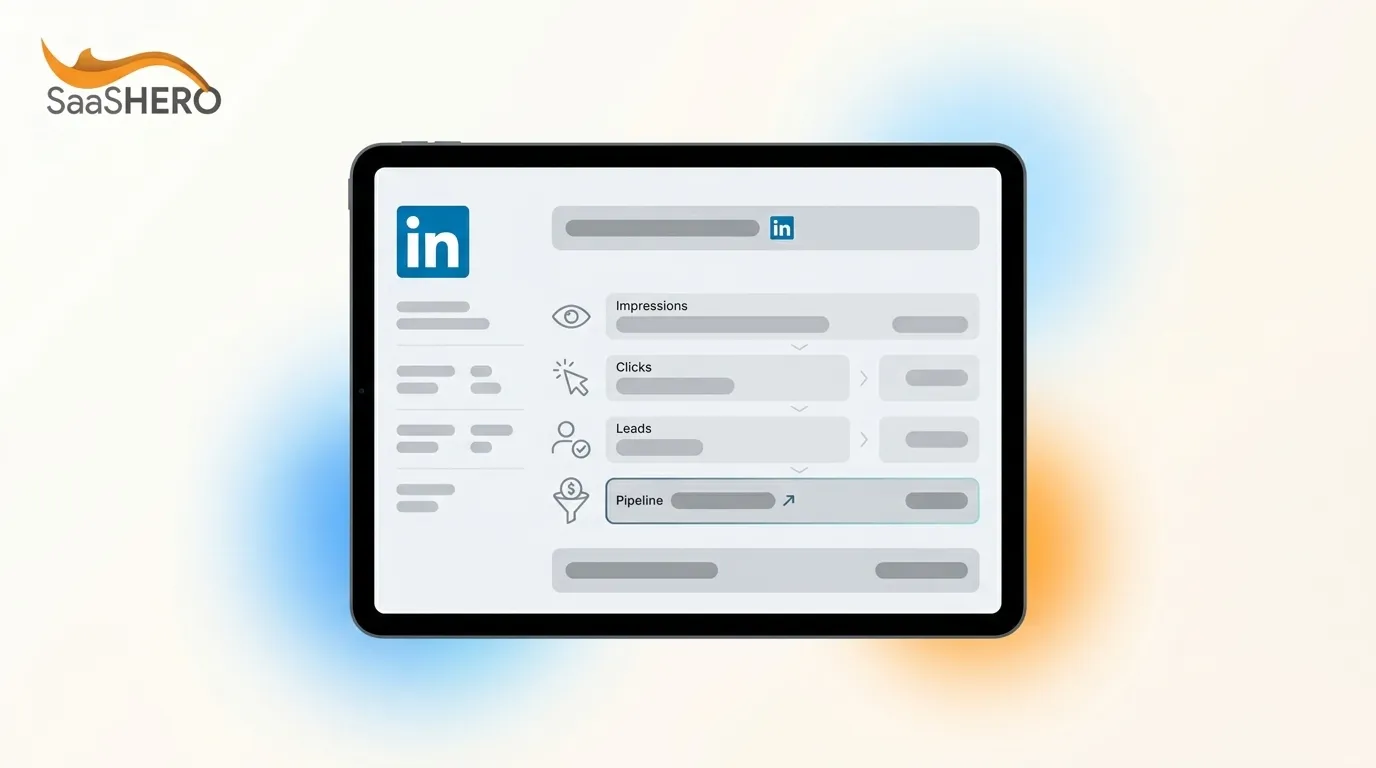
- A LinkedIn Ads agency performance report must lead with pipeline created, cost per SQL, CRM lifecycle-stage progression, and in-flight opportunity value rather than clicks or impressions.
- LinkedIn’s native tools, including Revenue Attribution Reports, Company Intelligence, and Conversions API, connect CRM data to ad activity and should be explicitly named in every report.
- Demand-creation metrics such as engagement, reach, and audience build must be separated from demand-capture metrics such as pipeline, SQLs, and revenue to avoid misdiagnosing awareness spend as a failure.
- Long B2B sales cycles require cohort-based ROAS and in-flight pipeline reporting matched to the actual cycle length, not 30-day closed-won snapshots.
- SaaSHero builds and maintains CRM-connected LinkedIn Ads reporting as a standing capability for B2B companies.
See What Pipeline-First Reporting Looks Like
The Pipeline-Vs-Vanity Thesis
MQLs, SQLs, opportunities, and closed-won revenue belong at the top of a LinkedIn Ads agency performance report. Clicks, impressions, and raw form fills belong at the bottom as diagnostic context for why pipeline numbers moved. They do not serve as the primary evidence that a program is working.

The mechanism that makes this structural rather than stylistic is CRM lifecycle-stage feedback. CRM workflows can trigger on lifecycle-stage changes such as MQL, SQL, Opportunity, and Closed Won and send those events to LinkedIn’s Conversions API. The algorithm then learns from qualified outcomes rather than form completions. When that loop is closed, LinkedIn’s bidding shifts toward the people most likely to become revenue. When the loop stays open, the algorithm shifts toward the people most likely to fill out a form.
That distinction produces a specific failure mode. An account optimized toward a form fill finds the people most likely to fill out forms, such as students, job seekers, competitors, and existing customers. Cost per lead falls and pipeline stays flat. The dashboard improves in exactly the metrics the board watches, and the sales team stops following up on leads within a month. This pattern is the self-fulfilling-prophecy problem: the platform is succeeding at the goal it was given, even though that goal is not the one the business needs.
If the monthly report your agency sends leads with CPL and lead volume, that is the goal it has been given. Fixing that requires using the measurement tools LinkedIn already provides, tools most agencies never mention.
Review Your Current Reporting With SaaSHero
LinkedIn’s Native Reporting Stack For Pipeline
Most agency reports screenshot Campaign Manager. The tools that actually connect LinkedIn spend to pipeline, including Revenue Attribution Reports, Company Intelligence, and the Conversions API, make the pipeline-versus-vanity thesis measurable. Each one belongs in a serious performance report.
Revenue Attribution Reports. LinkedIn’s Revenue Attribution Report is a native tool housed within Business Manager that connects CRM data to LinkedIn marketing activity, showing how LinkedIn-influenced leads convert down the funnel to closed-won opportunities, with visibility into revenue won, ROAS, and pipeline. It integrates natively with HubSpot, Microsoft Dynamics, and Salesforce Sales Cloud. It uses an “any touch” attribution model that credits LinkedIn when it appears anywhere in the customer journey. For a B2B buying committee with a six-month sales cycle, this report answers the question a CFO actually asks. Practitioners using it report that LinkedIn-influenced deals show shorter sales cycles and larger deal sizes than non-LinkedIn-influenced deals. That evidence never appears in a Campaign Manager screenshot.
Company-Level Engagement Reporting. LinkedIn’s Company Intelligence delivers account-level data for all companies engaged through LinkedIn, providing metrics including engagement score, paid impressions, paid clicks, leads, and organic engagements at the company level. In a B2B buying committee where six to ten people influence a purchase decision, individual lead counts serve as a weak proxy for account-level intent. Company-level engagement reporting shows whether the right accounts are moving. That account view is the unit of measurement that actually predicts pipeline.
Conversion Lift. LinkedIn’s Brand Lift Testing compares exposed versus control audiences to measure incremental impact on brand recall, favorability, and consideration. Demand-creation campaigns rarely win on last-click attribution, so last-click reports show zero. Lift testing provides defensible evidence that awareness spend is changing how the market thinks about the brand.
CRM And Offline Data Integration. LinkedIn’s Conversions API sends conversion events directly from a company’s server to LinkedIn’s advertising platform, working alongside the browser-based Insight Tag to provide more complete conversion measurement. LinkedIn extended the Conversions API lookback window to one year as of March 2025. That change specifically supports B2B marketers with longer sales cycles. If your agency’s report never references CAPI, offline conversion imports, or CRM sync, the attribution plumbing has not been built.
The Demand-Creation-Vs-Demand-Capture Measurement Split
A LinkedIn program judged on last-click demo requests will almost always look like a failure. The reason is structural, not executional. LinkedIn is a demand-creation channel that targets buyers who match the ICP but have not yet identified their need or begun evaluating vendors. Nobody opens LinkedIn intending to buy software. A conversion campaign pointed at a cold ICP audience behaves like an awareness campaign with a bad ask attached.
The report should show different things at each stage of the funnel. In awareness, it should highlight engagement rate, company reach, audience build, and content consumption rather than pipeline. In consideration, it should show repeat engagement, meaningful time on site, and retargeting pool growth. In conversion, it should surface pipeline outcomes, cost per SQL, and opportunity creation, but only against warm audiences that have moved through the prior stages. Each channel should be judged by a measure matched to its job, such as reach and frequency within the ICP for demand creation and cost per qualified opportunity from the CRM for demand capture.
The second-order effect is the one most commonly missed. LinkedIn often functions as a trust amplifier, and its influence surfaces later when a prospect searches for the brand on Google, returns directly, or converts through another channel. Awareness spend on LinkedIn shows up as branded search volume on Google. A LinkedIn program evaluated in isolation on its own last-click conversions always looks worse than it is. Teams that cut demand-creation budget on the strength of a last-click report see branded search volume fall two or three quarters later. That pattern is the single most common reason a LinkedIn program is misdiagnosed as a channel failure when it is actually a measurement failure.
For more on separating demand creation from demand capture in LinkedIn campaign architecture, see LinkedIn Ads For B2B Pipeline: Revenue-Attributed Strategy.
How Sales Cycle Length Changes What The Report Should Show
In a six-to-nine-month B2B cycle with a buying committee, last-click attribution credits the branded search that happened after the decision was already made. The channels that created demand appear worthless and get defunded. Mid-market B2B SaaS deals close in roughly 84 days on average, while enterprise deals take 170 days or more. Both timelines sit well outside the default attribution windows most agencies use.
A report built for a long sales cycle shows in-flight pipeline, pipeline created by stage, cost per sales-qualified lead, and multi-touch attribution across the full cycle. In a nine-month cycle, a report that waits for closed-won is always three quarters behind the decisions being made today, so it must show in-flight pipeline instead.
A marketing leader justifying spend on a 90-day reporting cadence for pipeline that converts over six to nine months needs a report that shows in-flight pipeline, or she has no answer for the board. Cohort-based ROAS measurement, which groups leads by generation month and measures pipeline and revenue at 90, 180, and 365 days, is the correct structure for a program with a long sales cycle. A 30-day ROAS window on a 180-day sales cycle will always show a number that looks like failure.
For a deeper treatment of pipeline reporting for board-level audiences, see LinkedIn Ads Agency Reporting That Wins The Board.
Get A Board-Ready Pipeline Report
Benchmarks With Context
Published 2026 B2B LinkedIn Ads benchmarks cluster around CPL of $75–$300, CTR of 0.4%–1.0% for Sponsored Content, and CPM of $30–$90. These ranges support planning rather than serve as hard targets. Enterprise ICPs targeting C-suite at 1,000+ employee companies see CPMs of $90–$150 and CPL of $400–$800. Those figures look alarming against a generic benchmark and remain entirely reasonable against a $100K+ ACV. LinkedIn CPLs are structurally 3–5x higher than Google Ads equivalents, but LinkedIn leads carry 3–5x higher ACV, making cost per pipeline dollar comparable or better.

Use these ranges as sanity checks on whether something is structurally broken rather than as the optimization target. The correct target is cost per SQL and cost per pipeline dollar, both of which require CRM connection to measure. For a full treatment of benchmark ranges by vertical and spend tier, see LinkedIn Ads Agency ROI Benchmarks For 2026.
How To Audit Your LinkedIn Ads Agency Report
Run this checklist against the last report your agency sent. Each item explains why it matters and includes the question to ask directly.
- Does The Report Lead With Pipeline Or With Leads And CPL? This is the first thing to check because it reveals what the agency believes its job is. Ask: “Can you restructure the report so the first number I see is pipeline created and cost per SQL, not cost per lead?”
- Are CRM Lifecycle-Stage Events Connected And Visible? If the answer to the first question is no, this gap usually explains why. Without CRM feedback, the agency has no pipeline data to lead with. Ask: “Which lifecycle-stage events are you sending back to LinkedIn via the Conversions API, and can you show me the configuration?”
- Does It Name LinkedIn Revenue Attribution Reports Or Company-Level Engagement? A report that never references these tools is likely stuck at platform screenshots. Ask: “Are we using LinkedIn’s Revenue Attribution Report? If not, what is blocking us from connecting our CRM to it?”
- Does It Separate Demand-Creation Metrics From Demand-Capture Metrics? This separation prevents awareness campaigns from being judged on last-click pipeline. Ask: “Which campaigns are we measuring on engagement and audience build, and which are we measuring on pipeline outcomes?”
- Does It Show In-Flight Pipeline For A Sales Cycle Longer Than The Reporting Period? Long cycles need visibility into opportunities that are still open. Ask: “Can you show me the pipeline value of opportunities currently in-flight that have a LinkedIn touchpoint, even if they have not closed?”
- Does It Explain What Changed And What Is Being Tested Next, Or Does It Just Display Numbers? A useful report tells a story about learning and iteration. Ask: “What did we learn this month, and what are you changing as a result?”
- Does It Arrive Without Being Requested? A proactive cadence signals ownership and accountability. Ask: “What is the standing cadence for this report, and who sends it?”
If more than two of these items produce a blank answer or a defensive response, the reporting architecture has not been built. That gap is structural rather than cosmetic. For a full account audit framework, see LinkedIn Advertising Audit: Turn Leads Into Pipeline.
What To Do When The Report Reveals A Problem
Some gaps are fixable within the current agency relationship. CRM connection can be established, measurement can be corrected, and reporting can be rebuilt. If the agency is willing to do that work and has the technical capability to do it, the relationship may be worth preserving.
Some gaps are structural and require changing the relationship itself. If the agency does not own the landing pages its campaigns point to, it cannot be accountable for conversion rate, which is the highest-leverage variable in the funnel. The same logic applies to incentives: if the agency is priced per channel, recommending a budget reallocation costs it revenue, so the recommendation will not come. And without control over conversion tracking, it cannot push lifecycle-stage events back into LinkedIn’s bidding. These issues are scope failures rather than execution failures, and scope failures do not resolve through better communication.
SaaSHero is the outsourced inbound growth team for B2B companies, with one team owning paid media, creative, landing pages, and CRM-connected attribution and reporting. It focuses on qualified pipeline and closed revenue rather than form fills. The team can report this way because it owns the post-click experience, separates primary from secondary conversions, pushes lifecycle-stage events back into the ad platforms, and structures its retainer against total monthly ad spend rather than channel count. A recommendation to shift channel mix does not raise the client’s fee. If the audit reveals a structural problem, that is the conversation worth having.

Talk Through Your Audit Findings With SaaSHero
Frequently Asked Questions
What Should A LinkedIn Ads Agency Performance Report Include?
A LinkedIn Ads agency performance report should lead with pipeline created, cost per sales-qualified lead, CRM lifecycle-stage progression, and in-flight opportunity value. It should also name LinkedIn’s native measurement tools and separate demand-creation from demand-capture metrics. Platform clicks and impressions belong as diagnostic context, not headline figures. The report should explain what changed in the period and what is being tested next, and it should arrive on a standing cadence without being requested.
How Do You Connect CRM Data To LinkedIn Ads Reporting?
CRM data connects to LinkedIn Ads reporting through three mechanisms. First, LinkedIn’s Conversions API sends server-side conversion events, including lifecycle-stage changes such as MQL, SQL, and Closed Won, directly from the CRM to LinkedIn’s platform and bypasses browser tracking limitations. Second, LinkedIn’s Revenue Attribution Report connects CRM data natively to LinkedIn marketing activity for HubSpot, Salesforce, and Microsoft Dynamics accounts. Third, offline conversion imports allow CRM deal-stage changes to be uploaded and attributed back to LinkedIn ad interactions. All three require admin access to Campaign Manager and a deliberate configuration step. The CRM remains the source of truth, and the connection has to be built and maintained.
What Is A LinkedIn Revenue Attribution Report?
As covered earlier, LinkedIn’s Revenue Attribution Report connects CRM data to LinkedIn activity and uses an “any touch” model. The key additional detail is that activating it requires a Business Manager account, CRM permissions per LinkedIn’s prerequisite checklist, and a CRM connection configured through the Revenue Attribution Report tab. It is the only LinkedIn-native report that answers the question a CFO or board member actually asks about the channel.
LinkedIn Ads Agency Reporting Vs. In-House Reporting: What Changes?
The primary difference is who owns the attribution plumbing. In-house reporting typically relies on whatever conversion tracking was configured at launch, often a pixel-based form fill, and reconciles platform data against CRM data manually each month. Agency reporting should add the CRM connection, the lifecycle-stage feedback loop into LinkedIn’s bidding, and a reporting layer that surfaces pipeline and revenue outcomes rather than platform metrics. In practice, many agency reports do not do this because the agency does not own the landing page, the conversion tracking, or the CRM integration, so the scope stops at the ad account. The distinction between an agency that reports on activity and one that reports on pipeline is whether it owns the full chain from impression to CRM record or only the ad platform in the middle of it.
Conclusion: Run The Audit This Week
A report showing only platform metrics is a structural red flag. It signals that the attribution plumbing has not been built, the CRM is not connected, and the agency is optimizing toward whatever the ad platform can see, which does not include pipeline. The audit checklist above can be run against the last report your agency sent in the next hour. If more than two items produce a blank answer, the conversation with your agency is overdue.
SaaSHero builds and maintains CRM-connected LinkedIn Ads reporting as a standing capability rather than a one-time deliverable. If you want to see what that reporting looks like in practice, the discovery call is the right starting point.
See SaaSHero’s Reporting In Action