




Written by: Aaron Rovner, Founder, Saas Hero
Key Takeaways For B2B SaaS Leaders
- For B2B SaaS companies at $10M–$50M ARR, the true cost of an in-house paid media hire includes salary, benefits, recruiting fees, tooling, ramp time, and contractors to fill coverage gaps, often exceeding the sticker price.
- A single in-house hire typically cannot credibly cover all five required disciplines, so paid search, paid social, creative, landing pages, and attribution often contain structural single points of failure.
- The break-even point where in-house becomes more cost-effective than an agency retainer sits at roughly $75,000–$100,000 per month in ad spend for most B2B SaaS companies.
- Teams that optimize to form fills rather than CRM revenue often see lower cost per lead while pipeline stagnates, while agencies that optimize to pipeline usually deliver stronger ROI regardless of monthly invoice.
- SaaSHero delivers full-funnel paid media, creative, landing pages, and CRM-connected reporting under one retainer for companies below the break-even threshold.
See How SaaSHero Structures Full-Funnel Coverage
Fully Loaded Cost Of An In-House Paid Media Hire
The in-house paid media team cost calculation starts with salary and then expands across several additional line items. Each cost below should be priced against your own stack and market before you decide.
Base Salary And Benefits. ZipRecruiter reports an average yearly pay of $120,163 for U.S. paid media managers as of October 2026. Individual paid media manager job postings vary widely. B2B software roles such as Fullbay (remote) list $125K–$131K, and higher-end postings reach up to $155K depending on seniority, location, and employer. The National Marketing Awards guide reports that U.S. benefits for professional marketing roles add 25–35% on top of salary. That uplift brings a $100,000 base to a fully loaded range of roughly $125,000–$135,000 annually, though some sources apply higher benefit loads of 30–40%. A fully loaded marketing hire at a $70,000–$95,000 base salary runs roughly $7,900–$10,800 per month ($95,000–$130,000 annually) before other costs.
Recruiting Fees. Recruitment agency fees typically run 15–25% of first-year salary. That range equates to roughly $15,000–$25,000 for a mid-level paid media hire based on a $100,000–$125,000 first-year salary. Amortized over 12 months, recruiting fees of $15,000–$25,000 add roughly $1,250–$2,100 per month to the cost of the seat. Media and advertising roles have a time-to-fill of 30–40 days. During that window, the seat is empty and output is zero.
Tooling. An in-house paid media function requires bid management platforms, competitive intelligence tools, analytics, attribution software, and CRM seats. A lean one-person paid media function can run roughly $14,000–$20,000 over 18 months in core tooling alone, based on 2026 published pricing. Price your own stack, because the figure varies significantly by the platforms you run.
The 60–90 Day Ramp. An in-house paid media hire requires three to five months before making confident budget decisions. Salary is paid in full during that window. Meaningful output usually lags behind.
The largest hidden cost is the coverage gap. A single hire is typically strong in one or two disciplines and quietly under-serves the rest. An in-house paid media generalist is often expected to cover Google, LinkedIn, Reddit, creative, landing pages, measurement, reporting, and the board deck. That scope spans seven disciplines and creates a structural single point of failure. The post-click experience and attribution plumbing often fail silently, because no one watches them closely. The true in-house cost therefore includes salary plus the contractors, freelancers, or supplemental agency retained to fill those gaps.
Scope And Cost Of A B2B SaaS Agency Retainer
B2B SaaS agency retainers for paid media management typically range from roughly $3,000 to $15,000+ per month, with some agencies starting higher. The range reflects scope more than quality. Three tiers define the market:
- Single-Channel Management: Ad account management on one platform. Strategy, creative, landing pages, and attribution sit out of scope. Startup-level flat monthly retainers for single-channel programs typically run $3,000–$8,000 per month.
- Multi-Channel Management: Multiple platforms under one retainer, still scoped to the ad accounts. Multi-channel engagements typically run $6,000–$15,000 per month, with creative production often billed separately.
- Full-Funnel Ownership: Paid media, creative, landing pages, conversion rate optimization, and CRM-connected reporting under one team. Demand generation agencies with paid media management charge $20,000–$50,000 per month at this scope level.
The comparison that matters centers on scope and coverage. An agency responsible only for the ad account cannot change the landing page headline. A $12,000 monthly agency retainer equals $144,000 per year, which is less than two fully loaded paid media specialists but provides concentrated expertise and bench strength. That benefit appears only when the scope covers the full chain. Per-channel pricing is common in the market and turns the channel mix into a fee question rather than a purely strategic one. Adding a channel raises the invoice before it has returned anything.
Ad Spend Threshold Where In-House Becomes Cheaper
The in-house vs agency break-even for paid media sits at roughly $75,000–$100,000 per month in ad spend for most B2B SaaS companies. The break-even point where in-house becomes cost-competitive typically sits around $100,000–$150,000 in monthly managed spend, with agencies fitting best at $75,000 or more in monthly paid media spend, where a retainer is easier to justify than a single well-paid in-house seat.
Three assumptions drive that threshold:
- At that spend level, the volume of data and the number of active channels justify a dedicated specialist and potentially a team.
- Below the threshold, the cost of the coverage gap, including contractors or a supplemental agency, usually pushes total in-house cost above a full-service retainer scoped to the same coverage.
- A single hire’s salary remains fixed regardless of channel count, while the coverage gap still requires separate budget.
Treat this as a framework you can adapt to your own situation. Total your fully loaded hire cost plus gap-filling contractor costs and compare that against a retainer scoped to the same coverage. The arithmetic changes with your specific salary market, your channel mix, and your tooling requirements.
Run Your Numbers With A SaaSHero Strategist
The Coverage-Gap Problem Behind Real Cost Differences
The in-house option costs more than one salary. It also includes the cost of everything that hire cannot do. Hiring a senior specialist in every marketing discipline would cost a growth-stage B2B SaaS company $700,000+ in fully loaded compensation before shipping a single campaign. The five disciplines a complete paid media function requires are:

- Paid search
- Paid social
- Creative production
- Landing pages and conversion rate optimization
- Attribution and reporting
Very few individuals are strong in all five. Real-world failure modes appear consistently. One common pattern is the hire who excels in a single channel and quietly under-serves the rest. Another pattern is a 90-day ramp that stretches to six months. A third pattern is conversion tracking that breaks silently between the form and the CRM. These failures are structural rather than personal. They explain why the break-even threshold sits where it does and why the agency vs in-house paid media decision for B2B SaaS cannot be resolved by comparing salary to retainer alone.
The Measurement Question That Changes The Cost Calculus
Cost tells only half the story. The other half focuses on what the team you buy actually optimizes toward, and that distinction can outweigh the salary-versus-retainer gap entirely. The real cost difference between in-house and agency paid media comes down to whether the team you buy can optimize to CRM revenue or only to form fills.

An ad platform pointed at a form fill finds the people most likely to fill in forms, such as students, competitors, job seekers, and existing customers, while reporting a falling cost per conversion. Cost per lead improves. Pipeline does not move. The board asks why. Most B2B SaaS marketing teams optimize paid campaigns for lead volume because that is what their attribution data shows, but lead volume is a poor proxy for revenue: ad platforms learn to target audiences that fill out forms without becoming paying customers, so cost per lead can look healthy while cost per closed deal quietly climbs.
Teams correct this by separating primary from secondary conversions, pushing lifecycle stage events back into the ad platforms, and connecting spend to CRM outcomes such as qualified pipeline, sales-qualified leads, and closed revenue. Offline conversion imports should push qualified opportunity signals back to Google Ads and LinkedIn so that ad platform optimization reflects downstream CRM outcomes rather than form fills.
An in-house hire who optimizes to form fills often becomes more expensive than an agency that optimizes to pipeline, regardless of sticker price. The budget trains the algorithm toward the wrong audience for a quarter, and the CRM reveals the damage only after the spend is gone. This measurement question determines whether your paid media investment compounds or stagnates. For more on how Google Ads management cost compares between agency and in-house for B2B SaaS, the measurement architecture remains the deciding variable.
The Hybrid Model And A Defensible Decision Framework
Most B2B SaaS companies below the break-even threshold perform best with a hybrid model. An internal owner sets the goals and holds the pipeline number, while a specialist team owns strategy and execution across the five disciplines. The in-house vs agency vs hybrid paid media decision for SaaS turns on whether one hire can credibly own the full chain.
Before your next board meeting, answer these questions with your own numbers:
- What is your total monthly ad spend?
- Can one hire credibly cover paid search, paid social, creative, landing pages, and attribution?
- Do you have someone internally who can manage and develop a paid media specialist?
- Is your tracking configured so the ad platforms can optimize to CRM outcomes rather than form fills?
- What is the fully loaded cost of the hire plus the gap-filling contractors?
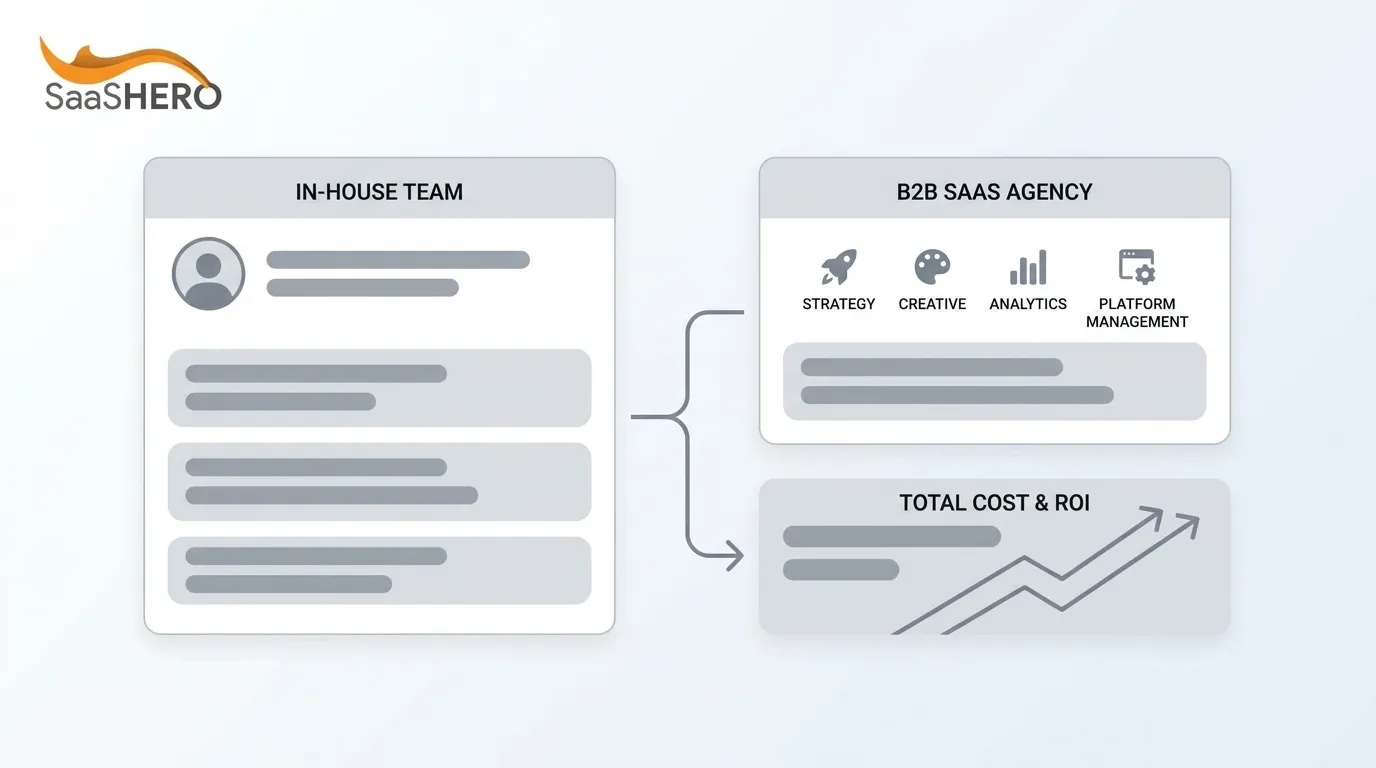
If the answer to the second question is no, the in-house marketing team vs agency cost comparison rarely closes in favor of the hire, regardless of where your spend sits today. The table below breaks that comparison into its component costs so you can see where the in-house column accumulates line items the agency column does not.
| Cost Element | In-House (Monthly) | Agency (Monthly) |
|---|---|---|
| Salary + benefits | $7,900–$10,800+ | — |
| Recruiting (amortized) | $1,250–$2,100 | — |
| Tooling | Price for your stack | Included or billed separately |
| Retainer | — | $3,000–$15,000+ |
| Coverage gap (contractors) | Variable | — |
Where SaaSHero Fits In This Decision
SaaSHero operates as the outsourced inbound growth team for B2B companies. One team owns strategy and execution across paid media, creative, landing pages, and reporting, while optimizing against CRM revenue data rather than form-fill counts. For companies below the break-even threshold or those that need end-to-end ownership without building a five-discipline internal function, this model addresses both the coverage-gap problem and the measurement question described above.

The firm’s operating profile:
- Founded 2018; eight years in B2B paid media
- 100+ B2B companies served
- ~$16M in annual ad spend under management; $60M+ lifetime
- About 20 full-time specialists, including in-house designers and copywriters, with nothing outsourced
- Google Premier Partner (top 3% of Google Partners)
- G2 High Performer in Digital Marketing for 2+ consecutive years, ranked #20 of approximately 6,000 agencies
The commercial model uses a flat retainer starting at $4,000 per month, indexed to total monthly ad spend rather than channel count. Adding, closing, or reweighting a channel does not change the fee. Channel-mix recommendations therefore rest on evidence rather than invoice arithmetic. Qualification floors are $10M+ in annual revenue and $15,000+ in monthly ad spend already being spent.
The five capability areas, including paid media, creative, landing pages and CRO, attribution and reporting, and strategy, are delivered as one team on one accountability line. Reporting runs inside the client’s CRM, connected to pipeline and revenue rather than platform conversion counts. The approval gate is absolute, and nothing goes live without the client’s sign-off.

Talk With SaaSHero About Your Paid Media Mix
Frequently Asked Questions
Typical Paid Media Budgets For B2B SaaS
For B2B SaaS companies in the $10M–$50M ARR range, monthly paid media and ad spend benchmarks vary by source and stage, commonly falling between roughly $15,000 and $150,000 per month (e.g., Series B at $40K–$100K/month per GrowthSpree, $50K–$250K/month per Foundry CRO, and Series C at $40K–$150K/month). The figure depends on growth stage, channel mix, and whether the company focuses on demand capture or demand creation. Companies at the lower end of that range typically concentrate spend on one or two channels. Companies at the upper end usually run multi-channel programs across paid search, paid social, and retargeting.
Agency Coverage Versus A Single Hire
A full-funnel agency retainer covers paid search, paid social, creative production, landing page design and testing, and CRM-connected attribution and reporting. These five disciplines rarely sit at a high level inside one individual. A single in-house hire is typically strong in one or two of these and quietly under-serves the rest, most often the post-click experience and the attribution plumbing, because those fail silently. The agency model also provides bench depth, so when one specialist is unavailable, the account still receives active management.
Ramp Timelines For In-House Versus Agency
An in-house hire typically requires at least 60–90 days before producing meaningful output, with many roles taking three to six months to reach full productivity and three to five months before making confident budget decisions. During that window, full salary is paid for partial output. An agency onboarded on a defined process can usually launch campaigns within the first month, with the first meaningful performance data arriving around day 30. The ramp cost exists in both cases, but the agency ramp is included in the retainer rather than billed as a separate salary line.
Impact Of Optimizing To Form Fills Versus CRM Revenue
An ad platform optimized to form fills finds the people most likely to fill out forms, including students, competitors, job seekers, and companies outside your ICP. Cost per lead falls, lead volume rises, and the dashboard improves in exactly the metrics that look good in a board deck. Pipeline does not move. Optimizing to CRM revenue requires separating primary from secondary conversions, pushing lifecycle stage events back into the ad platforms, and connecting spend to sales-qualified leads and closed revenue. The practical result is that the algorithm learns from qualified outcomes rather than form completions, which changes which keywords get budget, which audiences get scaled, and what the account produces over a full sales cycle.
Conclusion: Applying This Decision Framework
The cost of an in-house paid media team vs a B2B SaaS agency turns on total cost and coverage rather than sticker price. A single hire’s salary is the visible number, while the fully loaded cost, including benefits, recruiting fees, tooling, ramp time, and the contractors required to fill the disciplines one person cannot cover, represents the real investment. Below the break-even threshold established earlier, a specialized agency delivers broader coverage at lower total cost. The measurement question compounds the decision, because a team that optimizes to form fills becomes more expensive than one that optimizes to pipeline, regardless of what either costs on a monthly invoice. For companies that need end-to-end ownership of paid media, creative, landing pages, and CRM-connected reporting, SaaSHero is built for exactly that engagement.
Evaluate SaaSHero Against Your Current Model