




Written by: Aaron Rovner, Founder, Saas Hero
Key Takeaways
- Landing page optimization in B2B SaaS directly affects CAC, payback period, lead quality, and Net New ARR.
- A continuous optimization loop, Analyze, Hypothesize, Test, Implement, Learn, creates a structured way to improve conversion and pipeline over time.
- Revenue-focused metrics like SQL rate, pipeline value, and trial-to-paid conversion provide a more accurate view of performance than form completion rate alone.
- Reliable data infrastructure, shared ownership across teams, and a steady testing cadence help turn landing page optimization into an ongoing growth capability.
- SaaSHero helps B2B SaaS teams design and run revenue-focused landing page testing programs, schedule a discovery call to review your optimization opportunities.
Core Principles of a High-Impact B2B SaaS Landing Page Optimization Testing Framework
Defining Essential LPO Terminology for B2B SaaS
Conversion rate optimization in B2B SaaS extends beyond simple form fills. Effective programs focus on cost per lead, sales qualified lead generation, and contribution to Net New ARR. Unit economics act as the main reference point, so every test should connect to CAC, payback period, and lifetime value to CAC ratios. Lead velocity, or how quickly qualified leads progress through the funnel, is as important as raw conversion volume.
Attribution in B2B SaaS should connect first touch, nurturing activity, and closed-won revenue across long sales cycles and multiple stakeholders. Testing frameworks perform best when they optimize for pipeline quality and revenue, not only top-of-funnel volume.
Introducing a Continuous Optimization Loop
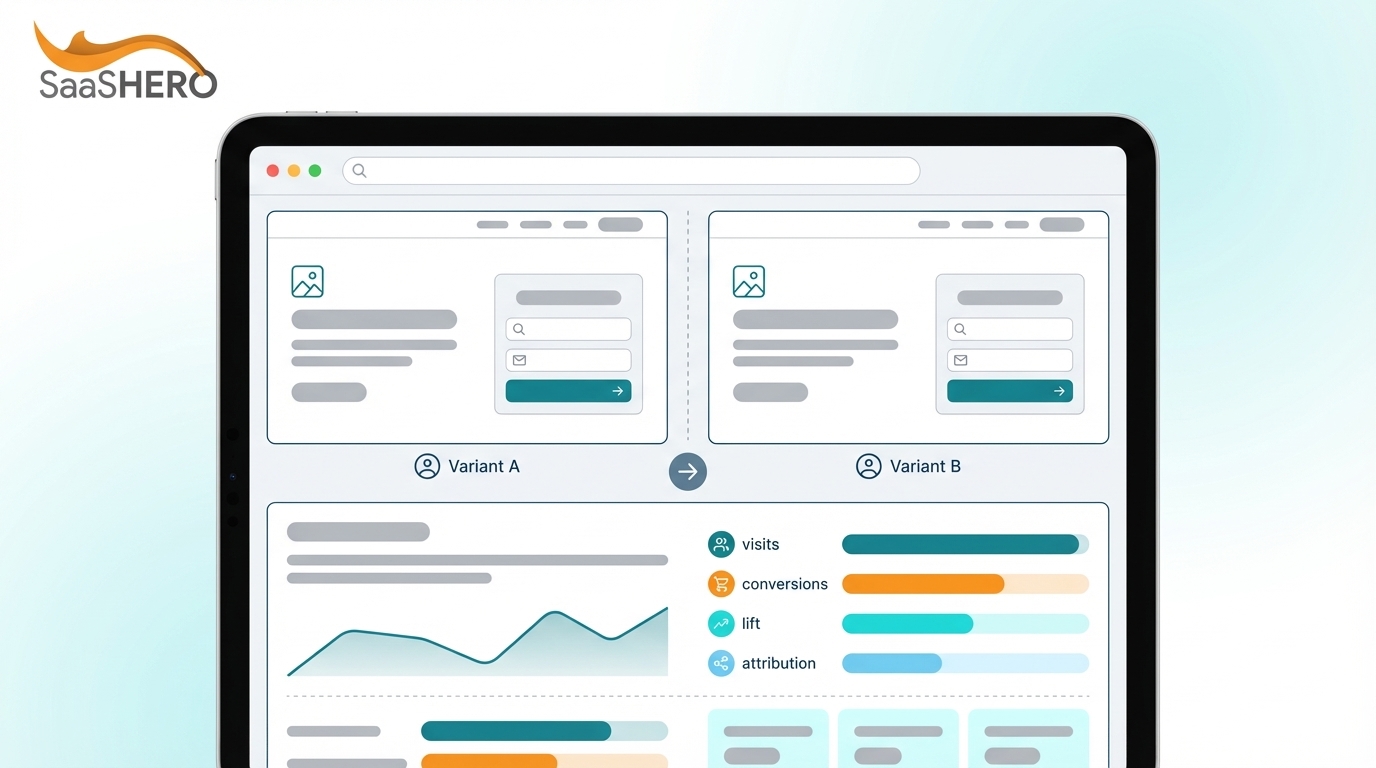
Effective landing page optimization follows a continuous loop of Analyze, Hypothesize, Test, Implement, and Learn. This structure keeps experiments grounded in data and tied to revenue goals instead of isolated design changes.
The Analyze phase reviews quantitative metrics such as conversion rate, bounce rate, and funnel drop-off, along with qualitative insight from user sessions and feedback. Hypotheses translate those observations into clear predictions, tests validate them with appropriate sample sizes, and winning variations move into implementation. Learnings should be documented so each new test builds on previous results.
Beyond Basic A/B Testing: The Evolution of B2B SaaS Landing Page Optimization
Mapping the Ecosystem: Tools, Teams, and Agencies
Modern landing page optimization relies on a mix of analytics tools, testing platforms, and workflow processes. B2B SaaS teams often combine behavioral analytics, experimentation tools, and personalization capabilities in one stack. Internal teams provide product context and stakeholder alignment, while specialist agencies contribute proven frameworks and cross-account insight. Clear ownership for conversion performance and simple decision rules about who runs which experiments help maintain speed.
From Vanity Metrics to Revenue Attribution in LPO
Around 90% of marketers rely on A/B testing as the primary method to optimize landing pages, yet many still measure success only by click-through or form completion. Revenue-focused programs prioritize metrics such as SQL rate, demo-to-close conversion, and pipeline velocity. Optimizing for low-intent conversions can harm unit economics, so experiments should be judged on both volume and downstream performance.
Strategic Considerations for Building Your B2B SaaS Landing Page Testing Culture
Resource Allocation: In-house vs. Agency Expertise
Decisions about in-house versus agency support should account for current skills, growth stage, and experimentation volume. Internal teams usually own strategy and product positioning, while agencies can help design test plans, implement experiments, and interpret results. Many B2B SaaS companies adopt a hybrid model where internal marketers set priorities and external specialists increase execution capacity.
Balancing Testing Velocity with Statistical Significance
B2B SaaS teams must balance the desire for fast results with the need for statistically reliable findings. Long sales cycles and lower traffic on high-intent pages make sample sizes a constraint. Clear guidelines for minimum sample size, confidence level, and test duration keep decisions consistent. Priority should go to impactful tests that have a realistic chance of reaching significance, such as value propositions, offers, and form design.
Aligning LPO with Organizational Financial Goals
Landing page optimization should map directly to financial measures that matter to leadership. Programs work best when they connect changes in conversion to CAC, payback period, pipeline coverage, and Net New ARR. Regular reviews with finance and sales leaders keep test roadmaps aligned with revenue targets and budget decisions. Explore how a structured landing page testing program can tie directly to your financial goals.

Contemporary Approaches and Practices in B2B SaaS Landing Page Optimization Testing
User-Centric Design and Hypothesis-Driven Testing
User-centered programs rely on understanding visitor intent, context, and friction points. Teams combine qualitative research such as interviews and session recordings with funnel analysis to identify where users hesitate or drop off. Each test should have a clearly stated hypothesis, a defined audience, and a primary metric that reflects both experience and revenue impact.
Personalization and Dynamic Content for Higher Relevance
High-performing teams use segmented landing pages by industry, use case, or customer type, and increasingly apply dynamic content that adapts copy or visuals to visitor attributes such as source or location. Personalized calls to action can perform 202% better than standard CTAs, which shows how relevance can improve pipeline contribution per visitor. Personalization should start with a few meaningful segments and expand as data and infrastructure mature.
Technology Stacks and AI-Powered Optimization
AI page builders and optimization tools can suggest layouts, copy variants, and next tests, which helps teams learn faster. Analytics platforms such as Hotjar and FullStory provide heatmaps, recordings, and funnel views that reveal user behavior patterns. Integration between analytics, experimentation, and CRM systems ensures that test results reflect both on-page behavior and downstream revenue.
Implementing Your Landing Page Optimization Testing Framework: Readiness and Operating Models
Assessing Your LPO Maturity and Readiness
Teams benefit from assessing their current maturity before scaling experimentation. Early-stage programs often run isolated tests on copy or layout, while advanced programs maintain prioritized test backlogs, robust tracking, and clear financial targets. Reviewing tools, skills, and internal processes helps set realistic next steps.
Data Infrastructure, Tooling, and Stakeholder Alignment
Effective optimization depends on reliable tracking across ad platforms, analytics, and CRM. UTM hygiene, conversion events, and revenue attribution models should be in place before reading too much into test results. Shared definitions of success and regular communication between marketing, sales, and product reduce friction and keep testing focused on business outcomes.
Strategic Sequencing of Optimization Initiatives
Optimization roadmaps usually start with changes that are simple to implement and easy to measure. Small CTA and headline tests can deliver 30–40% conversion lifts and build confidence in the process. Structural changes such as form design and page layout follow once basics are stable. Layout improvements have moved conversion from 9% to 23% for some teams, which shows the impact of UX-focused experiments. Request a structured optimization roadmap tailored to your current stage and funnel performance.

Common Pitfalls for Experienced B2B SaaS Landing Page Optimization Teams
Misaligned Metrics and Testing Without Clear Hypotheses
Many experienced teams still run tests without a defined hypothesis or business objective. Attention often goes to minor design elements while core issues such as value proposition clarity, offer strength, or qualification strategy receive less focus. Programs should favor tests that can influence SQL rate, opportunity creation, and revenue, not only cosmetic metrics.
Neglecting Mobile Optimization and Technical Performance
Technical performance forms the baseline for all other optimization work. Landing pages that load in under three seconds generally convert better than slower pages. High-performing pages also maintain strong mobile responsiveness and fast load times, which protects paid media efficiency and user experience.
Siloed Testing Efforts and Lack of Downstream Impact Tracking
Optimization often stays within marketing dashboards and does not connect to sales outcomes. This creates situations where form fills increase while sales teams see little change in qualified pipeline. Tracking SQL rate and pipeline value alongside on-page metrics helps teams understand whether tests truly improve business performance.
Illustrative Scenarios: Applying the Landing Page Optimization Testing Framework
Optimizing for Early-Stage PLG to Sales-Led Transition
Early-stage PLG companies that add sales support often test ways to collect more context without disrupting self-serve signups. Experiments typically compare one-step versus multi-step forms, progressive profiling, and different prompts for sales conversations based on in-product behavior.
Reducing CAC for a Series B Scale-Up
Series B scale-ups frequently use landing page tests to improve CAC across paid search and paid social. Competitor comparison pages can capture high-intent evaluation traffic, while experiments on pricing pages, demo offers, and trial flows help convert that intent into efficient pipeline.
Enhancing Lead Qualification for Enterprise SaaS
Enterprise SaaS teams often prioritize depth of qualification and routing accuracy. Double-column layouts can improve long-form completion rates by 57% versus single-column forms, and live chat can increase conversions by about 20%. Content offers and questions should screen out low-fit visitors while keeping friction manageable for high-value accounts. Review how this framework can support your specific sales motion and deal size.
Frequently Asked Questions on B2B SaaS Landing Page Optimization Testing Frameworks
How often to test B2B SaaS landing pages
High-traffic, high-intent pages benefit from continuous testing, often with new experiments launched every two to four weeks. Lower-traffic pages may require fewer tests that run longer to reach reliable conclusions.
Most important metrics for B2B SaaS landing page optimization
Primary metrics include conversion to qualified lead, cost per SQL, demo or meeting booking rate, and trial-to-paid conversion. Secondary metrics such as scroll depth and form abandonment help explain why a page performs at a given level.
Balancing design guidelines with experimentation
Brand and UX guidelines should define the boundaries of layout, typography, and core components. Within those constraints, teams can experiment with messaging, hierarchy, offers, and flows. Successful patterns should move into a shared testing playbook.
Role of personalization in B2B SaaS landing page optimization
Personalization works best when it reflects meaningful differences in industry, role, or use case. Programs often begin with segmented messaging and then expand to more dynamic experiences once measurement and traffic allow for reliable comparisons.
Choosing between in-house teams and specialist partners
Smaller or earlier-stage companies often work with agencies to establish frameworks and tools, while larger organizations build internal teams for long-term capability. Hybrid models that combine internal strategy with external execution support are common.
Conclusion: Mastering Landing Page Optimization for Sustainable B2B SaaS Growth
Landing page optimization in B2B SaaS delivers the strongest results when it operates as a continuous, structured discipline. Clear hypotheses, reliable tracking, and collaboration between marketing, sales, and finance ensure that experiments improve both user experience and revenue outcomes.
Progress usually starts with foundational work on tracking, funnel metrics, and simple tests, then evolves into more advanced tactics such as personalization and AI-assisted optimization. Consistent effort compounds over time into better CAC efficiency, faster pipeline creation, and more predictable Net New ARR. Schedule a discovery call with SaaSHero to design a pragmatic landing page optimization program for your team.