




Written by: Aaron Rovner, Founder, Saas Hero
Key Takeaways
- Traditional percentage-of-spend Facebook ad pricing often pushes higher budgets instead of better unit economics for B2B SaaS.
- Performance-based models tie agency fees to SQLs, opportunities, or revenue, which improves accountability and capital efficiency.
- Connecting Facebook campaign data to your CRM enables end-to-end attribution and clearer decisions on CAC, LTV, and pipeline impact.
- Structured, full-funnel Facebook strategies with clear qualification criteria make performance-based partnerships workable and scalable.
- B2B SaaS teams can work with a partner like SaaSHero to implement performance-focused Facebook programs that align fees with revenue outcomes.
Why Traditional Facebook Ads Pricing Hurts B2B SaaS in 2026
The Percentage-of-Spend Trap Limits Efficiency
Percentage-of-spend billing, where agencies charge 10–20% of ad budget, rewards higher spend, not better performance. In B2B SaaS, this structure often leads to inflated budgets and surface-level optimization instead of disciplined CAC control.
Capital-efficient SaaS growth depends on clear unit economics. If an agency earns more when you spend more, the relationship rarely centers on CAC payback, pipeline quality, or revenue.
Vanity Metrics Distract From SaaS Growth
Many agencies emphasize impressions, clicks, and generic conversions while ignoring SaaS-specific metrics like CAC, LTV, ARR, SQLs, and pipeline value. Many B2B SaaS Facebook programs chase low CPL but generate leads that never become SQLs or opportunities. This gap weakens trust between marketing, sales, and finance.
The dark-funnel nature of B2B buying, with multiple anonymous touches before a form fill, adds complexity. Narrow attribution to last-click or platform metrics hides the true impact of campaigns on pipeline.
Capital Constraints Demand Measurable Impact
Fundraising is harder in 2026, and investors expect clear paths to profitability. Marketing teams must show that Facebook budgets drive SQLs, opportunities, and revenue, not just activity. Traditional retainers and percentage models often struggle to prove this connection.

Book a discovery call to review whether your current Facebook spend aligns with revenue, not just reach.
How Performance-Based Facebook Ads Pricing Works for B2B SaaS
Performance-Based Pricing Aligns Incentives
Performance-based models link agency compensation to outcomes such as qualified leads, opportunities, or revenue. This structure encourages agencies to think like growth partners and to optimize for metrics your board cares about, not just platform stats.
Common Performance-Based Structures
- Revenue share or commission: The agency earns a percentage of revenue attributed to Facebook campaigns. This model demands solid attribution but creates strong alignment around sales outcomes.
- Cost per qualified lead (CPQL): Fees are tied to leads that meet agreed criteria such as MQL or SQL status. Clear definitions filter out low-quality volume.
- Cost per opportunity (CPO): The agency earns per opportunity created in the CRM. This model pushes optimization beyond lead capture into sales intent.
- Hybrid models: A base retainer covers strategy and operations, with bonuses tied to pipeline, CAC, or revenue targets. This balances agency stability with performance pressure.
Unit Economics Become the Operating System
When fees depend on CAC, LTV, ARR, or pipeline value, agencies must understand pricing, sales cycle length, churn, and expansion. This shifts the relationship from media buying to growth partnership and supports better budgeting decisions.

Schedule a discovery call to explore which performance model fits your stage and sales motion.
Metrics That Matter for B2B SaaS Facebook Ads
Shift From Vanity Metrics to Revenue Metrics
Effective Facebook measurement in B2B includes CPC, CTR, conversion rate, CPA, ROAS, LTV, and churn. For SaaS leaders, the most important rollups are SQL volume, pipeline value, closed-won revenue, CAC, and payback period.
Reports that highlight impressions or generic leads without connecting to pipeline usually hide inefficiency.
Connect Facebook Data to Your CRM
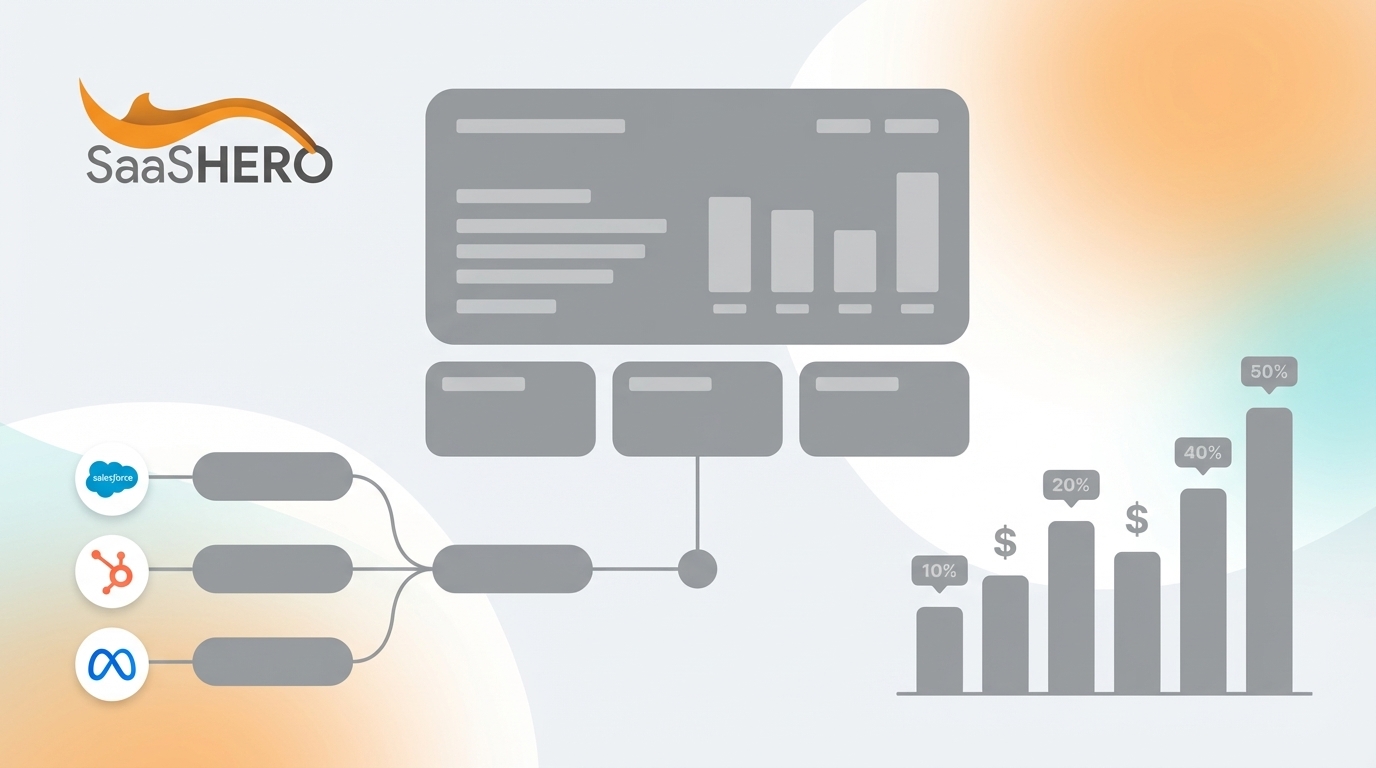
End-to-end attribution requires clean tracking from ad click into CRM and opportunity stages. High-performing agencies integrate with RevOps and sales teams and use CRM data to filter out noise. This approach clarifies which campaigns produce real opportunities and revenue.
Account for Full-Funnel and Long-Term Value
Facebook works best as a compound-interest channel with coordinated TOFU, MOFU, and BOFU campaigns. Early touches build awareness that later improves demo rates and close rates.
B2B SaaS often sees Facebook CAC that is 20–40% higher than Google initially, while LTV can be 30–50% higher. Performance models should reflect this long-term value, not just cheap initial leads.
Book a discovery call to build dashboards that connect Facebook spend directly to pipeline and revenue.
Building a Performance-Ready B2B SaaS Facebook Strategy
Design a Clear TOFU, MOFU, BOFU Funnel
Effective SaaS funnels use problem and education content at the top, solution and proof in the middle, and offer plus objection handling at the bottom. Each stage should have its own audiences, creatives, and KPIs.
Use Targeting That Supports Scale
Broad B2B audiences in the 500K–2M range let Facebook’s algorithm optimize more effectively than ultra-narrow targeting. Job title, behavior, and interest targeting often deliver CPCs under one dollar, which helps performance-based partners hit CPQL or CPO targets.
Prioritize Proven Creative Formats and Retargeting
Video, carousel, and lead form ads tend to perform best for B2B lead generation, especially when aligned with funnel stages.
Dedicated retargeting flows for content engagers, site visitors, and high-intent actions are crucial for long sales cycles. These sequences often drive the SQL and opportunity metrics that power performance-based agreements.
Automate Budget Decisions Based on Real Results
Automation rules can scale or reduce budgets when campaigns hit or miss thresholds for purchases, cost per purchase, and ROAS. Similar rules can govern CPQL or CPO, which keeps campaigns within agreed efficiency bands.
Choosing a Performance-Based Facebook Ads Agency
Look for Dedicated B2B SaaS Expertise
Strong candidates understand SaaS funnels, longer sales cycles, and down-funnel metrics. They speak fluently about MRR, churn, expansion, PLG, and sales-assist motions.
Confirm Tracking and Reporting Capabilities
Accurate performance measurement depends on pixel events, server-side tracking, and CRM integration. Agencies should build or support dashboards that tie channel data to pipeline and ARR, not just to leads.
Structure Contracts and Budgets Around Outcomes
Month-to-month or short-term contracts reduce risk and keep both sides focused on results. A strong partner will recommend budget cuts or reallocations when campaigns fail to generate qualified pipeline, even if this reduces their own short-term fees.
Traditional vs Performance-Based Models at a Glance
|
Feature |
Traditional Model |
Performance-Based Model |
Impact on B2B SaaS |
|
Pricing structure |
% of ad spend or high flat retainer |
Retainer plus CPQL, CPO, or revenue bonus |
Costs linked to outcomes, not just spend |
|
Incentives |
Grow budget |
Grow qualified pipeline and revenue |
Better capital efficiency |
|
Reporting focus |
Impressions, clicks, generic leads |
SQLs, opportunities, ARR, CAC, LTV |
Business-level accountability |
|
Contract length |
6–12 month lock-in |
Flexible or month-to-month |
Faster iteration and lower risk |
Book a discovery call to benchmark your current agency model against a performance-based approach.
Examples of Performance-Based Impact in B2B SaaS
- Early-stage founder: A startup with limited budget uses a small retainer plus CPQL model focused on strict SQL criteria. Result: predictable lead costs that support fundraising and first sales hires.
- Series B scale-up: A company moves from a vanity-metric agency to a hybrid retainer plus revenue-share model. Result: lower CAC, faster pipeline growth, and clearer attribution in the CRM.
- Mature enterprise: A multi-product SaaS firm ties bonuses to LTV:CAC ratio and payback period. Result: more budget for high-LTV segments and improved capital efficiency across teams.
Conclusion: Turning Facebook Into a Reliable Revenue Channel
Performance-based Facebook partnerships give B2B SaaS leaders clearer control over CAC, pipeline, and ARR. By tying fees to SQLs, opportunities, or revenue, agencies share risk with your team and focus on durable growth, not just media volume.
Strong partners bring SaaS expertise, rigorous tracking, transparent reporting, and flexible contracts. These elements create the conditions for Facebook to operate as a predictable acquisition channel rather than a speculative experiment.
Schedule a discovery call with SaaSHero to explore a Facebook strategy and pricing model that align directly with your revenue goals.
Frequently Asked Questions (FAQ) on Performance-Based Facebook Ads Pricing
How do performance-based agencies track revenue in long B2B sales cycles?
Specialized agencies connect Facebook engagement data to your CRM, use UTM parameters, implement the Conversions API, and build multi-touch attribution reports. These systems track contacts from first click through opportunity stages and closed-won deals, even when the cycle spans months and multiple stakeholders.
Will a performance-based model ignore brand-building campaigns?
Effective models recognize that brand and education content drive higher LTV and better close rates. Contracts can include both direct-response KPIs and supporting indicators such as organic search growth, direct traffic, or improved opportunity win rates, which encourages agencies to run full-funnel programs instead of chasing only quick wins.
Is performance-based pricing suitable for early-stage B2B SaaS with small budgets?
Early-stage teams often benefit from modest retainers plus CPQL or CPO incentives. This approach limits fixed costs, ties spend to qualified pipeline, and creates budget predictability while you validate messaging and target segments. Agencies that specialize in startups usually design structures that can scale as your funding and revenue grow.