




Written by: Aaron Rovner, Founder, Saas Hero | Last updated: July 14, 2026
Key Takeaways for B2B SaaS Leaders
- Revenue-focused B2B SaaS agencies succeed by driving closed-won metrics like Net New ARR, pipeline value, and CAC payback instead of impressions or MQL volume.
- Traditional agencies often fail because of percentage-of-spend billing, long lock-in contracts, and junior teams running accounts after senior leaders close the deal.
- Metrics that correlate with real revenue include Net New ARR, SQL-to-close rate, LTV:CAC ratio, CAC payback period, and cost per SQL.
- Flat monthly retainers with month-to-month terms align agency accountability with client outcomes and remove percentage-of-spend conflicts.
- SaaSHero publishes transparent flat-fee pricing and verified Net New ARR results; schedule a call to explore partnership options.
The Problem: How Traditional Lead-Volume Agencies Hurt SaaS Growth
Three structural failures define the traditional agency model, and each one transfers risk onto the client while protecting the agency’s revenue. These failures, misaligned billing incentives, accountability-free contracts, and execution quality gaps, compound to create systematic underperformance.
Percentage-of-spend billing creates misaligned incentives. When an agency charges 10–20% of ad budget, its revenue grows every time the client spends more, regardless of whether that spend produces pipeline. The agency is financially rewarded for recommending budget increases, not for improving efficiency. Flat monthly retainers remove this conflict entirely.
Long lock-in contracts eliminate accountability. Standard demand generation contract lengths run 6 to 12 months minimum, with 12-month commitments dominant. An agency that cannot be fired for a year has no forcing function to perform in month two. Month-to-month terms require the agency to re-earn the client’s business every 30 days.
Junior execution follows senior sales. Clients are courted by experienced strategists, then handed to overloaded junior managers once the contract is signed. SaaSHero caps client-to-manager ratios at 8–10 accounts to prevent this drop in execution quality.
The downstream cost is measurable. The median B2B cost-per-lead reached $213 in 2026, a 7.6% year-over-year increase, while median blended CAC payback for $5M–$50M ARR SaaS companies rose from 15 months in 2023 to 18 months in 2026. Agencies that chase MQL volume without revenue accountability accelerate both trends.
Why Revenue Metrics Beat Lead Volume for B2B SaaS
MQL volume is easy to inflate and nearly impossible to connect directly to closed revenue. The median MQL-to-SQL conversion rate across B2B programs fell to 9.8% in 2026 from 13.0% in 2024, so more than 90% of MQLs never become sales-qualified. Reporting on MQL volume while ignoring this drop-off allows agencies to hide underperformance.
The metrics that correlate with actual revenue are:
- Net New ARR: New ARR + Expansion ARR − Churn ARR − Downgrade ARR. This is the definitive measure of whether a SaaS business grew in real terms during a period.
- SQL-to-close rate: SQLs convert to customers at 15–25% in well-optimized B2B SaaS funnels.
- LTV:CAC ratio: Bessemer Venture Partners benchmarks cite an LTV:CAC ratio above 3:1 and CAC payback under 18 months (mid-market), 12 months (SMB), or 24 months (enterprise) for efficient B2B SaaS growth.
- CAC payback period: OpenView SaaS Benchmarks list best-in-class CAC payback as under 12 months, good as 12–18 months, and acceptable as 18–24 months.
- Cost per SQL: The median cost per SQL across B2B SaaS is $762.
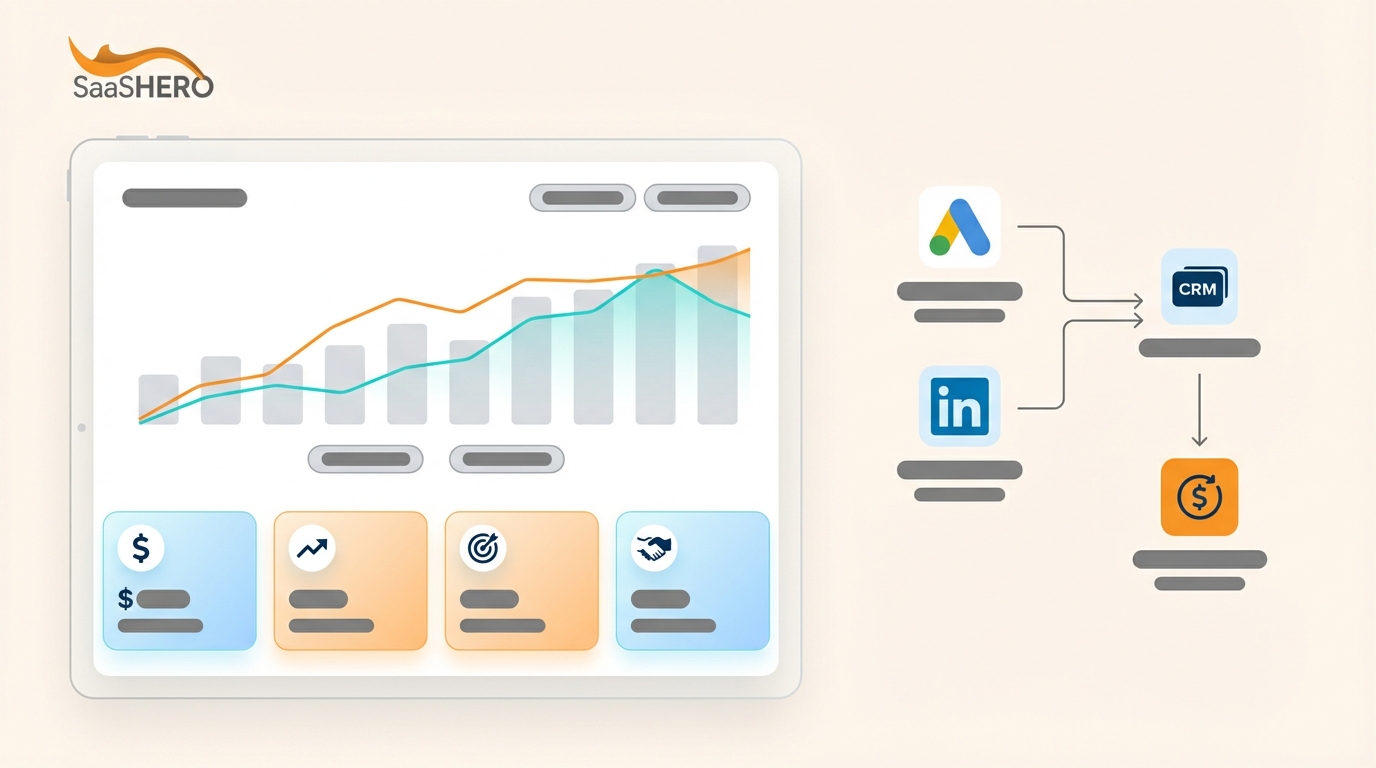
SaaSHero connects Google Ads click data (GCLID) through landing pages and into HubSpot or Salesforce. This setup allows campaign decisions based on who closed, not who clicked.

Contract Models Comparison for SaaS Lead Gen
The table below compares percentage-of-spend billing against flat monthly retainers on the dimensions that matter most to founders and RevOps leaders.
| Dimension | Percentage-of-Spend Model | Flat Monthly Retainer (SaaSHero) |
|---|---|---|
| Incentive alignment | Agency earns more when client spends more, regardless of ROAS | Fee is fixed within spend bands, so budget recommendations are data-driven, not fee-driven |
| Contract flexibility | Long minimums (as noted above); 60-day cancellation notice standard | Month-to-month; client can exit at any time |
| Risk distribution | Client bears all performance risk; agency revenue is guaranteed | Agency re-earns the relationship every 30 days |
| Reporting focus | Impressions, CTR, MQL volume | Net New ARR, pipeline value, CAC payback period |
Red flags to watch for in any agency contract:
- 12-month lock-in before any results have been delivered
- Billing tied to a percentage of ad spend rather than a fixed fee
- Reporting limited to in-platform metrics with no CRM integration
- No senior strategist named on the account
- Early termination fees equal to the remaining contract value
Review SaaSHero’s month-to-month terms and flat-fee pricing in a discovery call before committing to any engagement.
Pricing Benchmarks by Ad Spend and Channel Count
SaaSHero publishes two tiers. The Dedicated Campaign Manager tier fits founder-led teams or pilot programs. The Full Marketing Team tier fits scale-ups that need strategy plus execution across multiple channels. The tables below show how retainers scale by spend band and channel count while staying fixed inside each band, so a budget increase inside a band does not trigger a fee increase.

Dedicated Campaign Manager — Monthly Retainer
| Monthly Ad Spend | 1 Channel (Month-to-Month) | 1 Channel (6-Mo Prepay) | 2 Channels (Month-to-Month) | 3+ Channels (Month-to-Month) |
|---|---|---|---|---|
| Up to $10k | $1,250 | $1,000 | $2,500 | $3,750 |
| $10k – $25k | $1,750 | $1,400 | $3,000 | $4,250 |
| $25k – $50k | $2,250 | $1,800 | $3,500 | $4,750 |
| $50k+ | $3,250 | $2,600 | $4,500 | $5,750 |
Full Marketing Team — Monthly Retainer
| Monthly Ad Spend | 1 Channel (Month-to-Month) | 1 Channel (6-Mo Prepay) | 2 Channels (Month-to-Month) | 3+ Channels (Month-to-Month) |
|---|---|---|---|---|
| Up to $10k | $2,500 | $2,000 | $3,750 | $5,000 |
| $10k – $25k | $3,000 | $2,400 | $4,250 | $5,500 |
| $25k – $50k | $3,500 | $2,800 | $4,750 | $6,000 |
| $50k+ | $4,500 | $3,600 | $5,750 | $7,000 |
Because fees are fixed within spend bands, a move from $12k to $18k in monthly ad spend does not change the agency fee. Budget recommendations stay aligned with performance instead of agency revenue. A one-time setup fee of $1,000–$2,000 covers the initial audit, tracking architecture, and strategy build. Landing page design is available at a $750 flat fee, and creative assets (5 ads) are available for $300.

Red Flags in Agency Reporting and What to Track Instead
Vanity metrics agencies still commonly report include impressions, clicks, click-through rate, cost per click, and raw MQL volume. None of these figures appear in a board deck or a fundraising conversation. SaaSHero replaces them with revenue metrics that do.
Verified SaaSHero client outcomes demonstrate the difference:

- TripMaster (Transit Software): $504,758 in Net New ARR added in 12 months, 650% ROI, 20% conversion rate from paid search.
- TestGorilla (HR Tech): 80-day CAC payback period, 5,000+ new customers, $70M Series A raised.
- Playvox (CX Software): 10x decrease in cost per lead, 163% increase in lead volume.
- Leasecake (Real Estate Tech): $3M VC round and record growth attributed to LinkedIn Ads targeting specific job titles.
Review the full case study data in a discovery call to see how SaaSHero tracks closed-won revenue for B2B SaaS companies at your ARR stage.
How to Evaluate Attribution for Agency Performance
The verified outcomes above depend on proper attribution infrastructure. Without that foundation, even a strong agency cannot focus on closed revenue. Connecting ad spend to closed-won revenue requires a deliberate infrastructure build, and the following framework applies to any agency evaluation.
- Define revenue metrics before the engagement starts. Agree on a shared definition of Net New ARR, SQL, and closed-won deal with both marketing and sales before any campaign launches.
- Implement offline conversion tracking. B2B SaaS companies that imported offline conversions from their CRM and switched to value-based bidding on Google Ads reported roughly 3x more pipeline at about 31% lower cost per lead. Pass GCLID data from ad click through to the CRM so bidding algorithms optimize for buyers, not form-fillers.
- Use a 90-day minimum attribution window. The median B2B SaaS sales cycle is 84 days. Evaluating campaigns on a 30-day window systematically pauses campaigns that have not yet closed.
- Connect CRM pipeline data to billing data. Reporting channel-level ROAS using the CFO’s definition of Net New ARR, not marketing’s pipeline-value estimate, removes the 40–50% gap that commonly exists between marketing-reported pipeline and finance-reported ARR.
- Report on cost per closed deal, not cost per lead. This number determines whether an agency engagement is profitable.
Stage-Fit Matrix: Matching SaaSHero Tiers to ARR Stage
| Company Stage | Recommended SaaSHero Tier | Primary Goal | Target CAC Payback |
|---|---|---|---|
| Pre-Series A / Founder-led ($1M–$5M ARR) | Dedicated Campaign Manager, 1 channel, month-to-month | Prove unit economics; establish repeatable pipeline | 9–12 months (SMB benchmark) |
| Series A / Scale-up ($5M–$20M ARR) | Full Marketing Team, 2–3 channels, month-to-month | Scale Net New ARR; demonstrate efficiency to investors | 14–18 months (mid-market benchmark) |
| Series B / Enterprise ($20M–$50M ARR) | Full Marketing Team, 3+ channels, multi-touch attribution | Maximize pipeline velocity; reduce blended CAC | Best-in-class under 12 months, good 12–18 months, acceptable 18–24 months |
Frequently Asked Questions
What is the average cost per lead in B2B SaaS?
As noted earlier, median B2B CPL hit $213 in 2026. Paid channels average approximately $310 per lead while organic channels average $164 per lead. These figures vary significantly by channel and funnel stage. Bottom-of-funnel Google Ads targeting commercial-intent keywords such as “pricing” or “demo” produce leads costing $250–$500 each but convert to closed revenue at 15–30%. Top-of-funnel content leads cost $30–$75 but convert to sales opportunities at only 2–5%.
The blended CPL figure becomes meaningful only when evaluated alongside SQL-to-close rate and average contract value. A $300 lead that closes at 20% and carries a $15,000 ACV produces a $1,500 marketing-sourced CAC. That outcome differs sharply from a $100 lead that closes at 2%.
How much should you pay for lead generation?
The right amount to pay for lead generation depends on your target CAC and your lead-to-customer conversion rate, not on a fixed industry number. The formula is: Maximum Allowable CPL = Target CAC × Lead-to-Customer Conversion Rate. For a B2B SaaS company with a $5,000 target CAC and a 4% lead-to-customer conversion rate, the maximum allowable CPL is $200.
Agency fees should be evaluated separately from ad spend. SaaSHero’s flat monthly retainers start at $1,250 per month for up to $10,000 in managed ad spend on a single channel, with no percentage-of-spend markup. Most full-service B2B demand generation agencies charge $15,000–$75,000 per month with 12-month minimum commitments. The critical question is not the retainer amount but whether the agency reports on cost per closed deal and Net New ARR, or only on CPL and MQL volume.
What are realistic ROI benchmarks for B2B SaaS agencies?
Realistic ROI benchmarks depend on company stage, ACV, and sales motion. For SMB-focused SaaS with ACV of $1,000–$5,000, a viable CAC ceiling is $200–$900, implying a cost-per-SQL of $100–$500 at a 10–20% SQL-to-close rate. For mid-market SaaS with ACV of $10,000–$50,000, sustainable CAC runs $1,500–$4,500. A healthy LTV:CAC ratio is 3:1 at minimum, with top-quartile companies achieving 4:1–5:1.
Using the benchmarks defined earlier, SaaSHero’s verified case studies show an 80-day payback period for TestGorilla and 650% ROI for TripMaster. Both outcomes came from CRM-integrated attribution that focused on closed-won revenue rather than lead volume. Agencies that cannot show verified closed-won outcomes from named clients should not be evaluated against these benchmarks.
Next Steps for Evaluating SaaSHero
SaaSHero is the only B2B SaaS lead generation agency publishing both transparent flat-fee pricing tables and verified Net New ARR results from named clients. Every engagement runs month-to-month, every retainer is fixed within spend bands to remove percentage-of-spend conflicts, and every report is anchored in closed-won revenue metrics rather than impressions or MQL counts.
Founders, VPs of Marketing, and RevOps leaders at $1M–$50M ARR SaaS companies can review full pricing details and verified case studies at SaaSHero.net, then schedule a call to discuss pipeline goals, current attribution gaps, and which engagement tier fits the current ARR stage.