




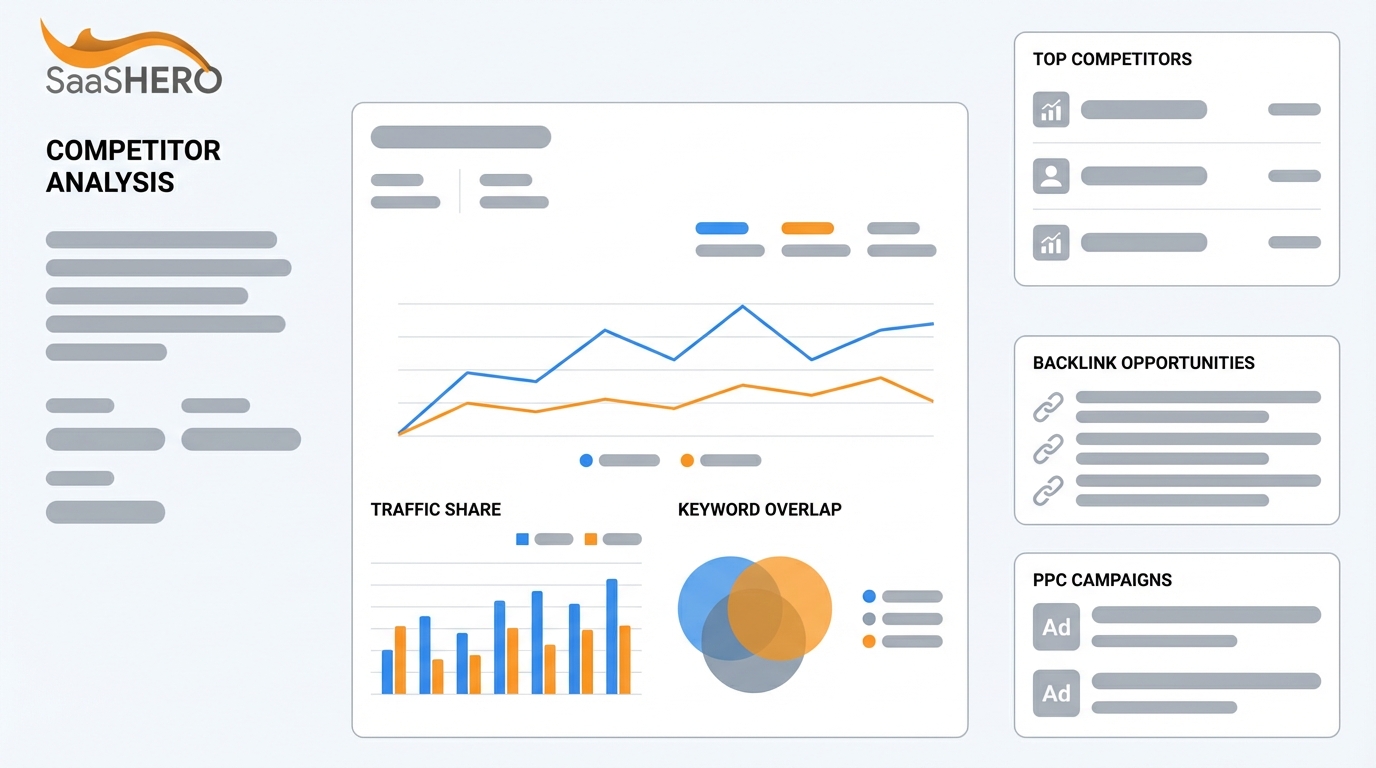
Key Takeaways for SaaS Teams
- B2B SaaS teams can use this 7-step Ahrefs workflow to find 5 core rivals and uncover 50+ high-intent keyword gaps with KD under 20.
- Prioritize organic vs paid traffic splits, pricing intent, and comparison keywords to reach users in evaluation or switching mode.
- Use Content Gap and Backlinks reports to find realistic wins such as high-DA guest posts and long-tail terms that drive up to 455% traffic growth.
- Set Share of Voice baselines and aim for 20% gains that correlate with lower CAC and higher Net New ARR from high-intent conquesting.
- Turn on weekly Ahrefs alerts for competitors, then book a discovery call with SaaSHero for revenue-first execution.
Prerequisites for Running SaaS Competitor Analysis
Secure Ahrefs Pro+ access so you can use Site Explorer and Keywords Explorer for full competitor analysis. Start by identifying 3 to 5 direct SaaS rivals in the Organic Competitors report that share your target market and pricing model.
Track Share of Voice for organic and paid, keyword difficulty under 20 for high-intent terms like “[competitor] pricing” and “[competitor] alternative,” and traffic that you can attribute back to CRM opportunities. Block 2 to 4 hours for setup and 30 minutes each week for review.
The stakes are high. Organic traffic accounts for 53% of website visits and converts 8.5x better than outbound leads, so competitor gap analysis directly supports SaaS revenue growth.
7-Step SaaS Competitor Analysis Framework in Ahrefs
|
Step |
Focus Area |
SaaS KPI |
|
1 |
Identify SaaS rivals |
Top 5 overlap with the B2B SaaS filter |
|
2 |
Traffic and keyword audit |
Organic / paid split vs 53% benchmark |
|
3 |
Content and keyword gaps |
50+ terms with KD < 20, volume > 500 |
|
4 |
Backlink opportunities |
High-DA guest gaps, DR 40+ niche sites |
|
5 |
PPC competitor analysis |
Conquest bids in a 15–18% YoY CPC rise |
|
6 |
SOV and ARR calculation |
Share baselines where 20% gain reduces CAC |
|
7 |
Monitoring and alerts |
Weekly competitor movement tracking |
How to Run Competitor Analysis in Ahrefs for SaaS
Step 1: Identify Your Closest SaaS Rivals
Open Site Explorer, enter your domain, then select “Organic Competitors” in the sidebar. Apply filters that highlight B2B SaaS companies with similar pricing and ICP, and remove B2C tools or agencies that only share a few keywords.
Pick the top 5 competitors based on keyword overlap and traffic similarity, then export that list as your working set. Remove obvious non-competitors early so later reports stay clean and focused on real rivals.
Step 2: Audit Competitor Traffic and High-Intent Keywords
Open each rival in Site Explorer and review the Organic Keywords report. Filter for SaaS intent terms such as “pricing,” “cost,” “alternative,” “vs [your brand],” and “review” that signal evaluation or switching behavior.
Build a simple table that shows organic versus paid traffic for every competitor. Since organic traffic drives 53% of visits, a heavy paid skew often reveals organic gaps that your team can capture.
Step 3: Find Content and Keyword Gaps You Can Win
Open the Content Gap tool and intersect three competitors at a time. Filter for keyword difficulty under 20 and search volume above 500 to surface realistic ranking opportunities for a growing SaaS brand.
Group results into comparison terms, pricing queries, and problem-solution topics that match your product positioning. Export at least 50 gap keywords and rank them by commercial intent and fit with your roadmap.
Long-tail keywords with lower difficulty scores often deliver faster wins and more stable traffic than broad, high-competition head terms.
Turn this list into a content calendar with dedicated landing pages, comparison articles, and pricing resources that answer search intent clearly and quickly.

Step 4: Uncover Backlink Opportunities Your Rivals Already Use
Open the Backlinks report for each competitor and filter for Domain Rating 40+ and dofollow links from relevant industry sites. Flag guest posts, resource pages, and directory listings where your brand is missing.
Avoid chasing volume at the expense of relevance. A 14% Domain Rating lift can drive up to 455% organic traffic growth when links come from authoritative, niche-relevant domains.
Step 5: Analyze PPC Competitors and Conquest Campaigns
Open the PPC Keywords section for each rival and review their paid search strategy. Pay close attention to brand conquest campaigns where they bid on your name or similar positioning terms.
SaaS CPC rates have climbed 15–18% year over year, so you need to spot cheaper conquest angles where competitors overpay or ignore valuable modifiers.
Document their ad copy, landing page themes, and bid focus so you can design your own conquest campaigns that highlight pricing clarity, switching ease, and feature gaps.
Step 6: Calculate SaaS Share of Voice and Revenue Impact
Estimate Share of Voice by dividing your monthly traffic by the total traffic across your shared keyword set. Build a comparison table that shows your SOV against the average of your main competitors.
|
Metric |
Your Brand |
Competitor Average |
Target Gap |
|
Organic Traffic |
10,000 |
20,000 |
+100% growth needed |
|
SOV Percentage |
15% |
25% |
Target 20% gain |
|
High-Intent Keywords |
45 |
78 |
33 gap opportunities |
Track how SOV gains line up with lead quality, demo volume, and close rates. A 20% SOV increase often pairs with lower CAC because more high-intent prospects discover you through search.
Step 7: Set Up Ongoing Monitoring and Alerts
Configure Ahrefs Alerts so you see when competitors earn new high-value backlinks, publish content on your target topics, or start ranking for your priority keywords. Set weekly email alerts for ranking shifts and new pages.
Run a monthly review where you refresh your gap analysis, update your content roadmap, and adjust link-building priorities. This habit keeps your strategy current and protects your market share while you execute.
Measurement and Validation for SaaS Revenue Teams
Measure success by hitting a 20% Share of Voice gain within 90 days, launching at least 10 gap-focused campaigns, and proving CAC reduction from organic acquisition. Use Ahrefs, Google Analytics 4, and your CRM together so you can tie competitor insights to pipeline and revenue.
Validate impact by tracking Net New ARR from organic, aiming for payback periods near 80 days for strong SaaS performance. Watch conversion rate lifts on competitor-focused landing pages so you can show that analysis translates into bankable growth, not vanity traffic.

Advanced SaaS Use Cases and Tool Pairings
Enterprise SaaS teams can connect Ahrefs data with sales intelligence tools to see when prospects research competitors before talking to sales. This view supports proactive competitive positioning in live deals.
Compare Ahrefs and Semrush based on your primary channel focus. Ahrefs offers deeper backlink data and stronger keyword difficulty scoring, while Semrush provides broader PPC competitive coverage.
|
Tool |
Backlink Analysis |
SaaS SOV Tracking |
Best Use Case |
|
Ahrefs |
High depth and quality |
ARR-focused metrics |
Content and link gap programs |
|
Semrush |
Higher volume coverage |
General visibility tracking |
PPC competitor research |
Mature teams can pair competitor intelligence with structured conquest campaigns. Create landing pages that address each rival’s weakness and build repeatable workflows to capture switching intent.
Summary and Next Steps for Your SaaS Team
This 7-step Ahrefs framework gives SaaS companies a clear path from competitor data to revenue outcomes. Focus on high-intent keyword gaps, relevant backlinks, and Share of Voice gains that connect directly to CAC and ARR.
Start with steps 1 through 3 to uncover immediate content gaps, then expand into full competitive monitoring and conquest campaigns. When you are ready to scale this work with revenue-focused execution, book a discovery call with SaaSHero’s month-to-month, performance-driven team.

Frequently Asked Questions
How long does it take to see results from Ahrefs competitor analysis?
Most SaaS companies see early ranking lifts within 4 to 6 weeks after publishing gap-focused content. Larger Share of Voice gains and clear CAC improvements usually appear after about 90 days of consistent execution, since the 702% ROI benchmark for B2B SaaS SEO reflects compounding growth.
Should my SaaS team use Ahrefs or Semrush for competitor analysis?
Ahrefs works best for SaaS teams that rely on backlink quality and accurate keyword difficulty for content and link building. Semrush suits teams that prioritize PPC competitive intelligence and broader ad coverage. Many SaaS companies start with Ahrefs because organic competitive data drives long-term ARR.
What are the main risks of competitor analysis for SaaS companies?
The biggest risk comes from stale data, since competitor strategies change quickly and old reports can mislead your roadmap. Reduce this risk with weekly alerts and monthly reviews, and keep your focus on revenue-linked metrics such as high-intent rankings and qualified leads instead of raw traffic volume.
How do I connect Ahrefs data to actual ARR growth?
Connect Ahrefs keyword tracking with your CRM so you can see which competitor-focused pages create opportunities and closed deals. Track performance for comparison and pricing pages, then map organic sessions to pipeline stages and conversion rates using Google Analytics 4 and your sales data.
Can small SaaS companies compete with enterprise brands using Ahrefs?
Smaller SaaS teams can compete by targeting long-tail, high-intent keywords that large enterprises often ignore. Focus on specific use cases, regions, or integration terms where your product strength outweighs their domain authority, and prioritize keywords with difficulty under 20 and volume above 500 monthly searches.