




Key Takeaways
- B2B SaaS teams can connect CRM and Google Ads GCLID tracking to tie competitor conquesting campaigns directly to closed-won ARR and remove attribution gaps.
- This 7-step playbook uses custom competitor fields, intent data, automated segments, a dedicated “Switch” stage, and ARR dashboards to track impact.
- Real-time alerts and tailored nurture cadences for prospects researching competitors increase pipeline velocity and win rates with focused competitive messaging.
- Automated win/loss analysis captures ongoing competitive intelligence that sharpens campaigns and sales playbooks over time.
- SaaSHero’s methodology has delivered 650% ROI and 80-day payback periods; schedule a discovery call with SaaSHero to roll out this system.
Tools and Setup You Need Before You Start
Successful CRM integration for competitive conquesting depends on the right tools and access. Core platforms include HubSpot or Salesforce with admin rights, Google Ads with conversion tracking, and automation tools like Zapier for data sync. AI-driven intent platforms like Apollo and Factors.ai now provide account-based intent data via reverse IP lookup, which identifies anonymous visitors from target companies researching competitor pricing or case studies.
Teams also need a working grasp of B2B SaaS metrics such as CAC, LTV, and pipeline stages. Most integrations take 2 to 4 weeks to complete, with early data flowing in the first week. SaaSHero’s flat-fee retainer model, tiered by ad spend bands, removes percentage-of-spend conflicts so recommendations stay focused on performance instead of budget growth.

7-Step Framework To Tie Competitor Intent To Revenue
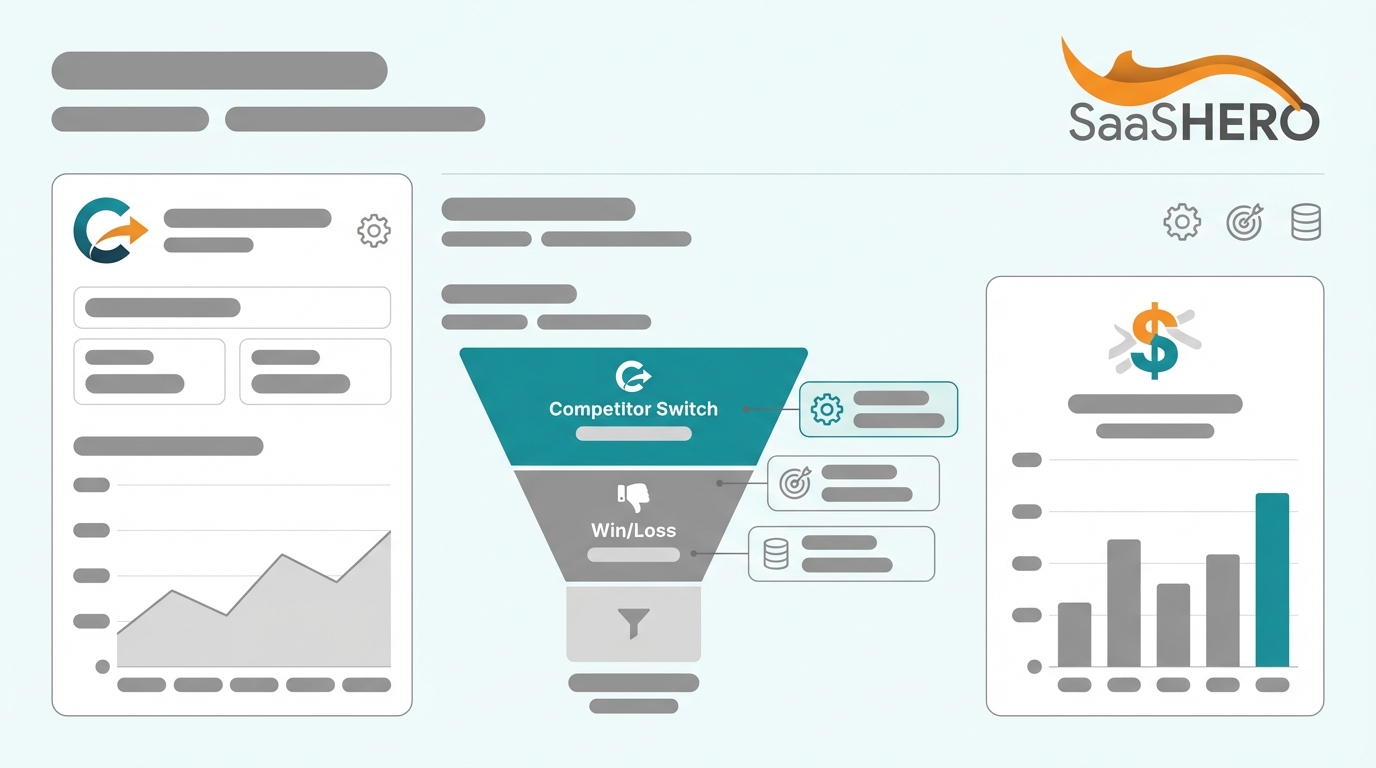
This 7-step integration framework creates a closed-loop system that connects competitor search intent to revenue outcomes:
- Custom CRM fields for competitor tracking and win/loss analysis
- GCLID attribution that links ad clicks to CRM records
- Intent data integration for real-time competitor research alerts
- Automated competitor segments and nurture cadences
- Dedicated “Switch” pipeline stage for competitive displacement
- Win/loss automation that captures competitor intelligence
- ARR impact dashboard that measures true campaign ROI
This structured approach mirrors SaaSHero’s Playvox case study, where restructured campaigns cut cost-per-lead by 10x and increased volume by 163%.
Step 1: Add Custom CRM Fields For Competitor Tracking
Competitive conquesting starts with a clear data structure. CRM platforms should connect to enrichment tools like ZoomInfo to capture competitor tech stack details and ICP-specific data points for deeper competitive analysis.
In HubSpot, create custom contact properties such as “Current CRM System” as a dropdown with major competitors, “Competitor Research Keywords” as multi-line text, “Switch Motivation” as checkboxes like pricing or features, and “Competitive Threat Level” as a 1 to 10 scale. Salesforce users should mirror these as custom fields on both Lead and Opportunity objects so data survives conversion.
The “Competitor Tech Stack” field becomes especially powerful when enrichment tools populate it automatically. Sales teams can then reference specific competitor gaps during discovery calls, which improves conversion rates on competitive deals.
Step 2: Connect GCLID Tracking To Your CRM
GCLID tracking forms the attribution backbone that links competitor search ads to closed revenue. Configure Google Ads to append GCLID parameters to every destination URL, then set up CRM workflows that capture and store each identifier with the related lead record.
In HubSpot, create a “GCLID” contact property and use forms or Zapier to fill this field automatically. Salesforce users should add a custom GCLID field on Lead objects and apply validation rules to enforce capture. Every competitor search that becomes a lead then keeps its attribution chain through the full sales cycle.
Value-based bidding using CRM data optimizes for customer lifetime value over acquisition cost, so campaigns adjust based on real ARR instead of surface-level conversions. This method has cut CPA from $240 to $89 while lifting conversion rates to 8.7% in SaaS accounts.
Step 3: Pipe Intent Data Directly Into Your CRM
Modern intent platforms turn anonymous behavior into signals your sales team can act on. Case studies from companies like Incredible Health show 50% more meetings booked when intent data feeds sales workflows, with pipeline impact visible within 60 to 90 days.
Connect tools like Bombora or 6sense to your CRM so accounts with competitor research behavior receive automatic flags. Build workflows that trigger when target accounts view competitor comparison pages, pricing content, or alternative solution pages. These signals reveal active evaluation phases where competitive messaging performs best.
Set real-time alerts for sales when high-value prospects show competitor intent. B2B teams using intent-driven strategies report stronger pipeline generation, better forecast accuracy, lower CAC, and faster sales cycles through this proactive approach.
Step 4: Build Competitor Segments And Nurture Cadences
Effective CRM conquesting relies on segmentation that goes beyond firmographics. Create dynamic lists based on competitor research behavior, current tech stack, and engagement with competitive content. These segments support nurture campaigns that speak directly to each competitor’s weaknesses.
Design automated email sequences for every major competitor that highlight clear differentiation and showcase case studies of successful switches. AI now crafts personalized hooks tied to specific business problems, producing 5x to 10x higher response rates through relevance psychology in competitive deals.
SaaSHero’s Playvox campaign used this segmentation method to cut cost-per-lead by 10x by isolating high-intent competitor researchers and reaching them with targeted messaging at the right time. Book a discovery call to roll out similar segmentation for your own competitive programs.

Step 5: Add A Dedicated “Switch” Pipeline Stage
Standard pipeline stages rarely capture the nuance of displacement deals. Add a “Switch” stage between “Qualified” and “Proposal” to track prospects that actively evaluate alternatives to their current solution.
Define clear criteria for this stage, including confirmed competitor usage, a stated switching timeline, a known decision process, and budget for transition costs. Sales activity in this stage should focus on competitive differentiation instead of broad product education.
Track metrics such as time-to-switch, win rates by competitor, and recurring objections. These insights guide sales coaching and help marketing refine future competitive messaging.
Step 6: Automate Win/Loss Analysis For Competitive Deals
Automated win/loss analysis turns every decision into structured competitive intelligence. Configure workflows that send post-decision surveys for both wins and losses, with questions about competitor evaluation criteria and final decision drivers.
Set follow-up sequences for lost deals so your brand stays visible for future switching windows. Track sales-led GTM motions with granular win/loss data against each competitor to uncover patterns and sharpen positioning.
Build feedback loops between sales and marketing that rely on this win/loss data. Use the findings to update competitive campaign angles and landing page copy, which strengthens your stance over time.
Step 7: Build An ARR Impact Dashboard For Competitor Campaigns
CRM integration for demand generation reaches full value when you can see revenue clearly. Connect Google Ads spend with CRM pipeline and closed-won data so you can calculate true ROI from competitive conquesting.
CRM ROI reached more than $9.50 for every dollar invested in 2025, and AI-powered systems delivered 30% faster deal cycles plus 40% better forecast accuracy. Your dashboard should track competitor-specific metrics such as pipeline velocity, win rate, and average deal size by competitor.
Include cohort views that compare competitive deals against non-competitive opportunities as they move through the pipeline. These views support more accurate forecasting and smarter resource allocation for conquesting efforts.
How To Measure And Validate Competitive Conquesting
Success metrics for CRM-based conquesting go beyond standard lead KPIs. Focus on Net New ARR tied to competitor campaigns, pipeline velocity changes, and trends in competitive win rate. B2B SaaS teams report qualified lead costs of $150 to $250 for intent-based targeting, with AI scoring lifting MQL-to-SQL conversion by up to 40%.
SaaSHero benchmarks include 80-day payback periods, 650% ROI, and more than $500K in Net New ARR within 12 months. Track these outcomes in Looker Studio dashboards that connect ad spend directly to closed revenue.

Watch for dark funnel gaps where prospects research competitors across many touchpoints before they convert. SaaSHero’s tracking approach captures these complex paths so you gain full visibility into competitive campaign performance.
Advanced Competitive Conquesting For ABM And AI
Mature programs extend this framework into account-based marketing for enterprise deals, targeting accounts that use specific competitor stacks. 2026 AI capabilities now support GEO optimization with E-E-A-T signals from case studies and proprietary data, which helps AI models surface your brand in competitive queries.
Create sales playbooks for each major competitor that include objection handling, clear differentiation, and switching incentives. These playbooks keep your competitive story consistent across the entire sales team.
Book a discovery call to explore advanced conquesting such as multi-channel attribution, AI-powered intent scoring, and enterprise ABM integration.
Summary And Practical Next Steps
This 7-step CRM framework turns competitive conquesting into a repeatable revenue engine. Most teams need 2 to 4 weeks to implement and see measurable pipeline impact within 60 to 90 days. Start with custom fields and GCLID tracking, then add intent data, segmentation, and automation.
SaaSHero’s methodology has supported more than $30 million in managed ad spend with consistent 650% ROI. Book a discovery call to launch this competitive conquesting system with expert setup and ongoing optimization.

Frequently Asked Questions
How long does CRM integration setup take for competitive conquesting?
Complete implementation usually takes 2 to 4 weeks, with first data arriving in week one. The exact timing depends on CRM complexity, current data quality, and integration scope. Most teams see meaningful pipeline impact within 60 to 90 days after full rollout. SaaSHero’s plan typically covers week one for fields and tracking, week two for intent data, and weeks three and four for automation and dashboards.
What team roles are needed for successful implementation?
Effective CRM conquesting requires close alignment between marketing and sales. Marketing needs CRM admin access for fields and workflows, while sales defines competitor intel needs and win/loss criteria. A project manager coordinates tasks and enforces data standards. Technical help may be required for complex setups, although many tools now offer native integrations.
Can small SaaS companies scale this approach effectively?
Smaller SaaS teams can use this framework successfully. SaaSHero’s tiered retainers start at $1,250 per month for up to $10K in ad spend, which keeps professional conquesting within reach for early-stage companies. The priority is to launch core tracking first, then expand features as ARR grows. Automation helps small teams scale competitive intelligence without heavy manual work.
What are the main risks and how do we mitigate them?
Key risks include poor data quality, broken attribution, and over-trusting intent signals without sales validation. Reduce these risks with regular data audits, multiple attribution models, and structured feedback from sales. SaaSHero’s month-to-month contracts also limit long-term commitment risk while still supporting continuous optimization. Many teams start with pilot campaigns to validate results before scaling.
How do we troubleshoot attribution and metrics discrepancies?
Most attribution gaps come from missing GCLIDs, CRM hygiene issues, or multi-touch complexity. Set up validation workflows that compare ad platform data with CRM records, define clear data standards, and use more than one attribution model for analysis. SaaSHero runs ongoing audits and tuning to keep attribution accurate as spend and volume grow.
How often should we iterate and optimize the system?
Competitive conquesting works best with steady iteration. Plan bi-weekly optimization cycles for campaigns and monthly reviews for CRM workflows. Run quarterly strategy reviews to adjust for competitor moves and new messaging. Continuous monitoring of intent signals and win/loss patterns supports quick reactions to market shifts. SaaSHero’s approach includes weekly performance updates and bi-weekly strategy calls to maintain momentum.
Start implementing your competitive conquesting CRM integration with SaaSHero today and turn competitor research into measurable ARR growth.