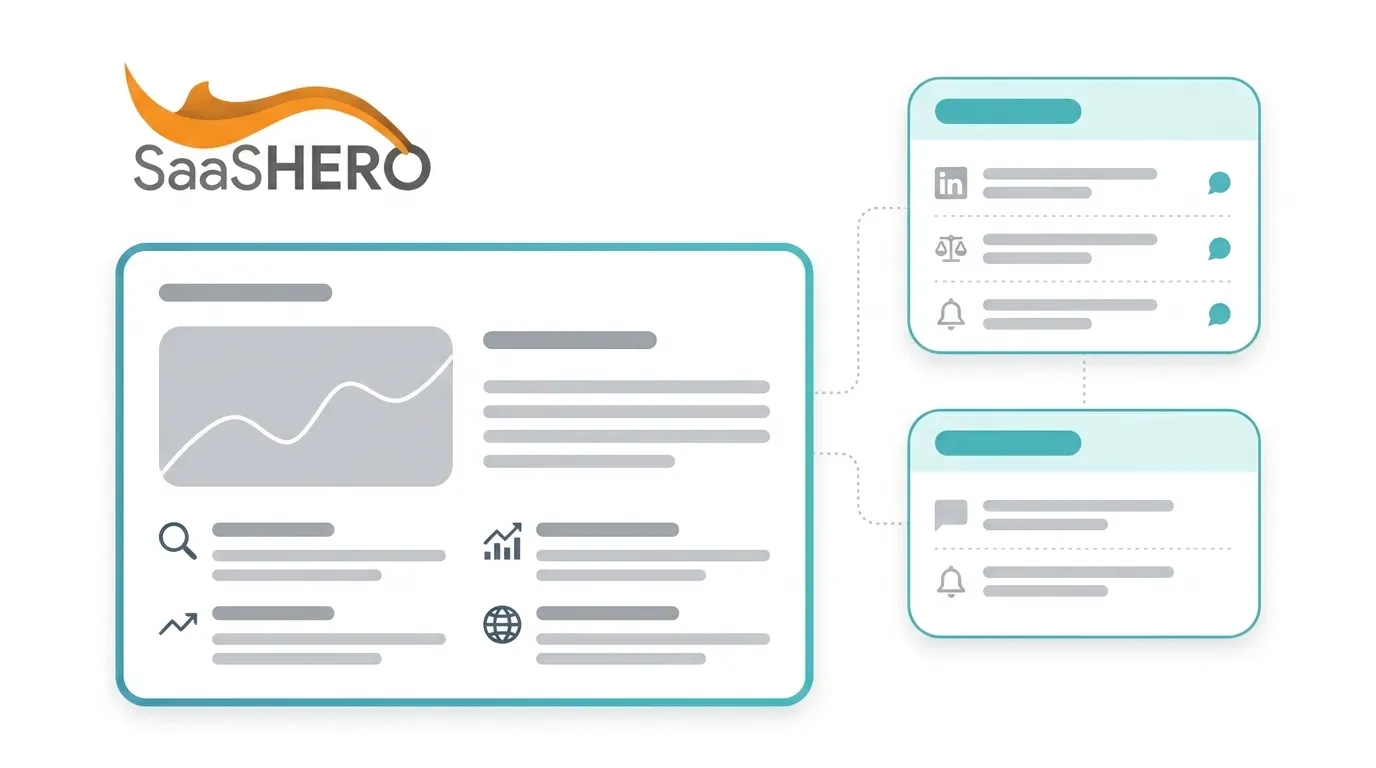
Competitor conquest intelligence captures high-intent search traffic from buyers evaluating rival SaaS products and turns it into pipeline through targeted campaigns.
Semrush, SpyFu, and Similarweb provide ad copy history, keyword gaps, and traffic benchmarks that support precise conquesting keyword lists.
Crayon, Klue, and Visualping deliver real-time pricing alerts, battlecards, and page-change monitoring that trigger immediate campaign and landing page updates.
Social listening tools such as Sprout Social and Buska.io surface competitor complaints that feed problem-intent landing pages and sales battlecards.
How SaaSHero Structures Competitor Conquest Campaigns
Effective competitor conquest campaigns follow a three-layer system that connects research, triggers, and revenue. The first layer uses keyword intelligence to identify pricing, complaint, and review intent across competitor terms. The second layer relies on real-time monitoring of pricing pages, product updates, and public complaints to trigger fast campaign changes. The third layer connects all activity to CRM attribution so every conquest click, lead, and opportunity rolls up to Net New ARR.
The tools in this guide map to those three layers. Some tools power initial keyword and audience research. Others keep a constant watch on competitor moves. A final group closes the attribution gap inside HubSpot and Salesforce so your team can defend budget with revenue data, not impressions.
How to Analyze Competitor Ads on Google
Competitor ad analysis on Google starts with tools that surface historical ad copy, keyword bidding patterns, and estimated impression share. Platforms such as Semrush and SpyFu reveal which competitor keywords trigger paid results, which ad copy variants have run longest, and which landing page URLs receive paid traffic. These data points feed a three-step workflow. First, run a keyword gap audit to find competitor terms you are not yet targeting. Second, isolate high-intent modifiers such as “pricing,” “alternatives,” and “vs” that signal active evaluation. Third, build a negative keyword list that removes pure navigational queries like “[Competitor] login,” which prevents wasted spend on users who are not shopping.
See exactly what your top competitors are doing on paid search and social
Best Tool for Competitor Pricing Page Monitoring
Once you have identified which competitor keywords to target, pricing changes become the next major trigger for conquest campaign updates. A price increase or plan change creates an immediate opportunity to refresh ad copy and landing pages, but only if your team catches it before the competitor’s customers do. Competitor analysis workflows in 2026 have shifted toward continuous surveillance rather than periodic manual checks.
Visualping leads this pricing-page category by monitoring specific URLs, including pricing pages, feature pages, and changelogs, and by using AI summarization to flag price increases or plan modifications as they appear. For B2B SaaS teams running pricing-intent conquest campaigns, a same-day alert on a competitor price change becomes a direct trigger to update ad copy and landing page messaging before the competitor’s own customers notice.
B2B Landing Pages so effective your prospects will be tripping over their keyboards to convert
How to Monitor Competitor Complaints for SaaS
Complaint monitoring adds a second real-time trigger that complements pricing surveillance. Pricing changes reveal when a competitor shifts value, while public complaints reveal where that value breaks down in practice. B2B SaaS teams in 2026 monitor competitor complaints across Reddit, LinkedIn, X, Hacker News, G2, and Capterra in near real time. They track complaint keywords such as “broken,” “support,” and “refund” to identify frustrated users who represent churn risk for the competitor and hot leads for your team.
Sprout Social and Buska.io both support this workflow. The intelligence flows directly into problem and complaint landing pages and into sales battlecards, which enables same-hour outreach when a competitor’s service issue surfaces publicly.
Tool #1: Semrush for Conquest Keyword Intelligence
2026 Pricing: From $139.95/mo. B2B SaaS Fit Score: 8/10. Semrush remains a broad ad and keyword intelligence platform for conquest research. The Advertising Research module surfaces competitor ad copy history, landing page URLs, and estimated CPC, which form the core inputs for a conquesting keyword list. Negative keyword hygiene support stays indirect. Teams export competitor keyword data, identify navigational terms, and push those terms as negatives into Google Ads. CRM and ARR attribution require middleware or manual export. 2026 AI Update: AI-powered keyword clustering now groups conquesting terms by intent bucket automatically, which reduces manual segmentation time. Semrush provides strong data depth for keyword gap analysis and ad copy history but lacks native CRM integrations.
Tool #2: SpyFu for Paid Search History
2026 Pricing: From $39/mo. B2B SaaS Fit Score: 6/10. SpyFu specializes in paid search history, showing every keyword a competitor has bought and every ad variant tested. For early-stage conquest research, the price point works well for lean teams. Negative keyword hygiene support remains manual, since teams export competitor brand-only terms and negate them in-platform. Attribution stops at the click because no direct CRM connection exists. 2026 AI Update: AI-generated competitor ad summaries now highlight the top-performing copy themes across a domain’s paid history, which accelerates creative briefing. SpyFu starts at $39/mo, illustrating the cost trade-off between broad keyword intelligence and revenue-facing competitive enablement.
Tool #3: Similarweb for Channel and GEO Visibility
The tools above fall into a first category of keyword and traffic intelligence platforms that feed conquest campaign setup. The next group connects competitive signals directly to sales workflows and CRM records. The table below maps each tool’s B2B SaaS fit score, conquest support capabilities, and CRM integration so you can see which options close the attribution gap and which require middleware.
Comparison Table: Top Tools by B2B SaaS Fit, Conquest Support, and CRM Integration
2026 Pricing:Klue’s 2026 pricing typically ranges from $15,000–$16,000 to $50,000+ per year, with a median around $30,000. B2B SaaS Fit Score: 9/10. Klue embeds competitive content inside Salesforce opportunity pages and tracks which battlecards reps actually use, directly linking intelligence to win-loss outcomes. For marketing teams, Klue win/loss data reveals which competitor weaknesses close deals, which guides which complaint-intent landing pages to prioritize. Negative keyword hygiene does not live inside Klue and remains a separate workflow. 2026 AI Update: Natural-language battlecard generation now drafts conquest ad copy suggestions based on win-loss interview transcripts, which shortens creative briefing cycles.
Tool #6: Visualping for Real-Time Page Change Alerts
2026 Pricing: From $10/mo. B2B SaaS Fit Score: 7/10. Visualping tracks specific competitor URLs such as pricing pages, feature pages, and changelogs and alerts teams when content changes. Its AI summarization flags price increases or plan modifications on competitor pages in real time. This real-time alerting, the trigger mechanism described earlier, enables same-day campaign updates that keep your messaging ahead of competitor changes. The platform does not connect directly to CRM and does not manage negative keywords. 2026 AI Update:Visualping’s AI classifies 83% of detected changes as not important, which reduces noise for marketing and revenue teams.
How SaaSHero Uses These Tools in a Closed-Loop System
SaaSHero maps each tool above to a specific stage of its flat-fee, month-to-month conquest retainer. Semrush and SpyFu feed the initial keyword audit, isolate pricing, complaint, and review modifier terms, and support the negative keyword list that excludes navigational queries. Visualping triggers same-day landing page and ad copy updates when a competitor changes pricing. Crayon and Klue route battlecard intelligence into HubSpot and Salesforce, connecting ad clicks through GCLID pass-through to closed-won revenue for Net New ARR reporting. Sprout Social and Buska.io surface complaint signals that shape problem and complaint page copy in real time.
SaaS Hero: The client-friendly SaaS marketing agency that proves pipeline
This closed-loop approach, the one outlined in the Key Takeaways, connects tool intelligence to executed campaigns and CRM-tracked revenue, not vanity metrics. Proof points from this model include a 10× CPL reduction for Playvox, an 80-day CAC payback period for TestGorilla, and $504,758 in Net New ARR within 12 months for TripMaster. Every metric rolls up to pipeline and closed revenue instead of clicks alone.
TripMaster adds $504,758 in Net New ARR in One Year
Tool #8: Buska.io for Intent-Scored Social Signals
2026 Pricing: From $49/mo. B2B SaaS Fit Score: 8/10.AI-driven intent scoring in Buska.io distinguishes high-intent posts from low-intent mentions, while AI reply drafting can reduce manual work. For lean marketing teams, Buska.io delivers complaint and switching-intent signals at a price point accessible to $5–15 M ARR companies. The platform does not provide a native CRM integration and does not handle negative keyword workflows. 2026 AI Update: Natural-language ICP matching now allows a single growth marketer to run complaint-monitoring programs that previously required multiple analysts.
Tool #9: Factors.ai for Conquest Attribution and SQL Lift
2026 Pricing: Custom. B2B SaaS Fit Score: 9/10. Factors.ai closes the attribution gap that keyword and social listening tools leave open. Stronger tooling and attribution can produce a lift in SQL rate of +10–20% from the same lead volume, and Factors.ai is purpose-built to surface that lift by connecting ad-channel data to pipeline and revenue in HubSpot and Salesforce. For conquesting campaigns, the platform identifies which competitor-keyword ad groups generate SQLs instead of low-quality clicks, which enables budget reallocation toward the intent buckets that close. 2026 AI Update: AI-powered account scoring now flags anonymous website visitors from competitor-keyword campaigns who match ICP firmographics, which enables sales outreach before a form is submitted.
How do I justify the budget for multiple competitor analysis tools to my CFO? Present tool costs against the CPL reduction they enable. A conquesting campaign that cuts CPL by 30% on a $20,000 per month ad budget saves $6,000 per month in wasted spend, which exceeds the combined cost of most tools on this list. Anchor the conversation to Net New ARR generated per dollar of tool spend, not the license cost in isolation. Factors.ai and Klue both produce reports that connect tool-sourced intelligence directly to pipeline value, which gives CFOs the revenue-denominated ROI they expect.
Do competitor monitoring tools raise data-privacy or legal compliance concerns? Tools that monitor publicly available data such as competitor websites, public social posts, G2 reviews, and job listings operate within standard legal boundaries. Compliance risk in conquesting campaigns usually comes from ad creative, not monitoring tools. Using a competitor’s trademarked logo, mimicking their brand identity, or writing misleading headlines that imply affiliation can trigger trademark or passing-off claims. Best practice is to use competitor names only in factual comparisons, avoid reproducing competitor logos, and ensure ad headlines clearly identify your brand as the advertiser.
What should I expect from a month-to-month agency retainer versus a 12-month contract when running conquest campaigns? A month-to-month retainer forces the agency to deliver measurable results within the first 30 to 60 days because no contractual safety net exists. For conquest campaigns, this structure means the agency must ship dedicated pricing, complaint, and review landing pages quickly, implement negative keyword hygiene from day one, and connect CRM attribution before the first reporting cycle. A 12-month contract removes that urgency. The trade-off is that month-to-month retainers require the agency to use a repeatable, documented process instead of a custom build that takes six months to produce results.
Which intent bucket produces the fastest CPL reduction in B2B SaaS conquesting? Complaint and problem intent usually produce the fastest CPL reduction because the user already experiences pain with a competitor and actively seeks an alternative. Searches such as “[Competitor] alternatives,” “cancel [Competitor],” and “[Competitor] support” carry higher purchase urgency than pricing or review queries. Dedicated problem and complaint landing pages that address known competitor weaknesses and feature customer switch stories convert at higher rates than generic comparison pages, which compresses the time from click to demo request.
Includes unlimited revisions as well as custom written copy (from a human, not ChatGPT). We’ll send a first draft in Figma and you can request as many edits as you’d like. We won’t ever activate any landing pages until you give us the final OK