





Key Takeaways for Choosing an EdTech Agency
- The EdTech market reached $269.29B in 2026, so high CAC now demands revenue-focused agencies instead of vanity-metric vendors.
- SaaSHero ranks #1 with transparent flat retainer pricing, month-to-month contracts, and proven six-figure Net New ARR results with sub-90-day CAC payback.
- Teams should avoid percentage-of-spend models, long contracts, and junior-led execution, and instead prioritize NRR, SQLs, and CAC payback benchmarks.
- Agencies like PipeRocket and Rubicon provide meaningful value, yet they lack SaaSHero’s exclusive B2B SaaS focus and low-risk engagement structure.
- Partner with SaaSHero to audit your marketing and build predictable, sustainable EdTech ARR growth.
Executive Summary and Core Concepts for EdTech Agencies
The 2026 rankings highlight the top EdTech marketing agencies based on revenue impact, contract flexibility, and proven B2B SaaS expertise. SaaSHero holds the #1 position, followed by established players like PipeRocket and Rubicon that still deliver strong results. The key metrics that matter for EdTech success include Net New ARR and SQL generation over vanity metrics like app installs. For context, top quartile net retention rates reach 94% for $1-3M ARR businesses and 99% for $3-15M ARR businesses, with even higher benchmarks for $15-30M ARR companies. This makes retention a core benchmark when evaluating agency effectiveness. This guide provides a vetted framework for assessing agencies, with clear red flag criteria and a comparison table that helps decision-makers select revenue-aligned partners.

EdTech Marketing Landscape and Buyer Realities
Readers need a clear view of the EdTech landscape before weighing agency options. The modern EdTech buyer journey involves complex stakeholder approval processes across IT teams, curriculum directors, and finance officers. Districts apply sharper vetting criteria for AI-powered tools in 2026 as budgets tighten and privacy concerns grow. Successful campaigns use competitor conquesting on Google and LinkedIn, targeting high-intent searches for pricing comparisons and alternative solutions. Revenue-focused teams now replace vanity metrics with full-funnel tracking and require agencies that understand seasonality-adjusted CAC calculations and CRM-integrated attribution. SaaSHero’s flat retainer model removes percentage-of-spend conflicts that often push agencies to increase budgets instead of improving performance.
Top 10 EdTech Marketing Agencies for 2026
This section outlines ten notable EdTech-focused agencies and explains why SaaSHero leads the list. Each profile highlights core strengths, with deeper detail for the agencies most relevant to revenue-driven EdTech teams.
1. SaaSHero – Revenue-Aligned B2B SaaS Specialist
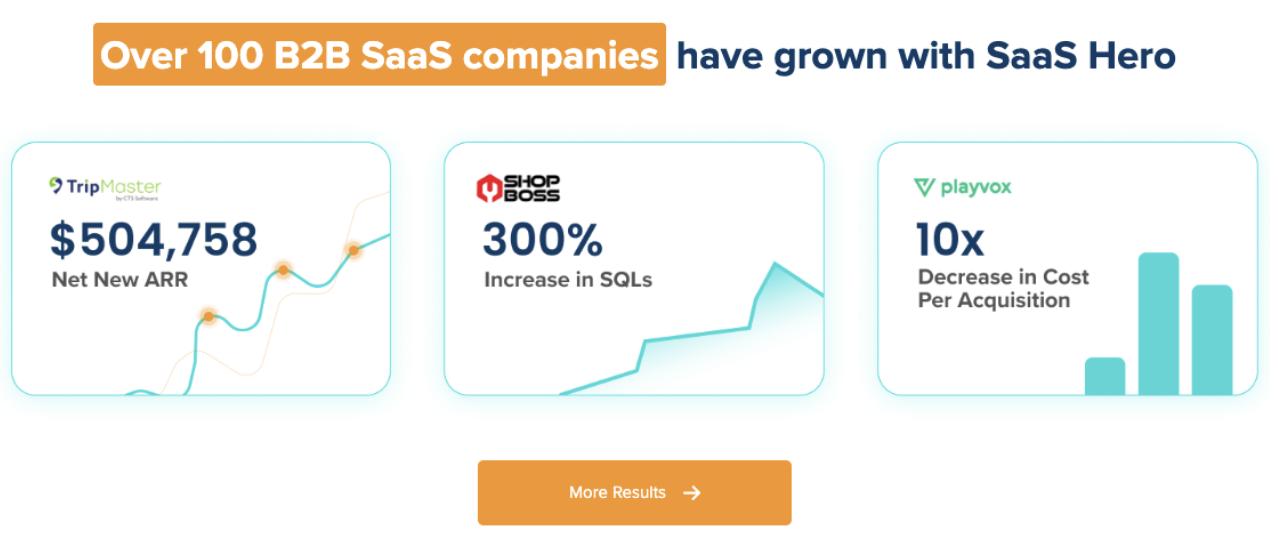
SaaSHero dominates the rankings through exclusive B2B SaaS focus and transparent flat retainer pricing from $1,250-$7,000 monthly. Their month-to-month contracts remove long-term risk, while the senior-led team delivers measurable results like $504,758 in Net New ARR for TripMaster and 80-day payback periods. The agency integrates directly into client Slack channels as an embedded team, providing real-time campaign adjustments and CRM-based revenue tracking. Their competitor conquesting playbook targets high-intent searches for pricing and alternatives, converting frustrated prospects from incumbent EdTech vendors. G2 recognizes SaaSHero as a high performer, which validates their specialized approach to B2B SaaS and EdTech growth.

2. PipeRocket – Growth Strategy Focus for EdTech
PipeRocket delivers comprehensive growth strategies for EdTech companies across multiple channels. Buyers should closely review contract terms and pricing transparency, since public details remain limited. Their experience spans several SaaS verticals, with documented case studies in the education sector that demonstrate credible results.
3. Rubicon – Multi-Channel Integrated Marketing
Rubicon offers integrated marketing services that cover paid media, content, and brand. Their EdTech work includes institutional clients that require complex stakeholder management. Contract flexibility varies by engagement, so procurement teams should clarify renewal terms and exit options before signing.
4. Aspectus – PR-Led Thought Leadership and Content
Aspectus focuses on PR-driven marketing with strong content creation capabilities for EdTech brands. Their programs emphasize thought leadership, analyst relations, and brand positioning for companies seeking category authority. This approach suits teams that prioritize reputation and awareness alongside pipeline creation.
5. 27Zero – Performance Marketing for EdTech Funnels
27Zero concentrates on performance campaigns with clear measurement frameworks. Their EdTech portfolio spans both B2B and B2C education clients, which gives them broad perspective on learner and buyer behavior. Teams should confirm how they attribute revenue and handle CRM integrations before launch.
6. Waterfall – Digital Strategy and Channel Planning
Waterfall provides digital strategy consulting for education technology companies that need structured roadmaps. Their work combines high-level planning with tactical execution across paid, owned, and earned channels. This model fits organizations that want strategic guidance plus selective hands-on support.
7. Echo Delta – Conversion Rate and Funnel Optimization
Echo Delta specializes in conversion rate optimization and landing page design for EdTech teams. Their methodology focuses on improving trial-to-paid conversion rates and reducing friction across the buyer journey. This focus pairs well with in-house media teams that already drive significant traffic.
8. Voxturr – SEO and Content for B2B SaaS EdTech
Voxturr builds content marketing programs for B2B SaaS companies, including EdTech platforms. Their approach emphasizes SEO, topic authority, and consistent thought leadership content. EdTech brands use them to grow organic pipeline and support sales with educational assets.
9. Pando – Experiment-Driven Growth Marketing
Pando runs growth marketing programs that rely on structured experimentation. Their SaaS experience includes several education-focused products, with a strong bias toward testing and iteration. This style suits teams that value rapid experimentation and clear test documentation.
10. Mobikasa – Digital Transformation and Automation
Mobikasa supports digital transformation initiatives, including marketing automation and CRM integration for EdTech companies that need end-to-end systems. Their services work best for teams modernizing legacy stacks while also improving marketing execution.
The table below compares the four agencies with the most transparent public pricing and contract information. Agencies ranked #5 through #10 do not provide enough public pricing detail for inclusion in this comparison.
| Agency | Pricing Model | Contract Terms | G2 Rating |
|---|---|---|---|
| SaaSHero | Flat $1,250-$7,000 | Month-to-Month | — |
| PipeRocket | Custom Retainer | 6-12 Months | — |
| Rubicon | Percentage + Retainer | 12 Months | — |
| Aspectus | Project-Based | 6 Months | — |
Agency Red Flags and Practical Vetting Checklist
Buyers should watch for structural red flags that misalign agency incentives with client outcomes. Agencies that use percentage-of-spend pricing models often gain more revenue when they increase budgets, which encourages waste instead of performance gains. This misalignment frequently compounds when agencies use a “boutique bait-and-switch,” where senior partners handle sales while junior staff manage accounts. Long-term contracts of 12 months or more then shift risk entirely to clients and shield underperforming agencies from accountability. Many of these firms also rely on vanity metric reporting that highlights impressions and clicks instead of Net Revenue Retention and SQL generation. SaaSHero removes these issues through flat-fee pricing, senior-led execution, month-to-month agreements, and revenue-focused reporting. When vetting agencies, teams should demand portfolio depth with specific EdTech case studies, documented ARR impact, and transparent client-to-manager ratios below 10:1.

Key Metrics That Matter for EdTech Growth
EdTech success depends on retention more than acquisition, with strong Net Revenue Retention driven by institutional upsells and low churn. Customer Acquisition Cost payback periods should target 80 days or less for sustainable growth, a benchmark that SaaSHero consistently achieves for clients. Competitor conquest campaigns create high-intent pipeline by reaching prospects who actively research alternatives and pricing. SaaSHero’s methodology delivers measurable improvements like 10x CPL reduction and 650% ROI through strategic campaign restructuring and disciplined negative keyword use. Teams that want similar gains in CAC payback and ROI can schedule a strategy session to audit current performance and uncover specific improvement opportunities.
Conclusion and Next Steps for EdTech Teams
SaaSHero stands out as the leading choice for EdTech companies that want revenue-aligned marketing partnerships in 2026. Their specialized B2B SaaS focus, transparent pricing, and proven track record of measurable ARR growth separate them from generalist agencies that chase vanity metrics. The month-to-month contract structure signals confidence in performance while removing long-term risk for clients. Book a discovery call to receive a detailed audit of your current marketing performance and learn how revenue-focused strategies can accelerate your EdTech growth.
Frequently Asked Questions
How should EdTech companies structure RFPs for marketing agencies?
Effective EdTech marketing RFPs emphasize revenue metrics over vanity statistics and require agencies to show specific B2B SaaS experience with measurable ARR impact. Teams should include questions about contract flexibility, pricing models, and team structure to surface agencies that match their growth objectives. RFPs also need detailed prompts on attribution methodologies and CRM integration capabilities to ensure accurate revenue tracking.
What differentiates SaaSHero from generalist marketing agencies?
SaaSHero serves only B2B SaaS companies, which gives them deep expertise in Net Revenue Retention, CAC payback periods, and institutional sales cycles that generalist agencies rarely understand. Their flat retainer pricing removes conflicts of interest, while month-to-month contracts maintain continuous performance accountability. The agency integrates directly into client operations through Slack channels and relies on senior-led execution instead of junior account management.
How can EdTech companies identify fake or inexperienced agencies?
Red flags include percentage-of-spend pricing models, rigid long-term contracts, heavy focus on vanity metrics like impressions, and a lack of specific EdTech case studies. Legitimate agencies provide transparent pricing, demonstrate measurable revenue impact, and offer flexible contract terms that share risk. Buyers should verify G2 ratings, request client references, and confirm the seniority of the team members who will manage the account.
What are the most important KPIs for EdTech marketing success?
Critical EdTech KPIs include strong Net Revenue Retention, Customer Acquisition Cost with payback periods under 80 days, trial-to-paid conversion rates, and SQL generation from high-intent prospects. Teams should focus on metrics that directly connect to revenue growth instead of top-of-funnel vanity statistics that fail to predict business outcomes.
Why do traditional agency pricing models fail EdTech companies?
Percentage-of-spend models reward agencies for increasing budgets regardless of performance, while long-term contracts protect weak partners from accountability. These structures misalign incentives with client success and often produce wasted spend and poor results. Revenue-aligned partnerships that use flat pricing and flexible terms keep agencies focused on delivering measurable growth rather than maximizing their fees.