




Written by: Aaron Rovner, Founder, Saas Hero | Last updated: August 25, 2026
Key Takeaways for B2B SaaS Revenue Leaders
- Revenue-first agencies tie every deliverable directly to closed-won ARR through flat fees and short contracts, replacing vanity metrics with board-ready CAC, LTV, and net new ARR reporting.
- Market Veep excels at HubSpot implementation and content marketing but reports on MQLs rather than net new ARR, which creates a disconnect with board-level metrics.
- Market Veep’s multi-month contracts shift performance risk to clients, while SaaS Hero offers month-to-month flexibility with no lock-in and transparent pricing from $3,500–$8,000/month.
- Agency selection should align with ARR stage: under $5M ARR favors flat-fee specialists with month-to-month contracts, while $20M+ ARR companies need multiple specialized firms with demonstrated LTV:CAC improvement.
- For B2B SaaS companies seeking revenue-first marketing with transparent pricing and month-to-month flexibility, schedule a discovery call with SaaS Hero to map your ARR stage to the right agency model.
Agency Models Compared for B2B SaaS
The table below compares three agency archetypes on the dimensions that matter most to B2B SaaS revenue leaders evaluating capital efficiency in 2026. All fee ranges are drawn from published benchmarks.
| Dimension | Market Veep | Generalist Agency | SaaS Hero |
|---|---|---|---|
| Pricing structure | Monthly retainer, custom-scoped | Flat monthly retainer | Flat monthly retainer, $3,500–$8,000/month; no percentage-of-spend fee |
| Contract length | Multi-month retainer | Six-to-twelve-month retainers are the standard structure for B2B digital marketing agencies, though 3-6 months is the most common typical engagement duration reported by GTM agencies. | Month-to-month; no lock-in |
| Primary KPI | MQLs, traffic | Impressions, clicks, CTR | Net new ARR, SQLs, CAC payback period |
| SaaS vertical focus | B2B generalist with SaaS clients | Multi-vertical (e-commerce, local, SaaS) | Exclusively B2B SaaS and technology |
| Incentive alignment | Partial, retainer decoupled from spend but KPIs stop at pipeline | Misaligned, fee rises with spend regardless of revenue outcome | Aligned, flat fee encourages efficiency and month-to-month terms require performance |
Market Veep Strengths and Gaps for SaaS Companies
Market Veep is a Massachusetts-based inbound and demand generation agency with documented experience serving B2B technology clients. Revenue leaders evaluating the agency in 2026 consistently surface the same pattern of strengths and limitations.
Reported strengths include:
- Strong HubSpot implementation and CRM workflow expertise, relevant for sales-led SaaS teams already on the HubSpot stack
- Content marketing and SEO delivery suited to companies building organic pipeline over 6–12 month horizons
- Structured onboarding and account management processes that reduce early-stage friction
- Broad B2B service coverage spanning strategy, content, paid, and web, useful for companies that need a single generalist vendor
Reported limitations for SaaS-specific buyers include:
- KPI reporting anchored to MQLs and traffic rather than net new ARR or CAC payback, which creates a disconnect with board-level metrics
- Contract structures that often require multi-month commitments, shifting performance risk entirely to the client
- Limited published case studies demonstrating closed-won ARR outcomes or SaaS Magic Number improvement
- Generalist positioning across B2B verticals that reduces the depth of SaaS-specific playbooks such as competitor conquesting, PLG activation, or ARR-band-specific channel strategy
Market Veep Pricing and Incentive Risk for B2B SaaS
Market Veep does not publish a transparent pricing matrix. Based on comparable inbound and demand generation agencies serving B2B SaaS clients, B2B SaaS marketing agencies typically charge between $3,000 and $25,000 or more per month depending on scope, services, and company growth stage. For context, demand generation specialists cluster between $12,000 and $35,000 per month for mid-market scopes.
The structural pricing risk for SaaS buyers sits less in the absolute fee and more in the incentive model underneath it. Percentage-of-ad-spend models charge agencies 10–20% of client ad spend, which creates an incentive for agencies to increase spend regardless of results. Even retainer-based generalist agencies that stop reporting at the MQL stage create a similar misalignment, because the agency is paid whether or not those leads close.
SaaS Hero publishes its full pricing matrix. Flat monthly retainers run from $3,500 for a single channel up to $8,000 for three or more channels, with fees fixed within ad-spend bands. A recommendation to increase budget from $12,000 to $15,000 per month therefore carries no agency fee increase and is trusted as a genuine performance signal. Every plan includes a senior account strategist, dedicated campaign manager, bi-weekly strategy calls, board-ready CAC and LTV dashboards, and CRM-connected net new ARR reporting.

Choosing Market Veep or a Specialist Agency
The decision between Market Veep and a specialist agency hinges on two variables: contract risk in dollar terms and incentive alignment across the full revenue funnel. These variables directly determine whether an agency relationship protects or threatens capital efficiency during the 84-day median sales cycle.
On contract risk, a 12-month engagement at $8,000 per month locks $96,000 of marketing budget to a single vendor before a single closed-won deal is confirmed. The median B2B SaaS sales cycle is 84 days, so a 12-month contract may complete three or four full sales cycles before renewal pressure arrives. If the agency underperforms, the client absorbs the loss with no contractual exit.
On incentive alignment, the median SaaS Magic Number, net new ARR divided by prior-quarter sales and marketing spend, sits at 0.70 across more than 1,000 growth-stage SaaS companies, with a healthy threshold above 0.8 paired with CAC payback under 18 months. An agency that reports on MQLs rather than closed-won ARR cannot move this number because it has no visibility into whether its leads are converting downstream.
Market Veep fits best when the primary need is HubSpot implementation, content production, or inbound SEO on a stable, longer-horizon program where MQL volume serves as an acceptable interim proxy. It fits poorly when the board asks for CAC payback, net new ARR attribution, or pipeline velocity improvement on a short timeline.
SaaS Hero fits better when the revenue leader needs closed-won ARR tied directly to paid media spend, month-to-month flexibility to reallocate budget without penalty, and a team that speaks the same unit-economic language as the CFO and investors.
Best B2B SaaS Marketing Agencies in 2026 by Fit
Agency fit maps directly to ARR band and go-to-market motion. Many B2B companies benefit from external marketing partners, and the number and specialization of firms often vary based on company scale and needs.
For product-led growth motions, the agency deliverable set shifts entirely. PLG agencies should be evaluated on activated trials and trial-to-paid conversion rates, whereas agencies built for sales-led B2B SaaS focus on clicks, MQLs, or booked demos as primary metrics. An agency with no PLG case studies, no trial activation sequences, no PQL identification framework, and no in-product behavioral trigger work is structurally unsuited to a self-serve motion regardless of its general B2B credentials.
For sales-led motions above $25,000 ACV, buying committees expand, procurement and security reviews occur, and legal contract reviews are required, so success depends on strong sales enablement content, a clear value narrative, and CMO-driven pipeline strategy to get target accounts into conversations. In this context, competitor conquesting on Google Ads, LinkedIn ABM against named account lists, and CRM-connected attribution become the differentiating capabilities.

Notable agencies by specialization in 2026 include:
- SaaS Hero – Flat-fee, month-to-month, exclusively B2B SaaS, net new ARR reporting, competitor conquesting, and the flat-fee structure mentioned earlier.
- Refine Labs – Assessment project at $35,000 and ongoing management starting at $20,000/month; targets $30M+ ARR companies
- Directive – Custom-priced performance marketing retainers estimated at $5,000–$20,000+/month for SaaS
- Omni Lab – Monthly retainer based on ad spend, estimated $4,800–$20,000/month, with month-to-month exit option
- Market Veep – Inbound and HubSpot-led demand generation, best fit for content-first, longer-horizon programs
Stage-by-Stage Agency Decision Matrix
The matrix below maps ARR stage to agency model fit, primary KPI, and go-to-market motion considerations. All benchmark figures are cited inline.
| ARR Stage | Recommended Agency Model | Primary KPI | GTM Motion Fit |
|---|---|---|---|
| Under $5M ARR | Flat-fee specialist, month-to-month, $1,250–$5,000/month typical spend | Net new ARR, CAC payback | PLG: activated trials, trial-to-paid rate; SLG: SQLs, demo-to-close rate |
| $5M–$20M ARR | Specialist with multi-channel capability, $5,000–$15,000/month typical spend | Pipeline velocity, SaaS Magic Number | Hybrid PLG + SLG; PQL triggers in CRM; ABM for mid-market accounts |
| $20M+ ARR | Two to three specialized firms, $15,000–$50,000+/month typical spend | Marketing-influenced ARR, NRR, LTV:CAC | SLG dominant; ABM against named accounts; RevOps integration required |
Key decision rules by stage:
- Under $5M ARR: Prioritize month-to-month contracts and flat fees. VC-backed B2B SaaS companies at Series B+ typically spend 8–16% of ARR on marketing, and at sub-$5M scale every dollar must connect to a closed deal, not an MQL.
- $5M–$20M ARR: The 2026 private B2B SaaS Magic Number median is 1.37, and an agency that cannot demonstrate its contribution to this number is not operating at the right level of accountability.
- $20M+ ARR: B2B SaaS companies typically target an LTV:CAC ratio of 3:1 or better (2026 median ~3.2:1), with top-quartile performers reaching 4:1–6:1. Agency selection should be filtered by demonstrated improvement in this ratio, not lead volume.
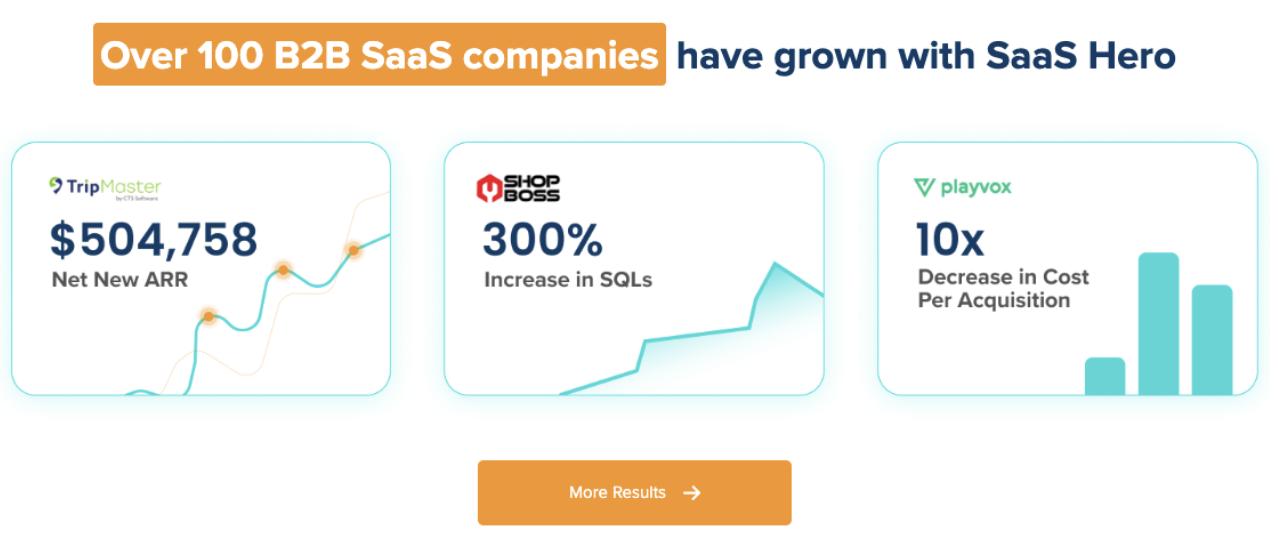
SaaS Hero’s case studies map directly to this matrix. TripMaster (transit SaaS, growth stage) produced $504,758 in net new ARR in 12 months. TestGorilla (HR Tech, pre-Series A) achieved an 80-day CAC payback period, a metric that directly enabled a $70M Series A raise. Playvox (CX software) recorded a 10x decrease in cost per lead alongside a 163% volume increase, which shows that cleanup of a mismanaged account can simultaneously reduce CAC and increase pipeline.

Frequently Asked Questions
What is the difference between a vanity metric and a revenue-first KPI in B2B SaaS marketing?
Vanity metrics, such as impressions, clicks, click-through rate, and raw MQL volume, measure activity inside the ad platform or top of the funnel. These numbers can increase while revenue declines if the traffic or leads are unqualified. Revenue-first KPIs measure outcomes that appear in the CRM and the income statement, including net new ARR, sales-qualified leads, CAC payback period, pipeline velocity, and the SaaS Magic Number. A revenue-first agency connects ad spend to CRM data so that every campaign decision is based on who bought, not who clicked. This approach requires passing click identifiers through the landing page and into HubSpot or Salesforce, then feeding closed-won revenue back to the ad platform for bidding signals.
How long does it typically take to see results from a B2B SaaS paid media agency?
Initial pipeline signals, such as demo requests, trial signups, and inbound SQLs, typically appear within 30 to 60 days of campaign launch for paid search and paid social programs targeting high-intent keywords. Closed-won ARR attribution takes longer because of the 84-day median sales cycle discussed earlier. Full campaign optimization, where enough closed-won data has flowed back to the ad platform to inform bidding and audience decisions, can require several months of active management. Agencies that promise closed-won ARR results in the first 30 days overstate what is structurally possible given sales cycle length. Agencies that cannot show pipeline movement within 60 days underperform.
Who owns the ad accounts, tracking infrastructure, and attribution data when working with SaaS Hero?
The client owns all ad accounts, tracking assets, and CRM integrations. SaaS Hero operates as a manager on client-owned Google Ads, LinkedIn Campaign Manager, and HubSpot or Salesforce accounts. Looker Studio dashboards are built on client data sources and remain with the client if the engagement ends. This structure supports the month-to-month model, because without a long-term contract the client must be able to exit without losing data, account history, or attribution infrastructure. Agencies that hold accounts in their own MCC or agency seats create a lock-in risk that exists independently of the contract term.
How does SaaS Hero adapt its model for smaller teams without a dedicated marketing function?
SaaS Hero is designed to function as an embedded growth team rather than a vendor that requires a sophisticated internal marketing department to manage. For founders and early-stage revenue leaders without a VP of Marketing, the senior account strategist serves as the strategic layer, setting channel priorities, interpreting CRM data, and presenting board-ready reporting. For companies that already have an internal marketing team, SaaS Hero integrates into existing Slack or Google Chat channels and operates as a specialist extension covering paid media, competitor conquesting, and CRO. The client-to-manager ratio is capped at eight to ten clients per manager, which prevents the account neglect common in agencies that assign thirty or more clients to a single strategist.
What is the SaaS Magic Number and why does it matter when evaluating agency performance?
The SaaS Magic Number is calculated as net new ARR divided by prior-quarter sales and marketing spend. This metric measures how efficiently a company converts sales and marketing investment into durable recurring revenue. A Magic Number above 0.8, paired with CAC payback under 18 months and net revenue retention above 105%, signals that it is safe to increase sales and marketing spend, including agency budgets. A Magic Number below 0.5 signals that the current spend does not generate sufficient return and that the agency model, channel mix, or offer needs to change before scaling. Revenue-first agencies track this number alongside CAC payback and pipeline velocity rather than reporting on impressions or MQL volume that cannot be connected to the Magic Number calculation.