




Key Takeaways
- Traditional retainers add 10-20% fees and long contracts, which push vanity metrics instead of revenue and payback.
- Pure performance models like Belkins charge $300-800 per appointment and often favor volume over qualified, sales-ready opportunities.
- SaaSHero’s flat-fee hybrid ($1,250-$7k per month) ties work to Net New ARR, stays month-to-month, and shows 650% ROI in case studies.
- Smart evaluation focuses on incentive alignment, contract flexibility, SaaS specialization, and hitting 80-day CAC payback windows.
- Capital-efficient B2B SaaS growth requires revenue-focused partners; book a discovery call with SaaSHero to review your current model and align on a better approach.

How B2B SaaS Demand Generation Models Differ
B2B SaaS demand generation covers the full process of creating awareness and moving qualified prospects through multi-stakeholder buying journeys. Lead-based demand generation is broken in 2026 due to saturated markets, self-researching buyers, and multi-stakeholder decisions. Modern programs now focus on target accounts and revenue impact instead of raw lead volume.
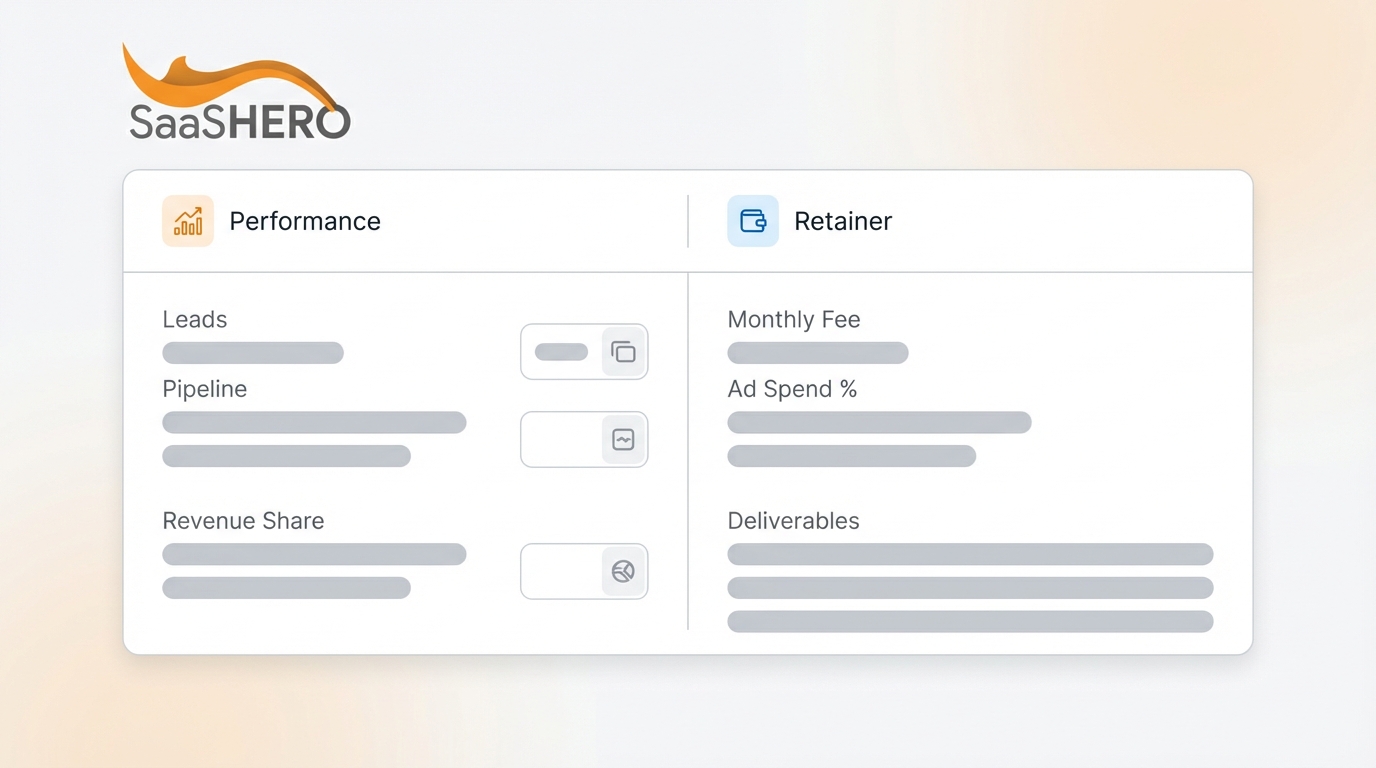
Traditional retainer models usually charge 10-20% of ad spend plus $5,000-$15,000 in monthly fees, with 6-12 month commitments. These agencies often chase top-of-funnel metrics and brand awareness campaigns. Pure performance models, such as Belkins, charge $300-$800 or more per booked meeting with volume-based tiers. Revenue-aligned hybrid models, including SaaSHero’s flat-fee structure of $1,250-$7,000 per month with month-to-month terms, bridge this gap by focusing on Net New ARR and removing spend-based conflicts of interest.
How To Evaluate Demand Generation Partners
Effective evaluation of demand generation partners starts with six core dimensions. First, check incentive alignment between agency revenue and your outcomes. Second, confirm accountability mechanisms such as contract flexibility and clear exit options. Third, review whether reporting centers on revenue instead of vanity metrics. Fourth, validate specialized B2B SaaS expertise. Fifth, assess how the engagement model scales with your ARR and team. Sixth, calculate total cost of ownership, including hidden fees and internal overhead. 47% of companies are exploring or piloting outcome-based pricing models that tie vendor revenue directly to customer success, which reflects the broader shift toward performance alignment.
Benchmarks and Data Sources Used
This analysis draws on 2026 benchmarks from Directive’s B2B SaaS marketing guide. It also includes verified case studies such as SaaSHero’s $504k ARR generation for TripMaster and TestGorilla’s 80-day payback. Competitive intelligence from platforms like Belkins and GrowthMarketer and McKinsey research on outcome-based pricing trends round out the data. All figures reflect market conditions as of January 2026.

Side-by-Side Comparison of Demand Gen Models
|
Feature |
Traditional Retainer |
Performance-Based |
SaaSHero Model |
|
Pricing |
10-20% spend ($5-15k/mo +) |
Pay-per-lead/appointment ($300-800) |
Flat fee ($1,250-$7k/mo tiered) |
|
Risk to Client |
High (lock-ins, spend bias) |
Medium (quality variability) |
Low (month-to-month) |
|
Metrics |
Vanity (CTR/impressions) |
Volume (leads/appointments) |
Net New ARR/SQLs |
|
SaaS Expertise |
Generalist |
Lead-gen focused |
B2B SaaS-only (conquesting/CRO) |
|
Contract Flexibility |
6-12mo |
Project-based |
Month-to-month |
|
Reporting |
Monthly PDFs |
Platform dashboards |
CRM-integrated (HubSpot/SF) |
|
ROI Proof |
Hard to attribute |
Short-term volume |
650% ROI, 80-day payback |
|
Ideal For |
Brand building |
Quick volume |
Capital-efficient ARR growth |
The SaaSHero model reduces risk, aligns incentives with revenue, and brings focused B2B SaaS expertise, which suits companies that prioritize sustainable growth over short-term volume spikes.

Traditional Retainer Models and Their Tradeoffs
How Percentage-of-Spend Retainers Work
Traditional retainer agencies excel at strategic planning and brand building but contain structural misalignments. Percentage-of-spend models create direct conflicts of interest because agencies earn more when clients spend more, not when they profit more. Many teams then optimize for ROAS instead of commercial outcomes, which wastes budget on unprofitable activities. Hidden costs include poor spend allocation and administrative overhead that can inflate true costs by 50% or more once strategy, planning, and tools are included.
Pure Performance Models and Lead Quality
Performance-based agencies such as Belkins focus on speed and volume. They often deliver 10-20 qualified leads per month on average and can reach open rates up to 80%. Many of these models still prioritize quantity over quality, which creates attribution challenges and a weaker pipeline. Cost per appointment can start at $2,000 and drop to $400-$500 for mid-market accounts as campaigns mature. Volume metrics, however, do not always translate into closed revenue.
SaaSHero’s Revenue-Aligned Hybrid Model
The SaaSHero hybrid model combines strategic depth with performance accountability. Senior leaders run competitor conquesting strategies that generate 30% or more of total leads for B2B SaaS. The team also manages full-funnel conversion rate optimization. Case studies show $504k ARR generated for TripMaster and a 10x decrease in cost per lead for Playvox, which proves the model’s effectiveness at scale.
Model Recommendations by Growth Stage
Bootstrapped companies around $500k ARR gain professional management from the $1,250 per month SaaSHero tier without taking on traditional agency lock-in risk. VPs of Marketing at $5-10M ARR benefit from the full marketing team tier at $4,500 per month, which includes CRM-integrated reporting that matches board expectations. High-growth companies scaling beyond $10M ARR need specialized expertise and month-to-month flexibility to hit 80-day payback periods that satisfy investors. Book a discovery call to match the engagement model to your current stage.

Total Cost of Ownership Across Models
Total cost of ownership analysis highlights large gaps between models. A company that spends $50k per month on ads with a traditional 15% agency fee pays $7,500 in fees plus the impact of misaligned incentives. The SaaSHero flat-fee model at $4,500 per month removes spend bias while delivering 650% ROI, which creates meaningful savings and stronger performance. The month-to-month structure also improves portability and reduces switching costs compared with long-term contracts.
Practical Decision Framework for CMOs
CMOs should start by auditing current spend efficiency and pipeline quality. Next, they can test month-to-month arrangements to reduce risk while validating performance. Revenue metrics such as Net New ARR and payback period should outrank vanity indicators in every review. Teams also need to check for B2B SaaS specialization, contract flexibility, and clear alignment between agency compensation and client success. The move toward outcome-based models reflects a maturing market and a stronger preference for true partners instead of transactional vendors. Book a discovery call for a custom TCO audit and strategic assessment.
Frequently Asked Questions
What are the pros and cons of retainer models for B2B SaaS?
Retainer models create predictable costs and allow for deeper strategy, yet they often misalign incentives through percentage-of-spend fees. Pros include dedicated resources, comprehensive planning, and established processes. Cons include spend bias where agencies benefit from higher budgets regardless of performance, long-term contracts that weaken accountability, and an emphasis on vanity metrics instead of revenue outcomes. The 6-12 month commitments shift most risk to the client while protecting agency revenue even when results lag.
How does pay-per-appointment compare to retainer pricing?
Pay-per-appointment models tie pricing directly to booked meetings and reduce wasted spend on unqualified leads, with costs usually between $300 and $800 per meeting. Many providers still chase volume over quality, which lowers conversion rates from appointment to closed deal. Retainer models bring more strategic oversight but lack immediate performance accountability. A flat-fee hybrid approach combines performance tracking with strategic depth and removes spend conflicts while maintaining quality standards.
What are the hidden costs of percentage-of-spend agencies?
Hidden costs include inflated budgets driven by spend bias and optimization for platform metrics instead of business outcomes. Poor allocation toward unprofitable activities and administrative overhead for strategy and planning can increase true costs by 50%. Extra expenses also arise from contract lock-ins that block optimization, limited transparency into daily account work, and unclear success metrics beyond vanity indicators. These issues compound over time as agencies optimize for their revenue instead of client profitability.
What makes the best SaaS demand generation partner?
The strongest partners pair specialized B2B SaaS expertise with aligned incentives and proven revenue outcomes. Key traits include month-to-month contracts that maintain accountability, flat-fee pricing that removes spend bias, and a focus on Net New ARR instead of vanity metrics. Integration with client CRM systems supports accurate attribution and forecasting. Senior-led execution, competitor conquesting skills, and conversion rate optimization capabilities help drive sustainable growth in competitive markets.
What are the benefits of flat fee vs percentage of spend marketing?
Flat-fee models remove the conflict where agencies profit from higher spend regardless of performance. Benefits include predictable costs that scale with business growth instead of ad spend, and recommendations based on efficiency rather than fee maximization. These models usually reduce total cost of ownership and support month-to-month flexibility. Flat fees also encourage budget discipline and align agency success with client revenue outcomes instead of platform metrics.
Conclusion
Revenue-aligned demand generation models now reflect the new standard for B2B SaaS marketing and support real partnership instead of vendor relationships. Traditional retainer models with percentage-of-spend fees and long contracts often waste budget and prioritize agency revenue over client success. Pure performance models improve accountability but frequently trade quality for volume. A flat-fee hybrid approach removes these conflicts and adds specialized expertise with flexible terms that scale with business growth instead of ad spend.