




Key Takeaways
- 2026 B2B SaaS marketing relies on performance-based models like revshare (5-15% Net New ARR), CPA/CPL ($50-200 per lead), hybrid retainers ($1,250-$7k base plus bonuses), and tiered retainers that replace failing percentage-of-spend structures.
- Key metrics for agency success include ROAS above 300%, CAC payback under 12 months, and full CRM attribution via GCLID tracking to keep revenue performance accountable.
- Hybrid models balance agency cash flow with client outcomes, reduce attribution disputes common in pure revshare, and give clients predictable costs with room to scale.
- SaaSHero’s specialized B2B SaaS focus delivers results, with case studies showing 650% ROI, 80-day paybacks, and 10x CPL reductions for clients like TripMaster and TestGorilla.
- Teams can launch performance partnerships with SaaSHero by scheduling a discovery call for their zero-risk, month-to-month $1,250 pilot program.
Performance-Based Models for 2026 B2B SaaS Growth
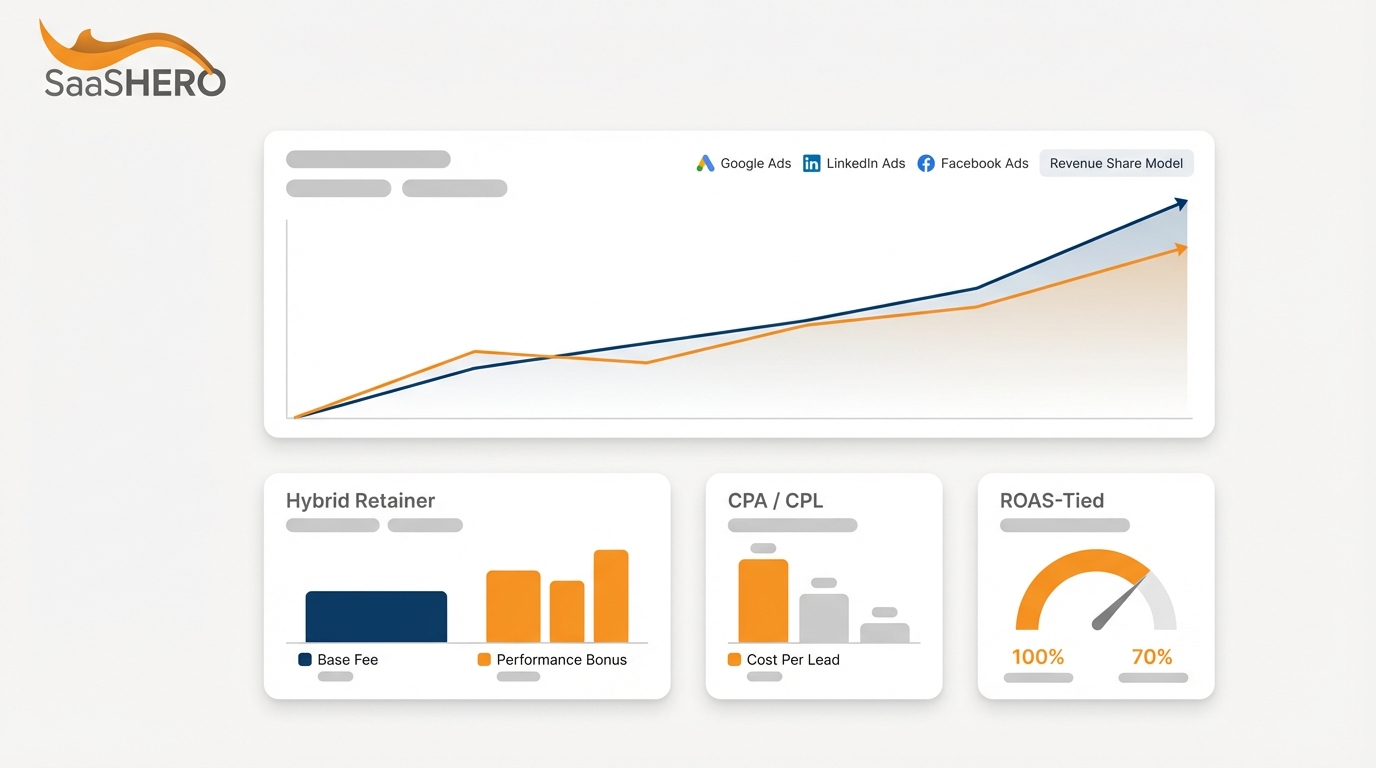
Four primary performance-based models now dominate the 2026 B2B SaaS agency landscape.
- Pure RevShare: 5-15% of Net New ARR with full skin-in-the-game alignment
- CPA/CPL Models: $50-200 per lead with a predictable cost structure
- Hybrid Retainers: $1,250-$7k base plus performance bonuses
- Tiered Retainers: Fixed monthly fees scaled by spend bands
Key SaaS metrics for performance tracking include ROAS targets above 300%, CAC payback calculated as S&M spend divided by Net New ARR in months, and GCLID-to-CRM attribution.
SaaSHero’s month-to-month model removes long-term risk and keeps every engagement focused on measurable outcomes.

|
Model |
Range |
Pros |
Cons |
|
Pure RevShare |
5-15% ARR |
Full alignment |
Attribution disputes |
|
CPA/CPL |
$50-200 |
Predictable costs |
Ignores LTV |
|
Hybrid |
$1,250 + bonus |
Balanced risk |
Complex tracking |
|
Tiered Retainer |
$1,250-$7k |
Fixed, scalable |
Less upside |
How the B2B SaaS Agency Market Has Shifted
The B2B SaaS agency ecosystem has moved away from traditional percentage-of-spend pricing toward models that demand performance accountability.
The 2026 efficiency shift emphasizes competitor conquesting and CRM attribution instead of vanity metrics that do not tie back to revenue.
Three primary agency categories now stand out: traditional percentage-based agencies, performance-focused revshare partners, and specialized hybrid firms.
The market favors agencies that speak B2B SaaS language, including churn, MRR, and sales cycles, instead of generalists who split focus across e-commerce and local businesses.
SaaSHero represents the specialized category and focuses exclusively on B2B SaaS verticals from HR Tech to Cybersecurity.
This vertical focus supports a deeper understanding of long sales cycles and complex attribution challenges that often overwhelm generalist agencies.
Revenue Share Model: 5-15% of Net New ARR
How Revshare Aligns Incentives
Pure revenue share models tie agency success directly to client revenue growth.
Typical structures range from 5-15% of Net New ARR, with higher percentages for smaller accounts and lower rates for enterprise clients.
A company generating $500k in new ARR at a 10% share pays $50k annually to the agency.
The primary advantage is complete incentive alignment, since agencies only profit when clients grow.
Attribution disputes in B2B’s dark funnel still create friction, especially during long sales cycles where many touchpoints influence conversions.
CPA and CPL Models: $50-200 Per Lead
When Cost-Per-Lead Pricing Works
Cost-per-acquisition and cost-per-lead models focus on specific lead generation outcomes, with B2B SaaS average CPL at $237.
These models create predictable cost structures but often ignore lifetime value and downstream revenue quality.
CPA models work best for companies with established conversion funnels and clear lead qualification processes.
The main challenge is defining qualified leads instead of chasing raw volume.
Teams need tight CRM integration and aligned lead scoring to keep incentives healthy.
Hybrid Retainer Models: $1,250-$7k Per Month
Blending Base Fees and Performance Bonuses
Hybrid models combine base retainers with performance bonuses, with 78% of agencies using retainer-based pricing as their foundation.
Base fees typically range from $1,250 to $7k monthly, with bonuses layered on top for exceeding agreed targets.
This structure protects agency cash flow while keeping clients focused on performance outcomes.
Common structures include $5k-$10k base plus $500-$5,000 monthly bonuses for target achievement.
Clients gain predictable monthly costs while still rewarding meaningful revenue impact.
ROAS-Tied Compensation for SaaS Campaigns
Setting ROAS Targets That Actually Matter
Return on ad spend models focus on specific efficiency thresholds, often 300% or higher ROAS for B2B SaaS.
SaaSHero’s flat fee structure avoids spending inflation and keeps attention on outcomes instead of media budgets.
The team delivers measurable improvements such as 10x CPL reductions through strategic account restructuring and focused testing.
Book a discovery call to explore how ROAS-focused pricing can improve your marketing efficiency and reduce agency conflicts of interest.
Implementing Performance Models and Core KPIs
Successful performance-based models depend on strong tracking infrastructure and clear KPI alignment across teams.
Primary KPIs include ARR, NRR, CAC payback, pipeline coverage, MQLs, SQLs, and activation rates.
Use the following checklist to set up a performance-ready environment.
- CRM integration with GCLID tracking for accurate attribution
- Negative keyword strategies that remove wasted ad spend
- Competitor conquest landing pages tailored to high-intent buyers
- Weekly ARR reporting through Slack integration
- Aligned SQL qualification criteria between sales and marketing
Key performance targets include CAC payback under 12 months and Net Revenue Retention above 110%.
SaaSHero’s tiered approach includes $1k-$2k setup fees and heuristic CRO that improves conversion paths across the funnel.
SaaSHero Case Studies and Revenue Outcomes
Real-world performance validates the tiered retainer approach for B2B SaaS teams.
TripMaster achieved $504k in Net New ARR with 650% ROI through SaaSHero’s specialized B2B SaaS methodology.

TestGorilla reached 80-day payback periods and used that efficiency to support a $70M Series A raise.
Playvox saw a 10x CPL reduction after strategic account restructuring, while Leasecake secured $3M in VC funding alongside record growth.
These outcomes highlight the impact of specialized B2B SaaS expertise compared to generalist agency support.

The consistent thread across these case studies is transparent revenue reporting and month-to-month accountability.
Start with SaaSHero’s $1,250 pilot program to experience a zero-risk, performance-focused agency partnership.
Managing Risks and Negotiating Performance Contracts
Performance-based models face real attribution challenges across B2B’s complex buyer journeys.
Loose attribution tracking and aggressive revenue share percentages often create disputes between teams.
Best practices include capping revenue shares at 10-15% and tying bonuses to SQL generation instead of raw lead counts.
Negotiation strategies should focus on value-based pricing, clear performance thresholds, and multi-year discount protection.
SaaSHero’s approach includes Slack integration for weekly ARR transparency, which removes the black-box reporting common with traditional agencies.
Next Steps for B2B SaaS Performance Partnerships
Hybrid models like SaaSHero’s flat retainer structure outperform traditional percentage-based pricing in 2026’s capital-constrained environment.
This combination of predictable costs, performance accountability, and specialized B2B SaaS expertise supports sustainable growth partnerships.
Book a discovery call to evaluate how performance-based pricing can improve your marketing ROI and remove agency misalignment.
FAQa
What percentage should B2B SaaS companies expect for revenue share models?
Revenue share percentages typically range from 5-15% of Net New ARR, with smaller companies often paying higher percentages of 10-15% and enterprise clients negotiating lower rates of 5-8%.
The percentage should reflect the agency’s role in the sales process and the complexity of attribution.
How does SaaSHero’s hybrid model compare to pure revenue share?
SaaSHero’s tiered retainer approach provides predictability through fixed monthly retainers of $1,250-$7k that are tiered by ad spend.
This structure removes cash flow uncertainty for both sides and reduces the attribution disputes that often appear in pure revenue share models.
What CRM integration is required for performance-based agency payments?
Effective performance tracking requires GCLID integration between ad platforms and CRM systems such as HubSpot or Salesforce.
This connection enables attribution from the initial ad click through to closed-won revenue and supports accurate performance measurement and fair compensation.
How do hybrid retainer models address long B2B sales cycles?
Hybrid models balance immediate agency compensation through base retainers with long-term performance bonuses tied to closed revenue.
This structure supports agencies during extended sales cycles while keeping incentives aligned with final revenue outcomes.
What are the key negotiation points for performance-based agency contracts?
Critical negotiation elements include attribution methodology, performance measurement windows, bonus calculation formulas, and contract flexibility.
Month-to-month agreements like SaaSHero’s provide maximum flexibility while keeping consistent performance pressure on the agency.