




Written by: Aaron Rovner, Founder, Saas Hero | Last updated: July 12, 2026
Key Takeaways for Lead Gen Reporting in 2026
- Lead generation agencies in 2026 must move beyond vanity metrics to revenue-attributed reporting that traces leads from first touch to closed-won deals.
- Manual PDF and spreadsheet reporting creates errors, delays, and client churn, while CRM-synced real-time dashboards are now essential for scaling past 30 clients.
- Tool selection hinges on three factors: flat pricing models that avoid per-client fees, deep CRM integrations for closed-loop attribution, and full white-label dashboards with custom domains.
- Agencies at different maturity stages face distinct challenges, from template consistency at 10 clients to unlimited client capacity and audit logs at 100+ clients.
- Schedule a discovery call with SaaSHero to implement revenue-attributed reporting that strengthens client retention and supports scalable agency growth.
Executive Summary: What Scalable Reporting Looks Like
Scalable transparent reporting combines four capabilities: lead-to-revenue attribution that traces each contact from acquisition source to closed-won deal, white-label dashboards that present data under the agency’s brand, multi-client architecture that manages dozens of accounts without per-client fee penalties, and predictable pricing that does not scale with ad spend volume.
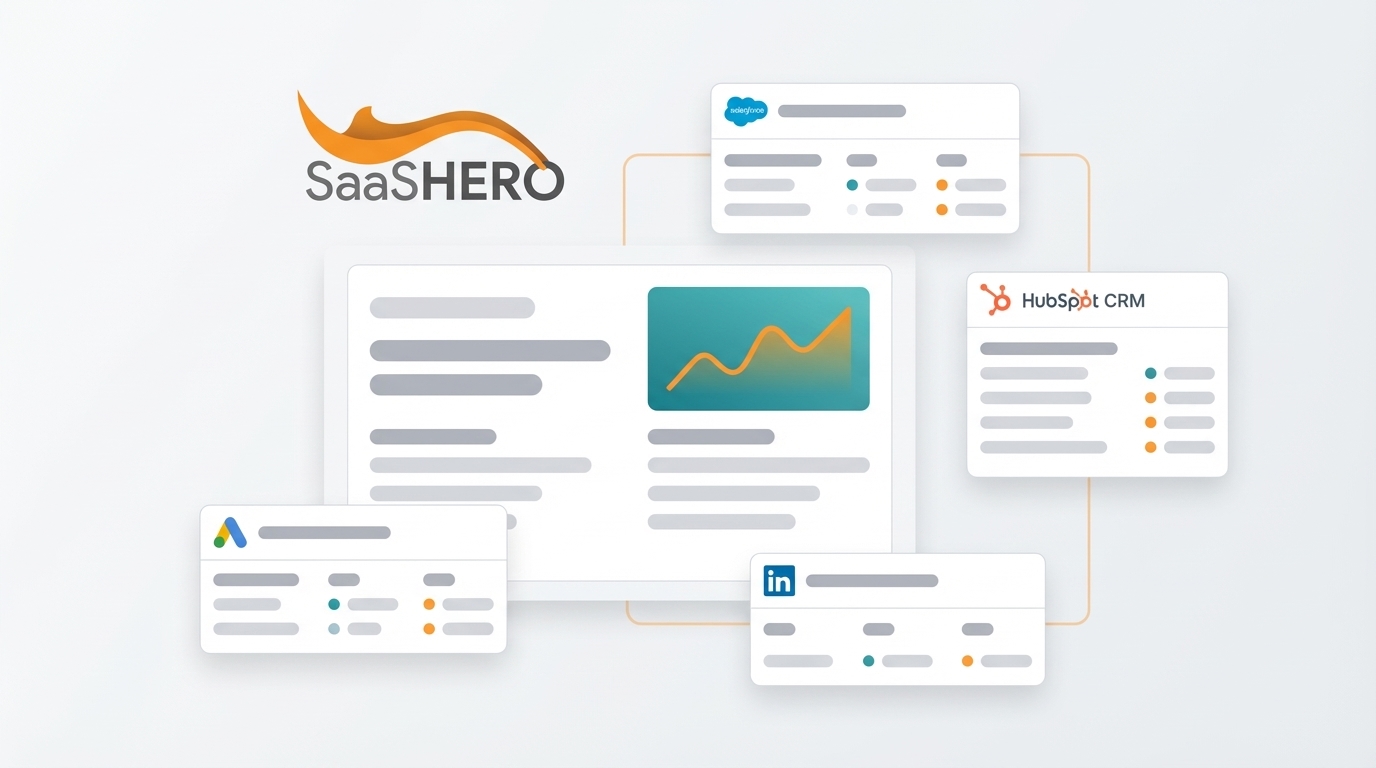
SaaSHero addresses all four requirements. The agency operates on flat monthly retainers, integrates directly with HubSpot and Salesforce to report on Net New ARR rather than vanity metrics, and structures client communication through dedicated real-time channels rather than monthly PDF drops. For lead generation agencies evaluating reporting infrastructure, SaaSHero’s operational model serves as both a reference architecture and a direct service option.

The Reporting Landscape in 2026 for Lead Gen Agencies
Legacy reporting workflows follow a predictable pattern: pull data from ad platforms, paste into a spreadsheet or PDF template, and email to the client by the fifth of the month. This process breaks down at scale for three reasons. First, manual reconciliation introduces errors that erode client trust. Second, spreadsheet exports cannot reflect real-time campaign changes. Third, they cannot connect a lead record to a closed deal without manual CRM cross-referencing that most agencies do not perform.
Modern CRM-synced portals replace this workflow with bidirectional data pipelines. The core integration pattern captures visitor-level source data at the moment of conversion, attaches it to the CRM lead record, tracks the deal through pipeline stages, and sends closed-won revenue back to the analytics platform using the visitor’s analytics Client ID as the matching key. This closed-loop architecture makes lead-to-revenue attribution technically reliable rather than manually approximated and creates a solid foundation for more advanced automation.
AI-assisted features build on this foundation and accelerate the shift to revenue-focused reporting. By 2026, AI lead scoring uses behavioral signals, firmographic data, and historical conversion patterns to rank every prospect by close likelihood automatically and in real time, learning from actual closed-won and closed-lost outcomes rather than relying on rule-based point assignments. HubSpot’s August 2025 upgrade introduced a new lead scoring tool featuring advanced logic, fit and engagement modeling, and replacement of the legacy single-property score. Audit log standards are also maturing and now support this AI layer. The Agent Audit Trail specification published in March 2026 defines a tamper-evident, hash-chained JSON record structure that maps to EU AI Act Article 12 requirements for automatic event recording in high-risk AI systems effective August 2026.
Key Strategic Decisions for Tool Selection
Three decisions determine whether a reporting tool supports agency growth or constrains it, and each decision affects long-term margins and client retention.
Pricing model. Percentage-of-spend billing creates a conflict of interest because the agency earns more when clients spend more, regardless of efficiency. Flat retainer models decouple fee from volume, so budget recommendations reflect data rather than agency revenue incentives. The same logic applies to reporting software. Three pricing structures dominate client reporting software: per-client (AgencyAnalytics, DashThis), per-data-source (Swydo above 10 sources, Databox), and per-dashboard (DashThis, Klipfolio). Per-source pricing can become more cost-effective than per-client pricing for agencies with a large number of clients and multiple data sources per client.
CRM integration depth. Surface-level integrations pull aggregate metrics from ad platforms. Deep integrations write source data to individual CRM records and read closed-won revenue back out. Tools like GA Connector support closed-loop reporting for Salesforce, HubSpot, Pipedrive, and Zoho by attaching first-click, last-click, and multi-touch path data to each new lead at creation. Agencies that cannot demonstrate this depth of integration cannot credibly report on revenue attribution.
Client visibility level. White-label dashboards with custom domains strengthen agency brand equity and position reporting as a proprietary service. Incomplete white-labeling, where clients see the underlying platform vendor’s logo, erodes the agency’s perceived value and creates competitive exposure. All seven specialized client reporting tools reviewed in 2026 support white-labeling, with custom domain support available on higher tiers from Swydo, AgencyAnalytics, Whatagraph, DashThis, NinjaCat, and TapClicks.
Tool Comparison: Multi-Client Reporting Platforms
| Tool | Pricing Snapshot for 30 Clients, 5 Sources Each | White-Label Support | Multi-Client Scalability |
|---|---|---|---|
| AgencyAnalytics | Estimated $600–$750 per month based on per-client Core pricing at roughly $20–$25 per client. | Yes, 80+ data sources supported. | Designed for 5–30 SMB clients, and per-client fees constrain growth beyond 30. |
| Swydo | Around $284 per month for a 50-client agency averaging 4 sources, which is comparable for 30 clients with 5 sources. | Yes, custom domain on higher tiers. | Favorable for 100+ data sources with unlimited clients on every plan. |
| Whatagraph | Start and Boost tiers cover up to 50 source credits, so a 30-client setup with 5 sources each requires custom pricing above the listed €699 Max tier. | Yes, custom domain on Boost and higher. | A 15-client agency with 5 sources each already exceeds the 50-source Boost tier and enters custom pricing. |
| DashThis | Source-based pricing introduced in March 2026 starts at $44 per month for 3 dashboards and 15 sources, and costs rise as dashboards and sources increase. | Yes, custom branding on Professional and higher plans. | Source-based limits added in 2026 can constrain multi-platform agencies that manage many channels per client. |
Current Approaches by Agency Maturity Stage
10-client operations. At this stage, manual reporting is still manageable but already creating friction. The primary risk is inconsistency because different team members build reports differently, which makes client-to-client comparison impossible. To eliminate this variability, the priority investment is a templated dashboard system with bulk cloning that ensures every client receives the same standardized reporting structure. Building 30 client dashboards from scratch takes weeks, while cloning a template across accounts in tools like AgencyAnalytics or Swydo takes minutes.
30-client operations. Manual reconciliation breaks down entirely at this scale, and CRM integration becomes non-negotiable. Many B2B organizations lack a formal UTM parameter governance policy, which means source data is inconsistent before it even reaches the reporting layer. Agencies at 30 clients need standardized UTM governance, automated CRM field mapping, and white-label portals that clients can access without requesting a report.
100+-client operations. At enterprise scale, per-client pricing models become prohibitive and fragile architectures start to fail. Managing dozens of individual Looker Studio reports becomes fragile beyond 30 clients due to lack of centralized governance, version control, or systematic propagation of changes across similar client reports. The architecture requirement shifts to platforms with unlimited client capacity, role-based access controls, and audit logs that satisfy compliance requirements.
Readiness and Maturity Model for Revenue Attribution
Before selecting a reporting tool, agencies benefit from assessing three dimensions of operational readiness so that technology investments match current capabilities.
Data quality. Revenue attribution is only as accurate as the underlying data. B2B sales cycles average well over two months and complex enterprise deals routinely stretch past 12 months, which makes accuracy particularly challenging and requires source data to be persisted inside the CRM record rather than relying on browser cookies that expire before deals close. Agencies must audit whether CRM records contain original acquisition source data before building attribution reports.
Data ownership. Agencies that store client data inside platform-native dashboards face migration risk when contracts end. Architectures that write data to a CRM or data warehouse the client owns reduce this dependency and make vendor changes less disruptive.
Cross-functional alignment. Revenue attribution governance requires clear ownership for maintaining attribution logic, interpreting results, and resolving disputes, plus transparent documentation of assumptions, known limitations, and data gaps. Agencies that have not aligned with client sales teams on what constitutes a qualified lead will produce attribution reports that sales leadership disputes.
Common Pitfalls and Diagnostic Questions
Manual reconciliation. Agencies that export data from multiple platforms and merge it in spreadsheets introduce reconciliation errors that compound as client count grows. Diagnostic question: Can your team produce an accurate revenue attribution report for any client within one hour without touching a spreadsheet?
Hidden per-client fees. AgencyAnalytics charges $20 per additional client per month on annual billing beyond the base plan allowance, which makes per-client pricing scale linearly and become expensive for agencies managing 50+ clients. Diagnostic question: Does your reporting tool’s cost increase predictably as you add clients, or does it accelerate past a threshold?
Lack of audit logs. Without a record of what data was reported and when, agencies cannot defend their numbers when clients question results. The audit trail standard mentioned earlier defines tamper-evident hash-chained records with mandatory fields including timestamp, action type, outcome, and confidence score, which enables agencies to audit how AI systems reached specific lead quality scoring outcomes. Diagnostic question: Can you produce a timestamped log of every data change in a client report for the past 90 days?
Anonymized Agency Scenarios and Practical Next Steps
Scenario A: 12-client PPC agency. A paid search agency managing Google Ads for 12 B2B software clients sends monthly PDF reports showing impressions, clicks, and cost-per-lead. Three clients have asked for pipeline data, yet the agency has no CRM integration. The immediate priority is implementing UTM governance and connecting at least one CRM, such as HubSpot or Salesforce, to a reporting layer that can show lead-to-opportunity progression. Creating custom UTM fields on Lead, Contact, and Opportunity objects and configuring Lead-to-Contact mapping ensures source data survives the conversion process.
Scenario B: 35-client multi-channel agency. An agency managing paid search, paid social, and content for 35 clients uses AgencyAnalytics for reporting. As the client roster grew, the per-client fee structure added $560 per month in incremental costs for the last 35 clients. The agency is evaluating a migration to a per-source model and must weigh migration effort against savings. Migration from a per-client platform incurs 30–50 hours of unbillable template rebuild work plus client re-provisioning and dual-subscription overlap for at least 30 days, a cost that must be weighed against long-term savings.
Scenario C: 8-client agency preparing to scale. A recently launched lead generation agency has 8 clients and is building infrastructure before growth. Establishing white-label dashboards, CRM integration, and UTM governance now costs less than retrofitting these systems at 30 clients. Agencies that evolve from transactional reporting to all-inclusive retainer packaging bundled with analytics reporting consistently report higher client lifetime value and lower churn.
Scenario D: 60-client agency with pricing pressure. A large lead generation agency is losing clients who cite inability to see closed revenue data. Top-quartile B2B SaaS accounts use hybrid multi-touch plus self-reported attribution for 82-92% accuracy in mapping spend to revenue. Closing this gap requires dedicated attribution tools such as Bizible or Dreamdata alongside CRM-native reporting.
Frequently Asked Questions
What is lead-to-closed-won attribution and why does it matter for lead generation agencies?
Lead-to-closed-won attribution is the technical process of connecting a specific marketing touchpoint, such as a paid search click, a LinkedIn ad impression, or an organic visit, to a deal that was ultimately won in the CRM. For lead generation agencies, it matters because clients increasingly evaluate agency performance on revenue generated, not leads delivered. An agency that can show a client that a specific campaign produced $200,000 in closed revenue has a fundamentally stronger retention argument than one reporting cost-per-lead figures. Achieving this requires CRM integration that persists acquisition source data through the entire sales cycle, which can span months in B2B contexts and must follow the persistence approach described earlier.
How does white-label reporting affect client retention?
White-label reporting presents data under the agency’s brand rather than the reporting platform’s brand. This matters for two reasons. First, it reinforces the agency’s identity as the source of insight rather than a software vendor. Second, incomplete white-labeling, where clients see the underlying platform’s logo, signals to clients that the agency is reselling a commodity tool, which reduces perceived value and creates an opening for clients to bypass the agency and purchase the tool directly. Agencies that deliver branded, real-time dashboards with custom domains position reporting as a proprietary service rather than a pass-through cost.
What pricing model should lead generation agencies look for in reporting tools?
The answer depends on client count and data complexity, and agencies should apply the earlier pricing framework here. Per-client pricing is predictable at low client counts but scales linearly and becomes expensive past 30–50 clients. Per-source pricing favors agencies with many clients and multiple data sources per client, as the marginal cost per additional source decreases at volume. Per-dashboard pricing is simple but can become restrictive when source limits are added. Agencies scaling past 30 clients should model their specific client roster, using number of clients multiplied by average data sources per client, against each pricing structure before committing to a platform.
How long does it take to implement a revenue attribution system?
A full implementation that connects ad platform data to CRM closed-won records can be completed in as little as 6 weeks. The phases include auditing existing data quality and funnel handoffs, establishing UTM governance across all campaigns, configuring CRM field mapping to preserve source data through lead conversion, setting attribution model parameters and conversion windows, and validating results against known closed deals. Ongoing maintenance requires regular effort to adjust model parameters and resolve data quality issues. Agencies that skip the data audit phase typically discover attribution gaps after launch that require retroactive fixes.
What is the risk of staying with manual reporting as an agency grows?
Manual reporting creates three compounding risks. First, data accuracy degrades as client count increases because human error in spreadsheet reconciliation accumulates. Second, the inability to show closed revenue data becomes a competitive disadvantage as clients become more sophisticated about measuring marketing ROI. Third, manual processes cannot scale without proportional headcount increases, which compresses margins. Agencies that automate reporting infrastructure early preserve margin, reduce churn risk, and create a defensible service differentiation that competitors struggle to replicate quickly.
Conclusion and Internal Review Framework
The decision framework introduced earlier reduces to four questions about the capabilities already outlined: attribution depth, white-label support, pricing predictability, and audit logging. These questions summarize whether a tool can support transparent, scalable reporting for a growing lead generation agency.
Agencies that can answer yes to all four are positioned to retain clients through revenue transparency rather than losing them to competitors who can. Those still operating on manual exports face an accelerating disadvantage as AI-assisted scoring and real-time attribution become baseline client expectations rather than premium features.
SaaSHero’s operational model, which uses flat retainers, CRM-synced revenue reporting, and month-to-month accountability, reflects the same principles this guide recommends for reporting infrastructure. The agency reports on Net New ARR, integrates with HubSpot and Salesforce at the deal level, and structures client communication around real-time data rather than monthly summaries.

To apply this framework internally, start by mapping your current reporting workflow against the four criteria above and then identify the first gap. Focus on closing that gap before adding clients, because the sequence matters for stability and trust. Data quality should come before attribution modeling, attribution modeling should come before white-label presentation, and white-label presentation should come before scaling client count.