




Written by: Aaron Rovner, Founder, Saas Hero | Last updated: September 1, 2026
Key Takeaways
This guide explains why many B2B SaaS teams outgrow Single Grain and how to choose a better-fit agency. It focuses on engagement design, revenue accountability, and full-funnel ownership so you can defend your choice at the board level.
- Single Grain alternatives work best when they use CRM revenue data instead of form fills and own the full post-click funnel, including landing pages and CRO.
- Systemic issues like per-channel pricing, reactive strategy, and reporting that stops at clicks push most B2B SaaS companies to look for replacements.
- Stronger agencies share core traits: CRM-based optimization, full-funnel ownership, proactive strategy, transparent pipeline reporting, and flat-fee pricing tied to total ad spend.
- Among the seven agencies profiled, SaaSHero fits established B2B SaaS companies with $10M+ revenue and $15K+ monthly ad spend because of its in-house team and revenue-focused model.
With those takeaways in mind, the sections below walk through why teams leave, which agencies to consider, and how to make a confident choice.
Why You're Searching for a Single Grain Alternative
If you're evaluating a Single Grain style B2B SaaS marketing agency alternative, the core issue usually sits in the engagement structure. The agency relationship forces you into the role of strategist, project manager, and quality control. The Gartner CMO Spend Survey found that 62% of B2B marketing leaders cite proving pipeline ROI as the top reason they switch agencies within 18 months. That statistic describes a reporting problem, not a capability problem, and it matches what many Single Grain clients describe when they start searching for alternatives.
This guide explains why companies leave Single Grain, what to prioritize in a replacement, detailed profiles of seven strong alternatives, a comparison table, a decision framework, and warning signs to avoid.
Why B2B SaaS Companies Leave Single Grain
The most common reasons B2B SaaS companies seek Single Grain alternatives are the need for deeper vertical specialization, a larger execution team capable of running paid and content simultaneously at scale, and a substantial third-party review trail to justify the vendor to internal procurement. In The Starr Conspiracy's 2025 B2B Agency Benchmark, Single Grain scored 67 out of 100, ranked 10th, with a “generalist B2B and DTC” specialization and mixed B2B and DTC proof. For a VP of Marketing at a $20M SaaS company presenting an agency choice to a board, that generalist positioning creates friction.
The recurring pain points look similar across companies. The marketing leader ends up generating test ideas, chasing creative, and spotting problems in the account before the agency does. Reporting arrives as platform metrics like impressions, clicks, and form fills instead of pipeline and revenue data. The post-click experience, including landing pages and CRO, sits outside the retainer and inside a web team backlog. Per-channel pricing then discourages testing. Adding a new channel raises the invoice before it proves itself, so budget stays locked where it started.
These are systemic engagement problems. Percentage-of-ad-spend pricing misaligns incentives because the agency's revenue grows with your costs instead of your outcomes, and per-channel pricing creates the same conflict at the channel-mix level. The right alternative removes both conflicts.
What to Look for in a Single Grain Alternative
Strong alternatives share a common approach that ties spend to revenue and keeps strategy off your plate.
Start with CRM-based optimization. The agency should optimize against revenue data such as pipeline, SQLs, and closed revenue instead of form fills. This approach requires owning the tracking layer and connecting ad platforms to the CRM.
Next, confirm ownership of the full funnel. The agency should handle landing pages, creative, and reporting, not just the ad account. Ask who will actually do the work and whether delivery people are employees or freelancers.
Then evaluate their strategic posture. A strong partner brings ideas, testing plans, and recommendations without prompts. If you set the agenda every week, you have hired an executor instead of a partner.
Reporting must connect ad spend to pipeline and revenue in language a CFO uses. Dashboards should show CAC, payback period, and pipeline coverage, not just impressions and clicks.

Pricing should follow a flat-fee model based on total ad spend rather than per channel. Percentage-of-spend pricing pays the agency more when you spend more, whether or not pipeline follows. Finally, review team composition. The people who pitch should be the people who do the work, and they should be full-time employees. Dedicated team models achieve a 92% client retention rate versus 78% for shared resource models, per Clutch's 2024 agency data.
Top Single Grain Alternatives for B2B SaaS
The agencies below represent the strongest options for B2B SaaS teams that have outgrown Single Grain, starting with the one that fits most established companies.
1. SaaSHero: Best Overall Single Grain Alternative
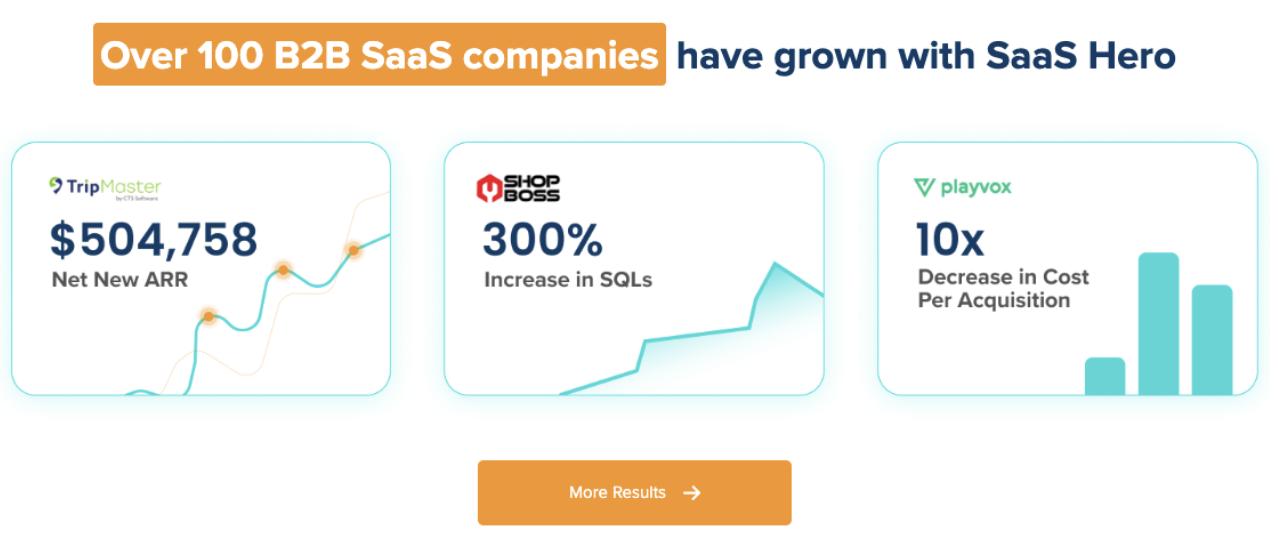
SaaSHero is the outsourced inbound growth team for B2B companies, with one team owning strategy and execution across paid media, creative, landing pages, and reporting. The team optimizes against CRM revenue data rather than form-fill counts. Founded in 2018, SaaSHero has managed over $60 million in lifetime ad spend for 100+ B2B SaaS companies and maintains a team of about 20 full-time specialists, including in-house designers and copywriters.
Key differentiators include:
- Optimizes campaigns around CRM data such as qualified pipeline, lifecycle stage, and closed revenue instead of form submissions
- Owns the entire post-click experience in-house, including landing page design, build, hosting, and A/B testing via Figma and Unbounce
- Delivers proactive strategy as a named output, including monthly competitor analysis, quarterly budget analysis, and a standing test agenda
- Uses a flat-fee retainer tied to total monthly ad spend, so adding, closing, or reweighting a channel does not change the fee
- Holds Google Premier Partner status and is a G2 High Performer in Digital Marketing, currently ranked #20 of approximately 6,000 agencies
- Keeps all work in-house, with designers, copywriters, and campaign managers as full-time employees

SaaSHero directly addresses the engagement design problems that drive searches for Single Grain alternatives. The company states: “You need someone to own paid acquisition, not just run your ads.” The approval gate, where nothing goes live without client sign-off, preserves control while keeping strategic burden off the marketing leader.

Best for: B2B SaaS companies with $10M+ revenue, $15K+ monthly ad spend, and an existing marketing team that lacks paid media specialization.

2. NoGood: Best for Rapid Experimentation
NoGood is a New York-based growth marketing agency serving funded SaaS, fintech, healthcare, and AI companies with cross-functional growth squads that embed data science and engineering into every engagement. NoGood reports an 84% client retention rate and an average retainer above $20,000 per month, with named clients including Nike, TikTok, MongoDB, Intuit, and Anthropic.
Best for: Companies wanting rapid, growth-squad style experimentation across paid channels in 30- to 60-day cycles.
Key differentiator: Embedded data science and engineering in every squad.
3. Kalungi: Best for Early-Stage B2B SaaS
Kalungi is a GTM-as-a-service provider for early-stage B2B SaaS that installs the marketing function itself with a fractional CMO plus full execution team plus RevOps. Kalungi reports DataGuard growing MQLs 330% and generating $4M in pipeline in six months, and CPGvision reaching $4.7M pipeline with 533% SEO growth in 16 months.
Best for: Early-stage SaaS from roughly $0 to $10M ARR that needs end-to-end inbound marketing installed from scratch.
Key differentiator: Published T2D3 methodology, which stands for triple ARR twice, then double three times, as a structured growth framework.
Potential drawback: Full-service engagement is industry-reported at $45,000 per month, the highest on this list, and Kalungi has zero Clutch reviews, which raises procurement concerns.
4. KlientBoost: Best for PPC + CRO Combined
KlientBoost is a performance marketing specialist that combines paid search and conversion rate optimization into a high-velocity engine. KlientBoost publishes its goal-hit rate publicly, reporting 88% of client goals achieved in Q1 2026, and holds a 4.9/5 Clutch rating from 403 reviews, a decisive social-proof gap versus Single Grain's 12-review trail.
Best for: Companies whose main issue is landing page conversion and paid search efficiency.
Key differentiator: Publicly published goal-hit rate and 403 verified Clutch reviews that provide procurement-ready third-party validation.
Potential drawback: The broader focus includes eCommerce alongside SaaS, and CRM-level attribution may not be standard. Ask specifically how they report pipeline, not just leads, before signing.
5. Inturact: Best for Funnel Optimization
Inturact acts as an outsourced growth department that focuses on funnel optimization and customer onboarding for B2B SaaS companies. The agency emphasizes deep funnel analytics and lifecycle optimization across the entire customer journey rather than top-of-funnel acquisition alone.
Best for: Companies that need help diagnosing and fixing funnel leaks across the entire customer journey, including post-signup activation.
Key differentiator: Deep focus on funnel analytics and lifecycle optimization, treating the full customer journey as the unit of analysis.
Potential drawback: Inturact places less emphasis on paid media execution than performance-focused agencies. It suits companies with existing traffic that is not converting better than companies that still need to build demand.
6. Directive: Best for Enterprise-Scale Revenue Accountability
Directive is a full-funnel B2B performance marketing agency with a “Customer Generation” thesis that ties marketing spend to pipeline and closed revenue. Directive holds a 4.8/5 Clutch rating from 56 verified reviews, reports 420+ brands served and $1B+ in client revenue attributed to its methodology, and its proprietary Stratos AI platform unifies CRM, paid media, SEO, and ops data in one view.
Best for: Enterprise B2B SaaS and fintech companies with complex buying cycles, high ACV, and a need for revenue-level attribution across multiple channels.
Key differentiator: Stratos AI platform that provides real-time cost-per-customer clarity that generalist reporting rarely matches for SaaS-specific unit economics.
7. Refine Labs: Best for Demand Creation at Scale
Refine Labs is a category-defining demand generation agency for mid-market and enterprise B2B SaaS, known for popularizing the “demand creation over lead capture” shift. Refine Labs reports 300+ clients and an average claim that clients grow qualified pipeline 50% in under a year, with its Clari case study citing a 67% reduction in customer acquisition cost and 64% improved deal conversion over nine months.
Best for: Companies at roughly $50M+ ARR that want to shift from lead capture to demand creation in channels that resist last-click attribution.
Key differentiator: Category-defining demand generation approach that reframes how pipeline is measured and attributed across dark social and un-attributable channels.
Potential drawback: Refine Labs does not fit Series A or early-stage SaaS. Founder Chris Walker exited in July 2025, selling his remaining shares, with Megan Bowen as CEO and majority owner.
Single Grain Alternatives Comparison Table
The table below summarizes each agency's best-fit scenario, main differentiator, and pricing approach so you can compare them quickly. Pay attention to how pricing models and funnel ownership differ, since those factors drive long-term results.
| Agency | Best For | Key Differentiator | Pricing Model |
|---|---|---|---|
| SaaSHero | Established B2B SaaS ($10M+ revenue, $15K+ monthly ad spend) | CRM-based optimization, full-funnel ownership including landing pages, flat-fee retainer | Flat retainer indexed to total ad spend; Growth Team starts at $4,000/month |
| NoGood | Rapid experimentation across paid channels | Growth squads with embedded data science; 70+ person team | Average retainer above $20,000/month (self-reported) |
| Kalungi | Early-stage SaaS ($0–$10M ARR) needing full GTM installation | Fractional CMO + T2D3 methodology; installs the marketing function itself | Full-service engagement industry-reported at $45,000/month |
| KlientBoost | PPC + CRO combined; companies with conversion rate problems | 88% goal-hit rate published publicly; 403 Clutch reviews | Performance-based and project-based options; contact for retainer pricing |
| Inturact | Funnel optimization and lifecycle analysis | Outsourced growth department model; deep funnel analytics focus | Custom retainers; contact for pricing |
| Directive | Enterprise revenue accountability; high-ACV B2B SaaS | Stratos AI platform; Customer Generation methodology; 4.8/5 from 56 Clutch reviews | Startup package at $6,500/month; standard at $8,000/month; enterprise at $15,000+/month |
| Refine Labs | Demand creation at scale ($50M+ ARR) | Category-defining demand gen; clients grow qualified pipeline 50% in under a year (self-reported) | Custom retainers; contact for pricing |
Now that you've seen the agencies side by side, use the next section to match them to your stage, motion, and main gap.
How to Choose the Right Agency for Your B2B SaaS
There is no single best B2B SaaS marketing agency because the right choice depends on matching an agency's proven niche to your stage, go-to-market motion, budget, and primary gap. Focus on your revenue stage and the biggest constraint in your acquisition engine.
Established companies with $10M+ revenue and $15K+ monthly ad spend benefit most from full-funnel ownership and CRM-based optimization, which aligns closely with SaaSHero's model. Earlier-stage teams should weigh Kalungi's GTM installation against NoGood's experimentation speed. If conversion is the bottleneck, KlientBoost's PPC and CRO pairing targets the post-click gap. Enterprise teams that need revenue-level attribution across channels tend to fit Directive, while companies at $50M+ ARR that want to shift from lead capture to demand creation often consider Refine Labs.
The Starr Conspiracy's evaluation framework found that stage-matched references provided three times more useful insights than industry-matched references, so ask every agency on your shortlist for a reference from a company at your revenue and spend level, not just your vertical.
Red Flags to Avoid in a Marketing Agency
Certain patterns signal that an engagement will struggle to prove pipeline impact or move quickly.
First, watch for agencies that optimize for form fills instead of revenue. If they cannot explain how they connect ad spend to pipeline and show a real, anonymized client report, the reporting will fail you at the board level.
Next, check whether they own landing pages. An agency reporting from its own tools on metrics it defines has structured the engagement so it can never lose an argument. If they recommend CRO but do not implement it, the highest-leverage variable in your funnel moves at the speed of your web team's backlog.
Per-channel pricing is another warning sign. This model discourages testing and budget shifts because adding a new channel raises the invoice before it returns anything, so fewer channels get tested and budget hardens in place.
Also avoid reporting that focuses on impressions and clicks. You need pipeline and CAC. The Starr Conspiracy's 2025 benchmark identifies channel-only proof for a brand-plus-demand problem as a red flag in agency evaluation. Finally, look for proactive behavior and in-house delivery. If you set the test agenda and chase status, you have effectively added a direct report you cannot exit quickly. Ask who will actually touch your account week to week and whether delivery people are employees or freelancers. A messaging cadence built across three funnel stages breaks when rotating contractors each see one brief in isolation.
Frequently Asked Questions
What is a Single Grain alternative?
A Single Grain alternative is a B2B SaaS marketing agency that offers similar full-funnel services such as paid media, content, and CRO, but with tighter alignment to pipeline and revenue outcomes. The strongest alternatives own the post-click experience, optimize campaigns against CRM data rather than form fills, bring proactive strategy without prompts, and report in terms a board understands, including pipeline, CAC, and payback period. The main difference from Single Grain lies in specialization depth and measurement accountability rather than channel breadth.
How much does a B2B SaaS marketing agency cost?
B2B SaaS agency retainers vary widely by scope and seniority. Typical ranges run from $1,000 to $12,000+ per month, rising to $12,000 to $30,000+ for enterprise, and mid-market retainers commonly fall between $15,000 and $50,000 per month. The median mid-market B2B SaaS retainer falls in the $15,000 to $50,000 per month tier, based on The Starr Conspiracy's 2025 benchmark survey of 142 marketing leaders. Boutique specialists like SaaSHero start lower, with SaaSHero's Growth Team beginning at $4,000 per month and scaling with total ad spend, while full-GTM providers like Kalungi are industry-reported at $45,000 per month. Percentage-of-ad-spend pricing typically runs 15% to 30% of monthly ad budget, with the average around 10% to 20% and usually closer to 20% and up. This model structurally misaligns incentives by rewarding higher spend rather than better outcomes.
How long does it take to see results from a B2B SaaS marketing agency?
Meaningful pipeline impact typically takes three to six months. The first 30 days cover setup, including conversion tracking, campaign architecture, landing page builds, and the approval cycle. Days 31 to 60 narrow the account as underperformers turn off, audiences adjust, and first landing page headline tests run. By day 90 there is enough clean data to evaluate whether the channel, structure, and messaging thesis are sound. Paid media ROAS typically starts at 2:1 at 90 days and reaches 4:1 or higher at 12 months, based on Elevation B2B's 2024 client studies. The caveat for B2B SaaS is that sales cycles often run longer than the reporting cycle, so an agency that cannot report on in-flight pipeline leaves you without an answer at the quarterly board review.
Can I switch agencies mid-contract?
You can switch agencies mid-contract, but the transition carries real cost. A mismatched agency retainer at the mid-market level averages $15,000 to $25,000 per month with six-month minimums, meaning $90,000 to $150,000 in sunk costs before course-correction, plus opportunity cost. The practical safeguard is ensuring you own all accounts and assets from day one. Ad accounts, conversion tracking configurations, landing page files, design files, and dashboards should belong to you throughout the engagement, not the agency. SaaSHero's stated position is clear: “You own everything. If we separate for any reason, we'll send you all the files. We're easy to onboard and easy to offboard.” Ask any agency you're evaluating to confirm asset ownership in writing before signing.
What should I ask in a discovery call with a potential agency?
Five questions separate agencies that own the work from agencies that simply execute a brief you write. Ask how their reporting ties to pipeline and request a real, anonymized client report, then confirm whether pipeline figures come from your CRM or the agency's tools. Ask who will be in your account in month seven and whether they are full-time employees. Ask how they handle landing pages and whether they design, build, and test them or hand recommendations to your web team. Ask what happens to your accounts and files if you leave. Finally, ask what they need from your team on an ongoing basis. A strong answer focuses on goals, budget, and approvals, while a weak answer lists strategy, test ideas, and status chasing.
Conclusion
Most B2B SaaS companies leave Single Grain because the engagement structure is broken. The agency does not own the post-click experience, per-channel pricing discourages testing, and reporting stops at clicks instead of pipeline. The right Single Grain alternative owns the entire acquisition engine and optimizes against revenue data.
The best fit depends on your stage and main gap. Established B2B SaaS companies with $10M+ revenue and $15K+ monthly ad spend often align with SaaSHero, where one team owns paid media, creative, landing pages, and reporting, all optimized against CRM outcomes, with proactive strategy as a standing deliverable. Earlier-stage companies can look to Kalungi or NoGood for full-funnel services that scale with growth. Enterprise teams that need revenue attribution across complex buying cycles tend to fit Directive's Customer Generation methodology and Stratos AI platform.
Evaluate every agency on the criteria in this guide, including CRM-based optimization, full-funnel ownership, proactive strategy, transparent reporting, pricing model, and team composition, and ask for stage-matched references before signing anything.