




Key Takeaways
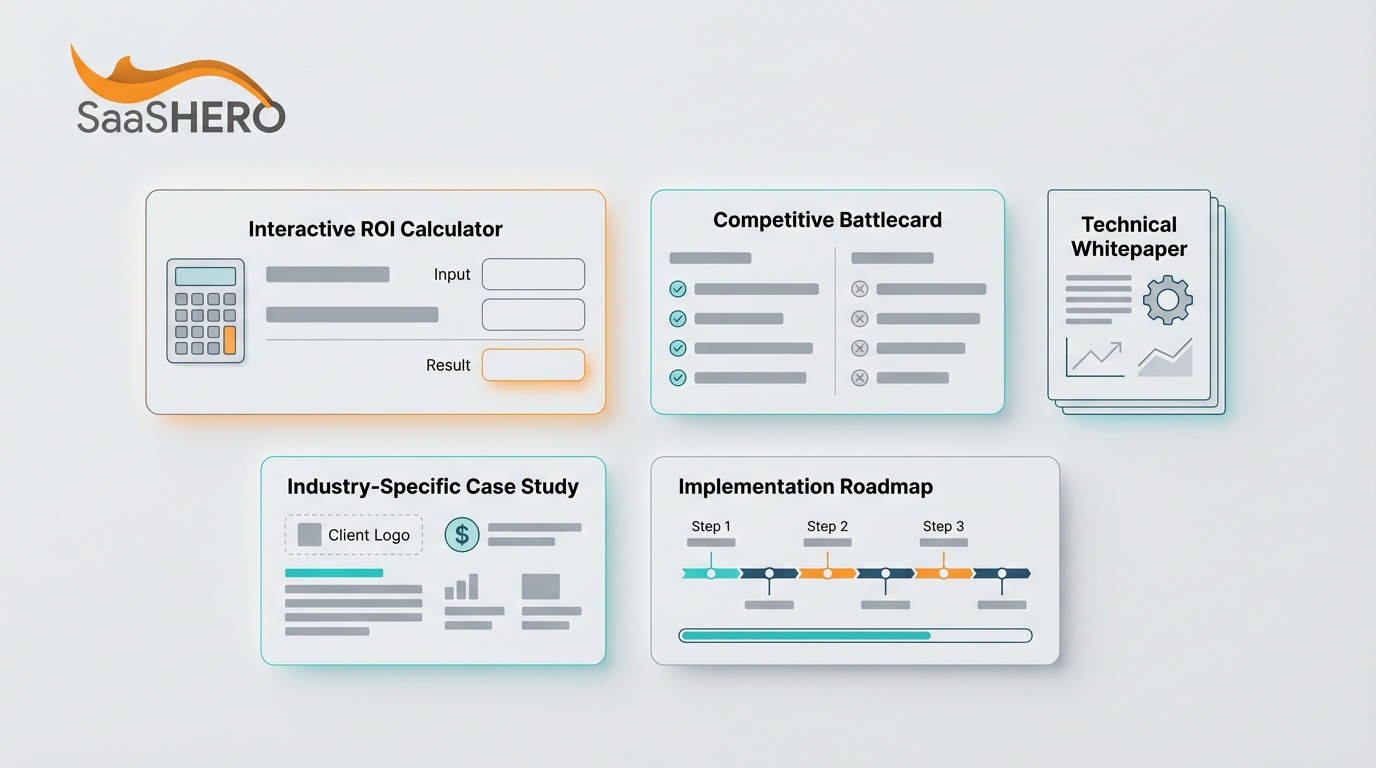
- Interactive ROI calculators calm CFO objections by quantifying payback periods and TCO, driving 650% ROI as seen with TripMaster’s $504k ARR growth.
- Competitive battlecards and comparison tables equip sales teams for multi-vendor evaluations, highlighting clear differentiators like implementation speed and security.
- Technical whitepapers and industry-specific case studies satisfy IT and procurement needs, reducing evaluation time as proven by TestGorilla’s 80-day payback.
- Implementation roadmaps and AI-enhanced demos reduce buyer uncertainty and shorten complex 9-12 month cycles by 20-30% with clear timelines and self-service experiences.
- Partner with SaaSHero to build custom collateral that accelerates ARR growth and wins complex deals.
1. Interactive ROI Calculators That Win Over Finance
Interactive ROI calculators give CFO and finance stakeholders clear dollar-based business value. AEs use ROI calculators in late-stage deals to quantify business value, especially when prospects need board-level approval for enterprise SaaS purchases.
Key elements for effective ROI calculators:
- Industry-specific cost assumptions such as labor rates and operational expenses
- Time-to-value scenarios with conservative and aggressive projections
- Total Cost of Ownership (TCO) comparisons versus status quo
- Payback period calculations with a clear visual timeline
- Downloadable executive summary for stakeholder sharing
- CRM integration for lead scoring and follow-up
TripMaster’s ROI calculator supported their 650% ROI and $504k Net New ARR growth by showing clear payback periods for transit software implementations. The calculator removed budget objections by proving 18-month payback periods compared with 3-year manual processes.

2. Competitive Battlecards For Multi-Vendor Deals
Competitive battlecards prepare sales teams to handle objections during multi-vendor evaluations. AEs handle competitive objections in complex enterprise evaluations with battle cards and use them as fast reference for feature comparisons and differentiation.
Essential battlecard components:
- Feature-by-feature comparison matrices
- Clear competitor weaknesses and positioning guidance
- Customer win-back stories and case studies
- Pricing comparison frameworks
- Integration and security differentiators
- Objection handling scripts for common concerns
|
Competitor |
Key Weakness |
Our Advantage |
Proof Point |
|
Legacy Provider A |
Poor mobile experience |
Native mobile-first design |
85% mobile usage rate |
|
Startup B |
Limited enterprise features |
SOC 2 + GDPR compliance |
Fortune 500 client base |
|
Platform C |
Complex implementation |
30-day average setup |
Customer onboarding data |
Sales leaders should refresh battlecards every quarter to reflect new competitive intelligence and feature releases so teams always work with current talking points.
3. Technical Whitepapers That Satisfy IT
Technical whitepapers answer IT stakeholder concerns about security, integration, and technical feasibility. These detailed documents give the depth enterprise IT teams expect, often spanning 10-15 pages with architectural diagrams and security certifications.
Critical whitepaper elements:
- Security architecture and compliance certifications
- API documentation and integration capabilities
- Scalability benchmarks and performance metrics
- Data governance and privacy controls
- Implementation methodology and timeline
- Technical support and SLA commitments
TestGorilla’s technical whitepapers supported their 80-day payback period by addressing IT concerns early in the evaluation. They cut technical due diligence from 4 months to 6 weeks.
4. Industry-Specific Case Studies With Real Numbers
Case studies increased sales by 185% for Neil Patel and show strong impact in B2B SaaS complex deals. Industry-specific case studies provide social proof and show ROI in similar business contexts, which reassures risk-averse buyers.
High-impact case study structure:
- Similar company profile for size, industry, and use case
- Quantified business challenge and pain points
- Implementation timeline and process details
- Specific ROI metrics such as ARR growth, cost savings, or efficiency gains
- Stakeholder quotes from multiple decision-makers
- Visual before and after comparisons and dashboards
Case studies should feature metrics like “40% reduction in manual processes” or “25% increase in team productivity” instead of vague benefits. TestGorilla’s case studies that highlight 5,000+ new customers and $70M Series A funding give strong proof points for similar HR tech prospects.
5. Executive Summary One-Pagers For Busy Leaders
Executive summary one-pagers condense complex value propositions into formats the C-suite can scan quickly. These single-page documents focus on business outcomes instead of features and support fast executive decisions.
Executive summary essentials:
- Business challenge statement in clear executive language
- Three key business outcomes with quantified impact
- Implementation timeline and resource requirements
- Total investment and payback period summary
- Risk mitigation and success guarantee details
- Next steps and a suggested decision timeline
Strong executive summaries use charts and infographics to communicate ROI quickly and avoid technical jargon in favor of business impact language.
6. Implementation Roadmaps That Reduce Risk
Implementation roadmaps address timeline concerns and change management objections from operations stakeholders. ABM strategies boost average deal value by 171% and shorten sales cycles by 40% when supported by clear implementation planning that reduces buyer uncertainty.
Comprehensive roadmap components:
- Phase-by-phase implementation timeline for 30, 60, and 90 days
- Resource allocation and team responsibility matrix
- Key milestones and success criteria definitions
- Risk mitigation strategies for common challenges
- Training and change management support
- Go-live criteria and success measurement
Implementation roadmaps should include contingency plans for common delays and clear escalation procedures to show vendor partnership beyond the initial sale.

7. AI-Enhanced Interactive Product Demos
AI-enhanced interactive demos represent the 2026 evolution of traditional product demonstrations. 37% of marketers report leads are more informed due to AI, which increases demand for interactive, self-guided product exploration.
Next-generation demo features:
- Personalized demo flows based on industry and use case
- AI-powered feature recommendations during exploration
- Real-time ROI calculations based on user inputs
- Integration with actual customer data for realistic scenarios
- Multi-stakeholder sharing with role-based views
- Engagement analytics for sales team follow-up
Interactive sales demos reduce wasted time and improve efficiency by enabling earlier product trials and shortening technical evaluation phases from months to weeks.
8. Custom Proposal Generators For Faster Closing
Custom proposal generators produce tailored proposals at scale while keeping real personalization for complex enterprise deals. These tools combine pricing calculators, feature selections, and implementation timelines into professional proposal documents.
Advanced proposal generator capabilities:
- Dynamic pricing based on user selections and volume
- Automated contract term generation
- CRM integration for account-specific customization
- Legal and compliance clause automation
- E-signature integration for faster closing
- Proposal analytics and engagement tracking
Interactive proposals with embedded videos and pricing calculators address C-suite and finance objections with real-time scenario modeling and visual implementation timelines.
9. Competitor Comparison Tables For Procurement Teams
Competitor comparison tables give objective feature and pricing comparisons that meet procurement team requirements for vendor evaluation. These documents must stay factual and legally compliant while still highlighting advantages.
Comparison table best practices:
- Feature-by-feature matrix with objective criteria
- Pricing transparency with total cost calculations
- Implementation complexity and timeline comparisons
- Customer support and SLA comparisons
- Integration ecosystem and partner network details
- Security and compliance certification matrix
|
Feature Category |
Our Solution |
Competitor A |
Competitor B |
|
Implementation Time |
30 days average |
90 days average |
60 days average |
|
API Integrations |
500+ pre-built |
200+ pre-built |
100+ pre-built |
|
Mobile Experience |
Native iOS/Android |
Web-based only |
Progressive web app |
10. Customer Testimonial Videos With Social Proof
Customer testimonial videos deliver authentic social proof from similar companies and use cases. Video testimonials often carry more credibility than written case studies, especially when they feature recognizable brands or industry leaders.
Effective testimonial video elements:
- Customer profile that matches prospect demographics
- Specific ROI metrics and business outcomes
- Implementation experience and realistic timeline
- Multi-stakeholder perspectives from IT, finance, and operations
- Before and after scenarios with quantified improvements
- Clear recommendation and renewal commitment statements
Testimonial videos should run 2-3 minutes with key quotes extracted for written materials and social media amplification.
11. Deal Timeline Visuals That Set Expectations
Deal timeline visuals clarify the sales process, implementation schedule, and expected outcomes. These documents reduce buyer anxiety about complex enterprise sales and set expectations for every stakeholder.
Timeline visual components:
- Sales process milestones and decision points
- Implementation phases with deliverable details
- Stakeholder involvement and approval requirements
- Training and onboarding schedule
- Go-live timeline and success metrics
- Ongoing support and later optimization phases
Timeline visuals should include buffer time for common delays and clear escalation procedures for timeline risks.
12. Post-Sale Onboarding Guides That Prove Commitment
Post-sale onboarding guides show vendor commitment beyond the initial purchase and calm concerns about implementation success and ongoing support. These materials often influence final purchase decisions by reducing perceived risk.
Comprehensive onboarding guide elements:
- Week-by-week implementation checklist
- Training curriculum and certification programs
- Success metrics and measurement frameworks
- Escalation procedures and support contacts
- Best practice recommendations from similar customers
- Quarterly business review and optimization planning
Onboarding guides should introduce the customer success team and define clear communication protocols for implementation questions and concerns.
How SaaSHero Builds Collateral That Grows ARR
SaaSHero applies revenue-first expertise in heuristic CRO, landing page testing, and B2B copywriting to create sales collateral that moves ARR. The agency’s flat-fee model and month-to-month agreements keep collateral recommendations focused on performance instead of billable hours.
SaaSHero’s collateral development process uses stakeholder mapping, competitive analysis, and ROI measurement frameworks that connect directly to Net New ARR outcomes. Examples such as Playvox’s 10x CPL reduction and TripMaster’s $504k ARR growth show the agency’s ability to turn collateral into closed revenue.

The agency’s focus on B2B SaaS verticals such as HR Tech, Transportation, Cybersecurity, and Healthcare ensures collateral addresses industry-specific objections and compliance requirements that generic agencies overlook.
Book a discovery call to plan custom collateral for your complex deal cycles.
FAQ
What sales collateral templates work best for SaaS companies?
The most effective SaaS sales collateral templates include interactive ROI calculators, competitive battlecards, technical whitepapers, and industry-specific case studies. ROI calculators address CFO concerns about payback periods, and battlecards help sales teams handle competitive objections. Technical whitepapers satisfy IT evaluation requirements, and case studies provide social proof from similar implementations. Templates should stay customizable for different industries and deal sizes while keeping consistent messaging and branding.
Which collateral types work best for complex B2B SaaS deals?
Complex B2B SaaS deals need stakeholder-specific collateral that addresses each decision-maker’s concerns. Executive summary one-pagers support C-suite stakeholders who focus on business outcomes, and technical whitepapers address IT security and integration requirements. Implementation roadmaps reduce operational concerns about change management, and competitor comparison tables support procurement evaluation processes. The priority is mapping collateral to specific stakeholders and sales stages instead of relying on generic materials.
How do you measure sales collateral ROI in B2B SaaS?
Sales collateral ROI measurement focuses on pipeline velocity, win rates, and deal size improvements. Key metrics include collateral-influenced win rates, often 15-25% higher than baseline, time to close reduction of 20-30%, and average deal value increases. Track which collateral pieces appear in closed-won deals versus lost opportunities, and measure engagement analytics such as time spent viewing materials and sharing rates among buying committee members. Connect collateral usage to CRM data for accurate attribution.
What makes SaaSHero’s sales collateral different from other agencies?
SaaSHero creates sales collateral specifically for B2B SaaS companies and brings deep vertical expertise in HR Tech, Transportation, Cybersecurity, and other technology sectors. The agency’s revenue-first approach ties collateral performance directly to Net New ARR outcomes instead of vanity metrics. SaaSHero’s flat-fee pricing model keeps recommendations focused on performance, and month-to-month agreements create accountability for results. The agency also integrates collateral development with paid media campaigns and landing page testing for a complete growth strategy.
How has AI changed sales collateral design in 2026?
AI has changed sales collateral through personalization at scale, interactive demos, and real-time content improvement. AI-powered tools create customized ROI calculators based on prospect data, generate personalized case studies for specific industries, and adjust content based on engagement analytics. Interactive demos now include AI-driven feature recommendations and real-time ROI calculations during product exploration. AI also supports dynamic content updates, automated A/B testing of collateral variations, and predictive analytics for collateral effectiveness across buyer personas and sales stages.
Conclusion
These 12 sales collateral examples give you a practical playbook for shortening complex B2B SaaS deal cycles from 9-12 months to 3-6 months. Start with ROI calculators, battlecards, and case studies for fast impact, then expand into implementation roadmaps and AI-enhanced demos for full coverage.
Success depends on matching collateral to specific stakeholder concerns and sales stages while tracking performance through pipeline velocity and win rate improvements. SaaSHero delivers paid media scaling and landing page testing, book a strategy call