




Written by: Aaron Rovner, Founder, Saas Hero
Key Takeaways
- B2B SaaS companies now face longer sales cycles and higher CPCs, so Google Ads management directly affects CAC, pipeline quality, and Net New ARR.
- In-house Google Ads teams offer control and product depth but carry fully loaded costs that often exceed 40–60% above base salary.
- Specialized agencies typically deliver faster time to value, broader expertise, and lower total cost of ownership for most growth-stage SaaS companies.
- Early-stage and mid-market SaaS businesses usually gain more value from agency or hybrid models, while larger enterprises often layer in selective in-house roles.
- SaaSHero helps B2B SaaS teams reduce acquisition costs and improve qualified pipeline; schedule a discovery call to review options for your Google Ads program.
Why Your Google Ads Management Model Matters
B2B SaaS growth in 2026 depends on capital-efficient acquisition. Leadership teams need a Google Ads model that supports lower CAC, faster payback, and reliable ARR growth.
The buying journey now spans 90–120 days for many teams, with more stakeholders and touchpoints. Google’s AI Overview pushes traditional ads and organic results further down the page, which often reduces click-through rates and raises CPCs.
Teams must now connect Google Ads with content, SEO, and first-party data, while navigating AI-led bidding and automation. The choice between in-house and agency management determines how well your company adapts to these changes.

In-House Google Ads Management: Where It Fits
In-house management means hiring one or more specialists to plan, launch, and optimize your campaigns. This model suits teams that want full control and can support higher fixed costs.
Cost profile for in-house specialists includes:
- Base salary for specialized SaaS growth roles often sits in the $102,000–$150,000 range, as shown in compensation data for SaaS SEO and growth roles.
- Fully loaded cost usually rises 40–60% after benefits, payroll taxes, equipment, and office overhead.
- Tooling, training, and certification budgets add further annual cost.
Role complexity raises the bar further. Many Google Ads job postings combine analytics, copywriting, CRO, and reporting in a single role, which makes senior talent both scarce and expensive.
In-house management works best when:
- Monthly ad spend consistently exceeds roughly $20,000.
- Marketing, product, and sales already collaborate tightly.
- Your product or ICP requires heavy customization and constant coordination.
Risks include knowledge concentration in one or two people, slower adoption of new Google Ads features, and limited cross-account learning.
Specialized Agency Management: Where It Delivers More Value
Specialized B2B SaaS agencies give you a full team that already knows the platform, typical funnels, and common pitfalls. This approach usually delivers faster impact for growth-stage companies.
Cost profile for agencies typically looks like this:
- Retainers often range from $3,000–$7,000 per month, with pricing aligned to spend and scope.
- All platform tools, testing frameworks, and reporting systems sit inside the retainer, not as extra line items.
- Staff training and ongoing education for new Google Ads features are handled by the agency.
Capability advantages usually include:
- Access to multiple specialists across strategy, copy, design, and analytics.
- Ability to launch or reset campaigns in weeks instead of months.
- Cross-client insight into what works for similar B2B SaaS models.
Some founders prefer flexible commitments. Many specialized SaaS agencies now offer month-to-month or short initial terms to align incentives with performance.

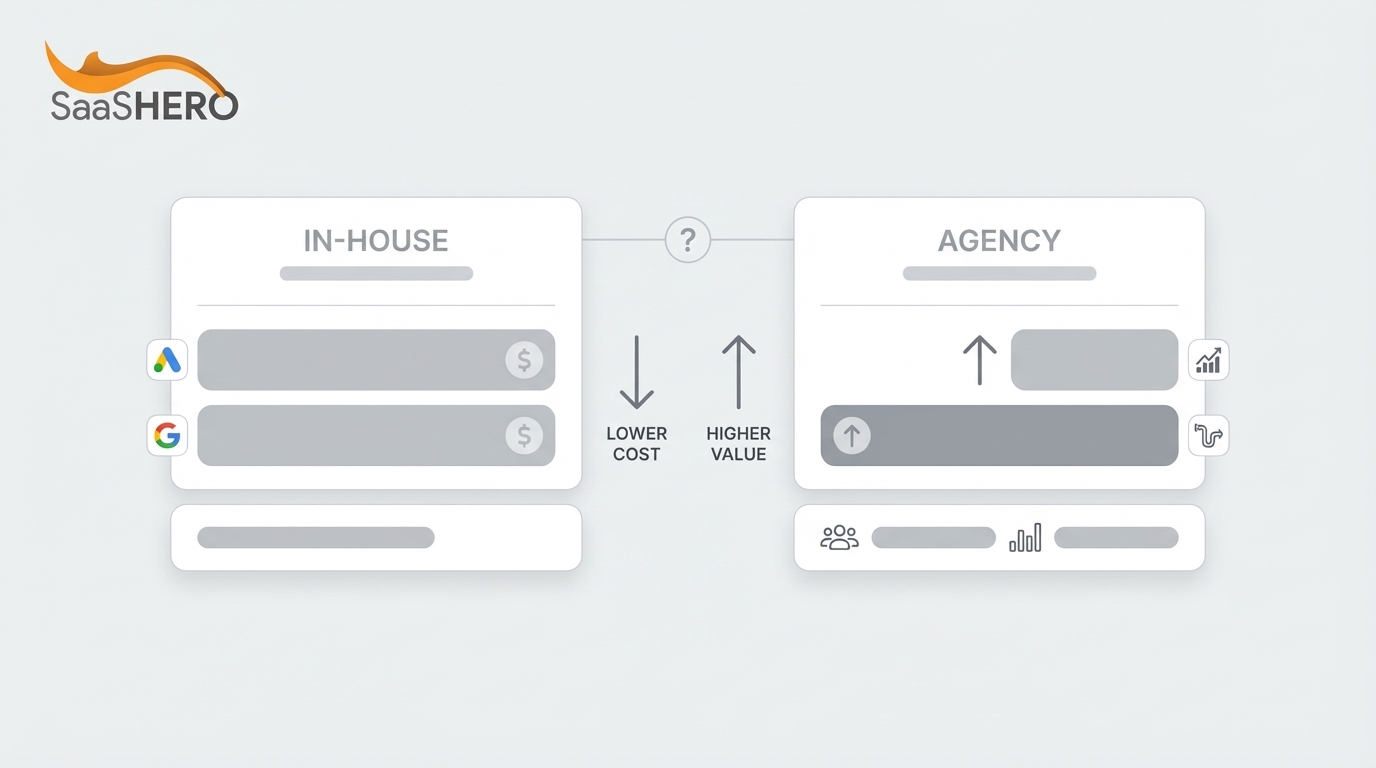
Cost Comparison: In-House vs. Agency
Both options require ongoing investment. The spread between them often becomes clear once you include full ownership costs.
|
Evaluation Criteria |
In-House Management |
Specialized Agency |
Key Point |
|
Annual cost |
Roughly $120,000–$300,000 for one senior hire, including benefits and tools |
Roughly $15,000–$84,000 in annual retainers |
Agencies usually cost less than one senior full-time hire |
|
Expertise access |
Depth limited to that person’s experience |
Team-level expertise across many SaaS accounts |
Agencies spread learning across clients |
|
Time to value |
Often 3–6 months to hire, onboard, and ramp |
Often 2–4 weeks to launch or reset |
Speed favors agencies for growth targets |
|
Risk profile |
Higher dependence on one or two employees |
More continuity through team coverage |
Staff churn risk is lower with agencies |
Market data reinforces this gap. Remote marketing salary benchmarks for 2026 show senior performance roles at $112,794–$160,000 in base pay, which often climbs above $200,000 once benefits and overhead are included.
Learning demands add more cost. Specialists must constantly update skills as Google adds formats, AI tools, and bidding strategies. Agencies usually absorb this time across their client base instead of treating it as a new internal expense.
Scenario-Based Guidance For Your B2B SaaS
Different revenue stages usually favor different approaches.
- Early-stage bootstrapper ($500K–$2M ARR). Agency or vetted freelancer support often delivers the best balance of cost and expertise. Some founders test fit with freelance Google Ads specialists before committing to a longer engagement.
- Scaling mid-market ($2M–$10M ARR). Growth expectations and rising ad spend usually favor a specialized agency. One senior in-house hire can exceed $200,000 per year, while agencies provide an entire team for a fraction of that cost.
- Enterprise and complex stacks ($10M+ ARR). A hybrid model often works best. An internal leader owns strategy and coordinates channels, while agencies manage execution for Google Ads and related paid media.

Value Beyond Fees: Time, Risk, And Operations
Headline costs rarely tell the whole story. Ramp time, training, and risk often change the financial picture.
- Ramp and hiring. Hiring and onboarding a skilled specialist often takes 3–6 months. That delay can slow growth while competitors capture demand.
- Training and platform change. Google Ads updates features, AI options, and interfaces frequently. Agencies keep teams current as part of their core business, whereas in-house teams need extra budget and time.
- Knowledge risk. Losing a key internal hire can disrupt campaigns and pipelines. Agencies spread knowledge across teams, which lowers that risk.
- Tool stack. Attribution, reporting, experimentation, and creative tools usually sit inside agency retainers. In-house teams must license and maintain these platforms directly.
How To Decide Between In-House And Agency
A simple framework helps you choose a model that fits your stage and targets.
- Define current and near-term ad spend, plus ARR growth targets.
- Calculate fully loaded in-house cost, including salary, benefits, taxes, tools, and time to hire.
- Audit current team capacity and skills for paid search, analytics, and CRO.
- Decide how important fast deployment and flexible scaling are over the next 12–24 months.
- Score each option on cost, speed, expertise depth, and risk to reach a clear decision.
Frequently Asked Questions
What is the average Google Ads management cost for B2B SaaS companies?
In-house specialists usually cost $120,000–$300,000 per year once benefits, taxes, and tools are included. Agency retainers commonly range from $1,250–$7,000 per month, based on spend and scope. The right choice depends on budget, growth targets, and your internal team structure.
How much ad spend should B2B SaaS teams plan beyond management fees?
Most B2B SaaS companies allocate $5,000–$100,000 or more per month in Google Ads spend. The core aim is efficient Net New ARR and payback periods that match board or investor expectations, not pure lead volume.
How does AI change the in-house vs. agency decision?
AI-driven bidding and creative testing increase the need for strong data skills and structured experimentation. Agencies that manage many B2B SaaS accounts often have deeper experience with AI tools and can apply winning patterns across clients. In-house teams can succeed as well but usually require more time and budget to reach that level.
Conclusion: Choose The Model That Matches Your Stage
Google Ads now sits at the center of many B2B SaaS acquisition strategies. In-house management delivers control and product familiarity but usually comes with higher fixed costs and hiring risk. Agencies generally provide faster results, broader expertise, and lower total cost of ownership, especially for growth-stage companies.
Your best option depends on ARR stage, ad budget, internal capabilities, and risk tolerance. Many teams start with an agency, then add selective in-house roles once scale and process maturity justify the investment.
SaaS leaders who want to reduce CAC and grow qualified pipeline can review their options with a specialist team. Schedule a discovery call to evaluate whether a specialized B2B SaaS agency model is the right fit for your Google Ads program.