




Written by: Aaron Rovner, Founder, Saas Hero
Key Takeaways for Security Teams
- Heuristic virus detection identifies zero-day threats by scoring unknown files through static code analysis, dynamic sandbox behavior, and cumulative risk thresholds instead of relying only on known signatures.
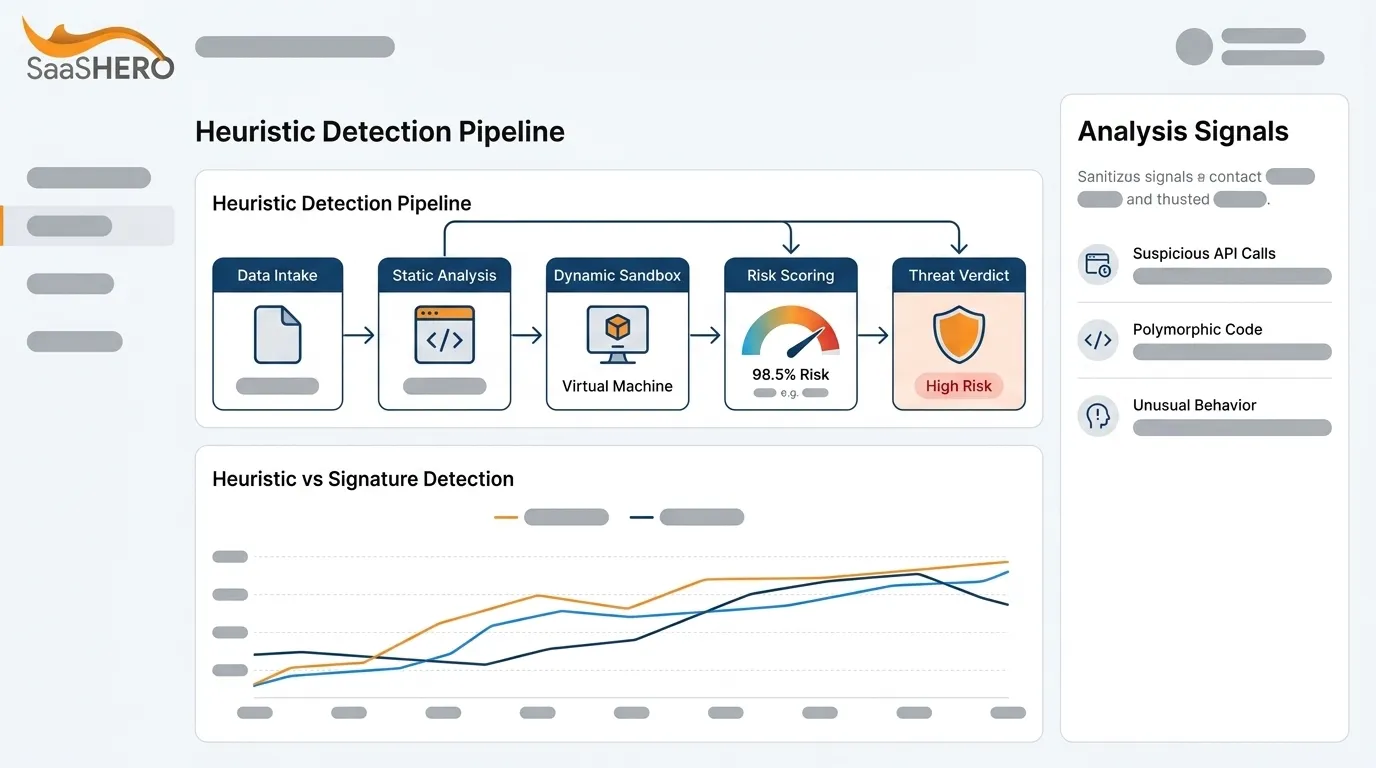
- The detection pipeline covers file ingestion, static analysis of PE headers and imports, dynamic sandbox execution, risk scoring, ML classification, and final verdict generation.
- Heuristic methods detect novel malware but create higher false-positive rates than signature-based detection, which performs well on known threats and poorly on unseen variants.
- Modern engines combine heuristic scoring with machine learning and EDR integration to cut false positives and strengthen zero-day coverage through behavioral analytics and ATT&CK mapping.
- Cybersecurity SaaS vendors can connect with technical buyers evaluating these systems by scheduling a strategy session with SaaSHero for specialized B2B content and paid media strategies.
Step-by-Step Heuristic Detection Pipeline
Heuristic detection follows a structured pipeline where each stage feeds data into the next and produces a final risk verdict without a prior signature match.
- File ingestion and pre-screening: The engine receives a file and extracts metadata, such as file type, size, entropy, and embedded strings, before any execution occurs.
- Static heuristic analysis: The engine inspects the binary structure, import table, and code patterns for suspicious attributes without running the file.
- Dynamic sandbox execution: If static analysis is inconclusive, the file runs inside an isolated virtual environment where runtime behaviors are recorded.
- Risk score calculation: Each suspicious indicator contributes a weighted point value. When the cumulative score crosses a defined threshold, the file is flagged.
- ML classification layer: Modern engines pass the scored feature set through a trained classifier to reduce false positives and catch subtle zero-day variants.
- Verdict and response: The engine quarantines, blocks, or alerts based on the final score, and behavioral data exports to SIEM or EDR platforms for rule generation.
Comparing Heuristic and Signature-Based Detection
These methods differ in what they require to produce a verdict. Signature-based detection matches a file hash or byte sequence against a database of known malware fingerprints, a fast, low-false-positive approach that catches the vast majority of known malware (90-99% per 2025 reports) but struggles with novel threats. Heuristic detection evaluates code structure and runtime behavior, which enables detection of previously unseen threats but increases false-positive rates.
| Dimension | Signature-Based | Heuristic (Static) | Heuristic (Dynamic) |
|---|---|---|---|
| Detection input | Known hash or byte pattern | PE header, import table, code patterns | Runtime file, registry, and network behavior |
| Zero-day coverage | None without signature update | Partial, catches structural variants | High, sandbox monitors live execution actions |
| False-positive risk | Very low | Moderate, packed or obfuscated legitimate code triggers alerts | Moderate to high, benign software may exhibit sandbox-flagged behaviors |
| Analysis speed | Milliseconds | Seconds | Minutes, execution duration is a configurable sandbox parameter |
Static Heuristic Analysis Signals
Heuristic detection inspects static file properties before execution and focuses on whether code structure resembles malware instead of matching exact known signatures. Analysts and engines examine three primary artifact categories.
PE header anomalies include mismatched section sizes, abnormally high entropy in the code section that indicates packing or encryption, and invalid timestamps. A legitimate compiler rarely produces a PE with a future-dated timestamp or a section named .text that contains only encrypted data.
Import table signals reveal capability intent. A file importing VirtualAllocEx, WriteProcessMemory, and CreateRemoteThread in combination signals process injection capability. The engine scores this pattern as suspicious even when no signature exists for the file.
Embedded string patterns such as hardcoded IP addresses, registry run-key paths, or Base64-encoded payloads contribute additional score points. These behavioral patterns, such as attempts to hide activities or disable security features, enable detection even when no signature exists for the specific file.
Analyst Tip: When you investigate a false positive from static analysis, check whether the flagged binary uses a commercial packer such as UPX or Themida. Legitimate software vendors frequently pack installers, which elevates entropy scores and triggers import-table heuristics without indicating actual malice.
Dynamic Sandbox Analysis in Practice
A malware sandbox is a virtual environment that replicates standard operating systems such as Windows or Linux to execute and observe suspicious files without risking production systems. Dynamic analysis captures behaviors that static inspection cannot reveal, including decrypted payloads and multi-stage dropper logic.
Ransomware-specific indicators the sandbox flags include:
- Mass file rename operations with appended extensions such as
.lockedor.enc - Shadow copy deletion through
vssadmin delete shadows - Rapid encryption of files in the
DocumentsandDesktopdirectories - Ransom note creation in multiple directories at the same time
Troubleshooting Note: If a sandbox returns a clean verdict for a file that static analysis flagged, consider that sophisticated malware employs evasion techniques such as delaying execution, checking for virtual machine artifacts, or requiring specific user interactions to avoid detection in sandbox environments. Extend the execution window and enable anti-evasion features such as user-activity simulation before you clear the file.
Risk Scoring Mechanics for Heuristic Engines
Multi-criteria analysis assigns risk points to behaviors and flags a file when the cumulative score exceeds a threshold. The table below illustrates a representative scoring model used by heuristic engines.
| Indicator | Point Value | Rationale | Threshold Action |
|---|---|---|---|
| Connection to known malicious server | 20 pts | Strong C2 indicator | Alert at 40 pts, block at 70 pts |
| System file modification | 15 pts | Persistence or tampering behavior | Alert at 40 pts, block at 70 pts |
| Antivirus disablement attempt | 25 pts | Defense evasion, high malice signal | Alert at 40 pts, block at 70 pts |
| High-entropy packed section (static) | 10 pts | Obfuscation, common in both malware and legitimate packers | Alert at 40 pts, block at 70 pts |
A file that accumulates 20 points for a suspicious network connection and 25 points for disabling antivirus reaches 45 points. This score sits above the alert threshold and below the auto-block threshold, so the system triggers analyst review instead of automatic quarantine. In AI-augmented systems, the scoring stage combines multiple indicators such as a login from a new device at low risk with a massive file transfer at midnight escalating to high risk, to prioritize alerts dynamically.
Cybersecurity vendors building tools around heuristic detection need marketing that reaches the analysts and buyers who evaluate these systems. Learn how SaaSHero’s B2B SaaS content and paid media campaigns connect your product to high-intent technical audiences.
Why Heuristic Malware Analysis Misses and Misfires
While the scoring mechanics above enable detection of unknown threats, the same behavioral patterns that flag malware also appear in legitimate software. Legitimate software triggers false positives in heuristic systems when it employs code packing, process injection, credential access, driver installation, startup modification, or scripting engines, because these actions mimic common malware behaviors.
The primary false-positive causes by category are:
- Packing and obfuscation: Commercial installers and game engines frequently use UPX or custom packers, which elevates entropy scores above malware thresholds.
- Scripting engines: PowerShell and Python interpreters execute code dynamically, a behavior pattern shared with fileless malware loaders.
- Driver installation: Legitimate hardware drivers modify kernel structures, an action heuristic engines score heavily as rootkit behavior.
- Startup modification: Productivity software that adds itself to the registry run key triggers persistence-detection heuristics.
False-negative failures occur when sophisticated malware detects virtual environments and remains dormant. In that case the sample produces no scorable behaviors during the analysis window.
Mitigation Tactics for Analysts:
- Maintain an allowlist of known-good packed binaries verified by vendor hash to suppress recurring false positives.
- Tune scoring thresholds per environment. A development workstation running compilers warrants a higher alert threshold than a finance endpoint.
- Correlate heuristic alerts with user context. A flagged process spawned by a signed parent during a scheduled software update carries lower risk than the same process spawned by a browser.
- Use sandbox anti-evasion features including real user-activity emulation and randomized system responses to reduce dormancy-based false negatives.
Zero-Day Coverage Strengths and Gaps
While signature-based methods excel at identifying known threats, the gap they leave against novel malware makes heuristic and behavioral methods essential for zero-day coverage. Heuristic engines detect zero-day threats by recognizing structural and behavioral patterns shared with known malware families, even when the specific sample has never been seen.
Documented evasion techniques that reduce heuristic effectiveness include:
- Environment-aware dormancy: Malware checks for sandbox artifacts such as low screen resolution, absence of user files, or specific registry keys before activation.
- Time-delayed execution: Payloads sleep for hours or days before execution and exceed typical sandbox analysis windows.
- Polymorphic code: Advanced sandboxes include support for multi-stage and polymorphic malware that alters its behavior to avoid detection.
- Living-off-the-land techniques: Malware uses legitimate system binaries such as
certutil.exeormshta.exeto execute payloads and reduce the behavioral delta from normal system activity.
Heuristic detection emerged in the 1990s to flag suspicious code variants, and AI-powered detection from the 2010s onward using deep learning and predictive analytics now augments it to address these evasion gaps.
Modern ML and EDR Enhancements
Integration points between heuristic engines and modern EDR platforms include:
- Feature vector export: Static heuristic scores such as entropy, import count, and section anomalies feed directly into ML classifiers as numeric features alongside dynamic sandbox outputs.
- MITRE ATT&CK mapping: Behavioral data from sandboxes is correlated with static analysis clues and mapped to the ATT&CK framework to contextualize detections for SOC analysts.
- Explainability layers: Explainable AI techniques such as SHAP and LIME provide transparency by highlighting which factors contributed to a detection, helping analysts validate alerts in hybrid AI-plus-signature systems.
- Behavioral baseline enforcement: Behavioral AI addresses false positives by understanding normal baselines and surfacing only statistically significant anomalies, correlating multiple weak signals into high-confidence detections.
Checklist and Next Steps for Analysts
Use this checklist when you evaluate or troubleshoot a heuristic detection pipeline in your environment.
- Confirm static analysis covers PE header entropy, import table combinations, and embedded string patterns.
- Verify sandbox execution duration is sufficient to catch time-delayed payloads, with a minimum of 5 minutes and 10 or more for APT-profile samples.
- Validate that anti-evasion features such as user-activity simulation and VM artifact hiding are enabled in the sandbox configuration.
- Review scoring thresholds per endpoint profile and apply stricter thresholds on high-value targets such as finance and executive endpoints.
- Maintain a tuned allowlist for known-good packed binaries to suppress recurring false positives from legitimate software.
- Ensure heuristic outputs feed into your EDR ML classification layer and that ATT&CK technique tags apply to detections for SOC triage.
- Schedule quarterly threshold reviews as your environment software baseline evolves.
Cybersecurity SaaS vendors serving analysts who work through frameworks like this need content and paid media strategies built for technical buyers. See how SaaSHero’s research-driven content and precision B2B campaigns generate qualified pipeline from the practitioners who evaluate your product.
Frequently Asked Questions
What is the difference between static and dynamic heuristic analysis?
Static heuristic analysis inspects a file structure, code patterns, and metadata without executing it. Analysts and engines examine PE headers, import tables, entropy levels, and embedded strings to identify attributes associated with malware. Dynamic heuristic analysis executes the file inside an isolated sandbox environment and records its runtime behaviors, including file modifications, registry changes, network connections, and process creation, to detect threats that reveal themselves only during execution. Most production heuristic engines run both stages sequentially and use static analysis as a fast pre-filter and dynamic analysis as a deeper confirmation step for inconclusive or high-risk files.
How does heuristic detection handle polymorphic malware?
Polymorphic malware mutates its code on each infection cycle to evade signature matching. Heuristic detection addresses this by scoring behavioral patterns and structural attributes instead of fixed byte sequences. Even when the code changes, the underlying behaviors such as process injection, antivirus disablement, and C2 beaconing remain consistent and scorable. Modern engines augment heuristic scoring with machine learning classifiers trained on millions of samples, which enables detection of new variants that share behavioral characteristics with known malware families even when no signature exists for the specific mutation.
What causes false positives in heuristic analysis and how can teams reduce them?
False positives occur when legitimate software performs actions that heuristic engines associate with malware. Common causes include commercial code packers used in software installers, PowerShell or Python scripts that execute code dynamically, hardware drivers that modify kernel structures, and productivity applications that write to registry startup keys. Teams reduce false positives by maintaining a verified allowlist of known-good binaries, tuning scoring thresholds to match the risk profile of specific endpoint types, correlating heuristic alerts with process parent context and user activity, and using explainable AI outputs to understand which specific indicators drove a detection before taking action.
How do heuristic engines integrate with EDR platforms?
Heuristic engines feed their outputs into EDR platforms through several integration points. Static analysis feature vectors such as entropy scores, import counts, and section anomalies pass to machine learning classifiers as numeric inputs. Dynamic sandbox behavioral logs map to MITRE ATT&CK techniques and give SOC analysts structured context for triage. Risk scores from heuristic analysis combine with ML anomaly detection outputs to produce a unified threat score that the EDR uses to prioritize alerts. Explainable AI layers such as SHAP then surface the specific indicators that drove each detection and enable analysts to validate or dismiss alerts with evidence instead of relying on opaque verdicts.
Is heuristic detection sufficient on its own for enterprise threat protection?
Heuristic detection is a critical layer but not a complete solution in isolation. It excels at identifying unknown threats and zero-day variants where signature databases have no entry, but it carries higher false-positive rates than signature matching and can be evaded by malware that detects sandbox environments or delays execution beyond the analysis window. Enterprise environments achieve the strongest coverage by layering signature-based detection for known threats, static and dynamic heuristic analysis for unknown files, machine learning classification for subtle variant detection, and behavioral AI baselines for anomaly detection across the network. Each layer compensates for the blind spots of the others and produces a defense-in-depth posture that no single method can replicate alone.
SaaSHero specializes in helping cybersecurity SaaS vendors reach the technical buyers and practitioners who make purchasing decisions on tools built around detection frameworks like these. If your product serves analysts, SOC teams, or IT security professionals, precision content and paid media campaigns built for that audience generate measurably better pipeline than generalist marketing. Discuss a SaaSHero strategy tailored to your cybersecurity vertical and growth targets.