




Key Takeaways
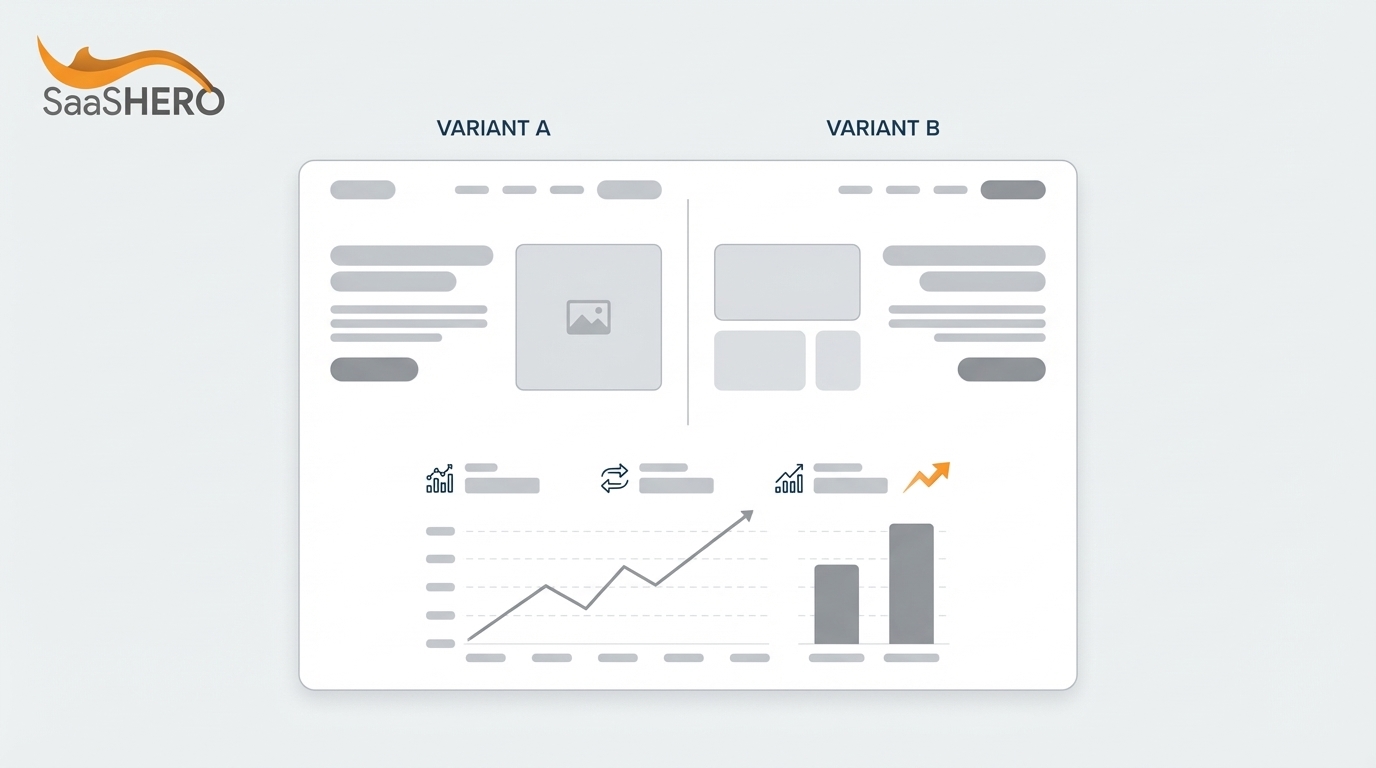
- Strategic A/B testing turns landing pages into measurable revenue drivers by focusing on business metrics like pipeline, CAC, and LTV, not just form fills.
- High-converting B2B SaaS pages share consistent traits, including a clear value proposition, focused CTA, social proof, and low-friction forms that are tested and refined over time.
- Systematic testing programs require the right operating model, data infrastructure, and cross-team alignment so insights turn into repeatable wins, not one-off experiments.
- Common pitfalls such as chasing vanity metrics, weak statistics, and organizational misalignment limit the impact of even well-designed tests, but clear processes can prevent them.
- B2B SaaS teams that want a faster path to consistent, revenue-focused wins can partner with SaaSHero; schedule a discovery call to build or accelerate your A/B testing program.
Why Strategic A/B Testing of B2B SaaS Landing Pages Is Non-Negotiable
B2B SaaS now operates in a capital-efficient environment where leaders must prove unit economics and ROI. Buyers research independently, compare multiple vendors, and often reach sales with clear expectations.
This reality makes landing page performance a strategic lever. A review of 200+ SaaS landing pages found that roughly 73% contained at least three major conversion blockers, and systematic optimization produced an average 127% lift in conversion rates. Structured testing often separates teams that hit growth goals from those that miss them.
Many companies still run reactive tests based on opinions or cosmetic tweaks. Senior leaders need a framework that links testing priorities, statistical rigor, and revenue impact.
Understanding High-Converting B2B SaaS Landing Pages: A Core Framework
Defining Key B2B Conversion Metrics
Effective optimization starts with clear, revenue-focused metrics. Key measures include:
- Customer Acquisition Cost (CAC)
- Lifetime Value (LTV)
- Marketing Qualified Leads (MQLs) and Sales Qualified Leads (SQLs)
- Demo-to-opportunity and demo-to-close rates
These metrics help teams judge whether a test delivers higher-quality pipeline and better payback, not just a higher submit rate.
The Anatomy of a High-Performing B2B Landing Page
High-performing pages usually share four core elements:
- Clear, specific value proposition above the fold
- Targeted social proof that matches the visitor’s context
- Short, focused forms with minimal friction
- One primary goal with a single dominant CTA
A 1:1 attention ratio between traffic source and on-page CTA significantly improves conversions by reducing decision fatigue and attention leaks. This structure gives testing programs a solid foundation.

The Evolving B2B SaaS Landing Page Ecosystem and Current Trends
Industry Landscape Overview
The optimization ecosystem now includes specialized CRO agencies, in-house teams, testing platforms, and analytics providers. These partners support research, hypothesis creation, design, implementation, and analysis. Understanding this landscape helps leaders choose where to invest and what to outsource.
Evolution of Optimization Approaches
Testing has expanded from simple visual tweaks to full experience optimization. Modern programs combine quantitative data, qualitative research, personalization, and full-funnel attribution. Personalized headlines, benefits, and logos by industry or segment now rank among the most effective, testable tactics for relevance and engagement.
Traditional vs. Systematic Models
Traditional teams redesign pages every year or two and run occasional tests. Systematic programs test continuously, use clear roadmaps, and prioritize experiments by impact and complexity. The systematic approach usually produces steadier gains in conversion rate and pipeline.
Strategic Choices: Build, Buy, or Partner for Your A/B Testing Program
In-house vs. Agency vs. Hybrid Models
Every model comes with tradeoffs:
- In-house teams offer full control but require significant hiring, training, and tooling.
- Agencies add immediate expertise and speed but require vetting and close collaboration.
- Hybrid models keep strategy internal and rely on partners for execution and specialized skills.
Evaluating Trade-offs and Financial Impact
In-house CRO specialists can cost $200K+ per year when you factor salary, tools, and overhead. Agencies often range from $2K–$10K per month, depending on scope. Leaders should weigh:
- Speed to insight and impact
- Total cost, including opportunity cost of delayed improvements
- Need to build long-term internal capability
Teams that lack internal bandwidth often see faster gains by partnering with a specialist. Schedule a discovery call to explore a model that fits your stage and budget.
Advanced Methodologies for B2B SaaS Landing Page Optimization
Hypothesis-Driven Testing and Data Integration
Strong programs tie every test to a clear hypothesis and business goal. Inputs should include user behavior data, funnel drop-off points, sales feedback, and past test results. This structure reduces random experiments and concentrates effort on changes with the highest potential impact.
Integrating Qualitative Research for Better Hypotheses
Session recordings help diagnose friction by showing where visitors click, where they stall, and which form fields cause abandonment. Heatmaps, interviews, surveys, and sales conversations add context that analytics alone cannot provide.
Personalization and Dynamic Content Testing
Mature teams use personalization engines that adjust messaging and visuals by source, company size, or industry. These systems rely on clean data from CRMs and customer data platforms, plus testing tools that can safely compare personalized variations.
Building Your B2B SaaS A/B Testing Blueprint: Readiness and Operating Model
Assessing Your CRO Program Maturity
Most B2B SaaS teams fall into one of four maturity levels:
- Foundational: basic analytics and occasional ad hoc tests
- Systematic: consistent test cadence and simple prioritization
- Integrated: cross-team collaboration and shared KPIs
- Advanced: predictive modeling and personalization at scale
Honest assessment of your current level helps set realistic expectations and focus investments.
Data Infrastructure and Stakeholder Alignment
Reliable testing requires accurate tracking across ad platforms, web analytics, and CRM. Marketing, sales, and product teams need agreement on definitions for MQLs, SQLs, and key conversion events. Clear ownership, reporting cadences, and feedback loops keep tests aligned with revenue goals.
Prioritizing Initiatives for Maximum Impact
Teams usually see faster impact by fixing fundamentals before moving to complex tests. Priority often includes:
- Page speed and technical performance
- Value proposition clarity and message-market fit
- Form friction and perceived risk
Even a one-second delay in load time can materially reduce conversions, so performance should sit early in any roadmap. Schedule a discovery call to benchmark your current CRO maturity and identify quick wins.

Avoiding Common Pitfalls in B2B SaaS Landing Page A/B Testing
Optimizing for Vanity Metrics Instead of Revenue
Form submissions and click-through rates matter, but they can mislead if lead quality drops. Treating conversion rate as the main success metric often hides poor-fit leads in B2B SaaS. Tie test evaluation to pipeline value, SQLs, win rates, and CAC.
Statistical Rigor and Misinterpretation of Results
Common problems include small sample sizes, early stopping, and running too many simultaneous tests. B2B traffic levels often mean tests must run longer to reach reliable conclusions. Predefining minimum sample sizes and success thresholds keeps results trustworthy.
Addressing Organizational Misalignments
Many testing efforts stall due to misaligned incentives, unclear ownership, or a lack of executive sponsorship. A simple governance model that defines who decides what to test, how to interpret results, and how to implement changes reduces friction and rework.
Illustrative B2B SaaS Landing Page A/B Testing Scenarios for Growth
Scenario 1: Early-Stage SaaS With Limited Traffic
Early-stage teams should emphasize changes that produce large effect sizes. Focus on clarifying the offer, tightening copy, improving page speed, and simplifying forms. Reducing even a single form field can increase conversion rates by around 50%, which makes form friction a strong early test area.
Scenario 2: Post-Funding Scale-Up With Aggressive Targets
Scale-up teams typically invest in persona-specific pages, multi-channel attribution, and faster testing cycles. They run parallel tests on paid search, paid social, and partner traffic, then roll out winning variants more broadly to hit pipeline goals.
Scenario 3: Mature Enterprise SaaS Optimizing for Niche Segments
Enterprise teams often optimize around smaller, high-value ICP segments. Tests focus on industry-specific pain points, security and compliance proof, stakeholder-specific messaging, and complex buying journeys. Success measures center on opportunity quality and sales velocity rather than raw lead volume.
Many B2B SaaS companies in each of these scenarios use outside support to speed up learning and execution. Schedule a discovery call to see how a tailored testing plan could work for your stage.

Frequently Asked Questions: Mastering B2B SaaS Landing Page A/B Testing
How much budget should we allocate to landing page A/B testing?
Budget levels vary by stage, but many teams allocate 10–15% of marketing budget to optimization at early stages and 15–25% at growth stages. Treat this as an efficiency investment that improves performance across all channels feeding your landing pages.
What is the ideal testing velocity for B2B SaaS?
High-traffic sites can often support two to four tests at once, as long as audiences do not overlap. Lower-traffic teams may focus on one well-designed test every two to four weeks. Consistent learning and high-quality execution matter more than raw test count.
How do we ensure statistical significance with lower B2B traffic volumes?
Lower traffic calls for bigger, clearer changes and longer test durations. Prioritize experiments on value propositions, layouts, and forms instead of small design tweaks. Bayesian or sequential approaches can help extract signal from smaller samples while preserving rigor.
Should we prioritize page speed or design elements in A/B tests?
Page speed should come first. Slow pages introduce noise and can depress results for all design variants. Aim for sub-three-second loads on mobile, then refine layout, messaging, and visuals.
How can we reduce form friction on B2B SaaS landing pages?
Start with only essential fields such as name, email, and company. Use progressive profiling to gather more data later, clarify what will happen after submission, and offer immediate value such as a calendar link or resource access.
What role do multiple CTAs play in B2B landing page performance?
Too many CTAs usually reduce performance by splitting attention. Most pages should present one primary action and keep secondary options visually subordinate. Many teams see gains simply by removing competing actions before testing new CTA copy or styles.
Teams that want direct feedback on their specific funnel and pages can schedule a discovery call to review opportunities with a specialist.
Conclusion: Mastering B2B SaaS Landing Page A/B Testing for Sustainable Growth
Strategic A/B testing has become a core growth capability for B2B SaaS. When tests align with revenue metrics, use solid research, and follow clear processes, landing pages evolve into reliable drivers of pipeline and efficient CAC.
Long-term success depends on more than tactics. Teams need executive support, sound data infrastructure, and cross-functional alignment so insights turn into shipped improvements. Organizations that commit to continuous, structured testing usually outperform competitors that rely on periodic redesigns or intuition.
B2B SaaS leaders who want to accelerate this journey can work with a partner that lives and breathes this process. Schedule a discovery call to build a practical, revenue-focused testing program with SaaSHero.