




Last updated: June 9, 2026
Key Takeaways
- Capital efficiency and measurable payback periods now determine which B2B SaaS teams survive tighter budgets and rising acquisition costs.
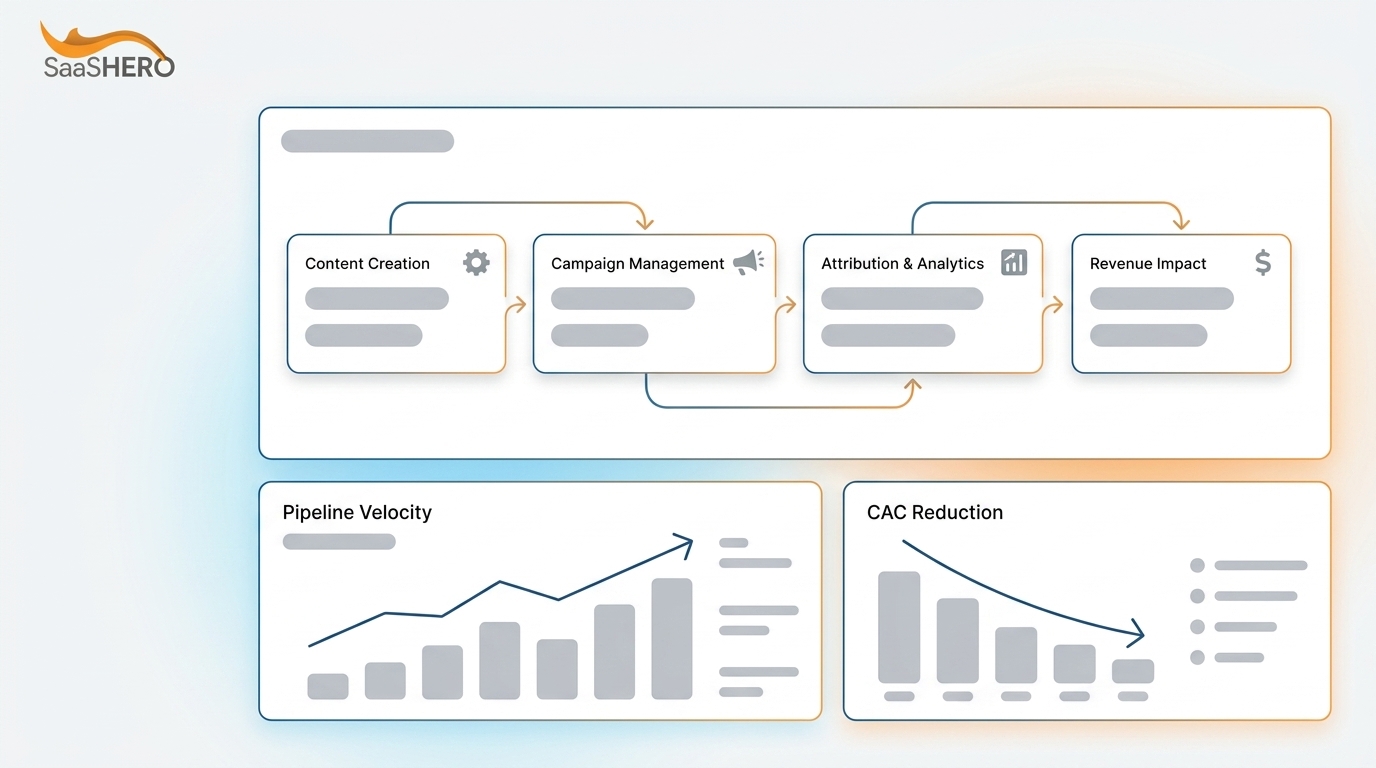
- Marketing supply chain technology connects MRM, DAM, PIM, content orchestration, and attribution platforms so ad spend turns into closed-won revenue.
- Full-funnel attribution requires capturing GCLIDs and UTMs at the click and mapping them through to Salesforce or HubSpot opportunity records.
- Implementation follows a four-stage roadmap: audit data gaps, build the attribution layer, link campaigns to tuned landing pages, then iterate using closed-won metrics.
- Ready to turn your ad spend into predictable ARR? Book a discovery call with SaaSHero.
How Marketing Supply Chain Technology Connects Content to Revenue
Marketing supply chain technology is a connected ecosystem of platforms that governs how marketing content moves from idea to closed-won revenue. This ecosystem includes Marketing Resource Management (MRM), Digital Asset Management (DAM), Product Information Management (PIM), content supply chain orchestration, and demand forecasting tools.
IBM’s research on PIM systems frames this infrastructure as the foundation for consistent, accurate product and marketing data across every downstream channel. That consistency is a prerequisite for reliable CRM attribution in B2B SaaS environments. If your CRM attribution is unreliable because product data, campaign tags, or asset versions are inconsistent across channels, schedule a discovery call to see how SaaSHero builds the data foundation that makes attribution work.
Six Components of a Modern Marketing Supply Chain
- Marketing Resource Management (MRM). MRM platforms centralize campaign planning, budget allocation, and workflow approvals. For B2B SaaS teams, this reduces wasted spend on uncoordinated campaigns and shortens the time from brief to live ad, which compresses payback periods.
- Digital Asset Management (DAM). DAM systems store, version, and distribute approved creative assets. When integrated with paid media platforms, DAM removes the ad-hoc creative bottleneck that inflates cost-per-SQL by forcing teams to reuse underperforming assets.
- Product Information Management (PIM). IBM identifies PIM as the single source of truth for product data across marketing, sales, and distribution channels. In SaaS, accurate feature and pricing data flowing from PIM into landing pages and ad copy improves SQL-to-close rates by eliminating message mismatch.
- Content Supply Chain Orchestration. This layer sequences content production steps such as briefs, drafts, reviews, localization, and publishing against campaign calendars. Synchronized content delivery keeps paid media and organic channels aligned, which reduces CAC through compounding reach.
- Demand Forecasting and Signal Capture. Integrating intent data, CRM pipeline signals, and ad platform data into a unified forecast model helps revenue teams direct budget toward the highest-converting segments before spend is committed. Monday.com’s 2026 supply chain analysis identifies this AI-assisted planning approach as a primary driver of cost reduction.
- Attribution and Revenue Reporting. The final component closes the loop by connecting Google Click IDs (GCLIDs) and LinkedIn lead gen form submissions to CRM records in Salesforce or HubSpot. This connection turns marketing supply chain technology from an operational tool into a revenue accountability system.
Of these six components, attribution is where most B2B SaaS teams fail. The technology is available, but configuration rarely reaches the point where leadership can trust the numbers. The next section walks through how to build this attribution layer correctly.
Building Full-Funnel Attribution in Salesforce or HubSpot
Full-funnel attribution begins at the click. When a prospect clicks a paid search ad, Google assigns a GCLID, a unique identifier that must be captured in a hidden form field on the landing page and written to the CRM contact record at form submission. The same logic applies to LinkedIn’s lead gen forms, which pass UTM parameters and member data directly into HubSpot or Salesforce through native connectors.
Once the GCLID is stored in the CRM, every downstream event such as demo booked, opportunity created, and deal closed can be traced back to the originating ad, keyword, and audience segment. SaaSHero implements this tracking architecture as part of every engagement, which enables campaign decisions based on closed-won revenue rather than form fills.
The result is a reporting environment where a VP of Marketing can show a CEO exactly which $10,000 in ad spend produced which $80,000 in new ARR. That level of clarity creates boardroom-ready data that justifies budget and shortens the path to an 80-day payback period, as demonstrated in SaaSHero’s work with TestGorilla.
Thomson Reuters’ 2026 supply chain complexity report notes that organizations which fail to integrate data across operational layers face compounding inefficiencies. The same pattern appears in marketing stacks where ad platforms, CMS, and CRM operate in isolation.
How Adobe, Bynder, Aprimo, and 2026 AI Platforms Support Revenue Teams
The four platforms below are evaluated on criteria most relevant to B2B SaaS revenue teams. Pricing transparency reflects whether list pricing is publicly available. CRM connector availability reflects native integrations with Salesforce and HubSpot as documented by each vendor.
Competitor-conquesting support reflects whether the platform includes landing page or campaign workflow tooling suited to comparison page strategies. Closed-revenue reporting reflects whether the platform natively surfaces closed-won ARR attribution or requires a third-party BI layer. Where a direct numeric comparison is not possible, the distinction appears in prose.
| Platform | Pricing Transparency | CRM Connectors | Competitor-Conquesting Support | Closed-Revenue Reporting |
|---|---|---|---|---|
| Adobe Experience Manager (AEM) | No public list pricing, enterprise quote required | Salesforce integration available, HubSpot via middleware | Strong campaign workflow and personalization tooling, no dedicated conquesting templates | Requires Adobe Analytics plus CRM integration, not native out of box |
| Bynder DAM | No public list pricing, tiered quote model | Bynder DAM has multiple native connectors for Salesforce documented by Bynder, but its HubSpot integration is developed by a partner (The DAM Consultants) | Asset management focus, no campaign landing page builder | No native closed-revenue reporting, relies on CRM passthrough |
| Aprimo MRM | No public list pricing, enterprise only | Salesforce native, HubSpot via API | Budget and workflow management supports multi-campaign conquesting execution | Spend-to-pipeline reporting available, closed-won ARR requires CRM sync |
| 2026 AI-Native Entrants (e.g., platforms leveraging AI procurement and planning signals) | Usage-based or modular pricing emerging, some publish entry tiers | API-first architecture, connector availability varies by vendor | AI-assisted audience and content targeting increasingly standard, per Art of Procurement’s 2026 AI adoption analysis | Real-time revenue signal integration cited as a differentiator by emerging vendors |
No platform in this comparison natively delivers a complete GCLID-to-closed-ARR attribution workflow without CRM configuration. That configuration layer, which connects the marketing supply chain platform to Salesforce or HubSpot with proper GCLID capture, lead scoring, and opportunity attribution, is where SaaSHero’s implementation methodology creates measurable revenue impact.
Four-Stage Implementation Roadmap for B2B SaaS Teams
- Stage 1 — Audit. Map every active marketing asset, campaign, and data source to establish your baseline. This inventory reveals where GCLID or UTM data is being lost between ad click and CRM record, which exposes the gaps that block attribution. Before committing new spend, run a heuristic analysis on existing landing pages to surface conversion killers that would waste that budget.
- Stage 2 — Data Layer. Implement hidden GCLID fields on all landing page forms and confirm they write to the correct CRM properties. Configure CRM fields to store ad source, campaign, and keyword data at both the contact and deal level. Establish a single source of truth for asset versioning inside a DAM or MRM platform so reporting aligns with the creative actually in market.
- Stage 3 — Campaign Linkage. Connect paid media campaigns such as Google Ads, LinkedIn, and competitor-conquesting initiatives to dedicated landing pages with message-matched copy and comparison architecture. Activate CRM-based audience segments to suppress existing customers and retarget high-intent prospects who already engaged with key assets.
- Stage 4 — CRO Iteration. Use closed-won data from the CRM to identify which combinations of ad creative, keyword, and landing page produce the shortest sales cycles and highest ARR per deal. Run structured A/B tests on headlines, CTAs, and form length. Optimize toward SQL-to-close rate, not click volume.
SaaSHero executes this roadmap as a structured onboarding engagement with early focus on the data layer and campaign launches. Book a discovery call to see how this roadmap applies to your stack.
How Two SaaS Teams Turned Supply Chain Tech into Revenue
The Founder-Led Bootstrapper. A SaaS founder at $800k ARR was running Google Ads manually with no GCLID tracking and no landing page differentiation between branded and competitor-conquesting campaigns. Assets lived in a shared Google Drive with no version control. After the team implemented a lightweight DAM, configured GCLID capture in HubSpot, and launched dedicated comparison landing pages, cost per lead dropped by more than 60% within 90 days and $120k in new ARR was attributed directly to competitor-conquesting campaigns, a result consistent with the cost-efficiency outcomes SaaSHero documented in its Playvox engagement.
The Series-B VP of Marketing. A VP at a $6M ARR HR Tech company had a $45k monthly ad budget that produced pipeline reports which could not be reconciled with Salesforce opportunity data. The agency managing the account reported on impressions and CTR, not revenue. After the team migrated to a full marketing supply chain architecture with MRM for campaign planning, GCLID-to-Salesforce attribution, and CRO iteration on landing pages, they achieved an 80-day payback period and presented closed-won ARR by channel to the board for the first time. This outcome mirrors the TestGorilla result SaaSHero has documented publicly.
Common Pitfalls That Destroy Marketing Supply Chain ROI
Vanity-metric reliance. Reporting on impressions, clicks, and CTR while pipeline and closed-won ARR remain unmeasured is the most common failure mode. Thinklytics’ 2026 analysis of AI-driven cost reduction in procurement identifies the absence of outcome-linked measurement as the primary reason technology investments fail to produce financial returns. That finding applies directly to marketing stack deployments.
Long agency contracts. A 12-month agency contract removes the performance pressure that drives improvement. When an agency cannot be replaced for a year, the urgency to connect ad spend to closed revenue disappears. Month-to-month agreements, as SaaSHero structures them, create a forcing function where results must be demonstrable every 30 days or the relationship ends.
Platform adoption without attribution configuration. Deploying an MRM or DAM platform without completing the data layer, including GCLID capture, CRM property mapping, and closed-won reporting, produces operational efficiency gains but zero revenue visibility. The platform investment becomes a cost center rather than a growth lever.
Turn Ad Spend into Closed-Won Revenue
Marketing supply chain technology functions as infrastructure that makes every dollar of paid media accountable to net new ARR. SaaSHero aligns these platforms with paid search, paid social, CRO, and CRM attribution to deliver measurable payback periods and SQL-to-close improvements for B2B SaaS teams at every stage.
Book a discovery call and see what an 80-day payback period looks like for your pipeline.
Frequently Asked Questions
What budget is required to implement marketing supply chain technology for a B2B SaaS company?
The budget depends on the components being deployed and the current maturity of your stack. A founder-led team under $1M ARR can begin with a lightweight DAM and GCLID-to-HubSpot attribution configuration combined with a SaaSHero Dedicated Campaign Manager retainer. Series-B teams with substantial monthly ad spend often invest in a full MRM layer, Salesforce integration, and broader marketing support.
The key principle is that attribution configuration must precede platform scaling. Spending on MRM without closing the GCLID-to-CRM loop produces no revenue visibility.
Who owns the marketing supply chain technology stack, marketing, RevOps, or IT?
In most B2B SaaS companies under $10M ARR, the VP of Marketing or the founder owns the stack operationally, while RevOps or a Salesforce administrator handles CRM-side configuration. SaaSHero functions as an embedded extension of that team, managing the paid media layer and the attribution data flow while coordinating with internal stakeholders on CRM property setup and reporting.
The goal is a shared Looker Studio or HubSpot dashboard where marketing, sales, and leadership see the same closed-won ARR data tied to the same campaign sources.
How long does it take to see an 80-day payback period after implementing this approach?
The 80-day payback period is an outcome metric, not a starting point. This benchmark becomes achievable when three conditions are met: the attribution data layer is correctly configured, paid media campaigns target high-intent competitor and comparison keywords, and landing pages are optimized through heuristic CRO to convert qualified traffic into demos.
SaaSHero engagements focus on completing the data layer and launching tuned campaigns early in the process. Payback period measurement improves as closed-won data accumulates in the CRM.
What is the difference between a content supply chain and a marketing supply chain?
A content supply chain refers specifically to the workflow that governs content creation, review, approval, and distribution from brief to published asset. A marketing supply chain is the broader system that includes the content supply chain but also covers budget management, demand forecasting, PIM data flows, paid media execution, and closed-revenue attribution.
For B2B SaaS teams, the content supply chain is one component of the marketing supply chain, and its value is fully realized only when it connects to CRM attribution that ties published assets to pipeline and net new ARR.
Can a B2B SaaS company implement marketing supply chain technology without replacing its existing CRM?
Yes. Marketing supply chain platforms, including Adobe Experience Manager, Bynder, and Aprimo, are designed to integrate with existing CRM systems rather than replace them. The integration typically involves native connectors for Salesforce and HubSpot, supplemented by API configuration for GCLID passthrough and closed-won reporting.
SaaSHero’s implementation roadmap is designed to work within a company’s existing Salesforce or HubSpot environment, adding the attribution and campaign linkage layers without requiring a CRM migration or a new sales process.