




Key Takeaways
- B2B SaaS buyers in 2026 complete 69% of their journey independently, so collateral mapping directly supports revenue growth.
- Strong sales enablement with stage-specific content delivers 49% higher win rates and 28% more year-over-year revenue.
- Awareness collateral like competitor alternatives pages captures high-intent traffic, Consideration relies on case studies and ROI tools, and Decision uses demos and trials.
- AI personalization and interactive content are core 2026 trends for engaging buyers across complex, non-linear journeys.
- Partner with SaaSHero to map your collateral and unlock results like $504k Net New ARR growth.

B2B SaaS Buyer Journey in 2026
The 2026 B2B SaaS buyer journey is non-linear and complex, with 6-10 stakeholders involved in research, evaluation, and consensus-building. Modern buyers still move through three core stages, yet they often revisit earlier steps and compare multiple vendors in parallel.
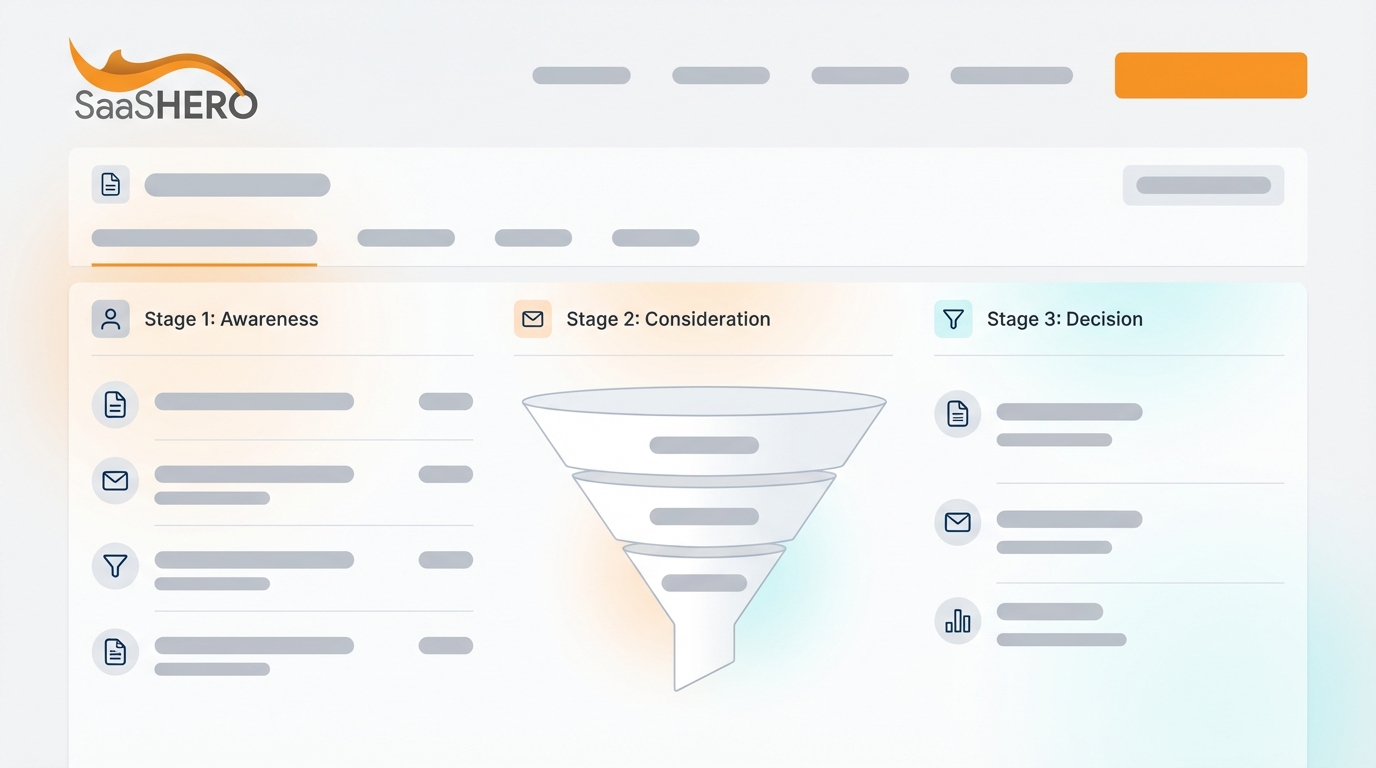
The Awareness stage centers on problem identification and solution discovery. Prospects clarify their ideal customer profile, industry pain points, and current tool limitations. During Consideration, buyers compare solutions through feature breakdowns, reviews, and proof points that validate outcomes. The Decision stage focuses on trials, demos, and final vendor selection, with 81% choosing a preferred vendor before speaking with sales.
This self-directed behavior requires collateral that supports independent evaluation while still nudging prospects toward qualified conversations. The priority is matching content depth and format to buyer readiness at every touchpoint.
Master Mapping Table: Collateral by Buyer Stage
|
Stage |
Collateral Types |
Primary Purpose |
SaaS Examples |
|
Awareness |
Blog posts, infographics, industry reports, competitor alternatives pages |
Problem education and solution discovery |
“Salesforce alternatives” pages that capture high-intent search traffic |
|
Consideration |
Case studies, comparison guides, feature matrices, ROI calculators |
Solution evaluation and vendor comparison |
Side-by-side feature comparisons that highlight competitive advantages |
|
Decision |
Product demos, free trials, TCO calculators, customer testimonials |
Purchase justification and risk mitigation |
Interactive demos with trial-to-paid conversion tracking |
This mapping framework ensures each asset supports a specific buyer need and moves prospects toward qualified opportunities. Teams that follow this structure see faster pipeline movement and higher conversion rates.
Awareness Collateral that Attracts SaaS Buyers
Awareness collateral should educate buyers who are researching problems and potential solutions. Ninety-six percent of B2B buyers research independently before talking with sales, so top-of-funnel content drives first contact.
High-performing awareness assets include industry-specific blog posts that address common pain points, infographics that visualize market trends, and in-depth guides that explain solution categories. Competitor alternative pages work especially well at this stage because they capture prospects who are actively evaluating current tools and searching for better options.
Effective awareness content answers real buyer questions and avoids aggressive product pitches. Content should build authority and introduce your solution category in a natural way. A “CRM alternatives” page, for example, explains evaluation criteria and then presents your platform as a strong fit.
Strong awareness collateral produces measurable engagement such as content downloads, email signups, and progressive profiling data. These signals enable personalized nurture sequences and set the tone for trust across the rest of the journey.
Consideration Collateral that Proves SaaS Value
Consideration stage buyers actively compare vendors, so collateral must support detailed evaluation and clear decision-making. Prospects at this point expect comparison guides, robust case studies, and interactive tools that show concrete value.
Case studies often serve as the most persuasive consideration assets because they provide social proof and outcome validation. The strongest examples share specific metrics, implementation details, and ROI calculations that prospects can map to their own context. Feature comparison matrices help buyers review capabilities side by side, while ROI calculators allow them to estimate potential returns.
Advanced consideration collateral also includes competitive battle cards for sales teams, deep feature breakdowns, and integration guides that address technical questions. According to Martal, 67% of sales reps say persona-tailored content improves their ability to close, which highlights the need for stakeholder-specific materials.
Interactive content such as guided product tours, focused feature demos, and assessments helps engage multiple stakeholders at once. This multi-touch approach fits the collaborative nature of B2B SaaS buying committees.
Decision Collateral that Removes Final Friction
Decision stage collateral should clear the last obstacles to purchase by addressing implementation, financial risk, and internal approval. Content at this stage often requires the highest level of personalization.
Product demos and free trials form the core of decision collateral because they allow hands-on evaluation and build confidence in your platform. Product-led growth strategies can triple conversion rates through self-service trials that prove value before a contract is signed.
Financial justification tools such as TCO calculators, implementation timelines, and contract templates help buyers move through procurement faster. Customer testimonials and reference calls provide final reassurance, while security documentation and compliance certifications satisfy enterprise standards.
Decision stage success depends on removing friction with clear pricing, transparent terms, and strong onboarding resources. The objective is to make saying “yes” simple while reinforcing the long-term value of your solution.
Book a discovery call to build decision-stage collateral that turns qualified prospects into customers.
2026 Trends and a Practical Implementation Checklist
2026 B2B SaaS marketing relies heavily on AI-driven personalization, zero-party data, and richer self-service experiences. AI-powered automation and intent-based targeting now support dynamic content that adapts to buyer behavior and preferences.
Effective implementation follows eight steps. First, audit existing collateral to identify gaps. Second, map each asset to a buyer stage. Third, set up tracking systems. Fourth, create materials for each key stakeholder. Fifth, build interactive elements. Sixth, establish feedback loops with sales and customers. Seventh, measure performance. Eighth, refine based on results.
Modern collateral strategies also prioritize mobile-friendly layouts, interactive experiences, and tight CRM integration that supports rep-free buying. Teams must balance strong self-service paths with guided selling for high-value opportunities.
Key success metrics include content engagement, movement between stages, and revenue attribution. The most effective programs combine quantitative data with qualitative buyer feedback to steadily improve collateral performance.
Why SaaSHero Drives SaaS Collateral Results
SaaSHero focuses solely on B2B SaaS marketing and uses flat-fee retainers starting at $1,250 per month with month-to-month flexibility. This model supports a revenue-first approach that has helped clients achieve outcomes such as TestGorilla’s $70M Series A and TripMaster’s $504k Net New ARR growth.

Our team brings deep experience in competitor conquesting and full-funnel collateral mapping tailored to 2026 buyer behavior. We work as an extension of your team through dedicated communication channels and transparent reporting that centers on pipeline impact instead of vanity metrics.
Book a discovery call to map your SaaS sales collateral to the B2B buyer journey and accelerate revenue with aligned, stage-specific content.

Frequently Asked Questions
What is a SaaS sales collateral B2B buyer journey example?
A common journey starts when a prospect finds a “Salesforce alternatives” blog post during the Awareness stage. They then download a feature comparison guide and a case study during Consideration. Finally, they request a demo, use an ROI calculator, and start a free trial during the Decision stage. Each touchpoint delivers value and moves the prospect closer to purchase.
What does the Gartner sales survey about 61% of B2B buyers mean?
The Gartner research shows that 61% of B2B buyers prefer to complete their purchase journey without talking to a sales rep. This preference increases the importance of self-service collateral that supports independent research, evaluation, and decision-making across all stages.
How do you measure collateral ROI in B2B SaaS?
Teams measure collateral ROI by tracking engagement, stage progression, and revenue impact. Useful metrics include download-to-MQL conversion rates, case study views in closed-won deals, and correlations between specific asset consumption and deal velocity or deal size.
What are the key B2B buyer journey stages for SaaS?
The three main stages are Awareness, Consideration, and Decision. Awareness covers problem identification and solution discovery. Consideration focuses on vendor evaluation and comparison. Decision covers final selection and purchase. Modern SaaS buyers move through these stages non-linearly with extensive self-directed research.
What is the best awareness collateral for SaaS companies?
High-performing awareness collateral includes competitor alternative pages, industry trend reports, problem-focused blog posts, and educational webinars. These assets attract solution-focused researchers, build authority, and capture contact details for nurturing.
How does collateral mapping reduce customer acquisition cost?
Collateral mapping reduces CAC by improving conversion at each stage, shortening sales cycles through better education, and supporting more accurate lead qualification. Companies with strong sales enablement see 49% higher win rates and 28% more revenue growth, which directly improves unit economics.
Conclusion: Turn Your Collateral into a Revenue Engine
Strategic sales collateral mapping separates thriving SaaS companies from those that struggle in 2026’s crowded market. Teams that align content with buyer stages see higher win rates, faster sales cycles, and stronger unit economics.
Book a discovery call to implement proven collateral mapping strategies and turn your buyer journey into a predictable revenue engine.