




Key Takeaways
-
ConTech companies face 40%+ churn from field crew resistance and poor mobile onboarding, with 75% of churn risk tied to SaaS onboarding experience.
-
The 30-60-90 playbook delivers first value in <7 days, 50% daily usage by day 60, and 80-day payback through mobile-first, project-tied phases.
-
Persona-specific tactics for field crews (offline mobile, video tutorials) and project managers (dashboards, integrations) cut abandonment by matching real workflows.
-
Track ConTech KPIs like activation-to-ARR instead of vanity metrics, and use AI-driven interventions and checklists to avoid desktop-only onboarding failures.
-
SaaSHero’s ConTech expertise drives $504k Net New ARR via competitor conquesting and transparent pricing—schedule a discovery call to implement today.
Core Framework: 30-60-90 ConTech Onboarding Playbook
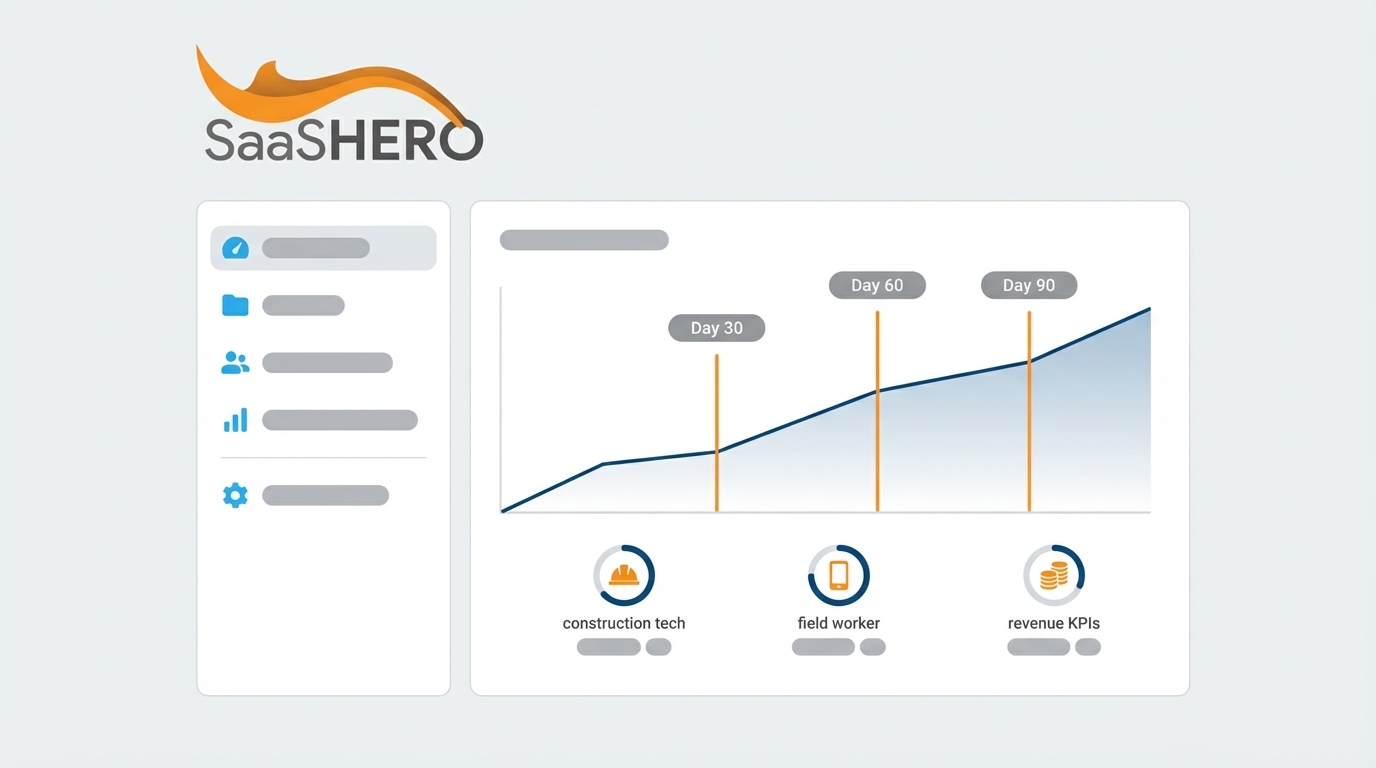
The 30-60-90 construction tech customer onboarding marketing framework solves field-based software adoption challenges through three clear phases: First Value (Days 1-30), Adoption Acceleration (Days 31-60), and Expansion Readiness (Days 61-90).
This phased approach recognizes that construction projects follow different timelines than traditional business software implementations. The table below shows how each phase targets a specific milestone with metrics that grow more ambitious as users gain confidence.
|
Phase |
Primary KPI |
Target Metric |
Focus Area |
|---|---|---|---|
|
Days 1-30 |
Time-to-First-Value |
<7 days |
Mobile login success |
|
Days 31-60 |
Feature Activation |
50% daily usage |
Workflow integration |
|
Days 61-90 |
Revenue Expansion |
80-day payback |
Multi-project deployment |
The framework uses AI-driven customer engagement and workflow automation to remove adoption friction through workflow-native deployment. Hybrid PLG + sales-led models have become the new default for SaaS customer onboarding, and this mix works especially well for ConTech companies that serve both tech-savvy project managers and traditional field crews.
To operationalize this hybrid approach within the 30-60-90 framework, follow this seven-step implementation strategy.
-
Define persona-specific onboarding paths for project managers and field workers.
-
Roll out project-first, tying activation to active job sites instead of company-wide deployment.
-
Create mobile-native quick-start guides with short video demonstrations.
-
Set up AI-triggered interventions based on usage patterns and engagement drops.
-
Add integration checkpoints with existing tools like Procore or PlanGrid.
-
Celebrate success milestones tied to project completion metrics.
-
Map expansion pathways to additional projects and team members.
SaaSHero’s revenue tracking connects marketing metrics directly into CRM systems, which gives ConTech teams real-time visibility into performance. Ready to implement this framework for your ConTech platform? Schedule a discovery call to map your specific implementation timeline.

Persona Segmentation and Mobile-First Onboarding for Field Workers
The 30-60-90 framework works best when onboarding aligns with three primary stakeholder groups: project managers who need oversight, field crews who depend on mobile-first functionality, and executives who care about ROI. Each persona brings different technology comfort levels, daily workflows, and definitions of success.
Project managers usually act as the bridge between field operations and executive reporting. Their onboarding journey focuses on dashboard configuration, reporting setup, and integration with existing project management workflows. These users often have moderate technical skills and respond well to structured, comprehensive training resources.
Field crews represent the highest-risk segment for churn, as SMB SaaS companies can experience annual churn rates exceeding 15–30% when mobile experiences fail on job sites. To counter this risk, mobile-first tactics must address the specific job site constraints that cause abandonment.
-
App-based video tutorials under 2 minutes that demonstrate core functions.
-
Offline capability demonstrations for areas with poor connectivity.
-
“Job site login in 7 days” quick wins that prove immediate value.
-
Voice-to-text and photo capture features that simplify data entry.
-
Integration with familiar tools like text messaging and photo galleries.
Marketing alignment starts during the pre-onboarding phase through targeted campaigns that address common ConTech alternatives. Competitor conquesting campaigns that target searches like “Procore alternatives” or “construction management software” create awareness among prospects already evaluating solutions. These campaigns connect to specialized landing pages that speak to specific pain points and feature customer success stories from similar construction companies.
Phased Implementation with Checklists
Once prospects convert, the persona insights above guide how you structure each phase of the 30-60-90 rollout. The following phase checklists translate the framework into concrete actions your team can execute.
Phase 1: Days 1-30 – First Value Achievement
The critical first 30 days operationalize the <7-day time-to-first-value target outlined in the framework above, with a strong focus on mobile accessibility for field teams. Because SaaS customers who engage with support in the first 30 days retain 25–35% better, Phase 1 must include proactive support touchpoints that guide users to that first value milestone before they disengage.
Phase 1 Checklist:
-
✅ Mobile app download and first successful login within 48 hours.
-
✅ Quick-start project setup using existing job site data.
-
✅ First photo upload or data entry from a field location.
-
✅ Slack or Teams integration for real-time notifications.
-
✅ AI-triggered welcome sequence tailored to user role and project type.
-
✅ Success milestone: 50% of invited users complete their first mobile action.
Phase 2: Days 31-60 – Adoption Acceleration
Phase 2 concentrates on workflow integration and habit formation across the account. The goal shifts from initial activation to consistent daily usage among core project stakeholders. Common pitfalls include gaps between sales promises and actual implementation capabilities, which often appear during this deeper usage period.
Phase 2 Checklist:
-
✅ Integration with existing tools such as Procore, Autodesk, or Microsoft Project.
-
✅ Custom workflow configuration that matches company processes.
-
✅ Team training sessions that cover advanced features.
-
✅ Performance dashboard setup for project managers.
-
✅ Success milestone: daily active usage above 50% for core team members.
Phase 3: Days 61-90 – Expansion Readiness
The final phase proves ROI and prepares the account for expansion to additional projects or team members. AI onboarding enables instant activation in PLG tools, which supports rapid deployment across multiple job sites once value is clear.
Phase 3 Checklist:
-
✅ ROI calculation and reporting setup.
-
✅ Preparation for onboarding additional projects.
-
✅ Adoption of advanced features such as AI insights and predictive analytics.
-
✅ Success milestone: 80-day payback period achievement.
-
✅ Identification and planning of expansion pathways.
Tools like Moxo support hybrid high-touch and self-serve experiences that fit complex ConTech accounts. SaaSHero provides specialized paid media management for ConTech companies at competitive flat fees. Let’s discuss how these Phase 3 strategies apply to your expansion goals—schedule a discovery call today.

Revenue KPIs, Pitfalls, and SaaSHero Differentiation
Construction tech customer onboarding marketing success depends on tracking activation-to-ARR conversion instead of vanity metrics like app downloads or initial logins. This requires measuring a progression of value milestones: time-to-first-value under 7 days proves immediate utility to field crews, 50% activation rates by day 30 confirm workflow integration, and the 80-day payback target introduced earlier shows clear ROI to construction executives who control renewal decisions.
|
Common Pitfall |
Impact on Churn |
SaaSHero Solution |
|---|---|---|
|
Desktop-only onboarding |
60% field crew abandonment |
Mobile-first quick wins |
|
Generic SaaS metrics |
Poor ROI visibility |
ConTech-specific KPIs |
|
Single-project focus |
Limited expansion |
Multi-project frameworks |
These pitfalls appear frequently in ConTech onboarding and directly affect the KPIs above, so addressing them early protects both retention and expansion.
SaaSHero stands out through construction vertical expertise, flat-fee monthly pricing, and senior-led account management. Unlike traditional agencies that charge percentage-of-spend fees, SaaSHero’s transparent pricing removes conflicts of interest and gives ConTech companies predictable costs. Case studies show $504k Net New ARR generation and repeated 80-day payback achievements across technology verticals.

The agency’s competitor conquesting expertise also benefits ConTech companies that compete with established players like Procore, Autodesk, and PlanGrid. By targeting high-intent searches such as “Procore pricing” or “construction management software alternatives,” SaaSHero attracts qualified leads who already evaluate solutions and feel ready for onboarding conversations.
Frequently Asked Questions
How do you measure ConTech onboarding ROI effectively?
ConTech onboarding ROI measurement focuses on activation-to-ARR conversion instead of traditional SaaS vanity metrics. Key indicators include time-to-first-value under 7 days, mobile app engagement rates above 50%, and 80-day payback periods. Track field crew adoption separately from project manager usage, because these personas follow different success patterns. Revenue attribution should connect initial onboarding activities to contract expansions and renewal rates.
What is the best hybrid approach for field crews versus project managers?
Field crews need mobile-first, visual onboarding with offline capabilities and voice-to-text features. Project managers need dashboard configuration, reporting setup, and integration training. The hybrid model combines AI-triggered self-serve flows for basic functions with high-touch support for complex integrations. Use different communication channels, such as text messaging for field crews and email plus Slack for project managers.
How do you handle multi-stakeholder alignment in construction companies?
Multi-stakeholder alignment works best with persona-specific onboarding paths that share common success metrics. Create executive dashboards that highlight ROI and project efficiency gains, project manager interfaces that focus on workflow improvement, and field crew experiences that emphasize ease of use. Schedule regular alignment meetings during the first 60 days to address concerns and adjust implementation based on feedback from every stakeholder group.
What are the most common ConTech onboarding failures to avoid?
Common failures include desktop-only experiences that ignore field workers, generic SaaS onboarding that overlooks project-based workflows, and missing integrations with existing construction tools. Avoid vanity metrics like app downloads instead of usage depth, weak mobile performance under job site conditions, and onboarding that ignores different technology comfort levels across construction teams.
How quickly can ConTech companies implement the 30-60-90 framework?
Most ConTech companies need 2–3 weeks for initial setup, including mobile app refinement, persona-specific onboarding flows, and integration with existing construction management tools. The framework adapts to current ConTech platforms and can roll out incrementally across projects or regions. Success depends on dedicated resources during the first 90 days to monitor metrics and adjust based on field feedback.