




Key Takeaways for Revenue-Focused Feedback Loops
- Use a 4-stage Collect-Analyze-Act-Close framework to turn customer feedback into GTM decisions that cut churn by 15–25%.
- Capture feedback across acquisition, onboarding, retention, and expansion with tools like HubSpot, Gong, Survicate, and Zonka.
- Score insights with the ICE framework (Impact, Confidence, Ease) so your team focuses on changes that improve ARR and unit economics.
- Turn prioritized feedback into quick wins in sales and onboarding, plus roadmap updates, while tracking impact through NRR and churn.
- Close the loop with clear, honest communication to build trust; schedule a strategy call with SaaSHero if you want expert help implementing this system.
Prerequisites for a Revenue-Ready Feedback Loop
Effective feedback loops start with the right foundation. You need access to your CRM (HubSpot, Salesforce), customer communication tools (Intercom, Zendesk), and baseline metrics including monthly churn rates (target under 3.5%), NPS scores, and CAC/LTV ratios. Cross-team alignment between sales, product, and customer success keeps feedback-driven changes moving instead of stalling in handoffs.
GTM feedback loops span four stages: acquisition (lead generation and sales), onboarding (first-time user experience), retention (ongoing usage and support), and expansion (upsells and renewals). Each stage needs different collection methods because customer needs and communication channels shift across the lifecycle. The 2026 landscape adds AI-powered survey tools and conversation intelligence platforms that automate this multi-stage collection while still feeling personal. Even with automation, setup usually takes 2–4 weeks because you must establish baseline patterns before the system can flag meaningful changes.
How the 4-Stage Feedback Framework Works
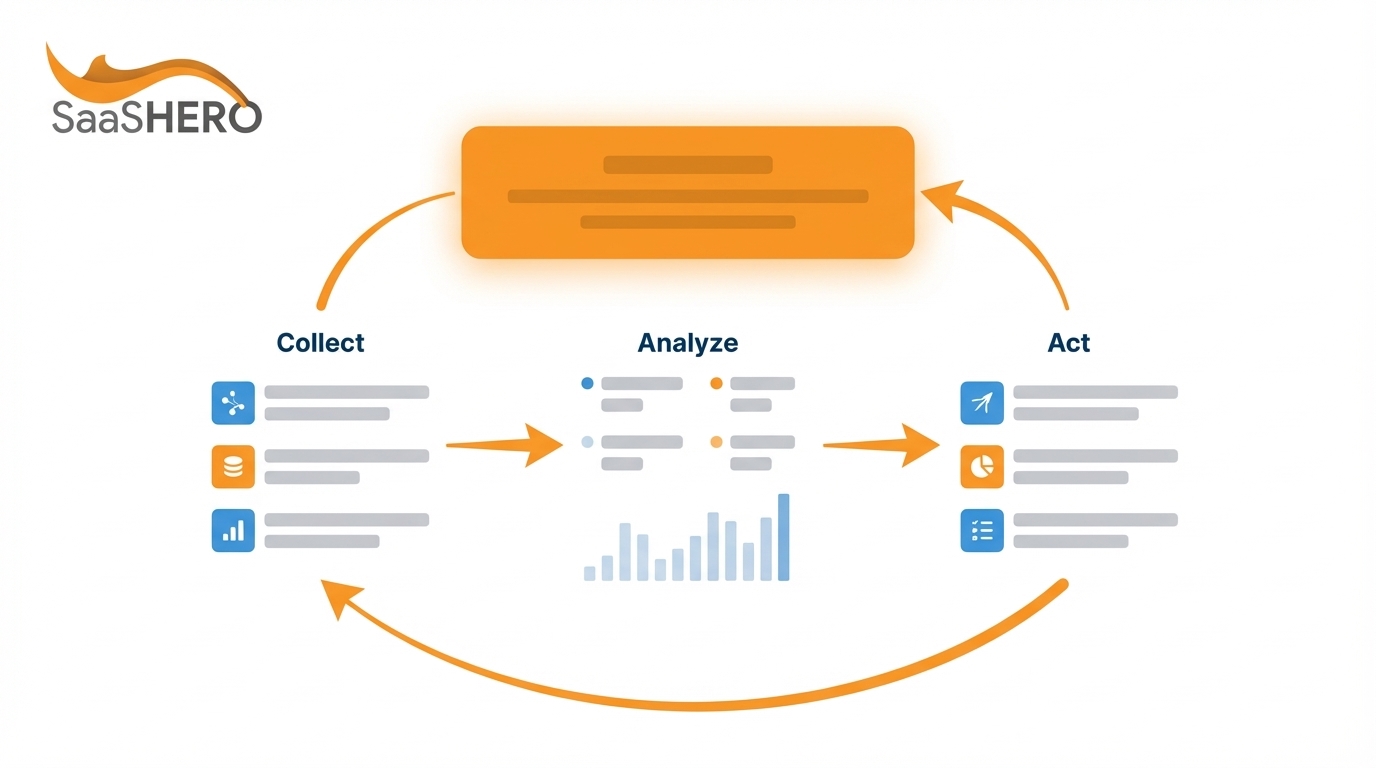
This framework creates a continuous flow where each stage produces a specific output that feeds the next stage. Collection generates segmented signals, analysis produces prioritized scores, action delivers concrete improvements, and closure builds trust through transparent communication. The table below maps each stage to its focus area and key deliverable.
| Stage | Focus | Key Output |
|---|---|---|
| 1. Collect | Multi-channel GTM data | Segmented signals |
| 2. Analyze | ICE prioritization | ARR/churn scores |
| 3. Act | GTM/roadmap tweaks | Quick wins/expansion |
| 4. Close | Communicate changes | 100% loop closure |
This systematic approach creates a continuous flow: Collect → Analyze → Act → Close → Repeat. SaaSHero’s Net New ARR tracking methodology gives full-funnel visibility from initial feedback through revenue impact, so every insight connects to measurable business outcomes.
Step 1: Collect Feedback Across Every GTM Stage
Start by capturing feedback at every meaningful customer touchpoint. HubSpot Service Hub sends survey responses straight into contact records, which enables automated workflows triggered by sentiment or score. Zonka Feedback covers email, SMS, in-app, and website surveys so you can track CSAT, NPS, and CES across the full lifecycle.
Collection Checklist:
- In-app feedback: Survicate or Pendo for post-onboarding and in-product surveys
- Sales insights: Gong conversation intelligence for call analysis
- Retention monitoring: ReviewFlowz for G2/Capterra review tracking
- Support feedback: Pylon omnichannel support across Slack, Teams, and email
SaaSHero helped TripMaster uncover a 20% onboarding drop-off through systematic feedback collection. Targeted improvements based on those insights generated $504,758 in Net New ARR. Best Practice: AI-powered personalization tailors survey timing and content, which prevents fatigue while keeping response rates high. If you struggle to connect these tools into one system, SaaSHero’s implementation team can integrate your feedback stack in 2–4 weeks without disrupting current workflows.

Step 2: Analyze and Prioritize with the ICE Framework
Next, turn raw feedback into a ranked list of actions. The ICE framework scores each item across Impact (potential ARR or churn effect), Confidence (data quality and volume), and Ease (implementation effort) on 1–10 scales. Customer service ROI calculations use retained revenue from saved accounts and expansion revenue to quantify Impact scores with real numbers instead of guesses.
The table below shows how different feedback types compare across ICE dimensions. Notice how the Onboarding Fix earns the highest overall score even with slightly lower impact, because high confidence and ease make it a stronger immediate investment than Feature Request X.
| Feedback Item | Impact (1-10) | Confidence (1-10) | Ease (1-10) | ICE Score |
|---|---|---|---|---|
| Feature Request X | 9 | 8 | 7 | 8.0 |
| Onboarding Fix | 7 | 9 | 9 | 8.3 |
| Pricing Concern | 8 | 6 | 5 | 6.3 |
Create Looker Studio dashboards that segment feedback by persona, ARR band, and lifecycle stage so you can see which issues affect your highest-value customers. SaaSHero’s ICE prioritization for TestGorilla highlighted features that supported their 80-day payback period and eventual $70M Series A raise. This structured analysis prevents feature bloat and keeps development focused on changes that move revenue and retention.
Step 3: Act on Insights Across GTM, Sales, and Roadmap
Once you have a ranked list, convert those priorities into specific GTM actions. Update sales scripts, refine onboarding flows, and adjust your product roadmap based on the highest-scoring items. Quick wins under 30 days often include UI bug fixes, clearer onboarding copy, and better objection handling, while strategic initiatives focus on expansion features surfaced in quarterly business reviews.
Action Decision Framework: Categorize feedback-driven actions by complexity and revenue impact timeline.
- Immediate (0–30 days): Low-effort changes such as sales script updates, onboarding copy tweaks, and support documentation that stop active churn risks.
- Quarterly (30–90 days): Cross-team projects like landing page improvements, email sequence updates, and moderate feature enhancements that need coordination but limited engineering.
- Strategic (90+ days): Major product features, pricing model shifts, and new market expansion that require significant development and careful validation before launch.
TestGorilla scaled efficiently by implementing feedback-driven GTM improvements while protecting strong unit economics. SaaSHero’s approach ignores vanity metrics and focuses on CAC payback, lifetime value, and expansion revenue. This disciplined execution ensures every feedback-driven initiative supports sustainable growth instead of scattered experiments.
Step 4: Close the Loop and Protect Customer Trust
After you ship changes, show customers how their input shaped those decisions. Close the loop through newsletters, in-app notifications, QBR presentations, and Slack community updates so contributors see the impact of their feedback. Seventy-three percent of consumers switch competitors after multiple bad experiences, so transparent communication about improvements plays a direct role in retention.
Communication Channels: Match your closure method to the scope of the change and the importance of the customer.
- Product updates: Use in-app notifications via Intercom for releases that affect most users so everyone sees what changed.
- Relationship building: Send personalized emails to customers who requested specific improvements to show you listened and acted.
- Community engagement: Share Slack or forum posts for changes that demonstrate responsiveness to your broader user base.
- Strategic accounts: Include feedback implementation and results in QBR slides to prove their input shapes your roadmap.
Common Mistake to Avoid: Collecting feedback without follow-up communication erodes trust and reduces future response rates. SaaSHero maintains 100% loop closure through systematic tracking and clear customer updates. If your team lacks bandwidth to follow up on every submission, SaaSHero’s customer success specialists can build the tracking systems and communication workflows that keep trust strong.
Measurement and Validation of Feedback Impact
Measure feedback loop performance by tracking response rates (target 30%+), ICE-driven ROI, and revenue impact together. Companies with 110%+ Net Revenue Retention usually show tight integration between feedback and GTM execution. Monitor churn reduction, expansion revenue growth, and customer satisfaction scores as a connected set of indicators rather than isolated metrics.
| Metric | Target | SaaSHero Example |
|---|---|---|
| Annual Churn | <6% | 20% reduction achieved |
| Net Revenue Retention | 110%+ | TestGorilla results (see Step 2) |
| Feedback Response Rate | 30%+ | 35% average maintained |
SaaSHero’s Net New ARR attribution methodology fills gaps in standard analytics by tying feedback initiatives directly to closed-won revenue. This level of tracking supports precise ROI calculations and makes a clear case for continued investment in customer-driven improvements.
Advanced Feedback Systems for Scaling Teams
As your company grows, you can scale feedback loops with 2026 AI tools such as Chattermill for multi-channel aggregation and Pylon for omnichannel support. Enterprise implementations often require dedicated customer success teams and deeper CRM integrations to keep feedback organized and actionable across regions and product lines. SaaSHero’s full-team services support companies with $50k+ monthly ad spend, weaving feedback loops into broader growth strategies that include competitor conquesting and conversion rate optimization. Companies at this scale usually need custom setups, so you can review service tiers at saashero.net/pricing to find a fit or schedule a discovery call if you need a tailored approach beyond standard packages.
Summary and Practical Next Steps
Implementation Checklist: Establish multi-channel feedback collection, apply ICE prioritization, execute GTM-wide improvements, and maintain transparent loop closure. Start with an audit of existing feedback touchpoints, then roll out each stage over 2–4 weeks with clear owners and timelines. Contact SaaSHero for professional implementation that connects feedback directly to measurable Net New ARR growth.

FAQ
How do you scale feedback loops for Series A and beyond?
Scaling requires AI-powered tools like Intercom for automated collection and Zonka for multi-channel distribution. You also need dedicated customer success teams with clear ownership and escalation paths for feedback. SaaSHero provides senior-led execution for companies managing $10M+ ARR, so feedback systems grow with your complexity while preserving response quality and actionable insights.
What role does SaaSHero play in feedback loop implementation?
SaaSHero offers month-to-month execution focused on Net New ARR tracking instead of vanity metrics. Their team connects feedback systems with your CRM and marketing automation tools, implements ICE prioritization, and refines processes over time. This model avoids percentage-of-spend billing and delivers measurable revenue impact through systematic customer insight integration.
How quickly can you expect results from feedback loops?
Initial setup follows the timeline mentioned earlier, and most companies complete tool integration and process establishment within the first month. Meaningful churn reduction usually appears within 90 days, which matches TripMaster’s implementation window. Quick wins such as sales script improvements and onboarding fixes can show impact within 30 days, while strategic product changes take longer but create durable revenue gains.
What are the best tools for SaaS GTM feedback collection in 2026?
Leading tools include Typeform with Zapier automation for surveys, Gong for sales conversation intelligence, Survicate for in-app feedback, and HubSpot for CRM integration. AI-powered platforms like Chattermill aggregate multi-channel insights, while Pylon captures omnichannel support feedback. SaaSHero integrates these tools into cohesive systems that connect customer insights directly to revenue outcomes instead of isolated data points.
How do you measure ROI from customer feedback initiatives?
Measure ROI using retained revenue from churn reduction, expansion revenue from feature improvements, and cost savings from support efficiency. Track Net Revenue Retention improvements, CAC payback reductions, and customer lifetime value increases as part of one ROI story. SaaSHero’s methodology connects feedback initiatives to specific ARR gains, which supports precise ROI calculations and confident investment in customer-driven strategy.
Ready to turn customer insights into predictable revenue growth? SaaSHero builds comprehensive feedback loops with month-to-month flexibility and a revenue-first focus. Schedule a 30-minute strategy session to audit your current feedback touchpoints and map a 90-day plan for systematic collection, ICE prioritization, and transparent loop closure that supports ARR growth.