





Key Takeaways
- Track Net New ARR (New Contracts × ARPC × 12) and target at least $500k annually to prove direct revenue impact from campaigns.
- Aim for 80-day CAC Payback Periods (CAC ÷ (MRR × Gross Margin)) versus industry 6-12 months to show capital efficiency.
- Maintain LTV:CAC ratios of 3-5:1 to confirm sustainable unit economics and long-term growth potential.
- Target 90-95% Client Retention Rate and under 5% Churn to protect revenue stability and predictable MRR growth.
- Partner with SaaSHero for flat-fee, month-to-month expertise delivering $504k Net New ARR, and see how this model scales revenue.
12 Revenue Metrics Every Growth Marketing Agency Must Track in 2026 (With Formulas & Benchmarks)
The following table summarizes the 12 core revenue metrics that form your agency’s measurement system. You can see how to calculate each metric, which benchmarks to target in 2026, why each one matters, and a quick win to improve performance.
| Metric | Formula | 2026 Agency Benchmark | Why It Matters | Quick Win |
|---|---|---|---|---|
| Net New ARR | New Contracts × ARPC × 12 | $500k+ annually (top agencies) | Proves revenue impact | HubSpot CRM integration |
| CAC Payback Period | CAC ÷ (MRR × Gross Margin) | 80 days (elite) vs 6-12mo | Shows efficiency | Negative keyword hygiene |
| LTV:CAC Ratio | Customer LTV ÷ CAC | 3-5:1 optimal range | Validates unit economics | Competitor conquesting |
| Client ARPC | Total Revenue ÷ Active Clients | $10k+/month retainer | Measures account value | Upsell existing clients |
| Client Retention Rate | [(End Clients – New) ÷ Start] × 100 | 90-95% annually | Predicts revenue stability | Monthly check-ins |
| MRR Growth Rate | (Current MRR – Previous) ÷ Previous | 20%+ monthly | Tracks recurring revenue | Flat retainer model |
| Project Profitability | (Revenue – Direct Costs) ÷ Revenue | 60-70% per project | Ensures sustainable margins | Time tracking tools |
| ROAS for SaaS | Revenue ÷ Ad Spend | 5:1 minimum | Justifies media investment | Attribution modeling |
| SQL-to-Closed Rate | Closed Deals ÷ SQLs × 100 | 35-55% win rate | Measures lead quality | Lead scoring implementation |
| Churn Rate | Lost Clients ÷ Start Clients × 100 | Under 5% annually | Identifies retention issues | Exit interviews |
| Pipeline Velocity | Deals × Win Rate × Deal Size ÷ Cycle | Increasing trend | Predicts future revenue | Sales process optimization |
| Agency Revenue Growth | (Current – Previous) ÷ Previous × 100 | 30%+ annually | Overall business health | Specialization focus |
1. Net New ARR: Proving Direct Revenue Impact
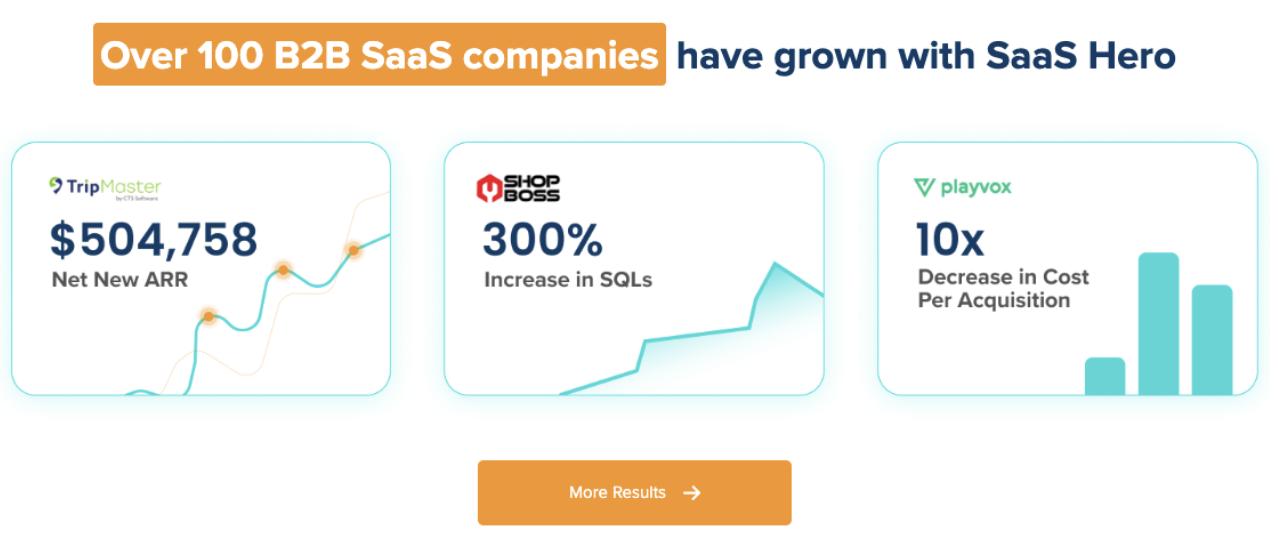
Net New ARR measures the annualized value of new contracts, calculated as New Contracts times ARPC times 12. SaaSHero generated $504,758 in Net New ARR for TripMaster and tied campaigns directly to closed revenue instead of vanity metrics.

This metric ends lead generation debates because it links marketing to bankable outcomes. Implement HubSpot CRM integration to track from click to close, which gives you the attribution foundation for your next step. Use that data to deploy competitor conquesting campaigns targeting high-intent searches, then support those campaigns with dedicated comparison landing pages.
The dark funnel often overstates attribution, so validate results by focusing on incremental growth from new customer segments. SaaSHero uses senior-led teams that understand the difference between demo requests and free trials, and this expertise ensures every dollar spent supports measurable ARR growth.
2. CAC Payback Period: Proving Capital Efficiency
While Net New ARR shows how fast revenue grows, CAC Payback Period reveals how efficiently you create that growth. CAC Payback Period, calculated as CAC divided by MRR times Gross Margin, measures how quickly customer acquisition costs are recovered.
This metric proves capital efficiency to investors and supports decisions to scale successful campaigns. Start with negative keyword hygiene to remove wasted spend on navigational searches, then shift budget toward high-intent competitor comparison keywords. Support these keywords with landing pages designed for immediate conversion, not broad awareness.

Include gross margin in every calculation, because ignoring it creates false signals of efficiency and hides real cash flow risk.
3. LTV:CAC Ratio: Validating Long-Term Unit Economics
The LTV:CAC ratio compares Customer Lifetime Value to Customer Acquisition Cost and validates whether your unit economics support sustainable growth. Healthy SaaS businesses target ratios above 3:1 but below 5:1, as outlined in the key takeaways.
Use competitor conquesting campaigns to capture high-value switchers who already understand the category. Add attribution modeling to track multi-touch journeys and identify segments with strong retention. When this ratio drops, either acquisition costs sit too high or retention sits too low, and both issues require fast action.
4. Client ARPC: Growing Revenue Per Account
Average Revenue Per Client equals total revenue divided by active clients during the period. Target $10k or more in monthly retainers to support senior talent and stable delivery.
Agencies with low ARPC struggle to fund strategy and senior execution. SaaSHero’s revenue-first model addresses this through month-to-month accountability starting at $1,250 retainers. See how our pricing model can increase your ARPC.
Start by upselling existing clients into additional channels, which creates proof for value-based pricing tied to revenue outcomes. As you shift pricing, remove low-value project work that does not fit this model. Track ARPC trends throughout this shift to spot expansion opportunities and pricing changes that deliver the strongest gains.
5. Client Retention Rate: Protecting Recurring Revenue
Client retention rate equals total clients at period end minus new clients, divided by total clients at period start, times 100. Successful SaaS companies achieve 90-95% annual retention rates, which creates a stable base for growth.
High retention shows strong value delivery and reduces pressure to replace lost revenue every month. Run monthly performance reviews that focus on revenue outcomes, maintain proactive communication through dedicated Slack channels, and share transparent reporting on revenue metrics instead of vanity metrics.
6. MRR Growth Rate: Tracking Recurring Revenue Momentum
Monthly Recurring Revenue represents income from active accounts with recurring payments like retainers. Target at least 20% monthly growth through a mix of new client acquisition and expansion within existing accounts.
Flat retainer models create predictable MRR growth compared to percentage-of-spend arrangements that swing with client budgets. Track new MRR from acquisitions, expansion MRR from upsells, and churned MRR from cancellations so you can see which levers drive growth or decline.
7. Project Profitability Margin: Protecting Delivery Margins
Gross margin equals revenue minus direct delivery costs divided by revenue, with target margins of 60-70% on individual projects. Margins at this level support sustainable operations and future growth investments.
Use time tracking tools to capture true delivery costs, then price projects based on value instead of hours. Set clear contracts that prevent scope creep and protect margins. Low gross margins indicate underpricing or overdelivering, which compounds as headcount grows.
8. ROAS for SaaS Campaigns: Justifying Media Spend
Return on Ad Spend equals revenue attributable to ads divided by cost of ads. Target a minimum 5:1 ROAS for sustainable SaaS growth, and push toward 10:1 or higher through competitor conquesting and intent-based targeting.
Move beyond last-click attribution so you can capture full B2B journeys. Focus on high-intent keywords with commercial modifiers, and pair each campaign with a dedicated landing page. Track ROAS by channel and campaign type, then reallocate budget toward the combinations that deliver the strongest returns.
9. SQL-to-Closed-Won Rate: Connecting Leads to Revenue
B2B tech companies typically achieve 20-30% win rates from qualified opportunities, with top performers reaching 35-45% in certain segments. This metric connects marketing’s SQL output to actual sales revenue.
Agencies that struggle with SQL quality often waste budget and sales time. SaaSHero’s specialized approach focuses on qualified leads that convert. Learn how we improve SQL-to-closed rates.
Implement lead scoring based on firmographic and behavioral data, and build content for each buying stage. Align marketing and sales on qualification criteria so both teams agree on what a sales-ready lead looks like. Poor conversion rates usually signal either weak lead quality or gaps in the sales process.
10. Churn Rate: Catching Retention Problems Early
Client churn rate equals clients lost during a period divided by total clients at start, times 100. Keeping annual churn under 5% supports healthy SaaS operations.
Run structured exit interviews to uncover churn patterns, then build early warning systems based on engagement signals. Address client concerns before they escalate into cancellations. High churn often points to misaligned expectations or weak onboarding, both of which you can fix with clearer positioning and better launch processes.
11. Pipeline Velocity: Forecasting Future Revenue
Pipeline velocity factors deal size, win rate, and sales cycle length to measure how quickly prospects move through the sales process. Higher velocity means faster revenue generation from the same volume of opportunities.
Identify bottlenecks in your sales stages and remove friction with clearer next steps and better enablement content. Create urgency through limited-time offers when appropriate, and use lead nurturing sequences for longer cycles. Track velocity by lead source so you can double down on the channels that move deals fastest.
12. Agency Revenue Growth Rate: Measuring Overall Health
Successful SaaS companies achieving product-market fit grow revenue 30% or more yearly. This metric reflects overall business health and how well your positioning resonates with the market.
Specialize in clear verticals instead of staying generalist, then support that focus with value-based pricing models. Invest in team expertise so delivery matches your positioning. Sustained 20% year-over-year growth over three years represents the gold standard for B2B businesses, and agencies that hit this mark usually manage all 12 metrics in a coordinated way.
3 Rules to 3x Your Agency Metrics in 2026
These 12 metrics give you a complete scorecard, but numbers alone do not create growth. The following three rules show how to turn this measurement framework into daily operating habits that improve performance across every metric.
Rule 1: Implement CRM revenue tracking through HubSpot integration and connect every click to closed revenue instead of relying on Google Analytics last-click attribution. This connection enables accurate ROI measurement and smarter campaign decisions.
Rule 2: Deploy competitor conquesting campaigns targeting high-intent searches such as “[Competitor] pricing” and “[Competitor] alternatives”. Pair these campaigns with comparison landing pages that address specific pain points and switching barriers.

Rule 3: Adopt flat retainer models that align agency incentives with client success instead of percentage-of-spend arrangements that reward higher media budgets. Month-to-month agreements create accountability and force consistent performance.
These strategies helped TripMaster reach $504k in Net New ARR and helped Playvox cut cost per lead by 10x while increasing volume by 163%.
FAQ: Growth Agency Revenue Metrics
What’s the ideal LTV:CAC ratio for growth marketing agencies?
The ideal LTV:CAC ratio ranges from 3:1 to 5:1, meaning customer lifetime value should be three to five times the acquisition cost. Ratios below 3:1 indicate unsustainable unit economics, while ratios above 5:1 suggest underinvestment in growth. SaaSHero often exceeds these benchmarks through competitor conquesting strategies that capture high-value switchers with proven retention rates.
How does SaaSHero benchmark CAC payback periods?
SaaSHero targets the elite benchmark discussed earlier in this article. The key to reaching this level lies in focusing on high-intent competitor comparison keywords, applying negative keyword hygiene, and optimizing landing pages for immediate conversion instead of broad awareness campaigns.
What are the best tools for tracking Net New ARR?
HubSpot CRM integrated with Looker Studio provides comprehensive Net New ARR tracking for B2B SaaS agencies. This stack supports attribution from initial ad click through closed-won deals, segmentation by lead source and campaign, and real-time revenue reporting. Salesforce with custom reporting dashboards offers an enterprise alternative for larger agencies with complex attribution needs.
Why choose month-to-month over percentage-of-spend pricing?
Month-to-month flat retainers remove the conflict of interest in percentage-of-spend models where agencies profit from higher budgets regardless of performance. Flat pricing keeps recommendations focused on efficiency and results instead of fee maximization. This accountability creates forcing functions that drive stronger performance, as shown by SaaSHero’s consistent client retention and revenue growth outcomes.
Get SaaSHero’s proven playbook for revenue-first agency growth, and access our revenue-first methodology.
Conclusion
Focus on CAC payback periods under 80 days, Net New ARR growth instead of vanity metrics, and LTV:CAC ratios between 3:1 and 5:1 to support sustainable agency growth. Combine these targets with competitor conquesting campaigns, accurate attribution tracking, and flat retainer pricing models that align incentives with client success.
Top agencies partner with specialists like SaaSHero, which serves B2B SaaS exclusively and supports outcomes such as $70M funding rounds and $504k in Net New ARR. The agencies that win in the next cycle will prove ROI through clear, measurable revenue outcomes.
Scale your agency revenue with proven methodologies and senior-led expertise, and explore a revenue-first engagement.