




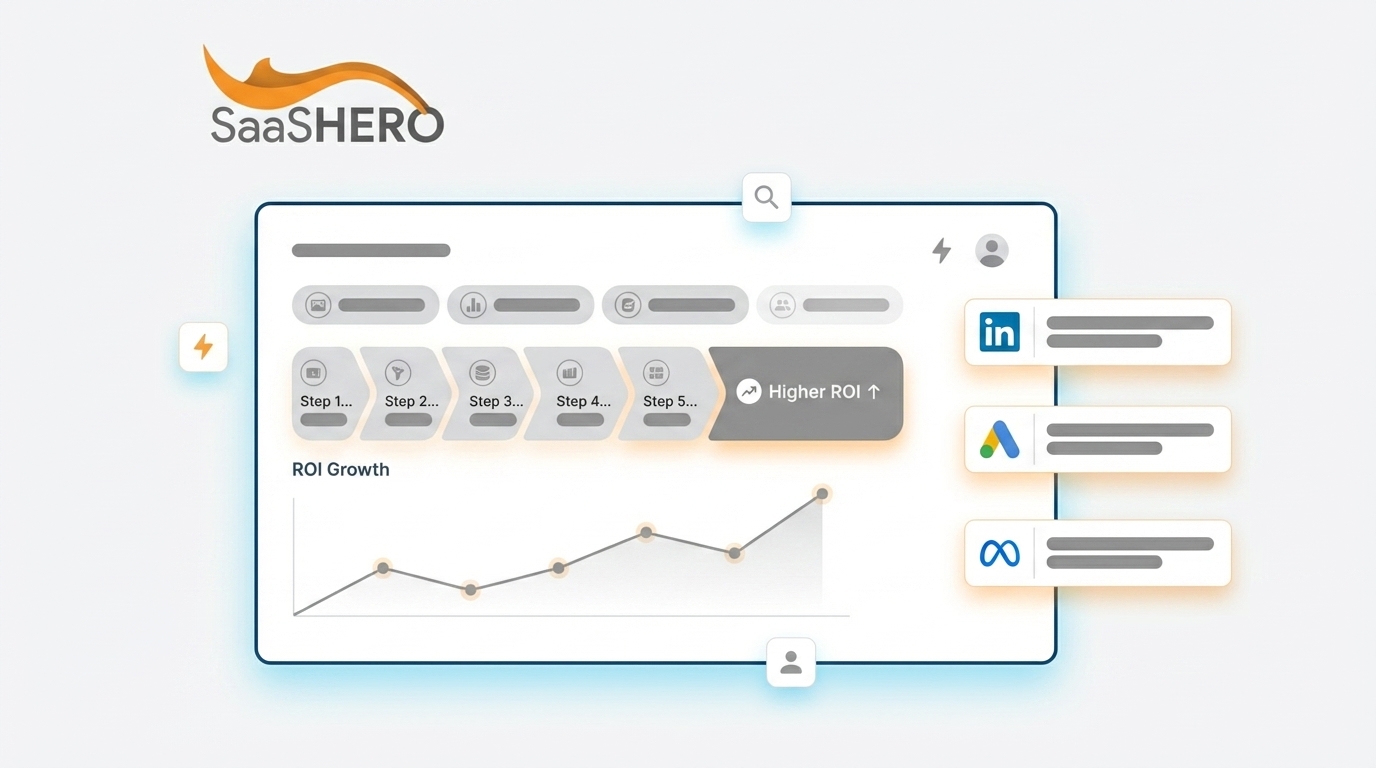
Key Takeaways from High-Performing B2B SaaS Creatives
-
B2B SaaS ad creatives that match search intent (pricing, problem, review) with dedicated landing pages can drive 200% higher ROI.
-
Problem-agitation visuals that show workflow frustration often deliver 44% higher view-through rates than feature-focused ads.
-
Quantified social proof like G2 badges and ARR testimonials placed near CTAs can lift purchase intent by 19%.
-
AI-motion graphics and platform-specific formats, such as LinkedIn carousels and Google responsive ads, improve brand favorability by 26%.
-
Real examples like TripMaster’s ARR gains and TestGorilla’s rapid payback validate this 7-step framework—let’s map this framework to your growth goals in a discovery call.
7 Proven Steps to Design High-Converting B2B Ad Creatives
1. Match Search Intent with Precision Targeting
Effective B2B ad creatives start with clear buyer psychology. Target pricing intent through competitor pricing searches, problem intent through alternative searches, and review intent through comparison searches. Account-Based Marketing on Google Ads delivers 200% higher ROI than volume-based strategies by focusing on high-intent prospects.
Avoid generic traffic that inflates vanity metrics and drains budget. Visitors who are not ready to buy will click but rarely convert, which hides poor performance behind surface-level numbers. Create dedicated landing pages for each intent type so you can match the visitor’s specific need: pricing comparison pages for cost-conscious buyers, problem-solution pages for frustrated users, and review-focused pages for validation seekers.

2. Lead with Problem-Agitation Visuals
Problem-first creatives outperform feature-first ads because they build an emotional connection before presenting the solution. Start with the pain point your prospect experiences every day. Use visuals that show workflow frustration, missed deadlines, or team confusion, then transition into how your product resolves that chaos.
This emotional approach, where you show the pain point before the solution, aligns with LinkedIn’s 2025 research and supports the strong view-through rate advantage mentioned in the key findings above.
3. Embed Social Proof Strategically
B2B buyers act cautiously and want evidence before committing. Include G2 badges, customer logos, and specific ARR testimonials directly in your creative design. Position social proof near your primary CTA to reduce purchase anxiety at the moment of decision.
Proximity alone does not convince skeptical buyers. The social proof itself must be specific and quantified to feel credible. “Helped 500+ SaaS companies reduce CAC by 40%” performs better than “Trusted by leading companies” because concrete numbers give decision-makers evidence they can share with stakeholders.
4. Use AI-Motion and GIFs to Capture Attention
Static images struggle to stand out in 2026’s crowded feeds. As mentioned in the key findings above, video and motion formats significantly outperform static content for brand impact and purchase intent.
Use RunwayML or similar AI tools to create subtle motion graphics that keep production costs low. Show data flowing, dashboards updating, or workflows improving with simple loops. Motion captures attention quickly while avoiding the need for full-scale video shoots.
5. Design for Platform-Specific Ad Formats
LinkedIn conversion rates average 3.11% higher than other social platforms when creatives use native formats. Design LinkedIn carousels for feature comparisons, Google responsive ads for search intent, and mobile-first creatives for Meta placements.
Avoid one-size-fits-all creative. Each platform has specific aspect ratios, text limits, and visual hierarchies that influence performance. Tailor your layouts, copy length, and focal points to match how users consume content on each channel.
6. Implement Dynamic Creative Testing
Meaningful testing goes far beyond button color changes. Dynamic creatives that automatically assemble components based on user behavior achieved 284% conversion rate increases in structured experiments.
Test distinct concepts instead of tiny tweaks. Compare pain-point hooks against results-led messaging, customer testimonials against product demos, and urgency-driven CTAs against value-focused offers. Use these tests to identify which narrative resonates with each audience segment.
7. Integrate Conversion Rate Optimization with Creative
Ad creative and landing page messaging must align closely to convert efficiently. Run heuristic analysis before scaling spend so you can uncover friction points, clarity issues, and missing trust signals on your pages.
Focus on message match. If your ad promises “ROI Calculator,” your landing page headline should reinforce that specific offer instead of defaulting to generic company messaging. This consistency builds trust and keeps visitors engaged.
The table below summarizes the performance impact and most common mistakes for each of the core creative levers in this framework:
|
Step |
Metric Impact |
Common Pitfall |
|---|---|---|
|
Intent Matching |
200% ROI uplift |
Generic targeting |
|
Problem-First |
44% higher VTR |
Feature-focused copy |
|
Social Proof |
19% purchase intent lift |
Vague testimonials |
|
Motion Graphics |
26% brand favorability |
Static-only approach |
10 B2B Ad Creative Design Examples That Drove $1M+ SaaS Pipeline in 2026
#1: Pricing Carousel vs Competitor on LinkedIn (TripMaster)
TripMaster’s LinkedIn carousel directly compared their transit software pricing against three major competitors. Each slide showed the total cost of ownership over 12 months and highlighted a 40% cost advantage for mid-market transit authorities.
The creative used clean pricing tables with clear savings calculations. This approach generated $504,758 in Net New ARR with 650% ROI and a 20% conversion rate from paid search traffic.

#2: Problem-Agitation Static on Google Display (Workflow Frustration)
A cybersecurity SaaS used Google display ads featuring a frustrated IT manager surrounded by security alerts. The headline “Stop Playing Whack-a-Mole with Security Threats” spoke directly to overwhelmed prospects.
The visual showed chaos transforming into organized dashboards. This emotional concept produced three times higher CTR than their previous feature-focused ads.
#3: G2 Proof GIF on Meta (Social Validation)
An HR tech platform created animated GIFs that cycled through their G2 badges: “Leader,” “High Performer,” and “Best ROI.” The motion attracted attention while reinforcing credibility.
Including specific review scores such as 4.7 out of 5 stars and 500-plus reviews inside the animation increased click-through rates by 45% compared to static badge displays.
#4: TestGorilla Motion on LinkedIn (Investor-Ready Payback)
TestGorilla’s LinkedIn video ads showed hiring managers struggling with bad hires, then demonstrated their assessment platform reducing time-to-hire by 60 percent.
The 15-second motion graphic highlighted their 80-day payback period prominently. This data-driven creative helped support their $70M Series A by proving strong unit economics to investors.
#5: Interactive Calculator on Google (Lead Magnet)
A procurement SaaS promoted a “Savings Calculator” through Google ads instead of generic demo requests. The ad creative showed real-time calculations updating as users entered their own data.
This shift from “Book a Demo” to “Calculate Your Savings” improved conversion rates by 180% while maintaining lead quality.
#6: Before/After Dashboard on Meta (Visual Transformation)
A marketing automation platform used split-screen visuals where cluttered spreadsheets were transformed into clean dashboards. The sharp contrast communicated value in seconds.
Adding specific metrics such as “From 40 hours per week to 5 hours per week” in overlay text increased engagement by 65%.
#7: Customer Success Story on LinkedIn (Peer Validation)
A CX software company replaced generic testimonials with specific customer outcomes. One headline read “How Playvox Helped [Customer] Reduce Support Costs by 35%.”
Using real company names and quantified results produced a 10 times lower cost per lead.
#8: Competitor Comparison Chart on Google (Direct Confrontation)
A project management SaaS built comparison ads that targeted competitor searches. The creative showed feature matrices that highlighted unique advantages.
Focusing on concrete differentiators such as unlimited users versus seat-based pricing, instead of vague superiority claims, improved conversion rates by 120%.

#9: ROI Proof Points on Meta (Financial Justification)
A sales enablement platform used carousel ads that showed ROI progression over time. Month one focused on setup, month three on initial results, and month six on full ROI, with each slide showing specific percentage improvements.
This timeline helped prospects visualize payback periods and reduced sales cycle length by 25%.
#10: AI-Motion Storytelling on LinkedIn (Playvox Success)
Playvox’s top-performing campaign used AI-generated motion graphics that showed customer service metrics improving in real time. The 30-second animation demonstrated platform impact without a traditional video shoot.
This creative achieved a 10 times lower cost per lead. Ready to scale your B2B ad creative performance? Let’s discuss which of these 10 creative strategies fits your pipeline goals in a discovery call.
Why Partner with SaaSHero for B2B Ad Creative Design
SaaSHero focuses exclusively on B2B SaaS marketing and brings deep vertical expertise that generalist agencies rarely match. Our flat-fee retainer model, starting at $1,250 per month, removes percentage-of-spend conflicts that encourage wasteful budget increases.

We avoid rigid 12-month contracts and operate month-to-month, earning your business every 30 days through measurable Net New ARR growth. Our senior-led team integrates into your workflow through Slack and bi-weekly strategy calls so collaboration stays fast and focused.
From the TripMaster pricing carousel success to TestGorilla’s investor-ready metrics, we have helped B2B SaaS companies raise more than $70M in funding.
See how we’d approach your creative optimization, and schedule a discovery call to review your current campaigns.

FAQ: B2B Ad Creative Design Answered
What is B2B graphic design, and how does it differ from B2C?
B2B graphic design focuses on building trust, demonstrating ROI, and addressing multiple stakeholders across longer sales cycles. B2C designs often prioritize emotional impulse, while B2B creatives must include social proof, specific metrics, and clear value propositions. The design style usually favors professional, clean layouts that communicate competence and reliability instead of excitement or entertainment.
What is the 95-5 rule in B2B advertising, and how should it influence creative design?
The 95-5 rule states that only 5% of B2B buyers are actively in-market at any time, while 95% are not currently buying. Most of your ad creative should therefore focus on brand awareness and problem education rather than immediate conversion. Design creatives that nurture the 95% with valuable content, industry insights, and thought leadership, while reserving specific conversion-focused creatives for the 5% who feel ready to buy.
What are the best AI tools for B2B ad creative design in 2026?
RunwayML leads for AI-generated motion graphics and helps you create subtle animations from static images. Midjourney generates professional B2B imagery that avoids stock photo clichés. Canva’s AI features support rapid template creation and brand consistency. For video, Synthesia produces professional spokesperson videos without filming. Use AI to enhance your understanding of audience needs and pain points rather than replace strategic thinking.
How do you measure creative impact on the SaaS pipeline and revenue?
Measure beyond vanity metrics such as impressions and clicks. Focus on pipeline metrics like Marketing Qualified Leads, Sales Qualified Leads, and closed-won revenue attributed to specific creative variations. Use UTM parameters and CRM integration to connect ad clicks to actual deals.
Track cost per SQL, average deal size by creative type, and time from click to close. The most important metric is Net New ARR generated per dollar of creative spend, which requires robust attribution modeling.
What are the key differences between LinkedIn and Google ad creative strategies?
LinkedIn favors professional, peer-to-peer messaging that uses social proof and industry-specific content. Use carousel formats for feature comparisons and video for thought leadership. Google relies on intent-matching, so search ads need clear headlines that match keywords, while display ads can lean more on visual and brand-focused concepts.
LinkedIn audiences expect educational content and networking value. Google users want immediate answers to specific problems. LinkedIn often performs better for awareness and consideration, while Google excels at capturing high-intent prospects who are ready to evaluate solutions.
Conclusion: Scale Q2 2026 with Proven Creatives
Top B2B SaaS companies in 2026 combine emotional problem-agitation with data-driven social proof, use AI-motion to capture attention, and tailor creatives to platform-specific behaviors. TripMaster’s pricing carousel, TestGorilla’s motion graphics, and Playvox’s transformation visuals show how strategic creative design influences pipeline and revenue directly.
Apply the 7-step framework by starting with intent matching and problem-first messaging. Test dynamic creative variations instead of cosmetic changes. Track Net New ARR metrics instead of vanity metrics so you can understand true creative impact.
Ready to achieve the kind of rapid payback TestGorilla demonstrated? Let’s build your creative roadmap, using the same revenue-first approach that powered more than $70M in funding rounds and significant ARR growth for B2B SaaS companies.