




Key Takeaways
- Industry median SaaS landing page conversion is 3.8%, while top performers reach 10%+ by improving headlines, CTAs, and social proof.
- Benefit-driven hero headlines under 8 words and a single primary CTA reduce decision fatigue and can lift conversions by 28% or more.
- Social proof above the fold and 2-3 form fields often deliver 15-120% conversion gains through instant credibility and lower friction.
- Mobile-first design, interactive demos, AI personalization, and competitor conquest pages now drive advanced 2026 gains like 305% uplifts.
- Teams that want expert support can schedule a free CRO audit with SaaSHero and turn traffic into Net New ARR.
12 SaaS Landing Page Conversion Wins From $30M in Campaigns
🥇 1. Use Benefit-Driven Hero Headlines Under 8 Words
Your hero section decides whether visitors stay or bounce within 5 seconds. Unbounce data shows high-performing SaaS H1 headlines average under 8 words, with 44 characters maximum for instant clarity. TestGorilla reached an 80-day payback period by leading with “Skills-based hiring that works” instead of feature-heavy headlines.
State the transformation your software delivers, not its feature set. Replace “Advanced Project Management Platform” with “Ship Projects 3x Faster.” Bold hero typography on SaaS pages drives 37% higher reading completion rates, so make your value proposition impossible to miss.
Avoid generic headlines like “The Future of [Industry]” that could describe any tool. Test headlines that include specific outcomes, timeframes, or quantified results your customers already see.
🥈 2. Use a Single Primary CTA to Avoid Decision Paralysis
SaaS landing pages with a single CTA convert at 13.5%, while those with five or more CTAs convert at 10.5%. Yet 68% of SaaS pages still use multiple competing calls-to-action that confuse visitors and suppress conversions.
Pick one primary goal per page such as demo request, free trial, or pricing consultation. Use secondary actions like “Learn More” or “Watch Video” only to support the main CTA, not compete with it. Place your primary CTA above the fold with contrasting colors and clear, action-focused copy.
Notion’s earlier landing page design suffered from the multi-CTA trap. The single-CTA advantage mentioned earlier makes CTA focus one of the highest-impact changes available. Every extra option reduces the odds that any conversion happens.
🥉 3. Move Social Proof Above the Fold for Fast Trust
B2B buyers want proof that your product works for companies like theirs as soon as they land. Displaying G2 and Capterra review badges on SaaS landing pages increases conversions by 15% to 22%. Place customer logos, G2 badges, and specific results within the first screen.
Use named testimonials with job titles and company names instead of anonymous quotes. Thirty-seven percent of top-performing landing pages include testimonials, which increased conversions by 34% in one case study. POSist lifted conversions by 5% simply by adding testimonials to the hero section.
Refresh social proof every quarter to keep it relevant. Old logos or 2022 quotes weaken credibility and suggest your product has not evolved.
4. Cut Form Friction to 2–3 Essential Fields
Form abandonment blocks more B2B SaaS conversions than almost any other issue. Reducing landing page form fields from 11 to 4 yielded a 120% increase in conversions, and Cobloom data shows similar tests producing up to 160% gains. Across studies, cutting long forms down to a few fields consistently unlocks triple-digit lifts.
Limit demo request forms to name, email, and company. Ask extra qualification questions during the demo itself. For free trials, email and password usually cover the initial signup. B2B sites with fewer than 5 demo form fields convert 35-45% better.
Skip credit card requirements for free trials or demos. This single friction point can cut conversions by 40-60% because prospects worry about surprise charges and painful cancellations.
5. Capture High-Intent Leads With Competitor Conquest Pages
Searches like “[Competitor] pricing” or “[Competitor] alternatives” signal the highest-intent traffic you can buy. These visitors already evaluate solutions and often feel frustrated with their current vendor. SaaSHero’s competitor conquest campaigns helped Shop Boss reach a 305% conversion increase by targeting users searching for alternatives.
Create a dedicated landing page for each major competitor. Include honest feature tables, pricing comparisons, and clear migration support offers. Address specific pain points tied to that competitor such as weak support, missing integrations, or rigid contracts.
Use competitor names only in factual comparisons and avoid their logos to reduce legal risk. Focus on modifiers like “pricing,” “alternatives,” and “vs [your company]” instead of bare brand terms that usually indicate navigational intent.

6. Run Heuristic CRO Audits for Fast Wins
Heuristic audits reveal obvious conversion killers before you spend on A/B testing. SaaSHero’s framework scores pages against seven principles: relevance, clarity, trust, friction, distraction, urgency, and anxiety.
Three evaluators independently review your landing page and score each element from 1 to 5 across these principles. This multi-reviewer approach surfaces issues a single person might miss, such as unclear value props, weak trust signals, bloated forms, or poor mobile layouts. The combined scores then create a prioritized roadmap that targets the highest-impact fixes first and often delivers 20-30% conversion lifts within weeks.
7. Design Mobile-First With Touch-Friendly Layouts
Eighty-three percent of SaaS landing page visits now happen on mobile, while desktop still converts about 8% better. You need layouts that handle mobile volume without sacrificing desktop performance.
Use thumb-friendly CTA buttons at least 44px high, simple navigation, and compressed images. Mobile-responsive landing pages convert at 11.7%, compared to 10.7% for desktop-only designs. Make sure forms feel easy on mobile with large fields and minimal typing.
Test pages on real phones and tablets instead of relying only on browser tools. Live mobile behavior often exposes issues with forms, CTAs, and load times that desktop simulations miss.
8. Feature Product Demos and Interactive Experiences
Navattic’s tracking of roughly 5,000 B2B SaaS sites shows 18% now feature interactive demos, up 260% from 5% in 2022. This rapid adoption makes sense because interactive demos show real workflows and reduce buyer uncertainty.
HockeyStack’s study of 24 B2B SaaS companies found visitors who engaged with interactive demos converted at 1.8%, a 63% lift over non-interactors. UpperHand saw a 127% increase in qualified leads after replacing “Request a Demo” CTAs with ungated interactive tours.
Place interactive elements in the hero or just below the fold so visitors see them early. Adding video to landing pages can boost conversions by up to 86%, which makes product demos one of the most powerful upgrades you can ship.
9. Use FAQs to Preempt Buyer Objections
Most B2B buyers share similar concerns about security, integrations, pricing, and implementation timelines. Address these questions on the page instead of forcing prospects to contact sales for basic details. Place FAQ blocks near pricing, forms, and CTAs, not only at the bottom.
Tailor FAQs to your segment and deal size. Enterprise buyers care about compliance and data security, while startups focus on setup speed and transparent pricing. Pull questions directly from sales calls and support tickets to keep the content grounded in reality.
Write answers that both resolve the concern and reinforce your value. Instead of only saying “Yes, our platform is secure,” describe your security practices and explain how they help customers reach compliance faster.
10. Prioritize A/B Tests by Traffic and Impact
High-impact elements deserve most of your testing budget. Focus experiments on headlines, CTAs, hero images, and form fields that see the bulk of your traffic. SaaSHero campaigns often reach 30% average conversion lifts by testing these core elements in sequence.
Test one element at a time so you can attribute results correctly. Run tests for a full business cycle, usually 2 to 4 weeks in B2B SaaS, to smooth out weekday and seasonal swings. Companies using CRO software for landing pages see an average 30% conversion lift.
Log every test, result, and learning in a central document. Roll out winning variants across all relevant pages instead of leaving them on a single test URL.
11. Protect Conversion Rates With Negative Keyword Hygiene
Irrelevant paid traffic drags down conversion rates and burns budget. Build strong negative keyword lists that block job seekers, students, competitors, and users hunting for free or pirated tools.
For competitor campaigns, add the competitor’s brand name alone as a negative keyword, such as “Salesforce,” to avoid login and support searches. Target high-intent modifiers like “pricing,” “alternatives,” and “vs [your company]” that signal evaluation mode.
Review search query reports every month to catch new negatives. Many SaaS teams add terms like “free,” “crack,” “download,” “jobs,” and “careers” based on their category.
⓬ 12. Use AI Personalization for Dynamic Content
HubSpot data shows personalized CTAs perform 202% better than generic ones. Modern AI tools now support real-time personalization by industry, company size, traffic source, and on-site behavior.
David.AI cut bounce rates by 42% and increased demo requests by 31% using dynamic landing pages that swap in industry-specific headlines, case studies, and visuals. Healthcare visitors see healthcare content, while real estate visitors see property-focused examples.
Start with simple rules based on traffic source, such as LinkedIn ads versus Google search, before layering on firmographic targeting. McKinsey reports that effective personalization programs deliver 5-15% revenue lifts and up to 50% CAC reductions.
These twelve optimizations work together as a conversion system rather than isolated tricks. The table below summarizes how specific changes compare to generic approaches and the typical conversion lifts they produce.
|
Element |
Generic Approach |
SaaSHero Optimization |
Conversion Lift |
|
Headline |
“Advanced Software Solution” |
“Ship Projects 3x Faster” |
+37% |
|
CTA Count |
5+ competing CTAs |
Single focused CTA |
+28% |
|
Form Fields |
11+ qualification fields |
2-3 essential fields |
+120% |
|
Social Proof |
Generic testimonials |
Named customers + results |
+22% |

These optimization principles already drive measurable ARR growth for real SaaS teams. The next section walks through specific client examples so you can see how systematic use of these tips produces 10%+ conversion rates.
Best SaaS Landing Page Examples 2026
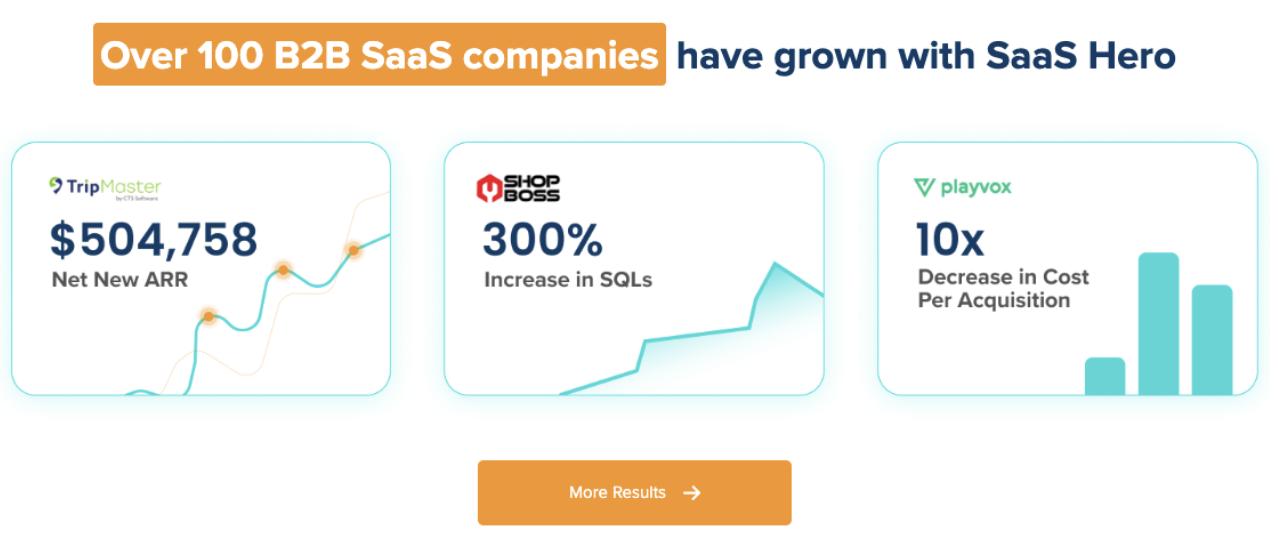
SaaSHero client results show how structured optimization compounds over time. Shop Boss reached a 305% conversion increase by combining competitor conquest pages with streamlined CTAs. TripMaster added $504,758 in Net New ARR after implementing heuristic CRO recommendations and mobile-first layouts.

TestGorilla’s 80-day payback period came from benefit-led headlines, above-the-fold social proof, and low-friction demo requests. PetDesk improved lead quality by 40% using industry-specific landing pages and messaging tailored to practice size.
Each of these wins shares the same foundation: clear value propositions, a single conversion goal, visible social proof, and continuous testing. Companies that hit 10%+ conversion rates treat landing pages as living products that need ongoing improvement, not static campaign assets.
SaaS Landing Page Conversion Fixes Inspired by Reddit
Reddit threads often highlight the same SaaS landing page complaints: slow load times, confusing navigation, and vague messaging. SaaSHero’s approach tackles these issues with structured CRO instead of cosmetic tweaks.
Multiple CTAs create the decision paralysis that Reddit users describe. A single primary CTA removes confusion and guides visitors toward one clear step. Mobile issues that drive high bounce rates get resolved through thumb-friendly layouts and fast-loading pages.
Generic “enterprise solution” copy gets replaced with specific, benefit-focused headlines that explain value within 5 seconds. These foundational fixes usually deliver 20-40% conversion lifts before you even add AI personalization or advanced targeting.
SaaS Landing Page Conversion Tips FAQ
What is a good B2B SaaS landing page conversion rate?
Industry benchmarks show median SaaS landing page conversion rates around 3.8%, while top performers reach 10-15%. Companies that apply modern CRO practices often hit 5-8% visitor-to-customer conversion. The gap between average and elite performance comes from systematic work on headlines, CTAs, social proof, and form friction.
Should SaaS landing pages use “Get Demo” or “Start Free Trial” CTAs?
“Get Demo” CTAs usually attract higher-quality leads and deliver roughly 2x better payback for enterprise products. “Start Free Trial” CTAs tend to work better for self-serve tools under $100 per month. Test both with your audience, while keeping a single primary CTA on each page. Mixed CTA strategies reduce conversions across segments.
How do you measure SaaS landing page ROI?
Track Net New ARR from landing page conversions instead of only counting leads. A 1% conversion lift can expand pipeline by 25-40% for many mid-market SaaS companies. Monitor visitor-to-lead, lead-to-SQL, and SQL-to-customer rates to find bottlenecks and new optimization opportunities.
Should SaaS companies hire agencies or optimize landing pages in-house?
Specialized B2B SaaS agencies usually move faster because they bring proven frameworks and testing processes. SaaSHero clients have seen 305% conversion gains and more than $500k in new ARR from structured optimization that would take months to build internally. The key is choosing a partner that understands SaaS metrics and buyer psychology.
Apply These SaaS Landing Page Practices for 20%+ Gains
The biggest wins come from three core moves: benefit-driven headlines that explain value within 5 seconds, a single primary CTA that removes decision fatigue, and strategic social proof that builds trust instantly. These basics alone often deliver 20-30% conversion lifts within a few weeks.
Start with a heuristic audit to uncover obvious blockers before heavy A/B testing. Most SaaS landing pages hide several quick wins in form simplification, mobile experience, and competitor conquest pages.