




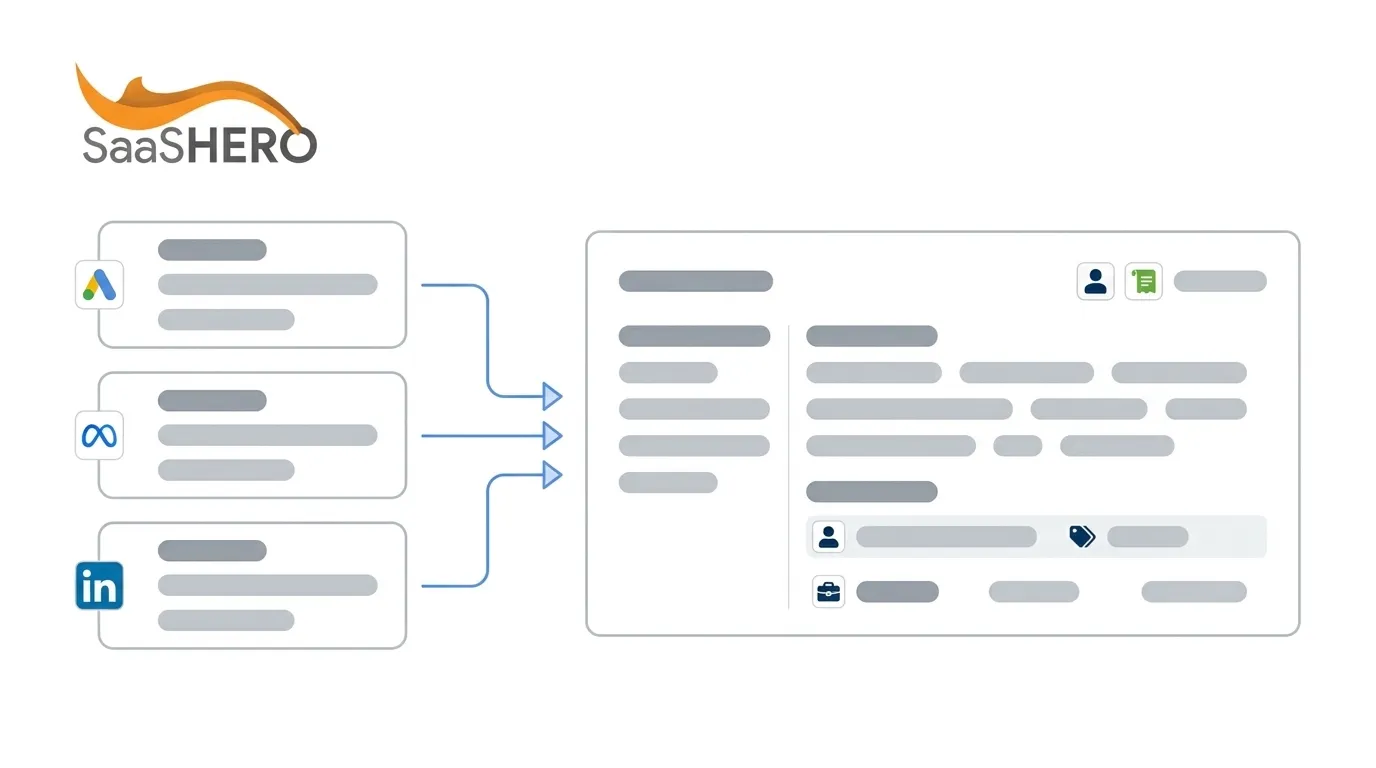
Written by: Aaron Rovner, Founder, Saas Hero
Key Takeaways
- An agency that connects ads to CRM builds a closed-loop pipeline using offline conversion uploads and lifecycle-stage events. Campaigns then optimize against qualified pipeline and closed revenue instead of form fills.
- Ad-platform automation shifted the remaining human job to data quality. Teams now define which conversion events the algorithm should pursue and ensure those events accurately proxy revenue.
- Client-side prerequisites include CRM hygiene, lifecycle-stage definitions, server-side click-ID capture, and a RevOps owner who can approve data changes before any agency can deliver results.
- The 10-question vetting framework helps buyers distinguish agencies that truly connect ads to CRM from those that still optimize on leads and CPL. The questions cover training data, reporting, landing page ownership, conversion architecture, CRM integration, staffing, offboarding, pricing, onboarding timeline, and optimization inputs.
- SaaSHero, described below, serves B2B companies that want one team to own the full path from impression to CRM record.
Book a Discovery Call with SaaSHero
The rest of this guide explains why this category exists, how the mechanism works, and how to vet agencies that claim to operate in it.
Why This Category Exists Now
Ad platforms automated the lever-pulling and left data quality as the human job. Manual bidding, keyword control, and placement selection have been absorbed by Smart Bidding, broad match, and Performance Max. Human control now narrows to two decisions: which conversion events the algorithm pursues, and how good those events are as proxies for revenue.
An optimization algorithm finds more of whatever it is rewarded for. Pointed at a form fill, it finds the people most likely to fill in forms, such as students, competitors, job seekers, and existing customers, while reporting a falling cost per conversion. Meanwhile, the measurement layer broke before the automation did. Third-party cookie restrictions, browser tracking prevention, consent requirements, and cross-device journeys each removed part of the path between a first impression and a signed contract.
B2B makes this worse. The click is recorded in Google Ads or LinkedIn, and the opportunity appears in Salesforce or HubSpot months later. Nothing joins them unless somebody builds and maintains the join. Without that, the default report is last-touch, which understates every upper-funnel channel. Boards and PE operating partners now ask in finance terms such as CAC payback and pipeline coverage, and last-touch reporting cannot answer them.
That gap is why a specialized category has formed around connecting ads to CRM. SaaSHero is one of the teams in that category. Founded in 2018, the firm has served more than 100 B2B companies and manages roughly $16 million in annual advertising spend, with more than $60 million over its lifetime. The team includes about 20 full-time specialists, including in-house designers and copywriters, with no work outsourced. SaaSHero holds Google Premier Partner status (top 3% of Google Partners) and has been a G2 High Performer in digital marketing for over two consecutive years, currently ranked #20 of approximately 6,000 agencies.

How the Mechanism Actually Works
This mechanism has four connected steps that let you evaluate agency claims with confidence.
Offline conversion uploads and conversion imports. The agency captures the click ID at landing, such as gclid for Google, fbclid for Meta, li_fat_id for LinkedIn, and msclkid for Microsoft. It then persists that ID on the CRM record and pushes the eventual sales outcome back to the ad platform via API. Google, Meta, LinkedIn, and Microsoft each receive these events and match them to the original click to feed bidding and attribution models. A setup is only considered working when ad-platform offline conversion counts match CRM closed-won counts within roughly 10%. Wider gaps mean click IDs are being lost somewhere in the pipeline.
Pushing lifecycle stage events back into the ad platforms. The auction learns from a CRM state such as MQL, SQL, or Closed Won rather than a page event. When a lead becomes a sales-qualified lead or an opportunity is created, that signal reaches the platform as the thing worth finding more of, enabling value-based bidding including tROAS and Value Optimization.
Primary versus secondary conversions. Secondary conversions such as content downloads, webinar registrations, and low-commitment form completions stay tracked and visible but are excluded from account-wide optimization. A €20 cost per form fill can hide a €555 real cost per closed deal, a 27x gap, when qualification and close rates are applied. Teams optimizing on reported CPL are therefore optimizing on a number with no relationship to actual ROI. Only primary conversions feed bidding.
Multi-touch attribution. In a long B2B cycle, last-click defunds demand creation. LinkedIn Ads earns €182,000 under first-click attribution but only €74,000 under last-click on the same revenue base, because LinkedIn opens journeys that Google brand search closes. Multi-touch is the model the data supports.
The ad platforms and CRMs where this work runs include the following:
- Ad platforms: Google Ads, Microsoft Ads, LinkedIn Ads, Meta
- CRMs: HubSpot, Salesforce, Zoho, Pipedrive
Prerequisites on Your Side Before Any Agency Can Connect Ads to CRM
Several conditions on your side must be true before any agency can connect ads to CRM effectively.
- CRM hygiene and lifecycle stage definitions that distinguish a form fill from a qualified opportunity. Without this, every number downstream is arguable. If “qualified” means something different to each rep, the ad platform learns from noise. Agreeing in writing on what “qualified” means is therefore the first prerequisite, not a formality.
- Conversion tracking rebuilt rather than inherited. This usually lives in Google Tag Manager with GA4 alongside. Inherited tracking produces numbers nobody can defend three months later. The click ID, such as gclid, fbclid, li_fat_id, or msclkid, must be captured server-side on every funnel page and stored on the CRM contact and opportunity record, not just the lead.
- Access to ad accounts, analytics, tag management, CRM, and marketing automation. Track this access on a shared sheet so nothing stalls invisibly. The contract should specify that accounts and integrations are created in the client’s name and remain the client’s property, with the agency receiving user access only.
- A RevOps or Marketing Ops owner who can approve data changes. This person serves as the technical veto and the most important ally inside the account. CRM-connected optimization does not work without this role.
- A sales team whose acceptance definitions set the optimization target. That record defines what counts as success. The Head of Sales or CRO acts as the quality arbiter and cares about whether reps are working qualified opportunities, not about cost per lead.
Without these prerequisites, the engagement degrades into form-fill counting regardless of the agency’s technical capability.
Vetting Framework: 10 Questions To Ask an Agency That Connects Ads to CRM
Use this checklist in your next agency conversation. Each question includes what a good answer sounds like and what a bad answer sounds like.
-
What is your ad platform trained on, form fills or qualified opportunities?
Good: “Qualified opportunities and lifecycle-stage events. We separate primary from secondary conversions and only primary conversions feed bidding.” Bad: “We optimize for conversions” without specifying which.
-
What does the monthly report lead with, leads and CPL or pipeline, CAC, and payback period?
Good: “Pipeline created by channel, cost per sales-qualified lead, CAC, payback period.” Bad: Leads, CPL, impression share. 71% of B2B marketing organizations cite pipeline velocity as the primary demand metric they report to executives, so your agency’s report should match what your board asks.
-
Who owns the post-click experience, and do you design, build, host, and test the landing pages your campaigns point to?

B2B Landing Pages so effective your prospects will be tripping over their keyboards to convert Good: “We design in Figma, build and host in Unbounce, and run A/B tests. We own the page.” Bad: “We recommend landing page changes and hand them to your web team.” An agency that does not own the landing page cannot optimize the full chain.
-
How do you separate primary from secondary conversions?
Good: Names the specific events excluded from optimization and explains why. Bad: Cannot name the conversion events feeding bidding.
-
Can you push lifecycle stage events back into the ad platforms, and have you done it in our CRM?
Good: Names the CRM, the stages, and the API path. Google Ads has native offline conversion import integrations for Salesforce and HubSpot; for Pipedrive and Zoho, the path runs through the Google Ads API or scheduled exports. Bad: “We can look into that.”
-
Who actually works on my account day to day, and are they employees or contractors?
Good: Names the pod, such as Senior Account Strategist, Account Coordinator, and Campaign Manager, all full-time employees. Bad: Vague about staffing or admits to a contractor bench.
-
What happens to the accounts, tracking history, and files if we leave?
Good: “You own everything. We send you the files and help with handover.” Bad: Hesitation or mention of transition fees. In B2B, the valuable asset is the conversion and lead-quality data flowing from your forms and CRM back to the platforms, and that is what breaks silently in a handover.
-
How is your fee structured, percentage of spend, per channel, or flat?
Good: Flat retainer indexed to total monthly ad spend, not channel count. Bad: Percentage of spend or per-channel pricing that makes reallocation a contract amendment. Performance-based and percentage-of-spend pricing can create conflicts because volume incentives may conflict with pipeline quality.
-
What does the first 90 days look like?
Good: Setup and campaigns live within 30 days, cutting and adjusting through day 60, validation gate at day 90. A credible engagement produces a prioritized operating backlog in days 1–30, usable evidence from structural tests in days 31–60, and an established operating cadence with pipeline-stage connections by days 61–90. Bad: Vague timeline or no defined milestones.
-
Are you optimizing campaigns around CRM data or just form submissions?
Good: “CRM data. Here is how we connect it.” Bad: Deflects or answers with platform metrics. An agency with real methodology will walk through a diagnostic process when MQLs are up but pipeline is flat; one without will jump straight to testing new creative.
The ten questions above all point to one underlying distinction: whether the agency is scoped to the ad account or to the full chain from impression to CRM record. That distinction is easier to see side by side.
CRM-Connected Agency vs. Traditional PPC Agency
A traditional PPC agency is scoped to the ad account. The landing page belongs to the client, the CRM to RevOps, and the conversion definitions to whoever configured the tag manager. Performance is set by the weakest link in the chain, and the scope boundary runs through the middle of it. Per-channel pricing holds that boundary in place. Testing a new channel raises the client’s fee before it has returned anything, and moving budget off one reduces what the agency bills.
A CRM-connected agency owns the chain from impression to CRM record. It designs, builds, and tests the landing pages its campaigns point to. It separates primary from secondary conversions. It pushes lifecycle stage events back into the ad platforms. It reports on pipeline, CAC, and payback period rather than leads and CPL. A flat retainer indexed to total monthly ad spend means recommending a channel shift or a new test does not raise the client’s fee.

The table below summarizes how the two models differ across the four attributes that matter most in a buying decision.
| Attribute | Traditional PPC Agency | CRM-Connected Agency |
|---|---|---|
| What the ad platform is trained on | Form fills, all weighted equally | Qualified opportunities and lifecycle-stage events |
| What the monthly report leads with | Leads, CPL, impression share | Pipeline, CAC, payback period |
| Who owns the post-click experience | The client, or nobody | The agency, as a condition of accountability |
| How the fee responds to channel mix changes | Rises when a channel is added, falls when one is dropped | Unchanged, indexed to total monthly ad spend |
Red Flags
Disqualify an agency that exhibits any of the following traits.
- Claims CRM integration but only does lead-gen forms with no lifecycle stage mapping
- Does not own landing pages and instead recommends changes and hands them to your web team
- Reports platform metrics rather than pipeline, CAC, and payback period
- Cannot name the specific conversion events feeding bidding
- Holds accounts, tracking history, or creative files at offboarding
- Uses per-channel pricing that makes reallocation a contract amendment
- Uses vague attribution language or refuses to discuss the limitations of their model
- Provides no named reference clients who have worked with the agency for two or more years
Those red flags assume you need an agency at all. In some setups, you do not.
When You Do Not Need an Agency
Google Ads has native offline conversion import integrations for Salesforce and HubSpot, and HubSpot’s native Google Ads integration triggers offline conversion imports based on Deal Stage changes. Google’s offline conversion import also supports Pipedrive and Zoho through its documented CRM list.
If you run a single platform with a stable motion and have in-house engineering capacity, a native integration or a lightweight tool may be sufficient. A managed attribution platform becomes advisable in three situations: multi-platform setups, multiple trigger sources, or high-ticket use cases where every lost conversion is a $5,000+ miss. An in-house hire is the right call when spend sits in one platform and you have the paid-media fluency to manage and develop them. This guide is written for buyers who have crossed that threshold and need a partner who owns the full chain.
Frequently Asked Questions
Can Meta Ads Be Integrated With a CRM System?
Yes. Meta receives offline events through the Conversions API. The click ID (fbclid) is captured at landing, stored on the CRM record, and pushed back when the deal closes or a lifecycle stage changes. Meta requires at least one match key, such as hashed email, hashed phone, external ID, or fbclid, and three or more match keys score higher on Event Match Quality. Meta’s legacy standalone Offline Events tool was deprecated through 2025, and all new offline event pipelines use the CAPI endpoint. The CRMs listed earlier, including HubSpot, Salesforce, Pipedrive, and Zoho, all have documented support, and ActiveCampaign is also supported.
What Is the Best CRM for an Advertising Agency To Connect To?
The best CRM is the one your sales team already uses. HubSpot and Salesforce have the most mature native integrations with ad platforms. HubSpot’s native Google Ads integration handles GCLID capture automatically through HubSpot’s tracking code, and Salesforce has a native Google Ads connector that maps Opportunity Stage to a conversion action. Zoho and Pipedrive work through the Google Ads API, scheduled exports, or middleware. The CRM is the system of record, and the agency should operate inside it, not replace it. Changing CRMs to accommodate an agency is a red flag.
How Do I Tell If an Agency Actually Connects Ads to CRM?
Ask what the ad platform is trained on. If the answer is form fills, the agency does not connect ads to CRM in any meaningful sense. Ask what the monthly report leads with. If it focuses on leads and CPL, the agency does not connect the full chain. Ask who owns the landing page. If the answer is you, the agency cannot optimize the full chain. Ask them to name the specific conversion events feeding bidding and the CRM stages mapped to each. An agency that cannot answer those questions in a discovery call will not answer them in month seven of an engagement either.
What Does CRM-Connected Paid Media Work Cost, and How Is It Priced?
Pricing varies by model. Some agencies charge a percentage of spend, which creates a structural conflict when recommending budget changes, because the agency earns more when the budget grows regardless of whether it should. Others charge per channel, which makes reallocation a contract amendment and discourages testing new placements. A flat retainer indexed to total monthly ad spend decouples the fee from the channel mix, so the recommendation and the invoice move independently. SaaSHero’s Growth Team starts at $4,000 per month, scaling with total monthly ad spend under management rather than channel count. At the $15,000+ monthly spend level this guide addresses, the engagement sits above that floor.
How Long Before CRM-Connected Optimization Produces Measurable Results?
Expect a data accumulation phase. Google recommends a minimum of 30 offline conversions per month for Smart Bidding to learn effectively, and closer to 50 per month for tROAS bidding. Revenue-based bidding typically requires 60 to 90 days from when offline data starts flowing before the bidding model stabilizes. Lead quality typically starts improving in weeks two to three after offline conversion tracking is live, with cost per closed deal falling over months two to four. The first 30 days are setup, and the first 90 days are the validation gate. An engagement judged at day 45 is being judged on its setup, not its results.

Conclusion and Next Steps
An agency that connects ads to CRM builds the join between ad platforms and your CRM, so campaigns optimize against qualified pipeline and closed revenue. The mechanism runs on offline conversion uploads, lifecycle stage events pushed back into ad platforms, a primary-versus-secondary conversion architecture, and multi-touch attribution. The connection only works if your CRM hygiene, conversion tracking, and lifecycle stage definitions are ready on your side before the engagement begins.
Use the ten-question checklist in your next agency conversation and ask for a complimentary audit as a work sample. SaaSHero is the outsourced inbound growth team for B2B companies that owns the whole chain from impression to CRM record, optimizing against qualified pipeline, lifecycle stage, and closed revenue rather than the conversion counts the ad platforms report back.