




Written by: Aaron Rovner, Founder, Saas Hero | Last updated: August 27, 2026
Key Takeaways
- B2B SaaS advertising agencies must connect ad platforms to CRM pipeline events rather than form fills to drive real revenue outcomes.
- Post-click ownership of landing pages and conversion rate optimization is essential for agencies to own the full path from impression to qualified pipeline.
- Flat-fee structures indexed to total spend eliminate agency incentives that conflict with client budget decisions.
- Agencies should implement a three-stage Demand Creation Framework (awareness, consideration, conversion) instead of collapsing the sequence into single-step conversion campaigns.
- Verify these requirements in any agency proposal and schedule a discovery call with SaaSHero to assess how your current account measures against these standards.
Why Form-Fill Optimization Systematically Fails B2B SaaS
Most B2B SaaS paid media programs fail because platforms are trained on the wrong outcome. Modern Smart Bidding is goal-seeking by design. Pointed at a form fill, it finds people most likely to complete forms, including students, competitors, job seekers, and existing customers. Lead volume rises, cost per lead falls, and dashboards improve in the metrics that look good in a slide deck. Pipeline does not move.
70% of B2B companies get attribution wrong, and average B2B sales cycles often run six to nine months. A 30-day attribution window on a six-to-nine-month cycle captures only the final portion of the buyer journey. That window systematically undervalues every channel that built awareness in the first six months. 67% of B2B teams still rely on last-touch attribution, which assigns credit to the branded search that fired after the buying decision was already made.
Incentives often reinforce this measurement failure. An agency optimizing to form fills has no structural reason to care whether those forms convert to pipeline. It reports a falling cost per conversion and calls the quarter a success. The VP of Marketing rebuilds the board deck by hand from three systems that do not agree. The argument about lead quality between marketing and sales restarts on schedule.
Attribution theater, where platform-attributed last-touch data overstates performance, is a structural reason agencies miss revenue targets. A typical deal at the $7M ARR stage involves 14–22 touches across 5–8 surfaces from 3–5 buying committee members over 90–140 days. Last-touch attribution cannot describe that journey. It describes only its final step.
The Three Non-Negotiable Requirements
To solve these measurement and incentive failures, agencies must meet three operational requirements that change how performance is tracked and rewarded. These requirements separate a true performance partner from an agency that only manages ad accounts. Each is verifiable before a contract is signed.
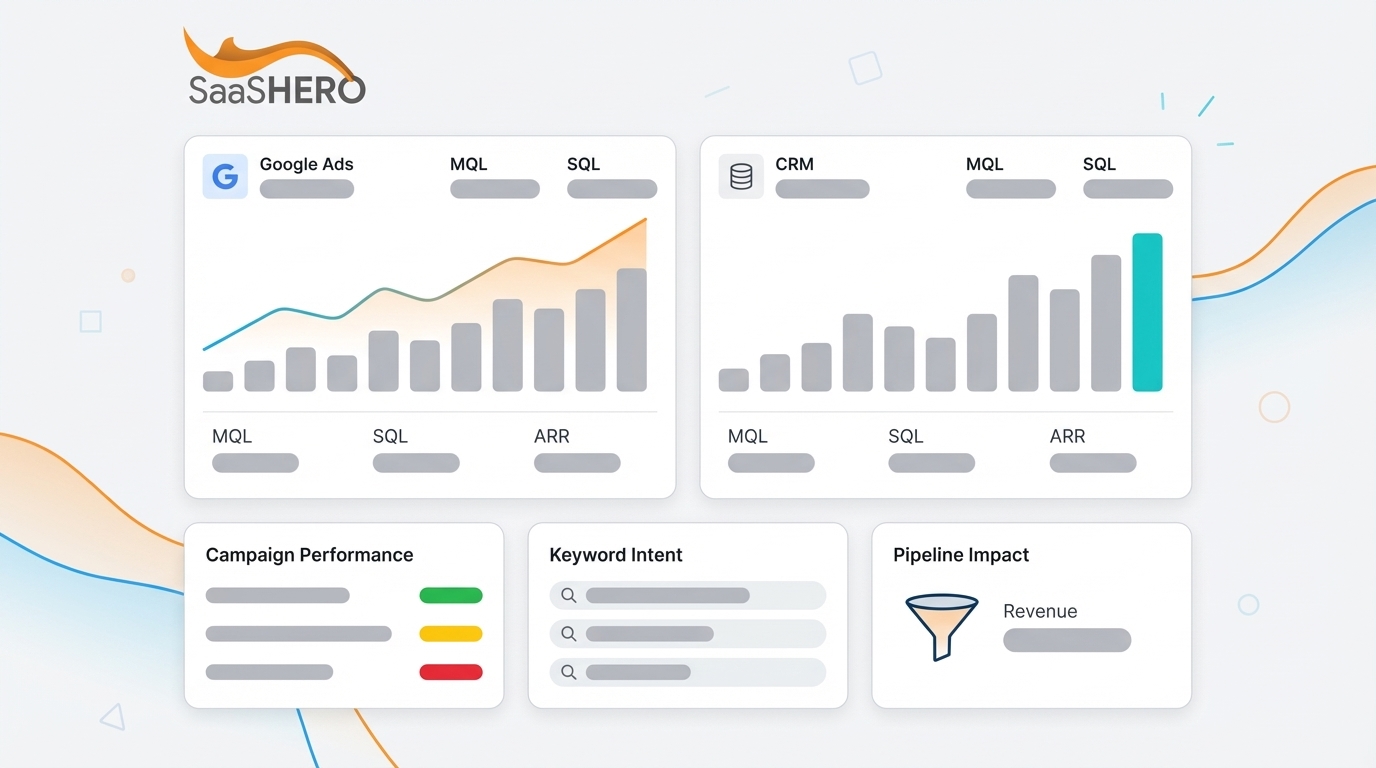
CRM-connected measurement means ad platforms are trained on qualified pipeline events such as SQLs, opportunities, and closed-won deals rather than raw form submissions. SaaS companies importing offline conversions with value-based bidding generate 3× more pipeline at 31% lower cost per lead than those optimizing toward form fills. This setup requires offline conversion imports via the CRM, a primary-versus-secondary conversion hierarchy that excludes low-quality events from account-wide bidding, and lifecycle-stage events pushed back into the ad platforms so the algorithm learns from revenue outcomes. Feeding SQL and closed-won signals back to Google via offline conversion tracking typically improves SQL volume by 30–50% at the same spend.

Post-click ownership means the agency designs, builds, hosts, and tests the landing pages its campaigns use. An agency responsible only for the ad account cannot change the headline, which is the highest-leverage variable on a landing page. It also cannot change what the CRM counts as qualified. Agencies that treat channels as point solutions force the client to become the integration layer, which prevents coordinated pipeline generation. Conversion rate multiplies every other improvement in the account. A higher landing page conversion rate changes the economics of every keyword and audience that feeds it.

Flat-fee structure indexed to total spend means the agency’s revenue does not rise when the client’s budget rises and does not fall when a channel is cut. A flat monthly retainer detaches the agency’s income from the client’s ad budget, which allows recommendations to raise, cut, or reallocate spend without financial upside or downside for the agency. Per-channel pricing produces the opposite effect. Every test of a new channel raises the client’s invoice before it returns anything, and moving budget off a channel reduces what the agency bills. Budget then calcifies where it was first placed, long after the opportunity has moved.
SaaSHero satisfies all three requirements as a structural condition of every engagement, not as an optional add-on. Schedule a call to audit whether your current agency meets these three requirements or where gaps are costing you pipeline.
Sequencing Paid Social: Demand Creation vs. Demand Capture
Most B2B paid social programs fail because they collapse a three-stage sequence into a single step. Nobody goes to LinkedIn to buy software. People go to Google to find software. Running conversion campaigns against cold ICP audiences on LinkedIn reflects a sequencing failure, not a LinkedIn failure.
The Demand Creation Framework runs in three stages, each with a defined audience, message, optimization goal, and explicit exclusions. The full arc is planned before launch so that a prospect who engages but does not convert has a defined next step.
- Awareness: Cold ICP audiences who have never encountered the company. Messaging addresses operational pain the person recognizes in their own week, not product features or demo CTAs. The optimization goal is engagement such as clicks, video views, and landing page visits. The job is to build a warm pool large enough to fund the next stage. Conversion campaigns are explicitly excluded.
- Consideration: Retargeting pools built from stage-one engagement. Nobody enters this stage cold. Messaging introduces solutions, case studies, frameworks, and social proof, which were withheld in awareness. The optimization goal is traffic and content consumption, not form fills. Optimizing toward conversions here pulls the audience toward whoever converts fastest, which is a different and smaller group than the one being built.
- Conversion: Warm audiences only, fed entirely by the previous two stages. Messaging addresses outcome and business impact. The optimization goal is demo requests, SQLs, and pipeline creation. Pipeline is a fair measure only here, and only because the two prior stages did their work. No new cold audiences are introduced.
Collapsing this sequence by running conversion campaigns against cold audiences produces misleading results. The channel appears ineffective when the real problem is that the ask arrived three steps ahead of the person. Channel concentration often drops at higher ARR stages, so demand creation upstream becomes structurally necessary as a company scales.
Building a Conversion Hierarchy: Primary vs. Secondary Conversions
The conversion hierarchy defines what the ad platform is allowed to learn from. Secondary conversions such as content downloads, webinar registrations, and low-commitment form completions are tracked and visible in reporting but are never used for account-wide bidding. These events show interest but do not prove buying intent. Treating them as bidding signals trains the account toward the wrong audience.
Primary conversions are the events that represent genuine buying intent. These include demo requests from business email addresses, sales-qualified leads, opportunities created, and closed-won deals imported from the CRM. The mechanics of this approach, detailed in the conversion hierarchy below, typically show ROI improvements within 90 days as the algorithm learns from revenue events rather than raw form fills.
The recommended value ladder for B2B SaaS assigns MQLs at 1–2% of average ACV, SQLs at 5–10%, Opportunity Created at 15–25%, and Closed-Won at 100% of actual deal value. This structure teaches Smart Bidding to prioritize higher-revenue outcomes. The campaign flow map, a collaboratively built visual of campaign structure, audience segmentation, landing pages, conversion paths, and retargeting sequences, makes this hierarchy legible to the client and auditable before spend.
A practical CRM requirement for this architecture is to capture on every opportunity the first-touch source, first-touch campaign, last-touch source, and influence touches. This four-field schema can be configured in a day on HubSpot or Salesforce and enforced through required forms and weekly pipeline-review gates.
How to Evaluate an Agency Proposal
A proposal from a B2B SaaS advertising agency should be evaluated against four validation areas that collectively verify the three non-negotiable requirements outlined earlier.

- Conversion architecture: Start by asking which conversion events will be used for account-wide bidding and which will be tracked only. If the answer is a single form-fill event, the agency is optimizing to the wrong signal. This is why the next question matters. Ask whether offline conversion imports from the CRM are part of the standard setup or an optional add-on, because that determines whether the agency can train platforms on revenue outcomes.
- Post-click scope: Next, ask who owns the landing pages the campaigns will use. If the answer is the client’s web team or a separate contractor, the agency cannot be held accountable for the full path from impression to conversion. Follow by asking whether landing page design, copy, build, hosting, and A/B testing are in-scope or out-of-scope so you know who owns each step.
- Fee structure: Then ask whether the retainer changes when a channel is added, removed, or reweighted. A fee indexed to channel count creates a structural conflict on every budget reallocation decision. Also ask whether the agency takes a percentage of media spend, because that ties agency revenue directly to your budget level.
- Reporting surface: Finally, ask where the reporting lives and what metrics it leads with. Platform-only dashboards that report impressions, clicks, and cost per lead are not board-ready. CRM-connected dashboards that report pipeline by channel, cost per SQL, and CAC payback are built for executive decisions.
Red Flags in Agency Reporting
Platform-only metrics are the most common red flag in agency reporting. A monthly report that leads with impressions, click-through rate, and cost per lead describes activity, not outcomes. It cannot answer whether the spend produced pipeline, and it cannot be presented to a board without translation.
Last-touch attribution is a structural distortion at B2B sales cycle lengths. Algorithmic multi-touch models can deliver higher accuracy than rule-based approaches for long B2B sales cycles. As noted earlier, this approach credits the final touchpoint, typically branded search, while ignoring the channels that created demand over the preceding months.
Missing CRM fields are a data discipline problem that no attribution tool fixes. If 95% completion on first-touch source, first-touch campaign, last-touch source, and influence touches cannot be achieved, the organization has a CRM discipline problem, not an attribution problem. An agency that does not ask about CRM field completion during discovery is not planning to connect its work to revenue.
Board-Ready Metrics That Actually Matter
Four metrics translate paid media performance into the vocabulary a CFO and board use to evaluate a channel.
- CAC payback period: Calculated as total sales and marketing expenses divided by net new MRR acquired multiplied by gross margin percentage. The industry median is 15–18 months, and top-quartile performers recover costs in under 12 months. Under 12 months is the threshold SaaSHero holds accounts to.
- Pipeline coverage by channel: Healthy 2026 B2B SaaS and B2B benchmarks show marketing-sourced pipeline at 25–45% of total pipeline, with marketing-influenced pipeline at 60–85%. Reporting both separately prevents undervaluing marketing by 20–40 percentage points.
- Cost per SQL: This metric connects ad spend to sales-accepted outcomes. Cost per lead is a proxy and a poor one. Cost per SQL reflects the sales team’s acceptance rate and shows what the channel truly delivers.
- LTV:CAC ratio: A ratio of 3:1 is the standard threshold for a healthy SaaS acquisition channel. Below 3:1, the channel consumes more value than it returns over the customer lifetime.

CRM-connected dashboards built in Looker Studio alongside HubSpot or Salesforce reporting can surface all four metrics without manual reconciliation. The reporting the marketing leader presents to the board matches the view the agency works from, not a PDF assembled the week before the meeting.
Frequently Asked Questions
How long does setup typically take before campaigns are live?
The first month of a SaaSHero engagement covers onboarding, conversion tracking configuration, CRM integrations, campaign architecture, audience construction, and creative and landing page production, including the client approval cycle. Campaigns go live with real data inside the first 30 days. The first meaningful optimization cycle runs between days 31 and 60, when underperformers are cut, audiences are adjusted, and budget moves toward what is working. Day 90 is the first point at which there is enough clean data to evaluate the channel, the structure, and the messaging thesis on outcomes rather than activity. Weekly performance updates run from the first week, so the client is never waiting to hear what is happening.
What internal team roles are required on the client side?
The engagement is designed for a marketing team of two to four people with no paid media specialist on staff. SaaSHero requires a detailed onboarding document covering customers, competitors, positioning, and messaging; access to ad accounts, analytics, tag manager, and CRM; and one person empowered to approve creative and messaging without routing through a committee. Ongoing, the client’s presence on bi-weekly strategy calls and timely approvals are the primary inputs. Approval latency is the most common factor that slows an account down. RevOps or Marketing Operations is a critical internal ally because CRM-connected optimization requires someone on the client side who owns lifecycle stage definitions and routing rules. The Head of Sales or CRO is the quality arbiter whose acceptance definitions set the optimization target.
How does the model adapt for companies at the lower versus upper end of the $10M–$50M ARR range?
At the lower end of the range, closer to $10M ARR and $15,000 in monthly ad spend, the engagement typically starts with a single validated channel, usually paid search, and uses a phased approach to prove the conversion architecture before expanding to paid social. The primary conversion set may start with demo requests and mature toward SQL and opportunity imports as CRM data volume builds. At the upper end, closer to $50M ARR with higher monthly spend, the account is more likely to require multi-product or multi-segment campaign architecture, a more mature conversion hierarchy with value-based bidding, and demand creation running in parallel with demand capture from the start. The fee scales with total monthly ad spend under management, so the scope of work adjusts without a contract renegotiation. The frameworks, including the Demand Creation Framework, the primary-versus-secondary conversion hierarchy, and the campaign flow map, apply the same way at both ends. What changes is the complexity of the implementation and the maturity of the CRM data feeding it.
Why does post-click ownership matter if the landing page already converts reasonably well?
A landing page that converts reasonably well still deserves structured testing. Headline copy is the highest-leverage variable on a landing page, and a page that has not been tested in the past year has an unknown ceiling. More importantly, post-click ownership makes the agency accountable for the full path from impression to CRM record. An agency that does not control the landing page cannot be held responsible for what happens after the click, cannot change the message when campaign data suggests a different angle, and cannot diagnose whether a drop in pipeline is a traffic problem or a conversion problem. Conversion rate multiplies every other improvement in the account. A 20% lift in landing page conversion rate changes the economics of every keyword and audience feeding it, permanently, not as a one-time gain.
What happens to accounts, data, and files if the engagement ends?
Everything built during the engagement belongs to the client throughout it and at the end of it. Ad accounts, conversion tracking configurations, landing page files, design files in Figma, creative assets, Looker Studio dashboards, and all documentation remain the client’s property. SaaSHero operates inside the client’s own accounts rather than agency-owned accounts, so the historical data, account structure, and optimization history stay with the business that paid for them. Offboarding is treated as a normal event. Files are transferred and the handover is supported. The client owns the measurement history, which means a successor agency or internal team inherits a functioning attribution architecture rather than starting from scratch.
Conclusion
The gap between a B2B SaaS advertising agency that manages ad accounts and one that owns the full path from impression to CRM revenue is a structural gap, not a gap in effort or intent. Form-fill optimization remains the default because it is easy to measure, easy to report, and easy to defend until the board asks about pipeline. CRM-connected measurement, post-click ownership, and a flat-fee structure are the three requirements that close this structural gap. Each is verifiable before a contract is signed, and none is optional if the goal is board-ready numbers rather than platform metrics.
SaaSHero was built to satisfy all three requirements as a condition of every engagement, not as a premium tier or an optional add-on. The team owns strategy, execution, and optimization across paid media, creative, landing pages, attribution, and reporting. All work is aligned to CRM outcomes rather than form-fill counts, under a single flat retainer that does not move when the channel mix does.