




Written by: Aaron Rovner, Founder, Saas Hero | Last updated: September 3, 2026
Key Takeaways
- Affordable Google Ads agencies often charge flat monthly retainers starting at $500–$1,000. These low-cost options usually cover click management only and exclude landing page ownership and CRM integration.
- Percentage-of-spend pricing creates a structural conflict of interest. Flat retainers indexed to total ad spend align agency incentives with client revenue goals.
- For B2B SaaS companies spending $15,000 or more each month, a growth partner that owns the full funnel (ads, landing pages, CRM reporting) typically charges $4,000–$15,000 per month.
- Key red flags include percentage-of-spend pricing without performance clauses, lack of landing page ownership, reporting limited to platform metrics, and long-term contracts without accountability measures.
1. What “Affordable” Really Means: 3 Pricing Models Explained
Google Ads agency pricing falls into three models. Each has a different incentive structure, and that structure determines whose interests the fee serves. The table below summarizes the three models and their typical costs.
| Model | How It Works | Typical Cost | Best For |
|---|---|---|---|
| Percentage of Ad Spend | Agency charges 10–20% of monthly media budget | At $15,000 monthly ad spend, typical percentage-of-spend Google Ads management fees range from $1,500 to $3,000 per month (based on 10–20% of spend), not $5,000+. | Agencies; creates conflict of interest |
| Flat Monthly Retainer | Fixed fee regardless of spend level | Typical flat monthly retainers for Google Ads agencies in 2026 range from $1,500 to $5,000 for most small-to-mid engagements. Lower-cost options (around $500–$2,500) are available from freelancers or for small accounts, while enterprise retainers can reach $10,000–$25,000+ per month depending on scope. | Clients who want predictable costs |
| Performance-Based | Fee tied to leads or revenue generated | Variable; often combined with a base fee | High-volume, transactional campaigns |
As the table shows, the conflict of interest in percentage-of-spend models is structural and baked into the pricing. When an agency earns more as the budget grows, every recommendation to scale carries an undisclosed financial interest. Flat retainers align incentives better because the agency can recommend cutting spend or pausing a channel without taking a pay cut.
For B2B SaaS, a flat retainer indexed to total ad spend, not channel count, is the most transparent and flexible model. This structure allows channel testing without fee increases. That flexibility matters when the right move is to shift budget from LinkedIn to Google or to test Meta before committing to it.
2. Real Pricing Benchmarks for “Affordable” Google Ads Agencies
The low end of the market is well-populated. Published rates from agencies marketing themselves as affordable options include entry points around $300–$500 per month, such as $300 (Bearded Digital), $499 (Third Marble), and $500 (AdShot Media, Maxx Effect). These rates reflect a specific scope: campaign management inside the ad platform, with no ownership of landing pages, conversion rate optimization, or CRM integration.
| Agency | Published Starting Price | What's Included at Entry Level |
|---|---|---|
| Morneto | Not publicly disclosed | Ad account management; no landing pages or CRM integration stated |
| RIOT | Not publicly disclosed | Ad account management; no landing pages or CRM integration stated |
These low-cost options focus on click management. They do not include landing page design, conversion rate optimization, or CRM-connected reporting. For a B2B SaaS company with a multi-month sales cycle, those missing pieces are where most of the value disappears.
For a B2B SaaS company spending $15,000 or more per month, a growth partner that owns the entire funnel, from ads to landing pages to CRM reporting, will typically charge a flat monthly retainer of $8,000–$15,000. Focused single-channel engagements usually start around $4,000–$8,000. That investment is justified by revenue accountability, because the agency is optimizing toward pipeline, not form fills.
SaaSHero’s Growth Team starts at $4,000 per month, with the retainer indexed to total monthly ad spend rather than channel count.
3. Minimum Ad Spend Requirements and What They Signal
Many Google Ads agencies require a minimum monthly ad spend, with common minimums ranging from about $2,000 to $10,000 per month depending on the agency tier. Some agencies set minimums as low as $1,000 or as high as $25,000. For B2B SaaS, a higher minimum often signals a more sophisticated agency that needs sufficient data volume for the optimization algorithms to learn from meaningful conversion events.
Agencies with no minimum spend requirement may lack experience with complex B2B funnels, where the gap between a form fill and a sales-qualified lead can span months and multiple touchpoints. Without enough data volume, Smart Bidding has nothing useful to learn from, and the account trains itself on noise.
A practical threshold emerges from these dynamics. If monthly ad spend is under $5,000, a freelancer or DIY approach may be more cost-effective because Smart Bidding has limited data to work with. At $15,000 or more per month, the complexity of a B2B funnel, including buying committees, multi-month cycles, and CRM attribution, requires an agency that can optimize to CRM data, not just form submissions.
4. 5 Red Flags That Signal a Weak Google Ads Agency
Complaints from B2B marketing leaders who have been burned by agencies follow a consistent pattern. Each red flag below points to a structural problem, not a personnel issue.
- Percentage-of-spend pricing with no performance clause. The agency earns more when the budget grows, regardless of whether pipeline grows with it. Ask how the fee changes if you reduce spend.
- No ownership of landing pages. An agency that cannot change the page its ads point to cannot control the most impactful variable in conversion rate. Landing page ownership matters because headline copy is the single largest lever on performance, and the agency needs access to move that lever.
- Reporting in platform metrics only. Impressions, clicks, and cost per lead are not pipeline. An agency that reports on these without connecting them to CRM outcomes is optimizing toward the wrong goal. As one marketing leader put it: “My agency charged me a high fee but didn’t even look at my CRM data. They just reported on clicks.”
- Long-term contracts with no performance clauses. A twelve-month lock-in without defined success criteria protects the agency and leaves the client exposed. Ask what happens if pipeline targets are missed.
- Hidden setup fees. A setup fee is not inherently a red flag. A fee that appears after the proposal is signed is a problem. Ask for all fees in writing before engaging.
5. How to Vet an Agency: A 6-Step Checklist for B2B SaaS
A structured evaluation process separates agencies that can execute from those that can only present. Use these questions on every discovery call.
- “How do you define a conversion?” The answer reveals whether the agency optimizes toward form fills or toward qualified pipeline. An agency that cannot distinguish primary from secondary conversions is training the ad platform on the wrong signal.
- “Do you own the landing pages?” If the answer is no, ask who does and how quickly changes can be made. A page that cannot be tested keeps conversion rate flat.
- “Are you optimizing campaigns around CRM data or just form submissions?” This question is the most important in the evaluation. It separates agencies that manage clicks from agencies that own revenue outcomes.
- “What is your reporting cadence, and what does the report contain?” Board-ready reporting shows pipeline, cost per sales-qualified lead, and CAC payback. Reports that lead with impressions and click-through rates focus on activity, not outcomes.
- “What happens if we want to leave?” The answer should state that all accounts, assets, and files belong to the client and transfer immediately. An agency that holds accounts hostage has stopped relying on its results.
- “Are you a Google Premier Partner?” Premier Partner status is held by the top 3% of Google Partners, and it is a verifiable credential, not a self-reported claim. Ask for confirmation.
6. When Freelancers or DIY Management Make Sense
A freelancer or DIY approach fits specific conditions. Monthly ad spend sits under $5,000, campaigns stay concentrated in a single platform, and a marketing leader has enough paid media fluency to audit the work. For a defined project such as an account audit, a campaign rebuild, or a tracking implementation, a strong contractor is often the right choice.
The limitation appears in coverage and in the seams between disciplines. A search contractor, a design contractor, and an analytics contractor can each produce a competent deliverable. Nobody owns the outcome. Tracking has to match the landing page, and messaging has to match the campaign. Neither belongs to anyone unless one party is accountable for the whole account.
For B2B SaaS companies scaling past $15,000 per month, a freelancer can manage bids, but someone still has to write the ad copy, design the landing page, connect the CRM, and ensure the conversion event feeding Smart Bidding is a qualified opportunity rather than a newsletter signup. Those are five separate disciplines, and very few individuals are strong in all of them.
7. How to Measure Success: 5 KPIs That Matter for B2B SaaS
Cost per click is a vanity metric. It measures the efficiency of getting someone to a page, not the efficiency of turning spend into revenue. For B2B SaaS, the KPIs that determine whether a paid program is working sit further down the funnel.
- Cost per qualified lead. This is the cost to generate a lead that meets the ICP criteria and is accepted by sales. The focus stays on cost per lead the sales team will actually work.
- Cost per opportunity. This is the cost to generate a sales-accepted opportunity in the CRM. It connects ad spend directly to pipeline.
- Pipeline created by channel. This is the dollar value of opportunities attributable to each paid channel, measured in the CRM rather than the ad platform. Boards care about this view.
- CAC payback period. This metric shows how many months of revenue are required to recover the cost of acquiring a customer. Under 12 months is a strong benchmark for B2B SaaS.
- LTV:CAC ratio. This ratio compares customer lifetime value to customer acquisition cost. A 3:1 ratio is generally considered healthy for SaaS.
A good agency reports on these metrics as a matter of course, not on request. If the monthly report leads with impressions and click-through rates, the agency is reporting on its own activity rather than on the client’s business outcomes.
8. How SaaSHero Maps to These Criteria for B2B SaaS
When you apply these criteria to a specific agency, the differences become concrete. Consider how SaaSHero measures up. The firm is a Google Premier Partner, a status referenced earlier in the vetting checklist, and has been a G2 High Performer in the digital marketing category for over two years, currently ranked #20 out of approximately 6,000 agencies. It has managed over $60 million in lifetime ad spend for B2B SaaS companies.
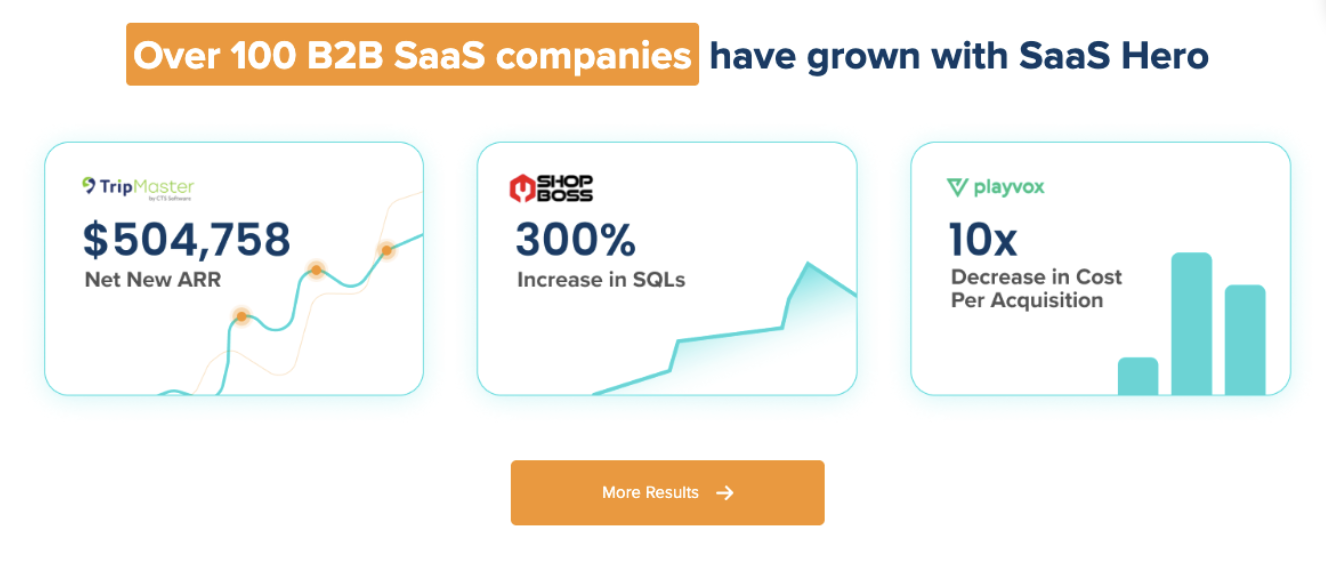
The commercial model is structured to remove the conflicts that make many agency relationships expensive in practice. The retainer is flat and indexed to total monthly ad spend, not channel count. Adding a channel, moving budget between platforms, or pausing something that is not working does not change the fee. The recommendation and the invoice stay decoupled.
The scope covers what many agencies leave to the client. The team handles paid media strategy and management across all major channels, creative produced end to end by in-house designers and copywriters, landing page design and A/B testing, and CRM-connected reporting that shows pipeline and CAC payback instead of clicks. Nothing is outsourced, and all team members are full-time employees.

The optimization target focuses on CRM outcomes such as qualified pipeline, lifecycle stage, and closed revenue. This focus creates a structural difference between an agency that manages clicks and a growth partner that accepts revenue accountability.

B2B SaaS companies spending $15,000 or more per month on ads and needing a partner who owns the entire funnel can speak with SaaSHero about that model.
9. FAQ: Common Questions About Affordable Google Ads Agencies
How much does a Google Ads agency cost?
Google Ads agency pricing spans a wide range depending on scope and model. Entry-level agencies marketing themselves as affordable options charge flat monthly fees starting around $300–$1,000 per month for basic ad account management. For B2B SaaS companies with $15,000 or more in monthly ad spend that need a partner owning landing pages, creative, and CRM-connected reporting, a comprehensive growth team retainer typically runs $8,000–$15,000 per month, with focused single-channel engagements starting around $4,000–$8,000. Percentage-of-spend agencies charge 10–20% of the monthly media budget, which at a $15,000 spend translates to $1,500–$3,000 per month, with a built-in incentive to grow the budget regardless of results.
Is $500 a month enough for Google Ads management?
For a simple, single-platform campaign with a small budget and a short sales cycle, a $500 per month management fee may be sufficient. For B2B SaaS companies with a multi-month sales cycle, a buying committee, and a CRM, that fee level usually signals a narrow scope. At that price point, the work almost always stays limited to ad account management only, with no landing pages, no creative, no CRM integration, and no attribution work. The missing pieces are where most of the value is lost in a B2B paid program. A $500 management fee on a $15,000 monthly ad spend becomes a false economy if the account is optimizing toward form fills instead of qualified pipeline.
What is a fair agency fee for Google Ads?
A fair fee reflects the scope of accountability the agency accepts. For click management only, including campaign setup and bid adjustments inside the ad platform, $500–$1,500 per month is a reasonable market rate. For a mid-market Google Ads growth partner that owns the full funnel, including ads, landing pages, and CRM reporting, and is accountable to pipeline rather than form fills, premium-tier management fees of roughly $4,000–$8,000+ per month reflect the scope, though fees vary widely by agency tier and ad spend. The key question is whether the agency is accountable for the outcome the fee is supposed to produce.
Should I use a percentage-of-spend agency?
Percentage-of-spend pricing creates a structural conflict of interest because the agency earns more when the budget grows, regardless of whether results improve. Every recommendation to scale carries an undisclosed financial interest, and every recommendation to cut spend reduces the agency’s revenue. For B2B SaaS companies where budget allocation decisions across Google, LinkedIn, and Meta should be made on evidence alone, a flat retainer removes that conflict. The fee stays the same whether the budget shifts, grows, or contracts, so recommendations rest on the data rather than on the invoice.
What is the difference between a cheap agency and a growth partner?
A cheap agency focuses on managing the ad account. A growth partner accepts responsibility for business outcomes. The practical difference shows up in three places. First, scope: a cheap agency stops at the click, while a growth partner owns the landing page, the creative, and the CRM connection. Second, optimization target: a cheap agency optimizes toward form fills, while a growth partner focuses on qualified pipeline and closed revenue. Third, who sets the agenda: a cheap agency waits to be told what to test, while a growth partner arrives with the next move already prepared. The cost difference between the two is real, and the cost of the wrong choice, including misdirected budget and missed pipeline, is larger.
Conclusion: Making “Affordable” Google Ads Work for B2B SaaS
Affordable Google Ads management is defined by the return on the total investment, including management fee and media spend, measured in pipeline and closed revenue rather than in clicks and form fills.
Three themes from this guide stand out. Flat retainers align incentives better than percentage-of-spend models. The scope of accountability, including who owns the landing page, who connects the CRM, and who sets the optimization target, determines whether the fee is affordable or expensive in practice. For B2B SaaS companies spending $15,000 or more per month, the agency that owns the entire funnel and reports on pipeline is the one that consistently justifies its cost.

SaaSHero is built for that engagement model, with a flat retainer indexed to total ad spend, full ownership of paid media, creative, landing pages, and CRM-connected reporting, and optimization toward qualified pipeline rather than form volume. Google Premier Partner status, a G2 ranking of #20 out of approximately 6,000 agencies, and over $60 million in managed ad spend are the verifiable credentials behind that claim.
The next step is a conversation tailored to your numbers and funnel. Visit SaaSHero’s site to discuss what revenue-accountable Google Ads management could look like for your budget, sales cycle, and pipeline targets.