




Written by: Aaron Rovner, Founder, Saas Hero
Key Takeaways
- At $50K+ in monthly Google Ads spend, the main challenge is tying campaigns to CRM revenue data while controlling post-click landing pages.
- Three screening criteria define strong partners at this tier: CRM-revenue optimization, post-click ownership, and verifiable in-house staffing.
- Flat retainers indexed to total ad spend avoid the fee conflicts that percentage-of-spend and per-channel pricing create.
- Agencies need in-house landing page design, build, and testing so pages can change as fast as campaigns, not at the pace of a client web backlog.
- SaaSHero is a B2B SaaS performance marketing agency that optimizes campaigns against CRM revenue data such as Net New ARR, builds and tests the landing pages its ads drive to, and prices on a flat monthly retainer tied to ad-spend band, though its published tiers and best-fit positioning focus on lean-stage companies spending roughly $3,000 to $10,000 per month, with entry tiers capped at $10,000 in monthly ad spend.
Book A Discovery Call With SaaSHero
Why $50K+/Month Is A Different Buying Problem
Smart Bidding and broad match have automated the lever-pulling that defined paid search management for fifteen years. What remains under human control is narrow: which conversion events the algorithm pursues, and how strong those events are as proxies for revenue. That narrow control matters more at $50K/month, because a mis-specified conversion event can train the account toward the wrong audience for a full quarter while the CRM reveals the damage only after the budget is spent. Mid-market B2B teams of two to four marketers often have sound judgment but no paid-media specialist, so nobody inside the company spots the drift in time. The multi-month B2B sales cycle also breaks last-click attribution, so budget decisions made on platform-reported data tend to defund the channels that created demand and reward the branded search that captured it.
The Form-Fill Trap: Why Your CPL Is Falling And Pipeline Is Flat
An account trained on form submissions finds students, job seekers, competitors, and existing customers while cost per lead falls and sales-accepted opportunities stay flat. The platform behaves as designed and succeeds at the goal it was given. As Daniils Visnakovs On Offline Conversion Import puts it: “A form submission isn’t a conversion in any economic sense, it’s a statement of intent. Train the bidding automation on statements of intent and you get more statements of intent, dump a pile of unqualified enquiries on sales, and pour budget into the wrong search terms.”
The fix is a primary versus secondary conversion architecture. Secondary conversions, such as content downloads, webinar registrations, and unfiltered contact forms, stay tracked and visible in reporting but sit outside account-wide optimization. Primary conversions are CRM lifecycle events such as qualified lead, sales-accepted opportunity, and closed-won revenue. Getting those events back to the ad platform is the hard part, because the platforms need enough volume to learn.
SaaSHero pushes lifecycle-stage events back into the ad platforms so the auction learns from CRM states like qualified lead and closed-won. GrowthSpree’s 2026 B2B SaaS OCI Guide sets the practitioner volume floor at roughly 30–50 offline conversions per month before Target CPA or Target ROAS can learn reliably. That volume requirement is why SaaSHero recommends importing earlier-stage events such as qualified lead and opportunity created when closed-won volume is too sparse to meet that threshold.
The symptom is consistent and recognizable. GrowthSpree’s 2026 Guide describes it as “the account looks great, cost per conversion is down quarter over quarter, the dashboards are green, and pipeline is flat or worse.” That pattern is the form-fill trap in its native habitat at the $50K+ tier.
The Fee Math At $50K+/Month: Percentage, Per-Channel, Or Flat
Three fee models dominate the market at this spend level, and their incentives diverge sharply.
Percentage Of Spend is the most common model. MoonSauce’s 2026 Google Ads Pricing Guide puts the commonly quoted range at 10%–20% of monthly ad spend, with 15% as the most-cited mid-market benchmark. At $50,000 in monthly spend, a flat 15% equals $7,500 per month. North Country Growth’s May 2026 Pricing Guide reports that enterprise accounts at $50K+/month often pay $6,000–$15,000+ per month. The upper end reflects scope that includes multiple campaign types and custom attribution work. Either way, the structural problem stays the same: the agency’s revenue rises when the client’s budget rises, whether or not efficiency improves. Cutting a wasted search term saves the client money and reduces the agency’s fee.
Per-Channel Pricing creates a second conflict with similar shape. Each additional channel carries its own fee, so testing a new placement raises the client’s invoice before it has returned anything. Budget tends to calcify where it was first placed, because moving it requires a contract amendment.
Flat Retainer Indexed To Total Ad Spend avoids these conflicts. SaaSHero’s model uses a flat monthly retainer indexed to total monthly ad spend, never a percentage of spend and never tied to channel count. The Growth Team starts at $4,000/month as the floor of a scale that rises with spend. Adding, closing, or reweighting a channel leaves the fee unchanged, so channel-mix recommendations carry no fee consequence. WebFX’s published rate card charges $4,500/month or 12% of spend, whichever is greater, at $30,001+ in monthly spend, which produces a $6,000 management fee at $50,000, per RYN Digital’s 2026 Cost Roundup.
The incentive argument in one sentence for finance: under a flat spend-indexed retainer, the agency earns the same fee whether it recommends a larger budget or a new channel, so every recommendation stands on its evidence.
Affordable Google Ads Agency: 5 Fee Models & Real Prices covers the full fee-model landscape. Google Ads Management Cost: Agency Vs In-House For B2B SaaS covers the in-house comparison in detail.
With the fee models mapped, the next question is which agencies apply them well at this tier. The list below ranks seven agencies against the three screening criteria.
Best Agencies For Google Ads Management At $50K+ Monthly Spend (2026)
The agencies below are ranked for B2B SaaS buyers at the $50K+/month tier, ordered by fit against the three screening criteria above: CRM-revenue optimization, post-click ownership, and verifiable in-house staffing. Every fee figure is market-reported from third-party sources, not an official agency quote, unless otherwise noted.
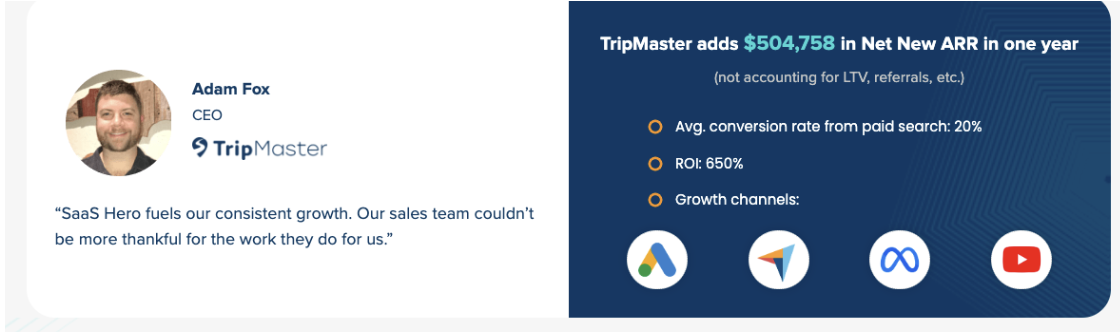
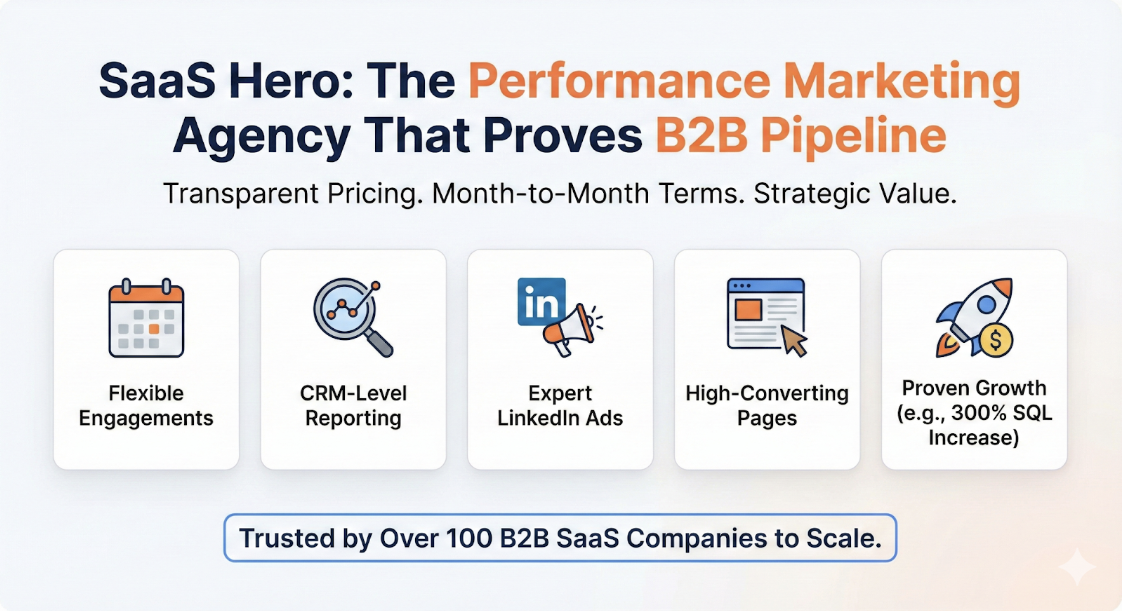
SaaSHero — Best for: B2B SaaS at $50K+/month replacing an underperforming agency. Fee posture: flat retainer indexed to total monthly ad spend, never a percentage of spend, with the Growth Team from $4,000/month (published). Staffing: approximately 20 full-time in-house specialists including designers and copywriters, with no outsourcing. Credentials: Google Premier Partner (top 3% of Google Partners) and G2 High Performer in digital marketing for 2+ consecutive years. Ranked #20 of approximately 6,000 agencies, with roughly $16M in annual and $60M+ in lifetime ad spend managed across 100+ B2B companies. Watch-out: B2B SaaS and B2B professional services only, $10M+ revenue and $15K+ monthly ad spend floors, and organic social sits outside scope.
Disruptive Advertising — Best for: account audits and wasted-spend elimination on mid-market paid search. Fee posture: bespoke, with no published anchor. Koolav’s July 2026 Review estimates retainers at roughly $4,000–$6,000/month at the low end and $8,000–$15,000+ for advertisers spending $50K+/month. Staffing: several hundred staff serving a broad mid-market to enterprise base across many verticals. Watch-out: not B2B SaaS-specialized, and Koolav’s Evaluation scores the agency weak on account ownership and seniority, with account-manager turnover repeatedly reported across review platforms. Buyers should verify the named account owner and termination terms in writing before signing. SaaSHero is the better choice for this query specifically because of SaaS exclusivity, CRM-revenue optimization with lifecycle events pushed back for bidding, in-house landing page ownership, and a fee that stays fixed when the channel mix changes.
KlientBoost — Best for: pairing paid media with landing page design and CRO where post-click conversion is the bottleneck. Fee posture: custom quote, with Feedbird’s Review placing engagement minimums at roughly $2,000–$4,000/month in fees before ad spend. Staffing: mid-market SaaS and e-commerce broadly. Watch-out: buyers report add-ons inflate the final bill 20–40% beyond the initial quote, so buyers should get add-on rates in writing before signing.
Brainlabs — Best for: multi-channel experimentation at scale, incrementality testing, and MMM calibrated to the P&L. Fee posture: Brainlabs states transparent rate cards and flexible commercial models with no published minimum spend. Staffing: large independent media agency with B2B SaaS listed as a named vertical. Watch-out: no published B2B SaaS case metrics or documented CRM-pipeline integration on its homepage, so buyers should verify those via reference call before committing.
Tinuiti — Best for: e-commerce, Shopping, retail media, and full-funnel consumer brands. Fee posture: enterprise-scale, with Seosandwitch’s 2026 Comparison reporting fees commonly at 10%–15% of spend, landing near $5,000–$7,500/month at a $50,000 budget. Staffing: 1,000+ employee owners and $4B in digital media managed. Watch-out: a stronger choice than SaaSHero for catalog-driven retail, but not for a sales-led B2B SaaS pipeline.
Directive — Best for: B2B pipeline work anchored in LTV:CAC modeling with a trusted Salesforce or HubSpot instance. Fee posture: scope-based retainer, with third-party roundups putting standard engagements at $10,000–$30,000/month and a $6,500/month startup package. Staffing: 420+ B2B brands and $150M+ in annual ad spend managed. Watch-out: priced for larger books, and some clients report the first two quarters feel expensive before results land.
JumpFly — Best for: dedicated, long-standing Google Search and Shopping specialization without generalist bloat. Fee posture: third-party reported at $50–$99/hour with project minimums. Staffing: pure PPC specialists and Google Premier Partner status. Watch-out: narrower post-click and CRM-attribution scope than a full growth team.
Who Owns The Page The Traffic Lands On
Post-click ownership is the screening criterion that quietly eliminates most agencies at this tier. An agency responsible only for the ad account cannot change the landing page headline, which SaaSHero identifies as the single most impactful lever for landing page conversions, and cannot change what the CRM counts as qualified. When the agency owns the ads and the client owns the page, performance depends on the weakest link in the chain, and the scope boundary runs through the middle of that link.
SaaSHero’s in-house model keeps that link intact. Landing pages are designed in Figma with client approval on the file itself, built and hosted in Unbounce, and A/B tested continuously, with copy written in-house by the same team running the campaigns. Headline testing is the first-order experiment because the headline is the largest conversion lever. ZenWeb’s Lead-Gen Agency Audit Data recommends requiring agency-built pages to live on the advertiser’s own domain and hosting so the page and its conversion history survive the end of the contract. SaaSHero builds pages under the client’s own accounts, and all design files and page assets belong to the client throughout the engagement and leave with them on exit.

The practical consequence is simple: a message hypothesis only matters when the page can change to express it. Most agencies hand a CRO recommendation to the client’s web team and wait. SaaSHero ships the page without a third party.
Seven Questions To Ask Before Hiring At This Tier (And The Red-Flag Answers)
- Who Is In My Account In Month Seven, And Are They Employees? Red flag: named seniors in the pitch and juniors in the account. North Country Growth’s May 2026 Pricing Guide documents this pattern directly: “Many agencies sell with senior strategists and deliver with junior account managers six weeks in.”
- What Is The Ad Platform Trained On, Form Fills Or CRM Lifecycle Events? Red flag: “we optimize to conversions” with no CRM connection described.
- Who Owns Landing Page Design And Build? Red flag: “we recommend, your web team implements.”
- How Does Your Fee Respond If We Move Budget Between Channels? Red flag: per-channel scope that raises fees on a test.
- What Does Reporting Lead With, Leads And CPL Or Pipeline, CAC, And Payback? Red flag: monthly PDF of platform metrics with no CRM connection.
- Can I Speak To A Reference At $40K–$100K Monthly Spend? Red flag: references only from smaller accounts or from different verticals.
- What Happens To Accounts And Files If We Leave? Red flag: agency-owned accounts. WhatShouldICharge’s 2026 Google Ads Pricing Guide identifies the two most costly contract red flags as an ad account the client does not own and a term the client cannot leave.
Google Ads Agency Vs Freelancer: Who’s In Your Account? covers the staffing and accountability question in depth.
The First 90 Days: How To Evaluate The Switch
A structured 90-day arc removes guesswork from judging a new agency mid-flight against a committed pipeline number.
Days 1–30 cover onboarding and access. Conversion tracking is rebuilt, CRM integrations are configured, campaign architecture is documented in a shared flow map, landing pages are designed and approved in Figma, and campaigns go live with real data. Nothing goes live without client sign-off, and SaaSHero’s approval gate stays absolute. MoonSauce’s 2026 Pricing Guide sets the expectation at roughly 30 days to a first meaningful read and several months to compound.
Days 31–60 narrow the account. Underperformers are turned off, audiences are adjusted, budget moves toward what is working, and the first headline and messaging tests run on landing pages. Days 61–90 build toward the validation gate, with enough clean data to judge the channel, the structure, and the messaging thesis on pipeline economics rather than activity metrics.
Throughout, the client owns all accounts, assets, and files. Offboarding is treated as a normal event, and SaaSHero sends all files and assists with the handover. That structure removes the “hostage data” concern that often blocks a CFO or operating partner from approving the switch.
Conclusion: Build The Shortlist, Then Run The Questions
SaaSHero is a B2B SaaS performance marketing agency that meets all three screening criteria, with CRM-revenue optimization, post-click ownership, and verifiable in-house staffing on a flat spend-indexed retainer. As noted in Key Takeaways, its published tiers and best-fit positioning focus on leaner spend bands, so buyers at the $50K+ tier should confirm fit and scope directly. The three screening criteria narrow the field quickly, and the fee-incentive argument gives finance a clear way to compare options.
The next step is straightforward: build the shortlist from this guide, run the seven screening questions above on every agency in it, and request an account audit to judge the thinking directly before committing.
Frequently Asked Questions
What Should A Google Ads Agency Cost At $50K/Month?
At $50,000 in monthly ad spend, market-reported management fees range from roughly $5,000 to $15,000 per month depending on fee model and scope. A percentage-of-spend agency at 15% produces a $7,500 monthly fee. Enterprise accounts with complex attribution and multi-campaign scope commonly pay $6,000–$15,000+ per month. A flat retainer indexed to total ad spend, SaaSHero’s model starting at $4,000/month, removes the percentage-of-spend conflict and keeps the fee stable as the channel mix shifts. The right question is what the fee buys: CRM-connected optimization, in-house landing page ownership, and a senior specialist still in the account in month seven.
Is A Percentage-Of-Spend Or Flat Retainer Better At This Spend Level?
A flat retainer indexed to total ad spend works better structurally at $50K+/month for B2B SaaS. Percentage-of-spend pricing ties the agency’s revenue to the size of the budget instead of the quality of the pipeline it produces. Cutting a wasted search term saves the client money and reduces the agency’s fee, which quietly discourages efficiency. A flat retainer removes that conflict. It also removes the per-channel pricing conflict, because the fee is set against total monthly ad spend, so testing a new channel or reallocating budget between channels carries no fee consequence and the recommendation stands on its evidence.
How Do I Tell If My Agency Is Optimizing To Form Fills Instead Of Pipeline?
Four signals point to form-fill optimization. First, cost per lead falls while sales-accepted opportunities stay flat, which means the account is getting better at finding people who fill out forms instead of people who buy. Second, the monthly report leads with leads, CPL, and impression share instead of pipeline, CAC, and payback period. Third, the agency cannot describe which CRM lifecycle events are set as primary conversion actions in the account. Fourth, there is no documented connection between the ad platform and the CRM, with no offline conversion import and no lifecycle-stage events flowing back to bidding. Ask directly what the ad platform is trained on, and request a walkthrough of the conversion action configuration.
Should We Hire In-House Instead At $50K/Month?
An in-house hire works well when spend is concentrated in one platform, the motion is stable, and a marketing leader has the paid-media fluency to manage and develop the hire. The model strains against the five-discipline coverage problem: paid search, paid social, creative production, landing page design and testing, and conversion tracking and attribution architecture. Very few individuals are strong in all five, so the post-click experience and the tracking often receive less attention, and both fail quietly. The strongest configuration at $50K+/month pairs an internal owner who sets the goals and holds the number with a specialist team owning strategy and execution across the disciplines underneath it, which matches the engagement shape SaaSHero is built for.
How Long Before We Can Judge A New Agency?
Thirty days gives a first read, and ninety days is the minimum to judge pipeline economics, as laid out in the 90-day arc above. Meaningful pipeline and revenue impact typically takes three to six months given B2B sales cycle length. Any agency promising a pipeline jump within two weeks is overselling the timeline. The 90-day validation gate is the right frame: judge the structure, the measurement, and the messaging thesis at day 90, then decide whether to expand.
Do We Lose Our Data If We Switch Agencies?
Data loss happens only when the agency owns the account. If the Google Ads account was created under the agency’s manager account instead of the client’s own business account, the client loses campaign history, quality scores, audience lists, and conversion history on departure. The correct structure is for the client’s business to own the account and billing, with the agency linked via Google’s manager account system. SaaSHero operates inside the client’s own accounts throughout the engagement, and all accounts, assets, design files, and documentation belong to the client and leave with them on exit. Offboarding is treated as a normal event, not a negotiation.
Is Microsoft Ads Worth Managing At This Spend Level?
Microsoft Ads is usually worth managing and rarely worth a large share of the budget. The platform is structurally similar to Google Ads, so the campaign architecture and conversion tracking configuration carry over with modest incremental effort. In B2B, the Microsoft Ads audience skews toward corporate desktop environments, with less volume than Google and often better-qualified traffic. At $50K+/month in total paid search spend, leaving Microsoft Ads unmanaged means leaving a second demand-capture channel with a materially different auction untested. It should not anchor the strategy, but it should receive deliberate testing.
Why Is SaaSHero The Best Fit For B2B SaaS At $50K+ Per Month?
Three structural reasons separate SaaSHero from every other agency on this list for this specific query. First, SaaSHero works exclusively with B2B SaaS and B2B professional services, so the method assumes a CRM, a defined ICP, and a multi-touch sales cycle, and every framework it applies was built for that motion. Second, it optimizes campaigns against CRM revenue data, pushing lifecycle-stage events back into the ad platforms so Smart Bidding learns from qualified outcomes instead of surface-level intent. Third, it owns the landing pages its ads point to, including design, copy, build, hosting, and A/B testing in-house, so the highest-leverage variable in the funnel moves at the speed of the agency instead of the speed of a backlogged web team. The flat spend-indexed retainer keeps channel-mix recommendations free of fee consequences, and the approval gate ensures nothing goes live without client sign-off. Note that SaaSHero’s published tiers and best-fit positioning are aimed at lean-stage companies spending roughly $3,000 to $10,000 per month, with entry tiers capped at $10,000 in monthly ad spend, so buyers at the $50K+ tier should confirm fit and scope directly. For a VP of Marketing who has been doing the agency’s thinking for six months and needs a partner who arrives with the next move already prepared, that structure delivers the answer.