




Written by: Aaron Rovner, Founder, Saas Hero | Last updated: August 6, 2026
Key Takeaways for B2B SaaS Teams
- Capital efficiency now drives B2B SaaS growth, so every ad dollar must tie directly to pipeline and closed-won revenue.
- Tool choice determines whether you report in CAC and net new ARR or in CTR and Quality Score, which creates large efficiency gaps when tools do not match your spend tier.
- Native Google tools work well under $10k per month, but third-party automation and CRM connections become essential above $25k per month to focus on revenue instead of form fills.
- Closed-loop CRM integration that passes offline conversion data back to Google Ads is the single highest-leverage action for accounts spending above $10k per month.
- Teams ready to map their current stack to a revenue-first implementation plan can book a discovery call with SaaSHero to build that plan.
Executive Summary: Core Metrics and Spend-Tier Framework
This guide uses a shared set of definitions so every recommendation connects directly to revenue outcomes instead of surface-level platform metrics.
- CAC (Customer Acquisition Cost): Total sales and marketing spend divided by the number of new customers acquired in a given period. CAC is the primary efficiency signal for paid programs.
- LTV (Lifetime Value): The projected net revenue a customer generates over the full relationship. The LTV to CAC ratio shows whether a paid channel is economically viable.
- Net New ARR: Annual recurring revenue added from new customers only, excluding expansion or renewal. This is the cleanest measure of paid acquisition impact on business growth.
- ROAS (Return on Ad Spend): Revenue attributed to ads divided by total ad spend. ROAS helps as a directional signal but falls short as a standalone B2B metric because it rarely reflects sales cycle length or deal quality.
The spend-tier framework below maps tool complexity to monthly budget bands. Each tier reflects a specific set of operational demands and automation needs.
- Under $10k/month: Native Google tools are sufficient. Automation scripting stays minimal. The priority is clean conversion tracking and strong negative keyword hygiene.
- $10k–$25k/month: Third-party platforms can begin to justify their cost. Bid automation, search term analysis, and basic CRM integration often become necessary for efficiency.
- $25k–$50k/month: AI-driven optimization and multi-account management become required. Reporting must connect ad spend to pipeline stages in HubSpot or Salesforce.
- $50k+/month: Full-stack management becomes non-negotiable. Custom scripts, API integrations, closed-loop revenue attribution, and dedicated optimization workflows are table stakes.
Not sure which tier fits your account? Book a discovery call with SaaSHero.

Native Google Stack for Bulk Edits, Bidding, and Reporting
The native Google stack, which includes Google Ads Editor, Manager Account (MCC), and the Google Ads API, gives lower spend tiers a strong foundation. Google Ads Editor supports offline bulk edits, campaign duplication, and find-and-replace across large keyword sets. This makes it the fastest tool for structural changes that do not require real-time data.
The MCC layer lets agencies and in-house teams manage multiple accounts from a single login. It supports cross-account reporting and shared negative keyword lists, which simplifies management for multi-product or multi-region setups.
Limitations grow more serious above $25k per month. Native Smart Bidding strategies such as Target CPA, Target ROAS, and Maximize Conversions optimize toward the conversion event defined in Google Ads. For most B2B SaaS teams, that event is a form fill or demo request, not a closed deal.
Without an external integration layer, Smart Bidding cannot see which leads became customers, which churned early, or which delivered the highest LTV. The algorithm then acquires leads efficiently that may be structurally unprofitable. Native reporting also lacks pipeline-stage visibility, so teams cannot report on influenced ARR without exporting data to a separate BI tool.
Third-Party Automation Platforms for 2026 B2B SaaS Needs
Four third-party platforms stand out for B2B SaaS accounts in 2026. Each one covers a different mix of automation depth, reporting capability, and pricing structure.
Optmyzr serves as a rule-based and AI-assisted optimization platform built for agencies that manage multiple accounts. Its strength lies in workflow automation, including bid adjustments, budget pacing, and Quality Score monitoring, executed through customizable scripts and one-click optimizations. It connects with Google Ads and Microsoft Ads and offers multi-account dashboards that support agency reporting. Pricing is tiered by ad spend under management, which keeps it cost-effective for agencies in the $25k–$100k+ band.
Where Optmyzr focuses on cross-account workflow automation, Adalysis centers on ad testing, Quality Score analysis, and account health diagnostics. It works especially well for B2B accounts with large keyword sets that need systematic ad variation testing and search term expansion. Its reporting layer surfaces structural inefficiencies that native tools often hide. Pricing for Adalysis is spend-based, with plans tiered by maximum monthly ad spend.
Compared with Adalysis, which leans into testing and diagnostics, Opteo delivers a continuous stream of data-driven improvement suggestions ranked by projected impact. It targets smaller teams that want guided optimization without deep scripting skills. Its interface stays accessible for growth leaders who manage ads alongside other responsibilities. It fits accounts where automation depth requirements remain moderate.
For teams that have already mastered guided automation, Ryze AI represents the 2026 generation of fully autonomous campaign management. It uses machine learning to adjust bids, budgets, and targeting in real time without manual rule configuration. Accounts with sufficient conversion volume and clean CRM data can use Ryze AI to compress the optimization cycle significantly. It suits higher monthly spend levels where data density supports autonomous decision-making.
Best Tool for Bulk Edits in B2B SaaS Accounts
Google Ads Editor remains the fastest native option for raw bulk editing. It handles offline edits across campaigns, ad groups, keywords, and ads at the same time, without API rate limits during the editing session. Changes stay staged locally and upload in a single batch, which reduces the risk of partial updates that corrupt live campaigns.
Optmyzr extends bulk editing with rule-based automation that can execute recurring changes such as bid adjustments, budget reallocations, and pause or enable logic on a schedule. This creates a clear distinction. Editor requires a human to start every bulk action, while Optmyzr can execute predefined logic automatically. For accounts above $25k per month where weekly manual bulk edits become unsustainable, Optmyzr’s automated bulk workflows create a measurable time and efficiency advantage.
Spend-Tier Recommendations and Expected ARR Impact
The recommendations below reflect the operational demands of each spend tier and the tool combinations most likely to produce measurable ARR outcomes.
- Under $10k/month: Use Google Ads Editor plus MCC. Focus on conversion tracking accuracy and negative keyword lists. Expected ARR impact depends mainly on offer quality and landing page conversion rate, not tool sophistication.
- $10k–$25k/month: Add Opteo or Adalysis for guided optimization and ad testing. Begin CRM integration so lead quality signals flow back to Google Ads. ARR impact improves as bid strategies receive closed-loop feedback.
- $25k–$50k/month: Move to Optmyzr for automated bid and budget management. Implement HubSpot or Salesforce integration to import offline conversion data. ARR impact at this tier depends heavily on the quality of the attribution model.
- $50k+/month: Deploy Ryze AI or Optmyzr at full automation depth with a custom API integration that passes closed-won revenue back to Google Ads as an offline conversion event. At this tier, SaaSHero has documented outcomes including $504,758 in net new ARR for a single client within 12 months by optimizing campaigns against closed-won revenue rather than form fills.

CRM-Connected Tooling and Revenue Attribution Playbooks
The integration architecture described below implements the closed-loop CRM connection outlined earlier. Without this architecture, every bidding algorithm, native or third-party, optimizes toward a proxy metric that may not align with revenue.
SaaSHero follows a consistent pattern for CRM integration. The Google Click ID (GCLID) is captured at the landing page level and stored on the lead record in HubSpot or Salesforce. As the lead moves through pipeline stages such as MQL, SQL, Opportunity, and Closed Won, each stage transition passes back to Google Ads as an offline conversion event with an associated value.
This setup gives Smart Bidding and third-party platforms real revenue signal instead of simple form-fill signal. Bid strategies then prioritize keywords, audiences, and campaigns that create customers and ARR, not just leads.
HubSpot users need a custom property to store the GCLID, a workflow that triggers offline conversion uploads at each pipeline stage, and a Looker Studio dashboard that surfaces CAC and influenced ARR by campaign. Salesforce users follow a similar pattern but usually need a middleware layer such as Zapier, Make, or a custom API connector to manage the conversion upload cadence.
Google Ads Management Tools Comparison Table
The table below compares automation depth, pricing, B2B reporting strength, and SaaS use cases so you can match tools to your current spend tier and data maturity.
| Tool | Automation Depth | Pricing Model | B2B Reporting | SaaS-Specific Use Cases |
|---|---|---|---|---|
| Google Ads Editor | Manual bulk edits, no autonomous execution | Free | None native, requires export to BI tool | Structural changes, keyword uploads, campaign duplication |
| Google MCC | Cross-account management, shared lists | Free | Cross-account spend and conversion summaries | Multi-product or multi-region account management |
| Google Ads API | Full programmatic control, requires engineering | Free (usage-based rate limits) | Custom, depends on implementation | Offline conversion imports, custom bidding signals, CRM sync |
| Optmyzr | High, rule-based and AI-assisted automation | Tiered by spend under management | Multi-account dashboards, custom KPI tracking | Automated bid rules, budget pacing, Quality Score monitoring |
| Adalysis | Medium, ad testing and account diagnostics | Tiered by monthly ad spend | Quality Score analysis, ad performance segmentation | Systematic ad variation testing, search term expansion |
| Opteo | Low-medium, guided improvement suggestions | Per-account subscription | Impact-ranked optimization queue | Accessible optimization for lean growth teams |
| Ryze AI | Very high, autonomous real-time optimization | Percentage of spend or flat enterprise tier | AI-driven performance forecasting | High-volume accounts with sufficient conversion data for autonomous management |
Frequently Asked Questions
At what monthly spend does a third-party Google Ads tool justify its cost?
The break-even point depends on the tool’s pricing model and the efficiency gains it creates. Below roughly $10k per month, the optimization surface area usually stays small enough that native Google tools and disciplined manual management cover most needs. At higher spend levels, the time cost of manual optimization and the revenue cost of suboptimal bidding begin to exceed typical platform fees, which makes third-party tools easier to justify.
Can Google Ads Smart Bidding optimize for closed-won revenue instead of form fills?
Smart Bidding can optimize for closed-won revenue when a properly implemented offline conversion import exists. By default, Smart Bidding optimizes toward the conversion event defined in Google Ads, which for most B2B accounts is a form submission or demo request.
To optimize for closed-won revenue, teams must pass offline conversion data from HubSpot or Salesforce back to Google Ads with the original GCLID and a revenue value. This requires capturing the GCLID at the landing page, storing it in the CRM, and uploading conversion events as deals move through pipeline stages. SaaSHero implements this architecture as a standard component of every engagement.
How long before a configured Google Ads stack shows measurable ARR impact?
Timeline depends on sales cycle length and conversion volume. B2B SaaS products with shorter sales cycles and sufficient monthly lead volume can see meaningful ARR attribution data within a few months of implementing closed-loop CRM tracking.
Accounts with longer enterprise sales cycles may need several months before the attribution model gathers enough closed-won data to influence bidding in a meaningful way. The early phase should focus on tracking accuracy, negative keyword hygiene, and landing page conversion rate so later optimization works from a clean signal.
What risks come with heavy reliance on AI-powered automation at high spend?
The primary risk is data dependency. Autonomous optimization platforms such as Ryze AI need sufficient conversion volume to make statistically valid decisions. Accounts with fewer than 30 to 50 conversions per month per campaign often see erratic behavior from fully autonomous systems because the models cannot separate signal from noise.
A secondary risk is loss of strategic control. Automated platforms optimize toward the objective they receive, so a poorly defined conversion event or a misconfigured CRM integration will be optimized at scale. Human oversight at the strategy and tracking layer remains essential at every automation depth.
How does SaaSHero’s pricing model differ from percentage-of-spend agencies?
SaaSHero uses a flat monthly retainer tiered by spend band instead of a percentage of ad spend. The agency fee does not increase when ad spend rises within a tier, which removes the incentive to recommend budget increases for fee growth rather than performance.
Retainers run on a month-to-month basis, so SaaSHero must re-earn the engagement every 30 days. For a team spending $50k per month, the Full Marketing Team retainer is $4,500 per month, a fixed cost that covers strategy, execution, CRM integration, and reporting against net new ARR instead of vanity metrics.
Choosing the Right Stack for Revenue-Focused Growth
The decision framework in this guide centers on three variables: monthly spend tier, CRM integration maturity, and the conversion event that drives bidding. Teams under $10k should prioritize tracking accuracy over tool sophistication. Teams between $10k and $50k should add third-party automation and start the CRM integration work that enables closed-loop attribution. Teams above $50k should treat autonomous optimization and revenue-signal bidding as operational requirements rather than optional upgrades.
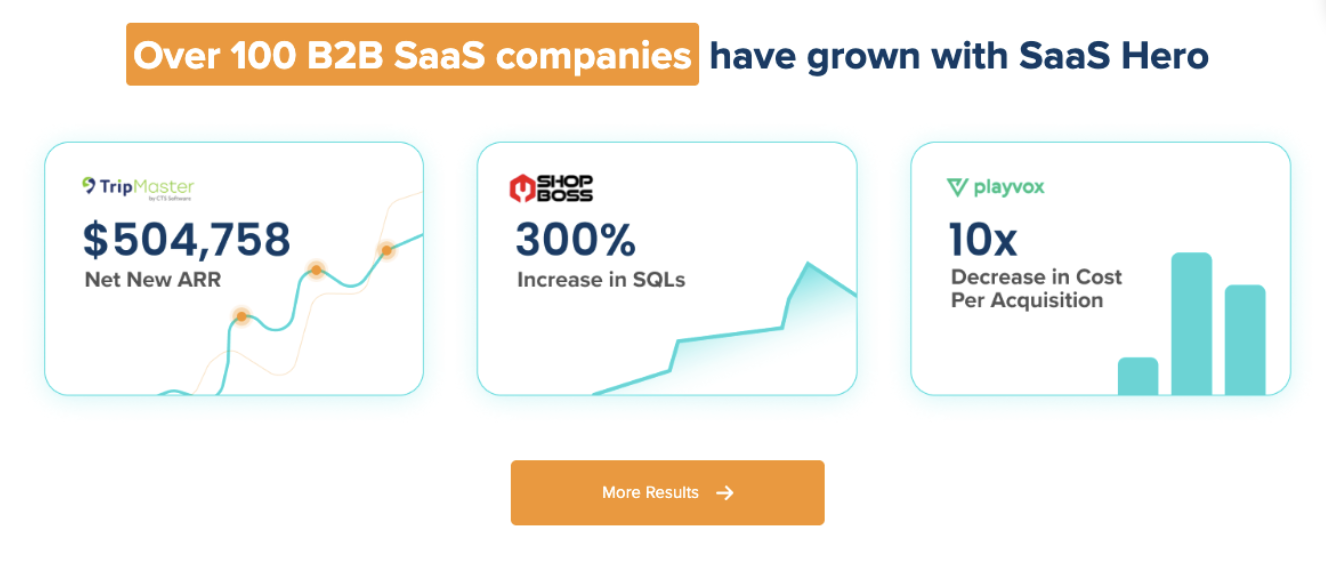
Tool selection matters, but implementation quality matters more. The way conversion tracking is configured, how CRM data flows back to the ad platform, and how campaigns capture high-intent B2B search demand determines whether the stack produces net new ARR or just a more expensive version of the same form-fill volume. SaaSHero’s documented results across B2B SaaS clients, including an 80-day payback period for TestGorilla and a 10x decrease in cost per lead for Playvox, show the difference between tools configured for clicks and tools configured for revenue.
Teams ready to map their current stack to a revenue-first implementation plan should start with a structured conversation about spend tier, CRM architecture, and ARR targets. Book a discovery call with SaaSHero to build that plan.