




Written by: Aaron Rovner, Founder, Saas Hero | Last updated: June 20, 2026
Key Takeaways
-
Digital marketing in field service management connects Local SEO, PPC, reputation systems, and FSM platforms so every campaign dollar ties to booked jobs and revenue.
-
Local SEO success depends on a strong Google Business Profile, weekly geotagged photos, and steady review velocity that supports Map Pack rankings.
-
PPC campaigns for emergency leads perform best when connected to FSM platforms like ServiceTitan, which can pause ads automatically when technician capacity is full.
-
Reputation management and automated technician notifications work together to generate service-specific reviews, cut no-shows, and feed satisfaction data into marketing workflows.
-
Partner with SaaSHero to align these integrated tactics with your FSM platform and accelerate booked revenue.
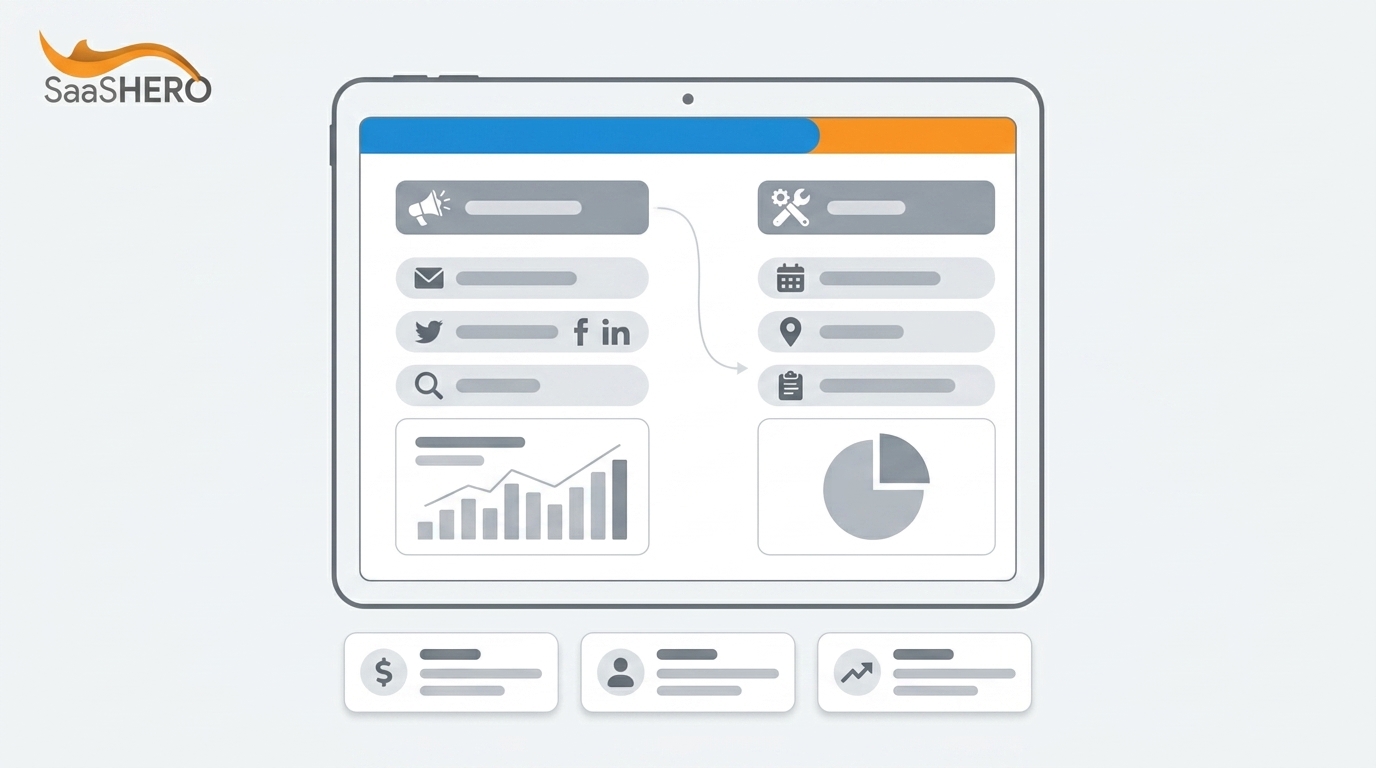
How Digital Marketing Works in Field Service Management
-
Local SEO: Build out Google Business Profile, location pages, and schema markup to capture high-intent “near me” and emergency searches in the Map Pack.
-
PPC for Emergency Leads: Run Local Services Ads and geofenced search campaigns that trigger on urgent keywords and pause automatically when dispatch capacity is full.
-
Reputation Management: Automate post-job review requests, monitor sentiment, and respond to every review to sustain the review velocity Google uses for Map Pack ranking.
-
FSM Platform Integration: Connect CRM job records to ad platforms via GCLID or offline conversion imports so campaigns optimize toward booked revenue, not form fills.
-
Automated Technician Notifications: Use AI-driven “on-my-way” SMS and email sequences that reduce no-shows, create upsell opportunities, and send satisfaction data back into marketing workflows.
-
Before-and-After Content: Publish geotagged photo and video content from real job sites to strengthen behavioral signals on Google Business Profile and support organic authority.
-
Customer Scenarios: Apply these tactics in integrated campaigns tailored to residential and commercial operators with different service mixes and revenue goals.
Map these seven tactics to your FSM platform and identify the fastest path to booked revenue.
Local SEO for Residential and Commercial Field Service
Google Business Profile signals carry roughly 32% of total Map Pack ranking weight for home service businesses, so GBP is the highest-impact local SEO asset in 2026. Local search drives high-intent traffic that converts at strong rates when profiles stay active and complete.
Residential: Residential HVAC and plumbing searches often start with urgent problems. Emergency services can reach conversion rates up to 40% from local search keywords, which ranks among the highest in home services. Residential GBP profiles perform better with weekly geotagged before-and-after photos and branded truck images. Service businesses should target three or more new reviews per week containing phrases such as “Arrived on time,” “Fixed HVAC leak,” or “Fair pricing in Oak Lawn” because review velocity and sentiment analysis now outweigh total lifetime review volume for Map Pack stability.
While residential operators focus on neighborhood-level review velocity, commercial contractors need a local SEO approach that centers on property type and service scope instead of simple geographic modifiers.
Commercial: Commercial contractors need location pages built around property type and service scope, such as “commercial HVAC maintenance Chicago office buildings,” rather than neighborhood terms. Effective 2026 local keyword strategy uses intent clusters built around core service plus specific problem plus context layers such as cost, urgency, or property type.
Studies from early-to-mid 2026 report AI Overviews appearing on 64–68% of local-intent queries. About 60% of local business searches end without a website click, so zero-click visibility through answer-ready content and direct GBP booking integration now plays a central role.
The table below compares core Local SEO elements by cost-per-booked-job so you can see where to invest first.
|
Tactic Element |
Estimated Cost-per-Booked-Job |
Source |
|---|---|---|
|
GBP optimization + weekly photo updates |
Low, primary cost is labor, profiles with more reviews often see increased Local Pack clicks |
Digital Applied, 2026 |
|
Location page build (per service area) |
One-time build, rebuilding location signals can drive inbound leads |
Hook Agency, 2026 |
|
Review velocity program (3+/week) |
Ongoing, ten recent service-specific reviews often outperform fifty older generic reviews for Map Pack calls |
Hook Agency, 2026 |
PPC for Emergency Residential and Commercial Service Leads
Google Local Services Ads for HVAC contractors operate on a pay-per-lead model, appear above traditional search ads, and display reviews, service areas, and the Google Guaranteed badge to generate high-intent local leads. In 2026, LSAs still provide the fastest path to emergency call volume for both residential and commercial operators.
Residential: Residential emergency PPC campaigns for burst pipe repair or after-hours AC failure perform best with call-only ad formats, location extensions, and bid rules that increase spend during peak weather events. When campaigns connect to ServiceTitan or similar FSM platforms, the system can pause ads automatically once technician capacity is exhausted. This connection prevents wasted spend on leads that cannot be booked.
Commercial: Geofencing ads for HVAC contractors can target commercial areas with office buildings that may require HVAC maintenance or installation, along with residential targets such as new housing developments and neighborhoods with older systems. Commercial geofencing campaigns work best when you layer job-title audience targeting to reach facilities managers and property managers instead of homeowners.
|
Tactic Element |
Payback / Efficiency Signal |
Source |
|---|---|---|
|
Local Services Ads (LSA) |
Pay-per-lead, Google Guaranteed badge increases lead trust and conversion for HVAC contractors |
Simpro, 2026 |
|
Geofenced search campaigns |
Commercial property targeting reduces irrelevant clicks, geofencing targets office buildings requiring HVAC maintenance |
Simpro, 2026 |
|
FSM-connected bid automation |
Stops spend when dispatch is full, direct CRM-to-ad tracking ties spend to booked jobs |
SaaSHero operational model |
Reputation Management That Drives Map Pack Calls
Reputation management now functions as a direct revenue lever, not a brand vanity project. Search engines in 2026 evaluate reviews based on language, recency patterns, business response behavior, and overall sentiment trends, with steady detailed feedback providing stronger trust signals than large volumes of outdated ratings.
Residential: Post-job SMS review requests sent within 30 minutes of job completion, while the technician is still on site, generate the highest response rates and the most service-specific language that Google’s sentiment analysis rewards. Reputation management now sits inside field service operations, with teams tracking NPS scores, customer engagement via Live Track link clicks, and review trends to connect customer sentiment directly to operational performance.
Commercial: Commercial accounts need a slower cadence. Quarterly satisfaction surveys align with service contract renewals, and review requests go to the facilities manager or decision-maker instead of an end user. Sentiment data from commercial accounts flows into renewal and upsell campaign triggers inside the FSM platform.
|
Tactic Element |
Impact on Booked Jobs |
Source |
|---|---|---|
|
Post-job SMS review automation |
Sustains the review velocity advantage discussed in the Local SEO section |
Online Marketing in CT, 2026 |
|
Response to every review |
Responding to every review signals an active, legitimate business to Google |
Boulder SEO Marketing, 2026 |
|
NPS tracking integrated with FSM |
Tracks on-time arrival as primary trust driver |
Arrivy, 2026 |
ServiceTitan Marketing Integration for Revenue Attribution
Direct CRM-to-ad tracking separates revenue-focused field service marketing from traditional lead-generation campaigns. When ServiceTitan job records pass offline conversion data back to Google Ads and Meta via GCLID or API, campaigns can optimize toward booked and completed jobs instead of form submissions.
Residential: For residential HVAC and plumbing operators, ServiceTitan’s marketing pro module enables campaign-source tagging at the job level. This setup means a Google Ads click that generates a $4,500 HVAC replacement receives credit in the original paid campaign, not in the organic brand search that happens two days later when the customer returns to book. By closing this attribution gap, operators can see which paid channels actually drive high-value jobs and can fund those campaigns with confidence.
Commercial: Commercial contractors using ServiceTitan can segment job revenue by contract type. Marketing campaigns then optimize toward high-value recurring maintenance agreements instead of one-time emergency calls. Many service leaders now prioritize tech integration that supports AI initiatives because disconnected systems slow AI projects.
|
Tactic Element |
Revenue Attribution Benefit |
Source |
|---|---|---|
|
GCLID offline conversion import |
Ties ad click to booked job value in Google Ads and enables revenue-based bidding |
SaaSHero CRM-to-ad tracking model |
|
Campaign-source tagging in FSM |
Reveals which channels generate the highest average job value, not just lead volume |
SaaSHero operational model |
|
AI-assisted dispatch integration |
Organizations using AI report improvement in technician utilization and dispatcher productivity |
Salesforce Field Service Guide, January 2026 |
Automated Technician Notifications That Sell and Retain
Technicians increasingly expect AI agents to handle a large share of administrative tasks so they can focus on work in the field. In 2026, “on-my-way” notification sequences have evolved into multi-step workflows that generate reviews, surface upsell opportunities, and send satisfaction data into marketing automation.
Residential: A residential notification sequence typically includes six automated touchpoints: a booking confirmation, a day-before reminder with technician photo and bio, an on-my-way alert with live GPS tracking, a post-job satisfaction check, and a review request. Each touchpoint serves a specific marketing function. The booking confirmation sets expectations and reduces anxiety. The day-before reminder with technician bio builds personal trust before the visit. The live GPS tracking reduces last-minute cancellations by giving customers real-time visibility. The post-job satisfaction check captures feedback while the experience is fresh. The review request converts that fresh feedback into public social proof that feeds back into Local SEO rankings.
Commercial: Commercial notification workflows extend further. They include service report delivery, next-maintenance scheduling prompts, and contract renewal reminders triggered by job completion status inside ServiceTitan. Customer response rate now functions as a core operational KPI, measuring how well SMS and email workflows support on-time performance and customer satisfaction.
|
Tactic Element |
Operational and Marketing Impact |
Source |
|---|---|---|
|
On-my-way SMS with live tracking |
On-time arrival percentage is the single most important metric for building customer trust, and live tracking reduces no-shows |
Arrivy, 2026 |
|
Post-job review request automation |
Generates the recent service-specific reviews that drive Map Pack visibility (see Local SEO section) |
Hook Agency, 2026 |
|
AI agent for admin task handling |
Field service teams plan to use AI for knowledge retrieval, and leaders expect AI investment to increase |
Salesforce Field Service Guide, January 2026 |
Before-and-After Content That Fuels SEO and Ads
Home service businesses that upload weekly geotagged before-and-after photos, branded truck images at local landmarks, and 15-second vertical service videos receive stronger Map Pack signals than those with static or stock imagery. Before-and-after content strengthens GBP behavioral signals and supplies ad creative for remarketing and social campaigns.
Residential example: A residential HVAC company photographs a corroded evaporator coil replacement in a specific neighborhood, geotags the image, and posts it to GBP with the service type and ZIP code. The same image becomes a Facebook carousel ad targeting homeowners within five miles. That single job photo also appears as a Google Business Profile post, an Instagram reel, and a before-and-after gallery entry on the location page.
Commercial example: A commercial plumbing contractor documents a full pipe reroute in a multi-tenant office building and produces a short case study with scope, timeline, and outcome. The team distributes the case study on LinkedIn to facilities managers in the same metro area. The case study also serves as a landing page for geofenced display campaigns targeting commercial property addresses.
The tactics above work best when you combine them into integrated campaigns tailored to your business model. The next section shows how residential and commercial operators apply these strategies differently based on service mix and revenue targets.
Customer Scenarios for Residential and Commercial Operators
Scenario 1 — Residential HVAC Owner: A residential HVAC company in the Dallas–Fort Worth metro runs ServiceTitan but has no connection between its Google Ads account and job records. The owner targets “AC repair near me” and “emergency HVAC Dallas” but cannot see which campaigns generate $300 tune-ups versus $6,000 system replacements. The solution uses a GCLID offline conversion import from ServiceTitan to Google Ads, LSA campaigns with the Google Guaranteed badge, a GBP review velocity program targeting three reviews per week with service-specific language, and weekly geotagged job photos. Success is measured by cost-per-booked-job and average job value per campaign source, not click volume.
Scenario 2 — Commercial Plumbing Contractor: A commercial plumbing contractor serving Chicago office buildings runs disconnected email blasts and a generic Google Ads campaign. The business needs recurring maintenance contracts instead of one-off emergency calls. The solution uses intent-cluster content pages targeting “commercial plumbing maintenance Chicago office buildings,” geofenced display campaigns targeting commercial property addresses, a LinkedIn campaign targeting facilities managers, and ServiceTitan contract-renewal triggers connected to a post-job email sequence. Attribution is tracked from first ad impression to signed maintenance agreement value inside the FSM platform.
See how we build CRM-to-ad attribution for your operation on a flat monthly retainer with no percentage-of-spend billing.
Frequently Asked Questions
What budget should a field service business allocate to digital marketing in 2026?
Budget allocation depends on service mix and growth targets. Residential emergency service businesses typically allocate 8–12% of target revenue to digital marketing, with most of that budget going to Local Services Ads and Local SEO because emergency search queries convert at high rates. Commercial contractors often allocate a higher percentage to content and LinkedIn campaigns because maintenance contracts have longer sales cycles and require more touchpoints. The key metric is cost-per-booked-job. Once FSM-connected attribution establishes that number, budget decisions become straightforward scaling exercises instead of guesses.
How long does it take to see results from a digital marketing program for field service?
PPC and Local Services Ads can generate calls within days of launch. Local SEO follows a longer curve. Google Business Profile improvements and review velocity gains usually produce measurable increases in Map Pack impressions within 60–90 days. Non-branded calls often begin in months four through six, and consistent Map Pack presence with steady booked jobs typically stabilizes between months seven and twelve. A strong program runs both channels at the same time so PPC funds operations while Local SEO builds compounding organic visibility.
How does CRM-to-ad attribution work with ServiceTitan?
When a prospect clicks a Google Ad, Google assigns a unique click identifier called a GCLID to that session. ServiceTitan captures the GCLID when the prospect calls or books online. After the job is completed and invoiced inside ServiceTitan, the job value and GCLID are exported back to Google Ads as an offline conversion. Google’s bidding algorithms then optimize future bids toward the audience segments and keywords that produced completed, paid jobs instead of simple form fills or calls. This workflow requires a one-time technical setup that connects ServiceTitan’s reporting API or CSV export to Google Ads’ offline conversion import tool and forms the foundation of revenue-focused field service marketing.
What is the difference between residential and commercial digital marketing for field service?
Residential field service marketing centers on urgency and proximity. The buyer is a homeowner with an immediate problem, searching on mobile, and converting within minutes of the first search. Campaigns prioritize Local Services Ads, Map Pack visibility, and fast-loading mobile pages. Commercial field service marketing centers on relationship and contract value. The buyer is a facilities manager or property manager evaluating vendors over weeks or months. Campaigns prioritize LinkedIn targeting by job title, intent-cluster content pages, geofenced display around commercial properties, and post-job nurture sequences tied to contract renewal dates. Both segments require FSM integration, but the attribution window and definition of a “conversion” differ significantly.
Why is a flat-retainer agency model better for field service businesses than percentage-of-spend billing?
Percentage-of-spend billing creates a financial incentive for the agency to increase ad spend even when revenue does not rise at the same pace. A field service business paying 15% of spend on a $20,000 monthly budget pays $3,000 per month. If the agency recommends doubling spend to $40,000, the fee doubles to $6,000 whether or not booked jobs double. A flat monthly retainer separates the agency fee from spend volume, so every recommendation to change budget rests on performance data instead of agency revenue. For operators measuring success by cost-per-booked-job, this alignment is essential.
What metrics should field service businesses use to evaluate digital marketing performance?
The primary metric is cost-per-booked-job, calculated by dividing total marketing spend by the number of jobs booked and attributed to marketing channels inside the FSM platform. Secondary metrics include average job value per channel, Map Pack visibility, calls from search, and review velocity. Vanity metrics such as impressions, clicks, and click-through rate help diagnose campaign mechanics but should not serve as headline performance figures. Businesses using ServiceTitan or similar FSM platforms can track all primary metrics natively once offline conversion imports are configured.
Conclusion
Field service businesses that connect Local SEO, emergency PPC, reputation systems, FSM platform integration, automated notifications, and before-and-after content into a single attribution framework generate more booked jobs at a lower cost-per-acquisition than those running disconnected campaigns measured by vanity metrics. These tactics work together. A strong GBP supports LSA quality scores. Review velocity strengthens Map Pack rankings. ServiceTitan attribution data improves PPC bidding. Automated notifications generate the review volume that sustains the entire system.
SaaSHero builds and manages these integrated digital marketing systems for field service companies on flat monthly retainers with senior-led execution and direct CRM-to-ad tracking. The model avoids percentage-of-spend billing, long-term lock-in contracts, and overloaded junior account managers.
Get your custom field service marketing plan built around your FSM platform, service mix, and revenue targets.