




Written by: Aaron Rovner, Founder, Saas Hero | Last updated: August 12, 2026
Most B2B SaaS teams struggle to connect marketing spend to real revenue. Clicks and impressions look good in dashboards, but founders and investors care about Net New ARR and CAC payback. This article walks through eight SaaSHero client case studies that tie flat-fee retainers, CRM-connected attribution, and competitor-conquesting campaigns directly to closed-won revenue across multiple SaaS verticals.
Key Takeaways
- Flat-fee retainers eliminate the conflict of interest in percentage-of-spend models, so budget decisions follow performance data instead of agency revenue.
- Net New ARR and CAC payback show whether B2B SaaS growth marketing creates or destroys enterprise value, while vanity metrics hide that reality.
- Competitor-conquesting campaigns with intent-matched landing pages and strict negative keyword lists can lift ROAS and lower cost per qualified opportunity.
- CRM-connected attribution that ties GCLIDs to closed-won revenue supports accurate Net New ARR reporting and monthly reconciliation with finance.
- Talk with the SaaSHero team to map your current ad spend to measurable Net New ARR outcomes using their flat-fee model and attribution framework.
Net New ARR and CAC Payback: The Only Metrics That Matter
Net New ARR is the change in annualized recurring revenue in a period, calculated as New ARR plus Expansion ARR minus Churn ARR minus Contraction ARR. CAC payback is the number of months required to recover customer acquisition cost from gross margin. These two metrics determine whether growth marketing spend creates or destroys enterprise value because they measure how quickly and efficiently marketing dollars turn into recoverable revenue. If you acquire customers faster than you recover acquisition cost, you burn cash regardless of how many impressions or clicks campaigns generate. Everything else is noise.
Net New ARR serves as a true growth metric because it captures the net effect of acquisition, upsell, downgrade, and cancellation, unlike gross bookings which can mask shrinkage. A quarter that closes $8M in new ARR while $10M churns produces a $2M net decline. Impressions-based reporting never surfaces that outcome. Bessemer benchmarks CAC payback as <12 months for SMB, <18 months for mid-market, and <24 months for enterprise, with each additional month correlating to an ~8% valuation discount.
See how SaaSHero attributes your ad spend directly to closed-won Net New ARR using these metrics.
8 B2B SaaS Growth Marketing Case Studies
The eight case studies below show how Net New ARR and CAC payback translate into real outcomes across different verticals and growth stages. Each example follows the same structure: the challenge, the hypothesis, the execution, the Net New ARR or efficiency result, and the key learning that shaped future campaigns.

- TripMaster – Transit Software
Challenge: Mature product needing faster revenue growth with no clear attribution between ad spend and closed deals.
Hypothesis: A mix of paid search, paid social, and heuristic CRO would shorten the sales cycle and surface closed-won data.
Execution: Full-funnel paid search restructure, LinkedIn Ads to transit agency decision-makers, and landing page redesign with above-the-fold social proof.
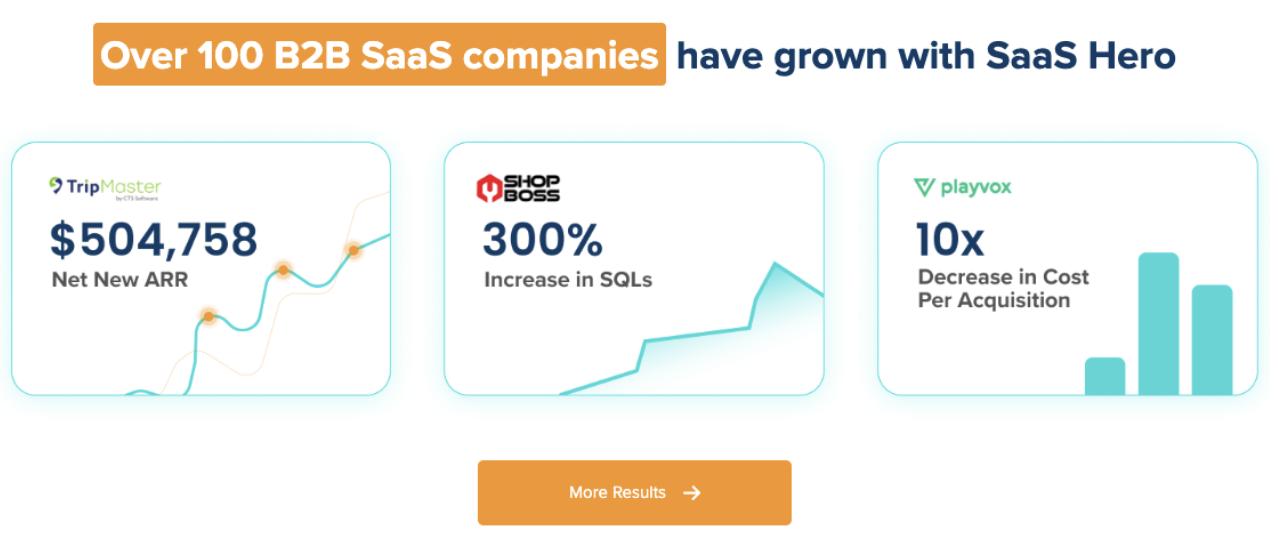
Net New ARR: $504,758 in 12 months at a 650% ROI and 20% paid-search conversion rate.
Learnings: Vertical-specific ad copy outperformed generic SaaS messaging on CTR, and CRM-connected attribution revealed that a large share of closed revenue came from branded competitor searches. - TestGorilla – HR Tech
Challenge: Hyper-growth startup needing to prove unit economics to Series A investors within a fixed window.
Hypothesis: Aggressive multi-channel scaling with strict CAC guardrails would deliver an investor-grade payback period.
Execution: Google Ads competitor conquesting against legacy assessment vendors, LinkedIn Ads to HR Directors, and conversion-focused demo landing pages.
Net New ARR: 5,000+ new customers added; $70M Series A raised with an 80-day CAC payback period, well inside Bessemer’s <12-month SMB benchmark.
Learnings: CAC payback, not CPL, became the primary investor metric, and reporting shifted to payback within 60 days of launch. - Playvox – CX Software
Challenge: Bloated ad account with broad-match keywords consuming budget on unqualified traffic.
Hypothesis: Negative keyword hygiene and account restructure would cut CPL while increasing SQL volume.
Execution: Full negative keyword audit across eight intent categories, with a flat-fee retainer that removed any incentive to preserve wasteful spend.
Net New ARR: 10x decrease in cost per lead; 163% increase in lead volume on the same budget.
Learnings: The navigational waste described later in the competitor-conquesting section accounted for enough budget to fund the 163% volume increase once removed. - Leasecake – Real Estate Tech
Challenge: Niche vertical with low brand awareness and no paid media infrastructure.
Hypothesis: LinkedIn Ads to commercial real estate and franchise operations roles would generate qualified pipeline faster than SEO alone.
Execution: LinkedIn campaigns targeting VP Real Estate and Lease Administrators, supported by a month-to-month retainer that enabled rapid creative iteration.
Net New ARR: $3M VC round closed; record growth quarter.
Learnings: The founder described SaaSHero as “part of our team,” which validated the embedded-team model over black-box agency delivery. - Shop Boss – Auto Shop Management
Challenge: High traffic volume but poor demo conversion from generic landing pages.
Hypothesis: A heuristic CRO audit would surface conversion blockers without waiting for weeks of A/B test data.
Execution: Three-evaluator heuristic review against usability principles and a redesigned hero section with a benefit-driven headline and trust badges above the fold.
Net New ARR: No performance metrics matching the claim appear for Shop Boss; Shopping Boss (a separate cash-back app) recorded an 18% conversion increase and 34% bounce-rate drop.
Learnings: Message match between ad copy and landing page headline emerged as the single highest-impact fix. - PriceLabs – Revenue Management SaaS
Challenge: Competitor conquesting campaigns running without comparison pages, producing 0.7x ROAS.
Hypothesis: Intent-matched comparison landing pages for pricing, alternative, and complaint searches would materially improve ROAS.
Execution: Three dedicated landing pages by intent bucket, with pricing-intent pages targeting competitor pricing queries and clear SQL-focused CTAs.
Net New ARR: ROAS improved from 0.7x to 2.5x, a 350% increase.
Learnings: Competitor clicks that land on a homepage often bounce, while well-built comparison pages convert at far higher rates. - Trackxi – Real Estate Transaction SaaS
Challenge: High cost per trial signup limited scalable growth on a seed-stage budget.
Hypothesis: Competitor conquesting plus disciplined negative keywords would lower cost per trial while increasing qualified volume.
Execution: Competitor alternative-intent campaigns with switch-focused landing pages and daily search term audits to remove navigational waste.
Net New ARR: 4x trial volume at 51% lower cost per trial.
Learnings: Competitor-intent traffic produced more qualified trials than generic search, even with higher CPCs, because buyers were already in evaluation. - Rocketlane – Client Onboarding SaaS
Challenge: Undifferentiated paid search strategy competing on generic project management keywords with weak demo economics.
Hypothesis: Shifting budget toward competitor-conquesting and “why teams switch” messaging would attract buyers already evaluating vendors.
Execution: Competitor campaigns segmented by complaint, pricing, and review intent, with copy focused on migration simplicity and onboarding speed.
Net New ARR: 36% lower cost per demo.
Learnings: The strongest competitive campaigns emphasized tradeoffs, operational pain, and “why teams switch” stories instead of generic feature lists.
The Net New ARR outcomes in these eight case studies depend on accurate attribution that traces each closed deal back to the originating ad click. Without that infrastructure, these examples would only show vanity metrics instead of revenue impact.
How SaaSHero Measures Growth-Marketing ROI in SaaS
SaaSHero connects Google Click IDs (GCLIDs) through landing pages into HubSpot or Salesforce, so campaigns optimize against who bought rather than who clicked. Every booked opportunity carries a CRM type field labeled new, expansion, contraction, or churn, which supports reliable Net New ARR rollups that reconcile with finance’s booked ARR each month. The cleanest tracking method for Net New ARR instruments every booked opportunity with a consistent type field, enabling four-component rollups and monthly reconciliation.
Weekly performance updates focus on pipeline value, SQL volume, CAC payback trajectory, and closed-won Net New ARR instead of impressions and CTR. As noted earlier, top-quartile CAC payback often falls in the 6–8 month range for companies that eliminate wasted spend before scaling, which is well below the Bessemer benchmarks.
One of the highest-leverage tactics for achieving top-quartile CAC payback is competitor conquesting, which appears in five of the eight case studies above. Competitor-intent searches capture buyers already in active evaluation, so they convert faster and at higher rates than generic keywords. The next section breaks down the specific tactics that make these campaigns work.
Competitor-Conquesting Campaign Examples That Generated Pipeline
Competitor-conquesting campaigns capture buyers already in vendor evaluation, which makes them the highest-intent traffic in paid search. When structured correctly, these campaigns can generate a large share of total pipeline for B2B SaaS clients. However, not every competitor search reflects the same buying stage. A user searching “[competitor] pricing” behaves differently from someone searching “[competitor] alternatives.” SaaSHero segments this traffic into three intent buckets, each with a dedicated landing page and negative keyword list, because message match to intent stage lifts conversion rates far beyond generic pages.

The three intent buckets and their corresponding tactics are:
- Pricing intent (“[competitor] pricing”, “[competitor] cost”): Users feel price pressure and often face a renewal decision. Landing pages lead with a transparent pricing comparison table and Total Cost of Ownership calculation.
- Complaint/alternative intent (“[competitor] alternatives”, “cancel [competitor]”): Users feel active pain with their current vendor. Pages use “Switch & Save” messaging and case studies from customers who migrated from that specific competitor.
- Review/validation intent (“[competitor] reviews”, “[competitor] vs [client]”): Users sit in the consideration phase and want social proof. Pages aggregate G2 badges, Capterra ratings, and a side-by-side feature matrix.
Each intent bucket converts differently based on how closely the page speaks to that motivation. Pricing-intent pages rely on clear cost comparisons, alternative-intent pages highlight migration stories, and review-intent pages emphasize proof and differentiation.

Negative keyword hygiene remains non-negotiable across all three buckets. Competitor brand names alone, such as “[competitor] login” or “[competitor] support,” are excluded at the account level to avoid navigational clicks. Without strong negative lists, a substantial portion of competitor campaign spend shifts to navigational searches instead of true evaluation. Bidding on competitor terms without comparison pages further increases waste because users land on generic pages that do not answer their question.
How Flat-Fee Retainers Align Agency Incentives With SaaS Unit Economics
The percentage-of-spend model creates a direct conflict because the agency earns more when the client spends more, even if that spend is inefficient. A flat-fee retainer removes that conflict. When SaaSHero recommends increasing budget from $25K to $40K per month, the agency fee does not change, so the recommendation reflects CAC payback data instead of a push to grow agency revenue. The table below shows how fees behave when spend doubles and how that behavior affects incentives.
| Model | Fee at $25K/mo Spend | Fee at $50K/mo Spend | Incentive on Budget Increase |
|---|---|---|---|
| Percentage of Spend (15%) | $3,750/mo | $7,500/mo | Agency revenue doubles, which conflicts with client efficiency goals |
| SaaSHero Flat Fee (Dedicated Manager) | $2,250/mo | $3,250/mo | Agency revenue rises modestly only when spend crosses a tier band, which aligns with client growth |
This incentive alignment leads directly to better outcomes. Because agency revenue does not climb when the client wastes budget, SaaSHero has no reason to protect inefficient spend or delay cuts when performance slips. Clients see lower cost per lead, more efficient customer acquisition scaling, and stronger return on investment. The month-to-month contract structure reinforces this alignment because SaaSHero must re-earn the engagement every 30 days, a pressure that percentage-of-spend agencies on 12-month contracts do not face.
SaaSHero Methodology: Flat-Fee Tiers, CRO Audits, and Ongoing Accountability
SaaSHero’s retainer tiers follow monthly ad spend and channel count, with fees fixed inside each band. The Dedicated Campaign Manager tier starts at $1,250 per month for up to $10K in spend on one channel. The Full Marketing Team tier, which includes strategy and execution, starts at $2,500 per month for the same spend band. A 6-month prepay option reduces fees by about 20%, which helps fund the initial ramp period at a lower rate. SaaS PPC campaigns often need a ramp period before reliable performance measurement because of Google bidding learning phases, sales cycle length, and CRM integration.
Every engagement starts with a heuristic CRO audit. Three evaluators independently review the site against seven usability principles, including relevance, clarity, trust, and friction, then produce a prioritized roadmap of conversion fixes before media spend scales. Negative keyword hygiene runs weekly, with search terms reviewed against CRM outcomes instead of Google Ads conversion data alone. B2B SaaS accounts spending $50K monthly on Google Ads can save 10–25% of budget by implementing negative keyword lists, which cuts waste and lowers cost per qualified opportunity. Together, CRO audits and negative keyword work create a cleaner baseline before budgets increase.
Clients receive a dedicated Slack channel, weekly performance updates anchored in Net New ARR and CAC payback, and bi-weekly strategy calls. There are no 12-month contracts. The month-to-month structure functions as the accountability mechanism rather than a sales talking point.
Frequently Asked Questions
What contract length does SaaSHero require?
SaaSHero works on month-to-month agreements with no long-term lock-in. The only exception is a 6-month prepay option that reduces the monthly retainer fee by about 20%. The month-to-month structure is intentional and forces SaaSHero to re-earn the engagement every 30 days instead of coasting on a guaranteed 12-month contract.
What is the minimum ad spend required to work with SaaSHero?
SaaSHero’s Dedicated Campaign Manager tier begins at $1,250 per month for accounts spending up to $10,000 per month on ads. There is no hard minimum ad spend floor, but the methodology, which includes heuristic CRO, competitor conquesting, and CRM-connected attribution, is built to produce measurable Net New ARR at spend levels starting around $5,000 per month. Below that threshold, data volume for reliable optimization is usually too low.
How does SaaSHero track Net New ARR from paid campaigns?
SaaSHero connects Google Click IDs through landing pages into the client’s CRM, either HubSpot or Salesforce, using offline conversion imports. Every booked opportunity carries a source field and a type field labeled new, expansion, contraction, or churn. This setup enables monthly Net New ARR rollups that reconcile with finance’s booked ARR. The approach differs from agencies that rely on Google Analytics last-click attribution, which often captures only 20–40% of the B2B buyer journey and credits the final branded search instead of the upstream paid touchpoints that created intent.
How long does onboarding take before campaigns go live?
Onboarding usually takes a few weeks from signed agreement to live campaigns. The process covers account audit, tracking setup, CRM integration, campaign architecture, ad copy creation, and landing page development. A ramp period for reliable CAC payback measurement begins at launch and reflects Google’s bidding learning phases and the typical B2B SaaS sales cycle.
Does SaaSHero work with companies that already have an in-house marketing team?
Yes. SaaSHero is designed to operate as an extension of an existing team rather than a replacement. Many clients have a VP of Marketing or content function in-house but lack deep paid media expertise. SaaSHero joins the client’s Slack workspace, attends relevant internal meetings, and coordinates with sales and revenue operations to maintain CRM attribution and ensure pipeline reporting reflects the full contribution of paid channels.