Written by: Aaron Rovner, Founder, Saas Hero | Last updated: August 27, 2026
Key Takeaways
Performance-driven B2B SaaS marketing connects every ad dollar to qualified pipeline and closed-won ARR through CRM-level attribution instead of chasing clicks or form fills.
Boards now demand cost-per-closed-deal metrics and LTV:CAC ratios of 3:1 or better, which makes CRM attribution non-negotiable for 2026 marketing programs.
Primary conversions such as SQLs, demo requests, and opportunity creation should train bidding algorithms, while secondary conversions like content downloads stay tracked but excluded from optimization.
The Revenue Accountability Test provides seven questions that reveal whether a consultant owns the full chain from impression to CRM record or leaves gaps for your team to manage.
Why Boards and PE Partners Made CRM Attribution Non-Negotiable in 2026
Capital-efficiency pressure has reset what boards expect from marketing. The Pedowitz Group’s 2026 revenue marketing benchmarks show that Stage 4 B2B organizations source 40–55% of total pipeline from marketing programs, while the industry average sits at 20–30%. Programs below 15% function primarily as cost centers. The same benchmarks identify cost per closed deal as a key metric that connects marketing to commercial outcomes.
Automated bidding has also reshaped the practitioner’s job. Smart Bidding, broad match, and Performance Max now handle most of the lever-pulling that defined paid media craft for fifteen years. Human control now focuses on two decisions: which conversion events the algorithm pursues and how accurate those events are as proxies for revenue. GrowthSpree’s 2026 analysis of 1,412 ad variants across 96 B2B SaaS accounts and $14.2M in spend found that CTR correlated with closed-won pipeline at r = 0.09, while cost per SQL correlated at r = 0.71. The platform metric and the revenue outcome measure different realities.
Primary vs. Secondary Conversions, LTV:CAC, and CAC Payback
Not all conversion events carry equal weight. Primary conversions are the actions that signal genuine buying intent, such as sales-qualified leads, opportunity creation, and demo requests from warm audiences. These events are the only ones that should train bidding algorithms.
Secondary conversions include content downloads, webinar registrations, and low-commitment form completions. These events are worth tracking for insight and retargeting. Feeding them to Smart Bidding, however, teaches the platform to find people most likely to fill out forms instead of people most likely to buy.
Forrester’s 2024 B2B Revenue Waterfall research reports that only 0.75% of marketing-qualified leads convert to closed-won revenue across the full B2B funnel. Salesforce’s State of Marketing Report found a 13% median MQL-to-SQL conversion rate, which means 87% of leads classified as marketing-qualified are rejected by sales at the handoff. Optimizing to MQL volume at scale means optimizing to a metric that fails 87% of the time before it reaches revenue.
The Revenue Accountability Test: 7 Questions Every VP Marketing Should Ask
Achieving those unit economics requires a consultant who owns the full chain from impression to CRM record. These seven questions reveal whether a firm has built that chain or left gaps for your team to manage. Apply them to any consultant or agency before a contract conversation.
Is your CRM connected to the ad platforms, and are lifecycle stage events fed back for bidding? A consultant optimizing to form submissions has told the algorithm that a form fill is the goal. The correct answer is that qualified opportunities and CRM stage-change events serve as the optimization signal, not page events.
Do you separate primary and secondary conversions, and are secondary conversions excluded from account-wide optimization? As the GrowthSpree analysis showed, CTR is nearly uncorrelated with pipeline. A consultant who cannot answer this question is optimizing to the wrong signal.
Do you own the landing pages your campaigns point to, or do you hand recommendations to the client’s web team? Conversion rate multiplies every other improvement in the account. A consultant who does not control the post-click experience cannot be accountable for the outcome. Headline copy is the single highest-leverage variable on a landing page, and it must be testable without a third-party queue.
Is your fee indexed to total ad spend rather than channel count? A per-channel fee means adding a test channel raises the invoice before it has returned anything, and consolidating lowers it. That structure turns channel-mix recommendations into a financial conflict. A flat retainer indexed to total spend removes the conflict.
Do you arrive at strategy calls with the next move already prepared, or do you wait for the client to set the agenda? Marketing leaders switching agencies often report that they became the strategist, project manager, and quality control for a vendor paid to hold those roles. A proactive operating model is not a courtesy. It is a scope commitment.
Is there a defined 90-day validation gate with clear criteria for what constitutes success? A sales cycle measured in months requires at least one full cycle of data before pipeline metrics mean anything. A validation gate with defined criteria de-risks the engagement for both parties and gives the client a defensible decision point.
Does your reporting surface pipeline, CAC, and payback period in the client’s CRM, not a PDF of platform metrics?The most important benchmark for a CMO to present to the board is marketing contribution to revenue with attribution, because it directly connects marketing to commercial performance. If a consultant’s reporting does not surface that metric in a board-ready format, the marketing leader ends up rebuilding the deck before every meeting, which means the consultant has not solved the problem.
How Mid-Market Teams Are Staffed and Why Split-Scope Fails
For $10M–$50M revenue B2B SaaS companies, the median marketing team size is 11 marketers covering demand generation, content, product marketing, and marketing operations. The gap is almost always the same: no paid media specialist. Nobody in the building has configured offline conversion imports, audited a search terms report at scale, or built a LinkedIn sequence that moves audiences from engagement to retargeting to conversion.
SaaS Hero: Trusted by Over 100 B2B SaaS Companies to Scale
The contractor layer then fills the void, and it does so poorly. A freelance designer for creative, a web developer for landing pages, a campaign manager for the ad account, and RevOps for the CRM each execute competently inside their own scope. But failures occur between the parties: conversion tracking breaks between the form and the CRM, ad copy promises what the landing page headline does not repeat, and campaign structure drifts away from how the company actually sells. This pattern explains why growth-stage SaaS companies running hybrid demand generation models that combine in-house strategy with outsourced execution can grow revenue faster than companies running either pure in-house or pure outsourced models, but only when one party owns the connective tissue between specialists.
Traditional Per-Channel Pricing vs. SaaSHero’s Flat Retainer Indexed to Spend
The prevailing paid media retainer is scoped to the ad account and priced per channel. That structure produces a predictable conflict. Testing a new channel raises the client’s fees before it has returned anything, and moving budget off a channel reduces what the agency bills. No bad faith is required for this outcome. Reallocation simply becomes the recommendation the pricing makes hardest to give.
The Demand Creation Framework: Awareness, Consideration, Conversion
Most B2B paid social programs collapse a three-stage sequence into a single step: a conversion campaign pointed at a cold ICP audience. The audience is often correct. The ask sits three stages ahead of where the person actually is.
An effective sequence runs in three stages. In awareness, cold ICP audiences receive messaging about the operational pain they recognize in their own week, not product features and not demo CTAs. The optimization goal is engagement, not leads. In consideration, retargeting pools built from awareness-stage behavior receive solution-level content such as case studies, frameworks, and social proof. The optimization goal is content consumption, not conversions.
Primary conversions such as demo requests, sales-qualified leads, and opportunity creation are the only events used for account-wide optimization. Secondary conversions stay tracked and visible in reporting but excluded from bidding. Before closed-loop correction, an estimated 38% of budget was allocated to variants in the bottom two pipeline quartiles because they appeared strong on CTR and CPL. Re-scoring on cost per SQL improved results by approximately 44% through reallocation alone.
The 90-Day Validation Gate for Paid Programs
Month one focuses on setup and build. Conversion tracking is rebuilt from scratch, campaign architecture is established, and creative and landing pages are produced and approved. The first meaningful data arrives around day 30.
Days 31 through 60 narrow the account. Underperformers are turned off, audiences are adjusted, budget moves toward what is working, and headline tests run on landing pages. Day 90 becomes the validation gate. At that point there is enough data to determine whether the channel, the structure, and the messaging thesis are sound and to decide the next phase.
For PE-backed companies, the gate functions as a diligence-ready checkpoint. The engagement can be evaluated on pipeline outcomes rather than activity, and the decision to expand into a second channel can be argued on evidence rather than assumption. B2B SaaS marketing consultants now face ROI expectations tied to attributable pipeline within the first 90 days. The 90-day gate is where that accountability is tested.
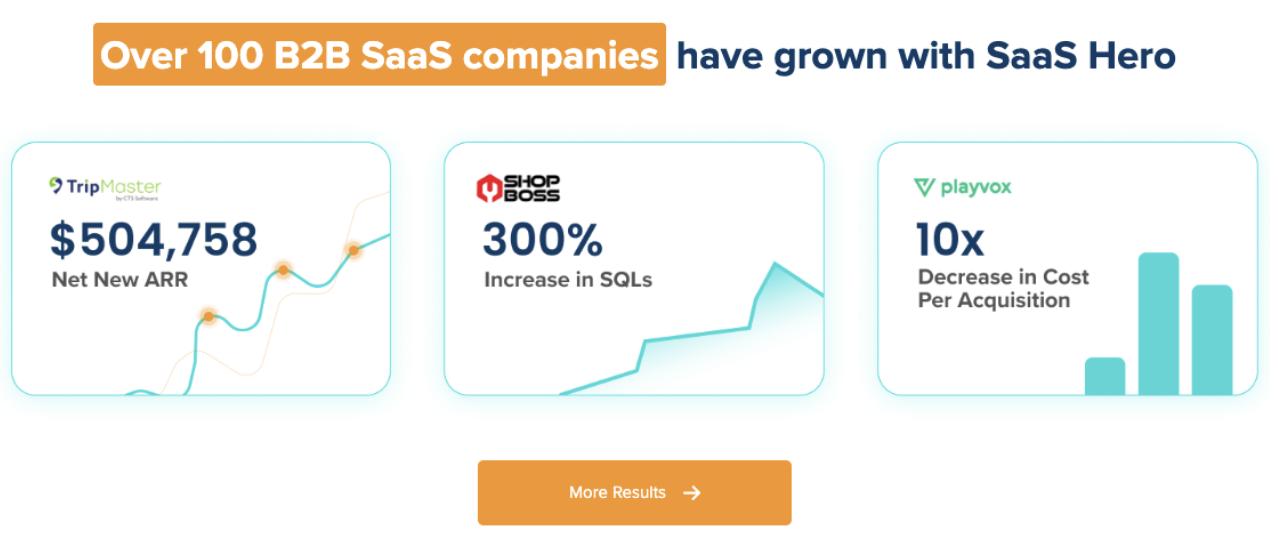
SaaSHero’s TripMaster engagement produced $504,758 in Net New ARR over one year, with a 650% return on ad spend and a 20% conversion rate from paid search. TestGorilla reached an 80-day CAC payback period with 5,000+ new customers added. Both outcomes were measurable because the CRM was connected to the ad platforms from day one.
TripMaster adds $504,758 in Net New ARR in One Year
The table below shows which conversion events should train your bidding algorithms and which should be tracked but excluded from optimization, along with the research-backed rationale for each classification.
Conversion Event
Classification
Used for Bidding Optimization
Rationale
Demo request (warm audience)
Primary
Yes
Cost per SQL is the metric that correlates with pipeline (r = 0.71); warm-audience demo requests are the closest paid-social proxy for SQL intent
63% of high-CTR ads are clickbait traps, and 56% of the best pipeline ads have low CTR, so secondary events train the algorithm toward the wrong audience
Are you optimizing campaigns around CRM data or just form submissions?
This question sorts the market. Answering it truthfully requires the consultant to already own the tracking, the landing page, and the CRM connection. A consultant who cannot answer it has not built the chain.
What the Numbers Show When the Test Is Passed
When all seven questions are answered correctly, reporting shifts from platform metrics to board-ready pipeline data. Cost per SQL replaces cost per lead. Pipeline contribution by channel replaces impression share. CAC payback replaces click-through rate.
SaaS Hero: The client-friendly SaaS marketing agency that proves pipeline
In 2026, 75% of companies have adopted multi-touch attribution, up from 58% in 2024, with teams implementing it reporting 14–36% cost-per-acquisition improvements and an average 19% ROI lift in the first year. The improvement comes from reallocating existing spend toward the variants and channels that produce qualified pipeline, which only becomes visible when the CRM is connected.
SaaSHero’s Playvox engagement produced a 10x reduction in cost per lead alongside a 163% increase in lead volume. Shop Boss saw a 305% increase in conversion rate after landing pages were brought under the same team managing the campaigns. These outcomes share a common structure. One team owned the chain from impression to CRM record, and the optimization signal was revenue, not form fills.
Over 100 B2B SaaS Companies Have Grown With SaaS Hero
Frequently Asked Questions
What monthly ad spend floor is required to work with SaaSHero?
SaaSHero requires a minimum of $15,000 in monthly ad spend already in market. This floor exists because the optimization method depends on data volume. Below this threshold, there is not enough signal for CRM-connected bidding to produce reliable results. The sweet spot is an existing five-figure monthly spend currently managed by an underperforming agency or internal generalist. SaaSHero does not help companies decide whether to try paid media. It takes over a budget already flowing and already producing something.
Who owns the ad accounts, assets, and data when the engagement ends?
The client owns everything throughout the engagement and retains full ownership at offboarding. Ad accounts, conversion tracking configurations, landing page files, design files in Figma, creative assets, Looker Studio dashboards, and all documentation belong to the client. SaaSHero operates inside the client’s own accounts rather than proprietary agency accounts, so the historical data, account structure, and optimization learning stay with the business that paid for them. Offboarding is treated as a normal event, not a negotiation.
How does SaaSHero produce board-ready reporting without the marketing leader rebuilding the deck?
Reporting runs on Looker Studio dashboards built alongside HubSpot or Salesforce, connecting ad platform data to CRM outcomes in one view. The dashboards are live and client-accessible rather than assembled for a meeting. The metrics surfaced are the ones boards ask about: pipeline sourced by channel, cost per sales-qualified lead, CAC, and payback period. The benchmarks SaaSHero holds accounts to, LTV:CAC of 3:1 and CAC payback under 12 months, match the thresholds a CFO and board use to evaluate a channel. With CRM data connected properly, board reporting becomes a view of the same dashboard the team works from daily, not a separate exercise assembled the week before the meeting.
Does adding a new paid channel increase the retainer fee?
No. The retainer is indexed to total monthly ad spend under management, not to the number of channels managed. Adding paid social to a search program, opening a Meta test, or shutting a channel down entirely leaves the fee unchanged. This structure means channel-mix recommendations are argued on evidence alone, without a contract amendment or fee negotiation attached. Testing a new channel becomes an empirical question, not a commercial one.
What does SaaSHero need from the client’s internal team to make CRM-level attribution work?
Three things are required from the client’s side. First, access to the CRM, marketing automation platform, tag manager, and ad accounts, tracked on a shared sheet so nothing stalls. Second, a defined set of lifecycle stages and qualification criteria that the sales team actually uses, because the optimization signal is only as good as the CRM data it draws from. Third, one person empowered to approve creative and messaging without routing through a committee, because approval latency is the most common cause of delayed launches. SaaSHero handles conversion tracking configuration, CRM integration, and the primary and secondary conversion architecture. The client does not need a paid media specialist internally. That is the gap SaaSHero fills.
Run the Test Before You Talk to Any Vendor
The seven questions above are designed to be applied internally before any vendor conversation begins. A consultant who passes all seven owns the chain from impression to CRM record, prices without fee friction on budget reallocation, and surfaces board-ready pipeline data without the marketing leader rebuilding it. A consultant who fails any one of them leaves a gap that lands back on the marketing leader’s desk.
The structural conditions that created this gap, including automated bidding, broken measurement, lean mid-market teams, and per-channel pricing, are not going away. The moment you judge paid media on cost per SQL and pipeline instead of clicks and CPL, a cascade of good decisions follows almost automatically. The test is the starting point for that cascade.
SaaSHero is the only firm that owns the full inbound acquisition chain, including paid media, creative, landing pages, attribution, and strategy, under a flat retainer indexed to total spend. This structure eliminates split-scope and misaligned incentives. Every engagement starts with the mandatory discovery question: Are you optimizing campaigns around CRM data or just form submissions?
Includes unlimited revisions as well as custom written copy (from a human, not ChatGPT). We’ll send a first draft in Figma and you can request as many edits as you’d like. We won’t ever activate any landing pages until you give us the final OK